
Indigenous Corrections Accountability Framework: Annual report 2023 to 2024

Land acknowledgement
We would like to respectfully acknowledge that the land on which we developed this report is in the traditional unceded territory of the Algonquin Anishinaabe people. We invite all readers across Turtle Island to take a moment to acknowledge the land they live and move on. From coast to coast to coast, we acknowledge the ancestral and unceded territory of all the First Nations, Inuit, and Métis people who call this land home.
In addition, we encourage readers to reflect on the past, be mindful of how harmful dynamics may continue to be perpetuated to this day, and consider how we can each, in our own way, move forwards toward collective healing and true reconciliation.
Indigenous Initiatives Sector, on behalf of The Correctional Service of Canada.
Alternate format

List of acronyms
- AID
- Aboriginal Initiatives Directorate
- CRS
- Custody Rating Scale
- CBSA
- Canada Border Services Agency
- CCRA
- Corrections and Conditional Release Act
- CRI
- Criminal Risk Index
- CSC
- Correctional Service of Canada
- DCIC
- Deputy Commissioner, Indigenous Corrections
- DEP
- Digital Education Pilot
- ECS
- Enhancing Community Success
- HCR
- Home Community Reintegration
- ICAF
- Indigenous Corrections Accountability Framework
- IIC
- Indigenous Interventions Centre
- IICPM
- Integrated Correctional Program Model
- IIS
- Indigenous Initiatives Sector
- IJS
- Indigenous Justice Strategy
- ILO
- Indigenous Liaison Officer
- ISC
- Indigenous Services Canada
- IWOCP
- Indigenous Women Offender Correctional Programs
- MOU
- Memorandum of Understanding
- NEWG
- National Elders Working Group
- NRCP
- Nationally Recognized Correctional Program
- OSL
- Offender Security Level
- STG
- Security Threat Group
- UTS
- Urban Transition Support
List of figures
- Indigenous offender representation in 2023 to 2024
- Indigenous population age
- Indigenous offender sentence length
- Indigenous sentence type
- Indigenous criminal risk index
- Indigenous offender security level upon admission
- Indigenous offender dynamic need
- Education need
- In custody offender population: 10-year trend
- Indigenous offender population under CSC jurisdiction: Percentage change from 2018 to 2019, to 2023 to 2024
- Indigenous offender admissions informed and interested in Section 81
- Section 84 of the Corrections and Conditional Release Regulations
- Initial Elder reviews completed for new Indigenous offender admissions
- Nationally Recognized Correctional Programs (NRCP)
- Nationally Recognized Correctional Programs: IIC Indigenous offenders
- Number of successful transfers Indigenous offenders and IIC flagged Indigenous offenders
- Percentage of successful transfers Indigenous offenders and IIC flagged Indigenous offenders
- Institutional behaviour: Urinalysis results
- Random sample urinalysis refusals
- Institutional behaviour: Rate per 1,000 offenders serious institutional security charges
- Discretionary releases granted: Indigenous offenders and IIC flagged offenders
- Rate of supervision suspensions per 1,000 Indigenous offenders: Indigenous offenders and IIC flagged offenders
- Successfully reaching sentence expiry date without re-admission: Indigenous and IIC flagged offenders
- Vision
- Inuit offender population by region
- Community Inuit offender population by supervision type
- Incarcerated Inuit offender population by security level
- Inuit offender population by sentence length
List of tables
- 10-year tread
- Indigenous offender population by region
- Inuit offender population by region
- Métis offender population by region
- First Nations offender population by region
- Healing lodge interest and actual successful transfers
- Section 84 interest and release planning
- Initial Elder reviews completed for new Indigenous offender admissions
- Nationally Recognized Correctional Programs (NRCP): Indigenous offenders and IIC flagged
- Successful transfers to lower security and Healing Lodges: Indigenous offenders and IIC flagged offenders
- Institutional behaviour: Urinalysis results
- Random sample urinalysis refusals
- Institutional behaviour: Rate per 1,000 offenders serious institutional security charges
- Discretionary releases granted: Indigenous offenders and IIC flagged offenders
- Rate of supervision suspensions per 1,000 Indigenous offenders: Indigenous offenders and IIC flagged offenders
- Successfully reaching sentence expiry date without re-admission: Indigenous and IIC flagged offenders
Each year, Correctional Service Canada (CSC) publishes the Indigenous Corrections Accountability Framework (ICAF) to report on progress and identify areas of opportunity in Indigenous corrections. CSC is steadfast in its commitment to addressing the overrepresentation of Indigenous offenders in the federal correctional system. This includes ongoing efforts to expand and enhance culturally responsive interventions and reintegration supports that are both effective and meaningful for Indigenous offenders.
In Fiscal Year 2023 to 2024, CSC was pleased to announce the appointment of the first Deputy Commissioner, Indigenous Corrections. This position is a direct response to Call for Justice 5.23 of the National Inquiry into Missing and Murdered Indigenous Women and Girls and was called for in the Commissioner’s Mandate letter from the Minister in 2022. The role of the position is to ensure appropriate attention and accountability towards Indigenous issues in the correctional system, address the overrepresentation of Indigenous offenders and help CSC implement the many other Calls for Justice that fall within our purview.
The Deputy Commissioner, Indigenous Corrections (DCIC) was appointed in May 2023 and quickly began addressing key areas of the Indigenous Corrections agenda. The establishment of this position is emblematic of CSC prioritizing and addressing the systemic challenges affecting Indigenous peoples in the federal correctional system.
Profile of Indigenous offenders under CSC jurisdiction
Research completed in this Fiscal Year contributes to CSC’s understanding of Indigenous offenders’ profile characteristics. Indigenous offenders tend to have more violent and extensive criminal histories and are more likely to have a Security Threat Group (STG) affiliation. Indigenous offenders are more likely to have:
- identified mental health concerns
- substance use issues
- indicators of high risk and need
Indigenous offenders therefore enter the federal correctional system with unique challenges that require consideration during correctional planning. These unique profile characteristics and experiences shape an Indigenous offender’s trajectory in the federal correctional system (Understanding the Profile Characteristics and Correctional Experiences of Indigenous Federal Offenders: A review of Research Results 2023 R-469).
Trends suggest the overrepresentation of Indigenous offenders is likely to continue growing in the coming years. Indigenous peoples accounted for 29.7% of new admissions to federal custody in Fiscal Year 2023 to 2024 and are less likely to be released on conditional release compared to non-Indigenous offenders (45.9% vs 62.63%). The shorter sentences being served by Indigenous offenders combined with the complex profiles that correspond with higher intervention needs, can make it difficult to address criminogenic need areas fully prior to Day and Full Parole eligibility dates (Barriers to Timely Release Among Indigenous Federal Offenders 2023 RIB-23-14).
The information in the following graphs further outline the current profile of Indigenous offenders in federal custody which provides an important context in discussing priority areas, achievements and challenges.

Data source: Statistics Canada 2021 Census, Corporate Reporting System-Modernized
Long description
According to Statistics Canada information:
- Indigenous people represent 5% of the overall Canadian population
- Indigenous people represent 29% of the overall population under CSC jurisdiction and 33% of the in-custody population
- Indigenous people represent 43% of the overall women’s population under CSC jurisdiction and 49% of the in-custody population
Indigenous offenders under CSC jurisdiction
Indigenous
population age

Long description
- 26% are 18 to 30 years old
- 70% are 31 to 65 years old
- 4% are 66 years old or older
Observation: 26 % versus 17 % non-Indigenous in the 18 to 30 years old range.
Indigenous
Offender
sentence length

Long description
- 7% are serving sentences of 10 years or more
- 18% are serving sentences of 4 years to less than 6 years
- 14% are serving sentences of 6 years to less than 10 years
- 24% are serving indeterminate sentences
- 37% are serving of less than 4 years
Observation: 37% versus 33% Non- Indigenous serving <4 yrs
Indigenous
sentence type

Long description
- 4% of Indigenous offenders are serving a sentence of Murder I
- 16% of Indigenous offenders are serving a sentence of Murder II
- 9% of Indigenous offenders are serving a non-schedule
- 61% of Indigenous offenders are serving a Schedule I
- 10% of Indigenous offenders are serving a Schedule II
Observation: 81% versus 75% Non-Indigenous Murder I/II or Schedule I
Indigenous
criminal risk
index

Long description
- 61% of Indigenous offenders have an initial Criminal Risk Index (Static Risk) of high
- 3% of Indigenous offenders have an initial Criminal Risk Index (Static Risk) of low
- 36% of Indigenous offenders have an initial Criminal Risk Index (Static Risk) of medium
Observation : 61% vs 47% Non-Indigenous CRI high
Indigenous
Offender security
level upon admission

Long description
- 9% of Indigenous offenders are rated at an Initial Offender Security Level (OSL) of maximum
- 70% of Indigenous offenders are rated at an Initial Offender Security Level (OSL) of medium
- 21% of Indigenous offenders are rated at an Initial Offender Security Level (OSL) of minimum
Observation: 79% vs 65% Non-Indigenous MAX or MED OSL
Indigenous
Offender dynamic
need

Long description
- 85% of Indigenous offenders have a high dynamic need
- 1% of Indigenous offenders have a low dynamic need
- 14% of Indigenous offenders have a medium dynamic need
- (7 Dynamic Need areas of Associates, Attitude, Substance Abuse, Personal/Emotional Orientation, Marital/Family, Community Functioning, Education/Employment)
Observation: 85% vs 61% Non-Indigenous have a high dynamic need

Data source: ICAF Offender Profile Data RADAR-PRIME Year End 2023 to 2024
Long description
- 11% of non-Indigenous offenders are identified with an education need
- 15% of Indigenous offenders are identified with an education need

Data source: Corporate Reporting System-Modernized
Long description
In custody offender population, 10-year trend:
- The non-Indigenous offender population has decreased, from 75% in 2014 to 2015 to 67% in 2023 to 2024 decreased by 25.2%
- The Indigenous offender population has increased, from 25% in 2014 to 2015 to 33% in 2023 to 2024 increased by 17.4%
Year |
Indigenous |
Indigenous |
Non-Indigenous |
Non-Indigenous |
|---|---|---|---|---|
2014 to 2015 |
3,657 |
25% |
11,229 |
75% |
2015 to 2016 |
3,783 |
26% |
10,929 |
74% |
2016 to 2017 |
3,798 |
27% |
10,361 |
73% |
2017 to 2018 |
3,917 |
28% |
10,175 |
72% |
2018 to 2019 |
4,168 |
29% |
9,981 |
71% |
2019 to 2020 |
4,135 |
30% |
9,585 |
70% |
2020 to 2021 |
3,914 |
32% |
8,485 |
68% |
2021 to 2022 |
4,028 |
33% |
8,300 |
67% |
2022 to 2023 |
4,223 |
32% |
8,831 |
68% |
2023 to 2024 |
4,579 |
33% |
9,276 |
67% |
| Data source: Corporate Reporting System-Modernized | ||||

Long description
The Indigenous offender population under CSC jurisdiction has increased in all Regions except the Pacific Region. The percentage of Indigenous offenders in each Region is:
- 34.6% in Pacific Region, down 5.2% (1118 to 1060)
- 50.2% in Prairie Region, up 7.5 % (2946 to 3168)
- 16.3% in Ontario Region, up 32.3% (878 to 1162)
- 12.6% in Quebec Region, up 11.6% (636 to 710)
- 17.4% in the Atlantic Region up 15.2% (336 to 387)
Region |
2018 to 2019 Indigenous offenders |
2023 to 2024 Indigenous offenders |
Percentage change in Indigenous population |
Percentage of current population in region that are Indigenous |
|---|---|---|---|---|
Atlantic |
336 |
387 |
+15.2% |
17.4% |
Quebec |
636 |
710 |
+11.6% |
12.6% |
Ontario |
878 |
1,162 |
+32.3% |
16.3% |
Prairies |
2,946 |
3,168 |
+7.5% |
50.2% |
Pacific |
1,118 |
1,060 |
-5.2% |
34.6% |
| Data source: Performance Direct (offenders under CSC jurisdiction) | ||||
Region |
2018 to 2019 |
2023 to 2024 |
Percentage change |
|
|---|---|---|---|---|
Atlantic |
12 |
13 |
+8.3% |
|
Quebec |
87 |
84 |
-3.4% |
|
Ontario |
64 |
51 |
-20.3% |
|
Prairies |
26 |
23 |
-11.5% |
|
Pacific |
9 |
12 |
+33.3% |
|
Total |
198 |
183 |
-7.6% |
|
| Data source: Performance Direct (offenders under CSC jurisdiction) | ||||
Region |
2018 to 2019 |
2023 to 2024 |
Percentage change |
|
|---|---|---|---|---|
Atlantic |
53 |
60 |
+13.2% |
|
Quebec |
341 |
398 |
+16.7% |
|
Ontario |
186 |
232 |
+24.7% |
|
Prairies |
843 |
761 |
-9.7% |
|
Pacific |
300 |
311 |
+3.6% |
|
Total |
1,723 |
1,762 |
+2.3% |
|
| Data source: Performance Direct (offenders under CSC jurisdiction) | ||||
Region |
2018 to 2019 |
2023 to 2024 |
Percentage change |
|
|---|---|---|---|---|
Atlantic |
271 |
314 |
+15.9% |
|
Quebec |
208 |
228 |
+9.6% |
|
Ontario |
628 |
879 |
+40% |
|
Prairies |
2,077 |
2,384 |
+14.8% |
|
Pacific |
809 |
737 |
-8.9% |
|
Total |
3,993 |
4,542 |
+13.7% |
|
| Data source: Performance Direct (offenders under CSC jurisdiction) | ||||
CSC’s Approach
Elders/Spiritual Advisors
Elders/Spiritual Advisors are the cornerstone of Indigenous corrections; CSC looks to them for guidance, direction and support in the rehabilitation of Indigenous offenders under our care. Upon her appointment, the DCIC set to work to increase CSC’s understanding of the importance of the Elders in Indigenous corrections. Providing opportunities for Indigenous offenders to connect or reconnect with their Indigenous culture plays a role in reducing risk and ensuring public safety. The creation of a “Cultural/Spiritual Intervention” casework record type this Fiscal Year will improve the ability to clearly document these interventions in an offender’s file. Work has also begun to draft a case management tool which will assist in understanding how these interventions impact need and risk areas.
One of the most important investments of the Fiscal Year was the attendance of 120 Elders/Spiritual Advisors and Elder Helpers, who provide services to CSC, at the 4-day National Gathering of Elders Kanata event at the end of October and beginning of November in Edmonton, Alberta. CSC was one of the event sponsors which provided us with opportunities to highlight the work of Elders/Spiritual Advisors and Elder Helpers who tirelessly work in federal institutions across the county.
This conference, which attracted over 4,000 delegates from across Turtle Island, provided an opportunity for engagement with CSC representatives, but also for outreach to Elders/Spiritual Advisors across the country. The DCIC delivered a Keynote Address which outlined the history of Elders working with CSC, which began with volunteers sharing their teachings and ceremonies in institutions, unrecognized, to support their incarcerated relatives, to eventually the role of Elders being enshrined in CSC policy. Her message shared her gratitude for the Elders support and guidance and hope for a strong, successful future working together.
The discussions held at the National Elders Gathering will help to inform CSC’s efforts to improve Elder procurement processes and management. In order to keep lines of communication open with Elders/Spiritual Advisors across the country, the DCIC implemented a Quarterly Update specifically for Elders/Spiritual Advisors providing services in CSC; releasing the first edition in December 2023. CSC was also able to consult the Elders/Spiritual Advisors on policy changes to Commissioner’s Directive 702-Indigenous Offenders, which provided essential guidance in outlining the role of the Elder and working with the Elder in the institutional environment.
Commitment to relationship building
In line with the United Nations Declaration on the Rights of Indigenous Peoples Act, CSC is committed to forging stronger relationships with Indigenous communities and organizations to advance reconciliation and respect the inherent rights of Indigenous peoples. Sections 81 and 84 of the Corrections and Conditional Release Act (CCRA) provides the legislated framework by which CSC is to engage Indigenous communities in the provision of correctional services for Indigenous offenders.
Section 81
In the Commissioner’s Mandate letter of 2022, the Minister of Public Safety instructed CSC to prioritize working with and funding Indigenous organizations and communities to create additional Section 81 and 84 agreements in accordance with the CCRA to ensure Indigenous offenders have access to culturally relevant programming and supports in the community. To that end, CSC finalized a Section 81 Strategic Plan in December 2023, A Plan to Expand its Use and Accelerate the Timely Release of Indigenous Federally Incarcerated Individuals. The Strategic Plan focuses on the following priorities:
- enhance the use of existing Section 81 Agreements by addressing barriers to full utilization
- expand the use of Section 81 of the CCRA through new agreements, particularly in under-served geographies
- enhance engagement with Indigenous partners and the whole of government to ensure the use of Section 81 of the CCRA to its full legislative intent
CSC is currently enhancing its policy framework for engaging in Section 81 agreements with Indigenous governing bodies/organizations. These enhancements will improve the timely and thorough assessment of applications received by the Minister. Simultaneously, CSC is improving the process for transferring Indigenous offenders to Healing Lodges, which supports a gradual reintegration plan back to their community. This Fiscal Year, CSC renewed their Section 81 Agreements with Waseskun Healing Centre and Indigenous Women’s Healing Centre (Eagle Women’s Lodge).
CSC engaged in discussions for renewal of partnerships with Beardy’s and Okemasis’ Cree Nation (Willow Cree Healing Lodge), Samson Cree Nation (Pê Sâkâstêw Centre) and Native Counseling Services of Alberta (Stan Daniels Healing Centre and Buffalo Sage Wellness House). CSC also began discussions with communities in the Atlantic Region who have expressed interest in a Section 81 Agreement.
A total of 138 Indigenous offenders were successfully transferred to Healing Lodges authorized under Section 81 of the CCRA during the 2023 to 2024 fiscal year. This result surpasses the 2019 to 2020 result of 72 and has been steadily increasing since 2020 to 2021. A qualitative examination of men’s experiences at Section 81 facilities conducted this fiscal year highlight the meaningful impacts that Section 81 facilities can have on residents. The study found examples of Indigenous offender’s growth, resilience, and adaptation at both the individual and community levels.
While residents are seen to have a generally institutional mindset when first transferred to a Healing Lodge, residents were described as becoming more centered in themselves and gaining a better understanding of their personal intergenerational traumas. The Healing Lodge environment provides a space for residents to strengthen and/or maintain their cultural identity, engage in introspection and self-reflection, and foster a sense commitment and accountability toward themselves and their communities: Experiences at Men’s Section 81 Facilities: A Qualitative Examination 2024 R-482.

Data source: National Indigenous Plan and ICAF Data RADAR-PRIME (AID-Admissions)
Long description
Of the 1,513 Indigenous offenders admitted to federal custody:
- 94% were informed of Section 81 and 67% were interested in Section 81
Comparatively:
- there were 138 successful transfers to Section 81 Healing Lodges this Fiscal Year
Of new admissions Indigenous offenders |
Total |
||
|---|---|---|---|
Indigenous offender new admissions |
1,513 |
||
Informed of Section 81 |
1,425 (94%) |
||
Interested in Section 81 |
1,020 (67%) |
||
Successful transfer to Section 81 |
138 |
||
| Data source: National Indigenous Plan and ICAF Data RADAR-PRIME AID-Admission | |||
Section 84
Section 84 of the CCRA provides a legal framework for CSC to collaborate with Indigenous communities in the release planning process when an offender expresses an interest, and provides consent, in having an Indigenous community involved in the process. The collaboration with Indigenous communities assists in establishing release plans that maximize the chance of an offender’s success while in the community. In addition, Section 84 provides culturally responsive interventions, supports and linkages to an offender’s community, prior to and while on release.
The engagement and partnership with Indigenous peoples further respond to the Truth and Reconciliation Commission of Canada Calls to Action to address the legacy of residential schools on Indigenous peoples and their communities within Canada.
CSC’s Research Branch completed a study in 2023 that explored drivers of success for Section 84 releases to Indigenous communities. Overall, the study found that cultural components, community connections and an offender-driven approach were identified as the main drivers for successful releases pursuant to Section 84 of the CCRA. One of the most helpful and meaningful elements of the Section 84 process was the opportunity to make connections with members of the Indigenous community prior to release. Continued cultural engagement post-release was identified as one of the largest indicators of success. The study also found that since the offender is required to take initiative in the Section 84 release planning process, it sets them up to develop skills and understanding that may help them to remain committed to their release plan in the community (Examination of the Drivers of Success for Section 84 Releases to Indigenous Communities 2023 R-462).
The Government of Canada provided funding in 2017 to transform the federal correctional system by supporting the reintegration of First Nation, Inuit and Métis offenders. Through this ongoing funding, Correctional Service Canada is supporting the development of community-based and culturally relevant projects with a focus on reintegration support for Indigenous offenders. Utilizing these funds CSC launched the Community Reintegration Fund in 2021 to focus on capacity building and growing the number of Indigenous led reintegration resources available to address over-representation of Indigenous Offenders in CSC. This funding supports trauma, addictions and life skills counselling and gang disaffiliation for Indigenous offenders and rural and remote Indigenous community engagement in Section 84 release planning. This Fiscal Year, all available funds were distributed to Indigenous communities across the country.

Data source: National Indigenous Plan and ICAF Data RADAR-PRIME
Long description
Of the 1,513 Indigenous offenders admitted to federal custody:
- 225 IIC Flagged Offenders were released on a section 84 release
- 461 were released on section 84 release
- 813 Indigenous offenders with a section 84 release plan on file prior to release
- 419 Indigenous offenders with a section 84 release plan on file prior their first release
- 1,004 Indigenous offenders were interest in section 84
- 1,424 Indigenous offenders were informed of section 84
Of new admissions Indigenous offenders |
Total |
|---|---|
Indigenous offender new admissions |
1,513 |
Informed of Section 84 |
1,425 (94% of admissions) |
Interested in Section 84 |
1,004 (66% of admissions) |
Section 84 release plan on file (prior to 1st release) |
419 |
Section 84 release plan on file (all Indigenous) |
813 |
Released on a Section 84 release |
461 |
IIC flagged offenders released on a Section 84 release |
225 |
| Data source: National Indigenous Plan and ICAF Data RADAR-PRIME | |
Community Reintegration Fund
The Indigenous Offender Reintegration Fund was fully allocated this Fiscal Year with $3.7 million in funding for 19 contracts and 6 contribution agreements that will serve to strengthen its reintegration support for Indigenous men and women offenders as they transition from the institution to life in the community. Within this Fund is the Urban Transition Support (UTS) funding which focuses on helping individuals overcome the challenges of reintegrating into city life by providing various supportive services. These include job training, trauma and addiction counseling, and specialized programs like gang exit initiatives. Additionally, some organizations address trauma, addiction, and life skills development to aid successful reintegration.
The Home Community Reintegration (HCR) funding focuses on strengthening the connection between remote Indigenous communities and CSC to aid in reintegrating Indigenous offenders into their home communities. This initiative is rooted in Section 84 of the Corrections and Conditional Release Act, which allows communities to play a central role in reintegration planning. Services provided under HCR focus on connecting offenders with their home communities through culturally responsive support, including access to Elders, traditional knowledge, and community resources, ensuring a smoother transition back into their home environments.
Lastly, the Community Reintegration Fund also includes the Indigenous Offender Reintegration Contribution Program which supports capacity and project development funding assistance to facilitate Indigenous offender reintegration support. These services included providing effective supports for gang disaffiliation, Fetal Alcohol Spectrum Disorder, reintegration for Indigenous women offenders, employment support with day-to-day mentorship and Elder support through pre-release programs upon release. These services helped to connect Indigenous offenders, both men and women, to their culture and provided guidance as they reintegrated back into society and their communities.
The National Indigenous Plan
In 2019 CSC released the National Indigenous Plan which outlined an Indigenous focused approach to initiatives and interventions. It recognized that to continue to simply have Indigenous offenders fit a strategy or mold designed for the mainstream will continue to leave Indigenous offenders behind and widen the gap in results between Indigenous and non-Indigenous offenders. The needs of Indigenous offenders, because they are unique, need to be considered separately, and approaches and interventions specifically designed to impact results need to be undertaken. To further build on the foundation of the Indigenous Corrections Continuum of Care that CSC has put in place, CSC has focused resources and interventions at Intake and medium security sites, to facilitate access to correctional and cultural interventions for Indigenous offenders serving short sentences and preparing them for release at the earliest eligibility. These Intake and medium security sites have become known as Indigenous Intervention Centres (IICs).
With respect to security classification, CSC completed and published research that explored the validity of the Custody Rating Scale (CRS) for offender sub-groups, including Indigenous men and women. This research, carried out with the support of an expert panel, indicated that the CRS holds predictive validity for Indigenous men and women at intake (Revalidation of the Custody Rating Scale for Indigenous Men Offenders, 2023, R-473) and (Revalidation of the Custody Rating Scale for Indigenous Women Offenders, 2023, R-476).
One of the first steps in addressing Indigenous offender needs is to provide access to Elders/Spiritual Advisors. When an Indigenous offender is newly admitted to federal custody and they express an interest in following a traditional path, an Elder/Spiritual Advisor will meet with them to conduct an Elder Review. This provides an opportunity for the Elder/Spiritual Advisor to meet with each Indigenous offender as they begin their sentence, to learn what has brought them to federal custody, to discuss a Healing Plan and to discuss the supports available to them throughout their sentence.
During the pandemic, where Elders/Spiritual Advisors were unable to meet with offenders face to face, there was a significant drop in Elder reviews being completed. CSC has been working to address this area this Fiscal Year; acknowledging that this requires sufficient resources to meet the demand of an increasing population. Elder Reviews are offered to any Indigenous offender who identifies an interest in following a Traditional Healing Path; some individuals choose not to engage with an Elder/Spiritual Advisor in this way. As part of the National Indigenous Plan, Indigenous offenders serving short sentences are flagged for early completion of an Elder Review. CSC is working towards bringing the result for Elder reviews for new admissions back to pre-pandemic numbers.

Data source: ICAF Admissions Data RADAR-PRIME
Long description
Year |
Initial elder reviews |
New Indigenous admissions |
|---|---|---|
2018 to 2019 |
1,190 |
1,410 |
2019 to 2020 |
1,135 |
1,346 |
2020 to 2021 |
922 |
1,064 |
2021 to 2022 |
1,102 |
1,255 |
2022 to 2023 |
1,098 |
1,375 |
2023 to 2024 |
1,215 |
1,514 |
The next step in addressing Indigenous offender needs is the identification of correctional program need and the delivery of the Indigenous Integrated Correctional Program Model (IICPM) and the Indigenous Women Offender Correctional Program (IWOCP). The focus this Fiscal Year has been to improve Indigenous offender completion rates in these Indigenous correctional programs, which is for many offenders the starting point in addressing the factors which have led to their incarceration. Figure 9 demonstrates the improvements which have been realized this Fiscal Year in this area, through prioritizing the delivery of IICPM and IWOCP and ensuring Indigenous offenders have access to these programs at all sites.
The results demonstrate a significant improvement in enrollments and a moderate improvement in the area of completion of correctional programs prior to first release eligibility. The IIC percentage identified in each area, demonstrates the additional success Indigenous offenders participating at IIC sites have experienced in correctional programs. The target is always to strive for completion of correctional programs prior to an offender’s first release eligibility date, to gain skills required to reintegrate in the community in a safe and productive manner.
Nationally Recognized Correctional Programs (NRCP)

Nationally Recognized Correctional Programs:
IIC Indigenous offenders

NRCP results |
2019 to 2020 |
IIC |
2020 to 2021 |
IIC |
2021 to 2022 |
IIC |
2022 to 2023 |
IIC |
2023 to 2024 |
IIC |
|---|---|---|---|---|---|---|---|---|---|---|
Indigenous offenders with a need for a NRCP who enrolled prior to first release eligibility date |
85.7% |
94.0% |
81.1% |
89.5% |
78.0% |
89.4% |
80.2% |
91.1% |
87.6% |
93.5% |
Indigenous offenders who enrolled in culturally-responsive NRCP |
72.9% |
87.2% |
76.2% |
90.2% |
74.4% |
88.6% |
74.1% |
82.6% |
78.5% |
85.5% |
Indigenous offenders with a need for a NRCP who completed Prior to first release |
72.4% |
86.5% |
64.8% |
76.4% |
60.8% |
71.5% |
66.4% |
77.7% |
73.9% |
84.3% |
Indigenous Offenders who completed culturally responsive NRCP Prior to first release |
70.8% |
87.8% |
75.5% |
89.1% |
72.2% |
87.2% |
70.8% |
81.9% |
77.4% |
85.9% |
Indigenous offenders with an accepted referral based on their preferred NRCP |
86.0% |
97.4% |
87.1% |
94.9% |
90.1% |
90.7% |
91.8% |
93.4% |
93.2% |
95.8% |
| Data source: National Indigenous Plan Data RADAR-PRIME | ||||||||||
What the data shows us
Indigenous offenders with a need for a Nationally Recognized Correctional Program who enrolled prior to first release eligibility date:
- results for Indigenous offenders improved from 85.7% in 2019 to 2020 to 87.6%
- results for IIC flagged Indigenous offenders remained consistent, 94% in 2019 to 2020 to 93.5%
Indigenous offenders who enrolled in culturally responsive Nationally Recognized Correctional Programs (IICPM and IWOCP):
- results for Indigenous offenders improved from 72.9% in 2019 to 2020 to 78.5%
- results for IIC flagged Indigenous offenders have decreased but remain above results for Indigenous offenders, 87.2% in 2019 to 2020 to 85.5%
Indigenous offenders with a need for a Nationally Recognized Correctional Program who completed the program prior to first release:
- results for Indigenous offenders improved slightly from 72.4% in 2019 to 20 to 73.9%
- results for IIC flagged Indigenous offenders have decreased but remain above results for Indigenous offenders, 86.5% in 2019 to 2020 to 84.3%
Indigenous offenders who completed culturally responsive Nationally Recognized Correctional Programs Prior to first release:
- results for Indigenous offenders improved from 70.8% in 2019 to 2020 to 77.4%
- results for IIC flagged Indigenous offenders have decreased but remain above results for Indigenous offenders, 87.8% in 2019 to 2020 to 85.9%
Indigenous offenders with an accepted referral based on their preferred Nationally Recognized Correctional Program:
- results for Indigenous offenders improved from 86% in 2019 to 2020 to 93.2%
- results for IIC flagged Indigenous offenders have decreased but remain above results for Indigenous offenders, 97.4% in 2019 to 2020 to 95.8%
In order to prepare for reintegration into the community a transition to lower security is the goal for offenders who are first incarcerated at a maximum or medium security level. For those Indigenous offenders who meet the IIC criteria, this means a transition from medium security to minimum security. For Indigenous offenders who indicate an interest, transfer to a CSC or Section 81 Healing Lodge is prioritized. CSC measures successful transitions to lower security and Healing Lodges as offenders being able to remain at lower security for at least 120 days.
Transfers to lower security
Number of successful transfers Indigenous offenders
and IIC flagged Indigenous offenders

Percentage of successful transfers Indigenous offenders
and IIC flagged Indigenous offenders

Successful transfers |
2019 to 2020 |
2020 to 2021 |
2021 to 2022 |
2022 to 2023 |
2023 to 2024 |
|---|---|---|---|---|---|
Transfer to lower security |
507 (95.1%) |
434 (93.1%) |
384 (92.3%) |
436 (89.3%) |
462 (90.4%) |
Transfer to Healing Lodges |
239 (94.8%) |
191 (95.5%) |
185 (95.4%) |
240 (93.8%) |
344 (93.2%) |
Transfer to lower security - IIC Flagged |
45 (91.8%) |
80 (95.2%) |
78 (90.7%) |
69 (85.1%) |
96 (89.7%) |
Transfer to Healing Lodges - IIC Flagged |
77 (95%) |
62 (96.9%) |
78 (97.5%) |
106 (94.6%) |
137 (90.1%) |
| Data source: National Indigenous Plan Data RADAR-PRIME | |||||
What the data shows us
Indigenous offenders successfully transferred to lower security: results for Indigenous offenders this Fiscal Year is 462, which has been improving since 2021 to2022, but remains slightly below 2019 to 2020 result of 507. The percentage of successful transfers to lower security for Indigenous offenders this Fiscal Year is 90.4%, which has been decreasing since 2019 to 2020 result of 95.1%, but has seen an improvement over last fiscal year.
IIC Flagged Indigenous offenders successfully transferred to lower security: results for IIC flagged Indigenous offenders this Fiscal Year is 96, which has been improving since 2019 to 2020, and is double the 2019 to 2020 result of 45. The percentage of successful transfers to lower security for IIC flagged Indigenous offenders this Fiscal Year is 89.7%, which has been decreasing since the 2020 to 2021 result of 95.2%, but is an improvement over last fiscal year.
Indigenous offenders successfully transferred to Healing Lodges: results for Indigenous offenders this Fiscal Year is 344, which has been improving since 2021 to 2022, and is an improvement over the 2019 to 2020 result of 239. The percentage of successful transfers to Healing Lodges for Indigenous offenders this Fiscal Year is 93.2%, which has been decreasing since 2020 to 2021 result of 95.5%, but is consistent with last fiscal year.
IIC Flagged Indigenous offenders successfully transferred to Healing Lodges: results for IIC flagged Indigenous offenders this Fiscal Year is 137, which has been improving since 2020 to 2021, and is an improvement over the 2019 to 2020 result of 77. The percentage of successful transfers to Healing Lodges for IIC flagged Indigenous offenders this Fiscal Year is 90.1%, which has been decreasing since the 2021 to 2022 result of 97.5%.

Long description
Urinalysis positive results |
2019 to 2020 |
2020 to 2021 |
2021 to 2022 |
2022 to 2023 |
2023 to 2024 |
|---|---|---|---|---|---|
Indigenous offenders |
15.6% |
14.9% |
23.6% |
25.6% |
24.3% |
IIC offenders |
10.2% |
18.6% |
25.2% |
25.2% |
23.3% |

Long description
Random sample urinalysis refusals |
2019 to 2020 |
2020 to 2021 |
2021 to 2022 |
2022 to 2023 |
2023 to 2024 |
|---|---|---|---|---|---|
Indigenous offenders |
11.6% |
13.1% |
14.3% |
19.3% |
20.6% |
IIC offenders |
8.4% |
9.7% |
10.6% |
13.4% |
14.8% |

Long description
Serious security charges |
2019 to 2020 |
2020 to 2021 |
2021 to 2022 |
2022 to 2023 |
2023 to 2024 |
|---|---|---|---|---|---|
Indigenous rate of security charges per 1,000 |
672.4 |
391.2 |
418.7 |
677.6 |
876.2 |
IIC rate of security charges per 1,000 |
283.2 |
177.4 |
203.8 |
548.9 |
681.2 |
| Data source: National Indigenous Plan Data RADAR-PRIME | |||||
Conditional release is an integral component of structured and gradual successful reintegration to the community. It allows federal offenders to serve a portion of their sentence in the community while supported by ongoing supervision. However, Indigenous offenders continue to be less likely than non-Indigenous offenders to be released at their earliest eligibility date. CSC conducted research this Fiscal Year which examined the barriers to timely release for Indigenous offenders.
As discussed earlier, Indigenous offenders tend to have complex profiles that correspond with higher intervention needs; in addition to this, they are often serving relatively short sentences (median sentence length was 3.9 years). This means a reduced amount of time for these offenders to address their complex needs; 44% of Indigenous offenders reached their day parole eligibility date within one year of their sentence commencing (Barriers to Timely Release Among Indigenous Federal Offenders 2023 RIB-23-14).
The Indigenous Intervention Centre approach tries to address the needs of these offenders in a timely manner, to improve release outcomes. The results for those offenders who meet the IIC criteria demonstrate improved results in this area.

Long description
Discretionary release granted |
2019 to 2020 |
2020 to 2021 |
2021 to 2022 |
2022 to 2023 |
2023 to 2024 |
|---|---|---|---|---|---|
Indigenous offenders |
512 (40.3%) |
472 (38.3%) |
415 (35.9%) |
477 (40.0%) |
531 (46.0%) |
IIC flagged Indigenous offenders |
157 (85.3%) |
162 (60.4%) |
167 (53.4%) |
205 (58.9%) |
268 (62.9%) |

Long description
Rate of supervision suspensions |
2019 to 2020 |
2020 to 2021 |
2021 to 2022 |
2022 to 2023 |
2023 to 2024 |
|---|---|---|---|---|---|
Indigenous offenders |
1095.8 |
1113.9 |
1226.4 |
1153.8 |
1169.3 |
IIC flagged indigenous offenders |
291.8 |
735.8 |
881.3 |
951.3 |
1169.8 |

Long description
Successfully reaching sentence expiry |
2019 to 2020 |
2020 to 2021 |
2021 to 2022 |
2022 to 2023 |
2023 to 2024 |
|---|---|---|---|---|---|
Indigenous offenders |
506 (44.7%) |
545 (45.3%) |
548 (45.6%) |
454 (42%) |
434 (40%) |
IIC flagged indigenous offenders |
N/A |
78 (62.9%) |
133 (60.5%) |
138 (50.2%) |
134 (44.2%) |
| Data source: National Indigenous Plan Data RADAR-PRIME | |||||
Anijaarniq Holistic Inuit Strategy
In 2022, CSC revitalized the Anijaarniq Holistic Inuit Strategy, which prepared the Service to collaborate with National Inuit organizations and governing bodies of Inuit communities throughout this Fiscal Year. The vision of the strategy is that Inuit have the support and resources they need to return and remain in their community and be contributing members of their families and society.
This Fiscal Year CSC invited representatives from national and frontline Inuit agencies to join a Working Group focused on actualizing the Anijaarniq Strategy. Several agencies accepted this invitation, and an Anijaarniq Working Group was established with organizations representing Inuit women and Inuit from Nunavut and Nunavik.
CSC also initiated a case review of every federally incarcerated Inuit person under their care to understand regional population needs, identify need areas and ensure any planned actions being taken through the Anijaarniq Strategy are well positioned to respond to the current population. The results of this review will inform the newly established Anijaarniq Working Group in their discussions throughout the new Fiscal Year.
Inuit make up less than 1% of the Canadian population and 3.9% of the total Indigenous population (Stats Canada Census 2021). Similarly, they represent less than 2.8% of the federally serving population and 3% of the federally serving Indigenous population. New admissions of Inuit to federal custody have remained consistent over the past 5 years. The total incarcerated Inuit population has decreased by 7.6% over the last 5 years.
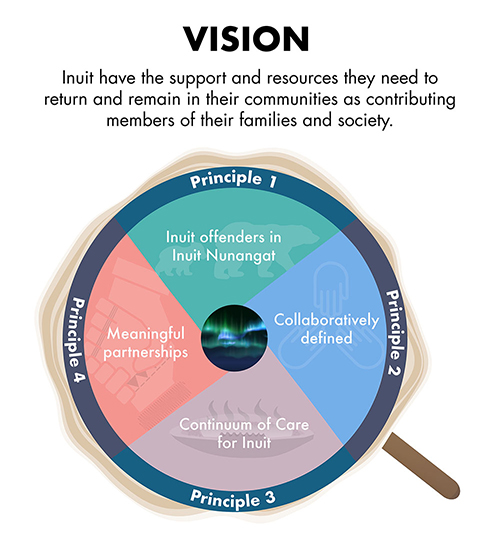
Long description
The vision of the strategy is that “Inuit have the support and resources they need to return and remain in their communities as contributing members of their families and society. There are 4 Key Principles:
- Principle 1: Inuit offenders in Inuit Nunangat
- Principle 2: Collaboratively defined
- Principle 3: Continuum of Care for Inuit
- Principle 4: Meaningful partnerships
Inuit offender
population by region

Long description
The total population of federally serving Inuit offenders
- There are 7 Inuit offenders in the Atlantic Region
- There are 62 Inuit offenders in the Quebec Region
- There are 32 Inuit offenders in the Ontario Region
- There are 19 Inuit offenders in the Prairies Region
- There are 8 Inuit offenders in the Pacific Region
Community Inuit offender
population by supervision type

Long description
The population of supervised federally serving Inuit offenders is 55.
- There are 7 Inuit offenders supervised on Day Parole
- There are 10 Inuit offenders on Full Parole
- There are 26 Inuit offenders on Statutory Release
- There are 12 Inuit offenders on Long Term Supervision.
Incarcerated Inuit offender
population by security level

Long description
The population of incarcerated federally serving Inuit offenders is 128.
- There are 9 Inuit offenders in minimum security
- There are 49 in medium security
- There are 33 in maximum security
- There are 37 serving in a multi-level institution.
Inuit offender population
by sentence length

Long description
Of the federally serving Inuit population:
- 47 Inuit offenders are serving a sentence of 4 years or less
- 22 Inuit offenders are serving a sentence between 4 and 10 years
- 5 Inuit offenders are serving a sentence longer than 10 years
- 54 Inuit offenders are serving an indeterminate sentence.
Horizontal collaboration with other government departments
In consultation and cooperation with First Nations, Inuit and Métis peoples, Justice Canada is developing an Indigenous Justice Strategy to address systemic discrimination and the overrepresentation of Indigenous people in the justice system. This Fiscal Year, CSC partnered with Justice Canada, provincial and territorial governments and First Nations, Inuit and Métis communities on the development of this strategy. This development has five phases:
- Pre-engagement (completed)
- Indigenous-led and Justice Canada-led engagement (completed)
- Reporting and development (completed)
- Validation and finalization (current phase)
- Release of the Indigenous Justice Strategy (2025)
CSC will continue to work with all partners on this important initiative. As part of the reporting and development phase that was undertaken this Fiscal Year Justice Canada developed a series of “What We Learned Reports” summarizing the outcomes of the Justice Canada-led engagements. The outcomes presented in these reports, as well as the reports received from the 38 federally-funded Indigenous partners, informed the development of the “Indigenous Justice Strategy Key Elements Consultation Draft” which is Canada’s first effort to consolidate what we have learned from Indigenous partners into the shared plan forward.
As part of an ongoing Memorandum of Understanding with Indigenous Services Canada (ISC), CSC continues to facilitate Indigenous offender applications and approvals to obtain their Certificate of Indian Status. Having government issued ID, particularly a Certificate of Indian Status, provides offenders with benefits and the ability to work and access other services in the community. This project also provides Indigenous offenders with the opportunity to connect/reconnect with their Indigenous community and to be supported by the community upon their release. In addition to this initiative, this Fiscal Year CSC and ISC facilitated a new initiative to support post-release access to community resources and services.
The Enhancing Community Success (ECS) initiative advances a partnership between CSC and ISC to optimize release planning and community reintegration for mutual clients. Leveraging ISC networks and services, this project presents an opportunity to aid Indigenous offender transitions and reintegration to the community, better identifying and/or linking offender to community resources and support for healing and social system needs.
The Federal Framework to Reduce Recidivism is the Government of Canada’s first step in putting together an implementation plan that identifies actions to support safe and successful reintegration into the community. The goal is to increase public safety by reducing recidivism, preventing victimization, addressing the overrepresentation of Indigenous peoples, Black Canadians and other marginalized groups in our criminal justice system. As part of the Public Safety Canada Department, CSC plays a critical role in the development and implementation of this framework. The Indigenous Initiatives Sector is focusing specifically on supporting successful rehabilitation and reintegration of Indigenous offenders into the community; moving forward with the understanding that Indigenous communities are critical partners in this work.
This Fiscal Year IIS engaged with the Modern Treaty Implementation Office regarding existing treaties to which CSC has commitments. The IIS team reviewed 956 enquiries to all of government modern treaties to identify organizational or public safety impacts. This work informed CSC’s understanding and obligations to First Nations and Indigenous communities with regard to the provision of correctional and rehabilitative services to Indigenous Offenders. This advice supported ratifying 2 modern treaties. Accepting these modern treaties is a positive step forward, opening the doors to negotiations regarding the administration of justice while maintaining balance with achievable commitments.