
Auditor General reports
Gaps exist in the federal government's approach to defending against cyber security threats

Overall, we concluded that the federal government had tools in place to protect and defend government networks and systems from cyber threats; however, there were significant gaps in cyber security services, monitoring, and response during active attacks. As cyber attacks become more sophisticated, pervasive, and harmful, the federal government must continually bolster its defences.
The responsibility for protecting government information technology (IT) systems and operations is shared by the Treasury Board of Canada Secretariat, Communications Security Establishment Canada, and Shared Services Canada. The organizations work together and with departments and agencies to prevent data theft and limit disruptions to systems that deliver programs and services to Canadians. However, not all federal organizations were subject to the same security policies, which resulted in the inconsistent use of available cyber security services. Gaps in cyber security defences undermine the government’s ability to protect critical information and manage cyber security risks.
Protecting federal networks and systems also requires the government to analyze the potential vulnerabilities of all government devices, including laptops, smartphones, and servers. Our audit found that Shared Services Canada and Communications Security Establishment Canada did not have a comprehensive, up-to-date inventory of all government IT assets. In 2017, Shared Services Canada began developing a cyber security project designed to provide a complete view of government devices, but the project had not been completed. Without up-to-date IT information across all departments and agencies, the federal government risks not being aware of—let alone being able to quickly respond to—changing cyber security challenges.
We also found that the coordination among the 3 organizations was insufficient during active attacks. For example, a lack of information sharing delayed the government’s response to a significant cyber attack in January 2024, allowing the attacker prolonged access to personal information. At the time of our audit, an initiative to set up a cyber security collaboration platform and incident case management tool had not received funding.
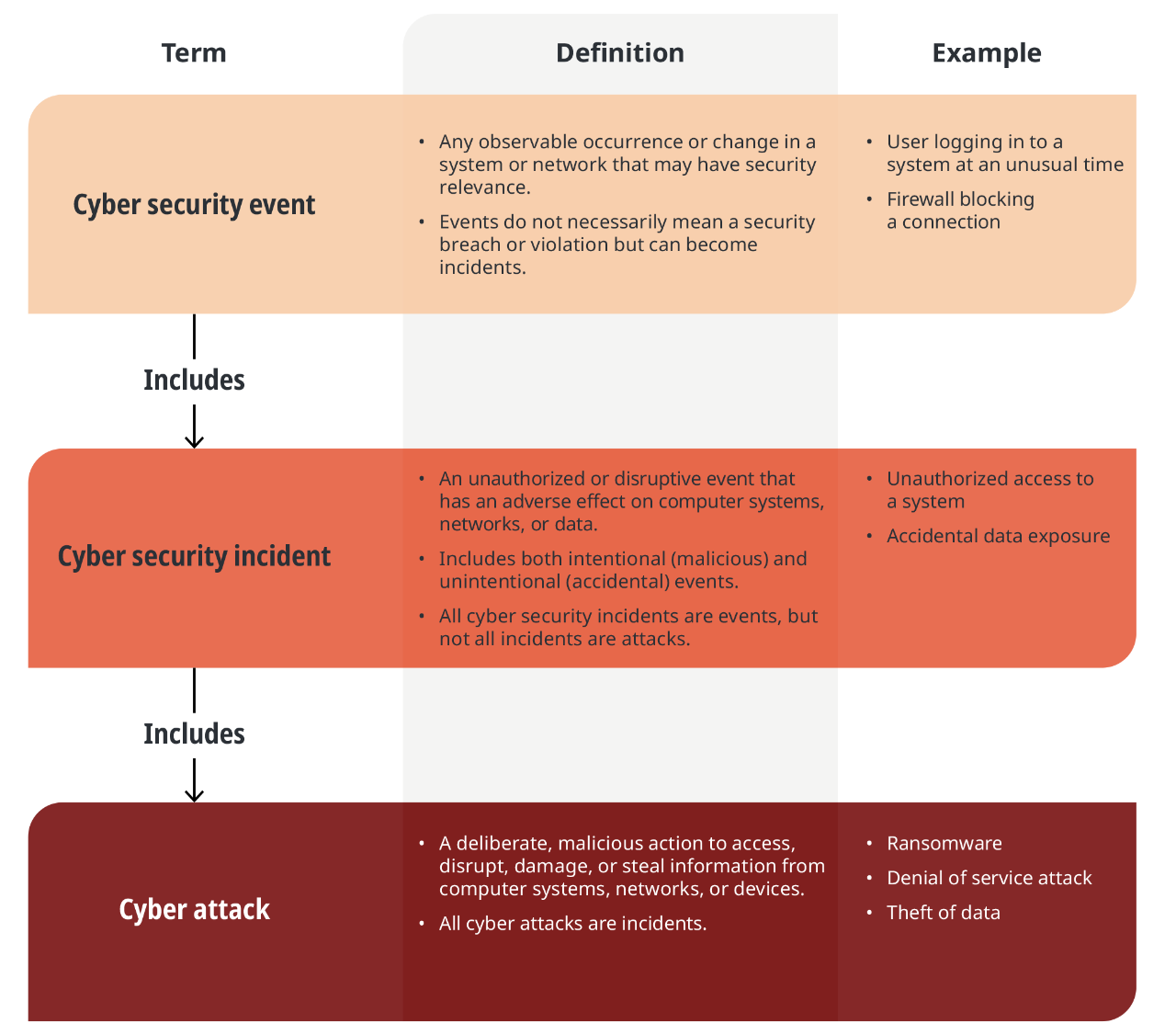
This chart defines the terms “cyber security event,” “cyber security incident,” and “cyber attack” and includes examples for each term. It also shows that a cyber security event includes a cyber security incident and that a cyber security incident includes a cyber attack.
A cyber security event is any observable occurrence or change in a system or network that may have security relevance. Events do not necessarily mean a security breach or violation but can become incidents. Two examples of cyber security events are as follows:
A cyber security incident is an unauthorized or disruptive event that has an adverse effect on computer systems, networks, or data. It includes both intentional (malicious) and unintentional (accidental) events. All cyber security incidents are events, but not all incidents are attacks. Two examples of cyber security incidents are as follows:
A cyber attack is a deliberate, malicious action to access, disrupt, damage, or steal information from computer systems, networks, or devices. All cyber attacks are incidents. Three examples of cyber attacks are as follows:

This chart shows the strategy objectives and examples of key actions of the Government of Canada Enterprise Cyber Security Strategy.
The strategy’s vision is as follows: “Building a world‑class, sustainable, and resilient federal government to reduce cyber security risks so that departments and agencies can enable secure and reliable digital service delivery.” The federal organizations that are responsible for implementing the strategy are the Treasury Board of Canada Secretariat, Communications Security Establishment Canada, Shared Services Canada, and other departments and agencies.
The chart lists 4 strategy objectives, and 2 examples of key actions are listed for each objective. There are many other actions under the strategy. The examples listed here represent some of the actions intended to have a government‑wide impact.

This chart shows the 3 types of cyber security defence sensors that Communications Security Establishment Canada developed and the years when they were each deployed.
In 2010, the department deployed the network‑based sensor, which detects and mitigates cyber security incidents on the government’s networks. This sensor is typically integrated with Shared Services Canada’s Enterprise Internet Service.
In 2012, the department deployed the host‑based sensor, which detects cyber attacks on IT endpoint devices such as laptop computers, servers, and local networks. The sensor analyzes and processes collected information to detect suspicious cyber security events occurring on a host machine. The information gathered is used to report anomalies and weaknesses to affected federal organizations.
In 2019, the department deployed the cloud‑based sensor, which operates in federal organizations’ cloud infrastructure and works in conjunction with the defences provided by cloud vendors. This sensor automates the collection of logged activity in the cloud and analyzes the information to detect and mitigate suspicious cyber security events.

This exhibit presents 2 charts: 1 chart showing the number of federal organizations that voluntarily use Shared Services Canada’s Enterprise Internet Service and 1 chart showing the number of federal organizations that voluntarily use Communications Security Establishment Canada’s cyber security defence sensors.
Of the 119 federal organizations that are not required to use Shared Services Canada’s Enterprise Internet Service, 24 organizations, or 20%, voluntarily used it, and 95, or 80%, did not.
Similarly, of these 119 organizations, 76 organizations, or 64%, voluntarily used 1 or more of Communications Security Establishment Canada’s cyber security defence sensors, and 43, or 36%, did not.

Shared Services Canada's Enterprise Internet Service blocked trillions of cyber threats.
There were 6.6 trillion threats blocked in just 12 months, including attacks, malicious actions, and external events.
That’s averaging 18 billion attempts a day.

Not all organizations are using Shared Services Canada’s and Communications Security Establishment Canada’s cyber security tools.
Out of 204 federal organizations, 119 organizations are not required to use the enterprise service. Twenty‑four of these organizations have adopted this service to provide security from malicious sites. That’s 20%.
The remaining 85 organizations are required to use Shared Services Canada’s Enterprise Internet Service for security, site filtering, and Communications Security Establishment Canada monitoring. Only 63 of these organizations were using this required service.
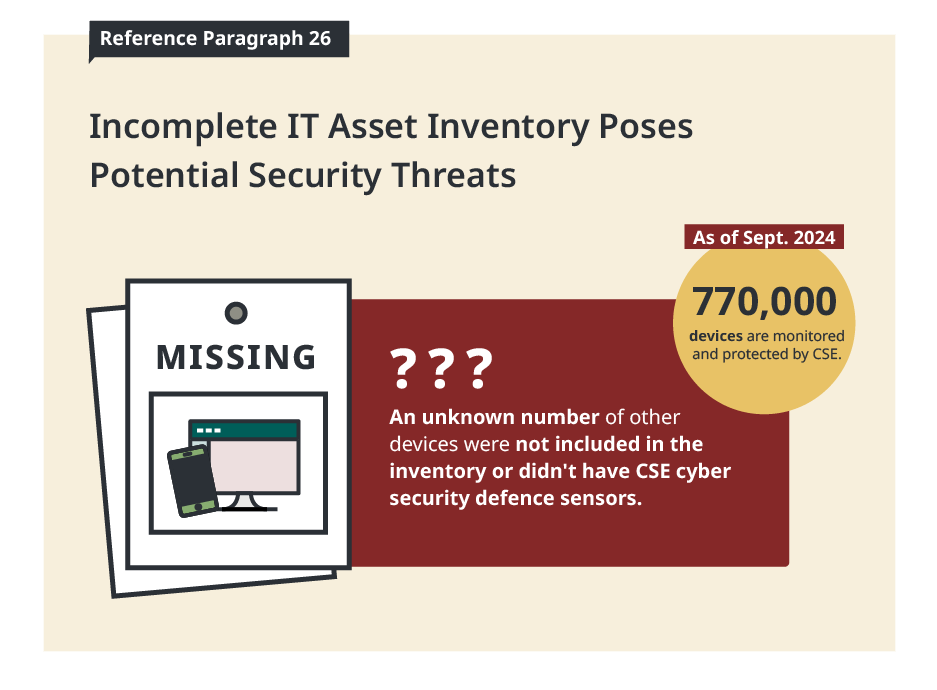
Incomplete information technology asset inventory poses potential security threats.
As of September 2024, 770,000 devices are monitored and protected by Communications Security Establishment Canada.
An unknown number of other devices were not included in the inventory or didn't have Communications Security Establishment Canada cyber security defence sensors.