Northwest Territories government must act to ensure equitable access to housing and housing supports
Housing in the Northwest Territories

Report metadata
- Tabling date:
- Report type
- Northern legislative assemblies reports
At a glance
Housing is a persistent challenge in the Northwest Territories due to factors such as the territory’s geography and climate. Public housing and homeownership support are essential to the health, safety, and stability of residents of the Northwest Territories. Overall, in this audit, we concluded that Housing Northwest Territories did not provide residents most in need with equitable access to housing and housing supports through its public housing and homeownership programs.
Housing Northwest Territories developed a point‑rating system for public housing allocation to those most in need based on criteria such as affordability and how long applicants have been waiting. However, during our audit period, the corporation did not know whether units were allocated equitably as it performed only limited monitoring of the independent local housing organizations’ assessing those criteria.
Understanding the condition of public housing units and performing regular maintenance reduce costs and help to ensure the safety of residents, especially those in units beyond the end of their useful service life. We found that Housing Northwest Territories did not follow its own requirements to monitor the condition and maintenance of its public housing units. During the audit period, the corporation completed unit‑condition rating verifications for only half of the local housing organizations, and maintenance was monitored in an ad‑hoc and limited way.
We also found that Housing Northwest Territories did not monitor outcomes for its homeownership programs, which provide funds to help residents buy modest private homes, repair their homes, and prepare them to become homeowners. Therefore, the corporation could not ensure that funds for these programs were being allocated to meet the objective of equitable access to housing supports for Northwest Territories residents. Further, Housing Northwest Territories did not consistently apply key eligibility criteria for equitable access to the homeownership programs.
Some of our current audit findings are outstanding issues from previous audits in both 2008 and 2012. It is critical that Housing Northwest Territories deliver on its commitment to the well‑being of individuals and communities by providing equitable access to quality housing support for people most in need so that each individual has a safe place to call home.
Key facts and findings
- Across the territory’s 33 communities, Housing Northwest Territories is responsible for
- funding, supporting, and overseeing independent local housing organizations, which manage 2,365 public housing units
- delivering programs that support homeownership
- In the last 3 fiscal years, public housing and homeownership supports represented on average $83.6 million, or 64%, of the corporation’s overall expenses.
- About 15% of the 15,356 households across the territory live in public housing, according to 2024 data from the Northwest Territories Bureau of Statistics.
- According to Housing Northwest Territories data, 918 households were on the public housing waitlist as of March 31, 2025, with the average household on the list for about 2 years.
- We found that as of March 31, 2025, unit‑condition ratings for public housing units were, on average, not completed within the required 2‑year period. The average time between unit‑condition ratings was every 2.28 years and differed by Housing Northwest Territories district office, including 1 district that had unit‑condition ratings completed on average a little over 5 years apart.
- Housing Northwest Territories’ data indicates that it funded 644 applications of the 1,654 homeownership program applications it received between April 1, 2023, and March 31, 2025.
Highlights of our recommendations
- Housing Northwest Territories should systematically monitor local housing organizations to ensure that requirements for public housing unit allocation are met and corrective actions are taken if it identifies that allocations are not made in accordance with its policies, procedures, and guidance.
- Housing Northwest Territories should review and update its policies, procedures, and guidance to support the equitable allocation of public housing carried out by the local housing organizations.
- Housing Northwest Territories should monitor and document its monitoring of unit‑condition ratings and maintenance carried out by local housing organizations, as required, and follow up to ensure public housing units are adequately maintained.
Why we did this audit
- Across the territory’s 33 communities, Housing Northwest Territories is responsible for
- funding, supporting, and overseeing independent local housing organizations, which manage 2,365 public housing units
- delivering programs that support homeownership
- In the last 3 fiscal years, public housing and homeownership supports represented on average $83.6 million, or 64%, of the corporation’s overall expenses.
- About 15% of the 15,356 households across the territory live in public housing, according to 2024 data from the Northwest Territories Bureau of Statistics.
- According to Housing Northwest Territories data, 918 households were on the public housing waitlist as of March 31, 2025, with the average household on the list for about 2 years.
- We found that as of March 31, 2025, unit‑condition ratings for public housing units were, on average, not completed within the required 2‑year period. The average time between unit‑condition ratings was every 2.28 years and differed by Housing Northwest Territories district office, including 1 district that had unit‑condition ratings completed on average a little over 5 years apart.
- Housing Northwest Territories’ data indicates that it funded 644 applications of the 1,654 homeownership program applications it received between April 1, 2023, and March 31, 2025.
Exhibit highlights
Percentage of households reporting a need for major repairs in the Northwest Territories compared with Canada's provinces in 2024

Text version
This illustration shows that 18% of households in the Northwest Territories reported a need for major repairs compared with 7% of households in Canada’s provinces.
Source: Based on data from the Northwest Territories Bureau of Statistics and Statistics Canada
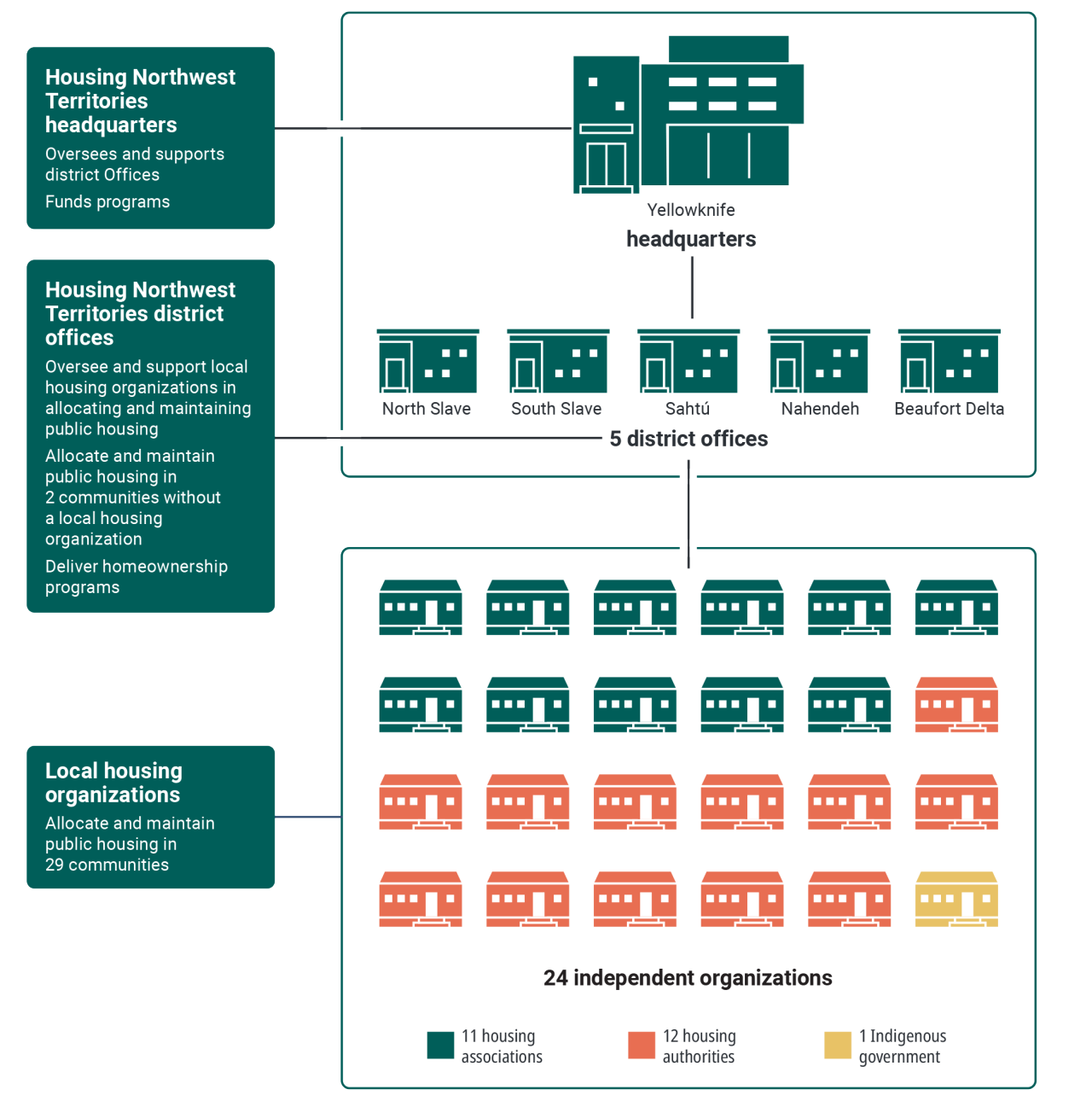
Public housing and housing homeownership program oversight and management in the Northwest Territories
Text version
This illustration shows that Housing Northwest Territories headquarters and its 5 district offices oversee and manage public housing and homeownership programs and that local housing organizations allocate and maintain public housing in the Northwest Territories.
Housing Northwest Territories headquarters in Yellowknife oversees and supports district offices and funds programs.
The corporation’s 5 district offices oversee and support local housing organizations in allocating and maintaining public housing. They also allocate and maintain public housing in 2 communities without a local housing organization.
The district offices also deliver homeownership programs. The 5 district offices are in North Slave, South Slave, Sahtú, Nahendeh, and Beaufort Delta.
Local housing organizations allocate and maintain public housing in 29 communities. These are 24 independent organizations composed of 11 housing associations, 12 housing authorities, and 1 Indigenous government.
Source: Based on data from Housing Northwest Territories
Distribution of public housing units across the territory

Text version
This map shows the areas served by the 5 district offices of Housing Northwest Territories and the number of public housing units managed by each district office. The number of units is based on data as of March 31, 2025. Numbers do not add up to 100% due to rounding.
The 5 districts are Beaufort Delta, Sahtú, Nahendeh, North Slave, and South Slave.
Following are the number of public housing units for each district from the largest number to the smallest number:
- The Beaufort Delta district office has 828 public housing units or 35% of the units in the Northwest Territories.
- The North Slave district office has 610 public housing units or 26% of the units in the Northwest Territories.
- The South Slave district office has 511 public housing units or 22% of the units in the Northwest Territories.
- The Sahtú district office has 261 public housing units or 11% of the units in the Northwest Territories.
- The Nahendeh district office has 155 public housing units or 7% of the units in the Northwest Territories.
Source: Based on data from Housing Northwest Territories
Eligible residents waited an average of about 2 years for a public housing unit in the Northwest Territories as of March 31, 2025

Text version
This illustration shows the public housing demand in the Northwest Territories: 3,080 people from 918 households were waiting for public housing units as of March 31, 2025. The average wait time was 2 years.
Source: Based on data from Housing Northwest Territories