Shortcomings found in the implementation of financial measures to help reduce greenhouse gas emissions
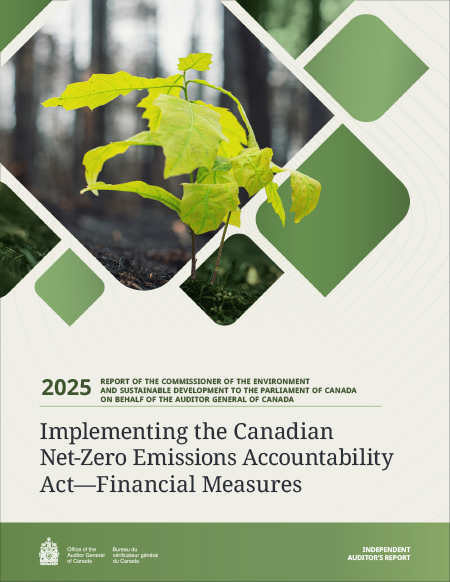
Implementing the Canadian Net-Zero Emissions Accountability Act—Financial Measures
Report metadata
- Tabling date:
- Audited entities:
- Canada Revenue Agency
- Department of Finance Canada
- Natural Resources Canada
- Environment and Climate Change Canada
- Office of the Superintendent of Financial Institutions Canada
- Report type
- Commissioner of the Environment and Sustainable Development reports
At a glance
Overall, we found that federal organizations had developed financial measures to help reduce greenhouse gas emissions that are projected to be worth over $100 billion of federal investment. However, we identified shortcomings in their implementation that will impact the effectiveness of these measures.
Concerns we identified included the low initial uptake of the Clean Economy investment tax credits and ongoing federal investments in projects in the oil and gas sector that faced significant risks in a transition to a net‑zero economy. There was also a lack of transparency of expected emission outcomes and insufficient systems for measuring results. In addition, limited progress had been made in developing sustainable investment guidelines for activities to help Canada’s economy transition to net‑zero emissions by 2050.
We also followed up on 9 recommendations we made to Environment and Climate Change Canada and the Office of the Superintendent of Financial Institutions Canada in 2 other recent reports involving financial measures to address climate change. We found that while both organizations took actions to advance all 9 recommendations, some elements to improve guidance and promote transparency were not fully addressed.
We found that the Department of Finance Canada issued its first annual report, as required by the Canadian Net‑Zero Emissions Accountability Act, on the key measures that the government had taken to manage its financial risks and opportunities related to climate change. However, the report missed opportunities to align with best practices for reporting on climate-related financial disclosures.
In our first 2 annual reports under the act, we found that Canada’s current measures and pace of emission reductions were not enough to meet the target of reducing greenhouse gas emissions by 40% to 45% below the 2005 level by 2030. Since then, the consumer carbon price was eliminated. The government will need to strengthen or add measures if it is to meet Canada’s national and international commitments in the global effort to limit temperature rise.
Why we did this audit
- The federal government committed to using financial measures to encourage investments from the private sector to accelerate the transition to a net‑zero economy. Implementing effective financial measures and establishing a sustainable finance guideline would help meet Canada’s 2030 target and help align the economy to transition to net‑zero emissions by 2050.
- Recommendations from audit reports aim to address the deficiencies in climate change measures found by our audits. Federal organizations commit to specific actions they will take to respond to the recommendations that they have agreed to and to timelines for implementation in their management action plans.
- Improving and increasing climate-related financial information is important to better understand the risks and opportunities for decision making and accountability.
Highlights of our recommendations
- To provide businesses and other investors with greater certainty to support and accelerate clean electricity investment in Canada, the Department of Finance Canada should provide a timely update on the status of the implementation of the Clean Electricity Investment Tax Credit.
- To enhance the alignment of sustainable financing to Canada’s emission reduction targets, the Department of Finance Canada should publish a timeline and actions required to develop and implement the sustainable investment guidelines.
- To improve the relevance, consistency, completeness, and transparency of its annual reporting on climate-related financial risks and opportunities, the Department of Finance Canada should report on the key measures taken by the federal public administration, including certain federal Crown corporations, to manage climate-related financial risks and opportunities using an approach that aligns with climate-related financial disclosure frameworks.
Key facts and findings
- The federal government has made several commitments since the introduction of the Canadian Net‑Zero Emissions Accountability Act to reduce greenhouse gas emissions, starting with an interim objective to reduce emissions by 20% below the 2005 level by 2026. It also set more ambitious targets for subsequent years, with the ultimate aim of achieving net‑zero emissions by 2050.
- According to the federal government’s data for 2023, the most recent year available, emissions have been reduced by 8.5% since 2005.
- The federal government has stated that it needs to take significant and transformative steps to put the Canadian economy on the path to reach net‑zero emissions by 2050, which would require up to $140 billion in annual investment.
- There are 149 measures to support greenhouse gas emission reductions reported in the federal government’s 2023 Progress Report on the 2030 Emissions Reduction Plan. We have audited 40 of these emission reduction measures since 2021.
- The 9 measures we audited this year had shortcomings that limited the effective implementation to support emission reductions by 2030.


Climate change is causing widespread harm for Canadians, communities, and the natural environment, and the risks are escalating. For more than 3 decades, the federal government has set targets and taken actions to reduce greenhouse gas emissions to meet its national and international commitments to fight climate change. Its recent commitments have been legislated in the Canadian Net‑Zero Emissions Accountability Act and stem from the United Nations’ Paris Agreement, which seeks to limit global average temperature rise to well below 2 degrees Celsius and preferably no higher than 1.5 degrees Celsius above pre‑industrial levels.
The federal government stated that it met its commitment to phase out inefficient fossil fuel subsidies. However, federal departments had not included any indicators or metrics to measure the phase‑out and had not planned to consolidate reporting on data. For example, the federal government did not provide any data for the indicator tracking the amount of fossil fuel subsidies per unit of gross domestic product for Goal 12 (Responsible Consumption and Production) of the Sustainable Development Goals.
Exhibit highlights
The federal government’s recent commitments and actions to reduce greenhouse gas emissions
Text version
This timeline shows the federal government’s recent commitments and actions to reduce greenhouse gas emissions. It shows documents, legislation, and targets that apply to these commitments and actions for the period from 2015 to 2024. In 2015, the United Nations’ 2030 Agenda for Sustainable Development was adopted. Sustainable Development Goal 13 calls for urgent action to combat climate change and its impacts. Target 13.2 calls on countries to integrate climate change measures into national policies, strategies, and planning. Also in 2015, the United Nations’ Paris Agreement was adopted. It seeks to limit global average temperature rise to well below 2 degrees Celsius and preferably no higher than 1.5 degrees Celsius above pre‑industrial levels. In 2021, under the Paris Agreement, Canada set targets to reduce greenhouse gas emissions by 40% to 45% below the 2005 level by 2030 and to reach net‑zero emissions by 2050. Also in 2021, the Canadian Net‑Zero Emissions Accountability Act came into force. The act promotes transparency and accountability in the federal government’s efforts to ensure Canada achieves net‑zero greenhouse gas emissions by 2050. In 2022, the federal government published the 2022–2026 Federal Sustainable Development Strategy. The document set out the Government of Canada’s sustainable development goals and targets, including its 2030 emissions target under Goal 13, and outlines implementation strategies and short‑term milestones for achieving them. Also in 2022, the Minister of Environment and Climate Change published the 2030 Emissions Reduction Plan. This first plan under the Canadian Net‑Zero Emissions Accountability Act outlined the emission reduction measures that the federal government intended to take to achieve Canada’s 2030 target. Under the Canadian Net‑Zero Emissions Accountability Act, the federal government set an interim objective to reduce greenhouse gas emissions by 20% below the 2005 level by 2026. In 2023, the Minister of Environment and Climate Change published the first progress report on the 2030 Emissions Reduction Plan. The document reported on 149 federal measures and sub‑measures across 11 economic sectors and categories, led by 20 federal organizations, intended to reduce greenhouse gas emissions. In 2024, under the Paris Agreement, Canada set a new target to reduce greenhouse gas emissions by 45% to 50% below the 2005 level by 2035.Source: Based on information from various federal government and United Nations sources
Canada’s greenhouse gas emissions, interim objective, and targets
Text version
This graph shows Canada’s greenhouse gas emissions, interim objective, and targets since 1990 in megatonnes of carbon dioxide equivalent. Overall, Canada’s greenhouse gas emissions increased from 1990 to their peak of 774 megatonnes of carbon dioxide equivalent in 2007. Since then, emissions have fluctuated significantly on a slightly downward trend. In 1990, the Canada’s greenhouse gas emissions were 606 megatonnes of carbon dioxide equivalent. In 1991, emissions decreased to 602 megatonnes. In 1992, emissions increased to 619 megatonnes. In 1993, emissions increased to 624 megatonnes. In 1994, emissions increased to 646 megatonnes. In 1995, emissions increased to 665 megatonnes. In 1996, emissions increased to 686 megatonnes. In 1997, emissions increased to 701 megatonnes. In 1998, emissions increased to 708 megatonnes. In 1999, emissions increased to 718 megatonnes. In 2000, emissions increased to 746 megatonnes. In 2001, emissions decreased to 739 megatonnes. In 2002, emissions increased to 746 megatonnes. In 2003, emissions increased to 764 megatonnes. In 2004, emissions remained steady at 764 megatonnes. In 2005, emissions decreased to 759 megatonnes. In 2006, emissions decreased to 755 megatonnes. In 2007, emissions increased to 774 megatonnes. In 2008, emissions decreased to 758 megatonnes. In 2009, emissions decreased to 714 megatonnes. In 2010, emissions increased to 728 megatonnes. In 2011, emissions increased to 738 megatonnes. In 2012, emissions increased to 741 megatonnes. In 2013, emissions increased to 750 megatonnes. In 2014, emissions decreased to 747 megatonnes. In 2015, emissions decreased to 742 megatonnes. In 2016, emissions decreased to 725 megatonnes. In 2017, emissions increased to 738 megatonnes. In 2018, emissions increased to 747 megatonnes. In 2019, emissions remained steady at 747 megatonnes. In 2020, emissions decreased to 682 megatonnes. In 2021, emissions increased to 694 megatonnes. 2022, emissions increased to 700 megatonnes. In 2023, emissions decreased to 694 megatonnes. The interim objective for 2026 is 607 megatonnes (20% below the 2005 level). The target for 2030 is from 455 to 417 megatonnes (40% to 45% below the 2005 level). The target for 2035 is from 417 to 379 (45% to 50% below the 2005 level).Note: The land use, land‑use change, and forestry accounting contributions were not included because those values had not yet been published.
Source: Based on data from the National Inventory Report 1990–2023: Greenhouse Gas Sources and Sinks in Canada, Environment and Climate Change Canada, 2025
Performance of Group of Seven countries in reducing greenhouse gas emissions
Text version
This graph shows the emissions changes between 1990 and 2023 and between 2005 and 2023 for the following countries: Canada, France, Germany, Italy, Japan, and the United Kingdom. For the United States of America, it shows the emissions changes between 1990 and 2022 and between 2005 and 2022 because data for this country was not available for 2023. The baseline year for reporting emissions and assessing progress under the United Nations Framework Convention on Climate Change is 1990. The baseline year that Canada chose for its 2030 target under the Paris Agreement is 2005. Canada was the worst performer of the 7 countries using either of the 2 baseline years: 1990 or 2005, and it is the only country whose emissions increased from 1990 to 2023. During this period, Canada’s emissions increased by 14%. But from 2005 to 2023, its emissions decreased by 8.5%. Other countries’ emissions follow. From 1990 to 2023, France’s emissions decreased by 31%. From 2005 to 2023, its emissions decreased by 32%. From 1990 to 2023, Germany’s emissions decreased by 46%. From 2005 to 2023, its emissions decreased by 32%. From 1990 to 2023, Italy’s emissions decreased by 26%. From 2005 to 2023, its emissions decreased by 35%. From 1990 to 2023, Japan’s emissions decreased by 16%. From 2005 to 2023, its emissions decreased by 22%. From 1990 to 2023, the United Kingdom’s emissions decreased by 52%. From 2005 to 2023, its emissions decreased by 45%. From 1990 to 2022, the United States of America’s emissions decreased by 3%. From 2005 to 2022, its emissions decreased by 15%.Source: National inventory reports for 1990–2023 for each country, except for the United States of America, which was its national inventory report for 1990–2022
Canada was slow to develop sustainable investment guidelines
Text version
This timeline shows the steps that Canada has taken to develop sustainable investment guidelines. The period of time shown is 6 years, from April 2018 to October 2024. In April 2018, the Minister of Finance and the Minister of Environment and Climate Change jointly appointed the Expert Panel on Sustainable Finance. In June 2019, the Final Report of the Expert Panel on Sustainable Finance was published, which recommended that the Department of Finance Canada lead in convening key interested parties to develop sustainable investment guidelines. In July 2020, the Government of Canada announced the creation of the Sustainable Finance Action Council, with $7.3 million over 3 years, to provide expertise to the Minister of Finance and the Minister of Environment and Climate Change. In May 2021, the federal government launched the council, whose mandate included making recommendations on common standards for sustainable and low‑carbon investments. In September 2022, the council completed its Taxonomy Roadmap Report with 10 recommendations to the Government of Canada. In November 2023, the 2023 Fall Economic Statement announced that the government would undertake the next steps to develop these guidelines. In October 2024, the Department of Finance Canada provided an update on the plans to develop guidelines, including that it would provide funding to a third party to develop and govern the guidelines.Source: Based on information from various federal government sources