
Report of the Auditor General of Canada to the Board of Directors of the Canadian Tourism Commission—Special Examination—2024

Table of Contents
- Audit Summary
- Introduction
- Findings
- Conclusion
- About the Audit
- Exhibits:
- 1—The tourism sector supports the Canadian economy
- 2—The corporation’s main source of funding comes from parliamentary appropriations
- 3—Corporate governance—Key findings and assessment
- 4—Strategic planning—Key findings and assessment
- 5—Corporate risk management—Key findings and assessment
- 6—The corporation’s marketing activities relate to brand strategy, global marketing, and business events
- 7—The corporation was developing the Canadian Tourism Data Collective platform and the Wealth and Wellbeing Index to inform interested and affected parties
- 8—Management of operations—Key findings and assessment
Audit Summary
We examined how the Canadian Tourism Commission, operating as Destination Canada, implemented its corporate management practices and managed its operations during the period covered by the audit.
We found no significant deficiencies or weaknesses to highlight for improvement. The corporation had good systems and practices in carrying out corporate management and in managing operations. We make no recommendations in this report.
Introduction
Background
1. The Canadian Tourism Commission is a federal Crown corporation established under the Canadian Tourism Commission Act in 2001 to
- sustain a vibrant and profitable Canadian tourism industry
- market Canada as a desirable tourist destination
- support a cooperative relationship between the private sector and the governments of Canada, the provinces, and the territories with respect to Canadian tourism
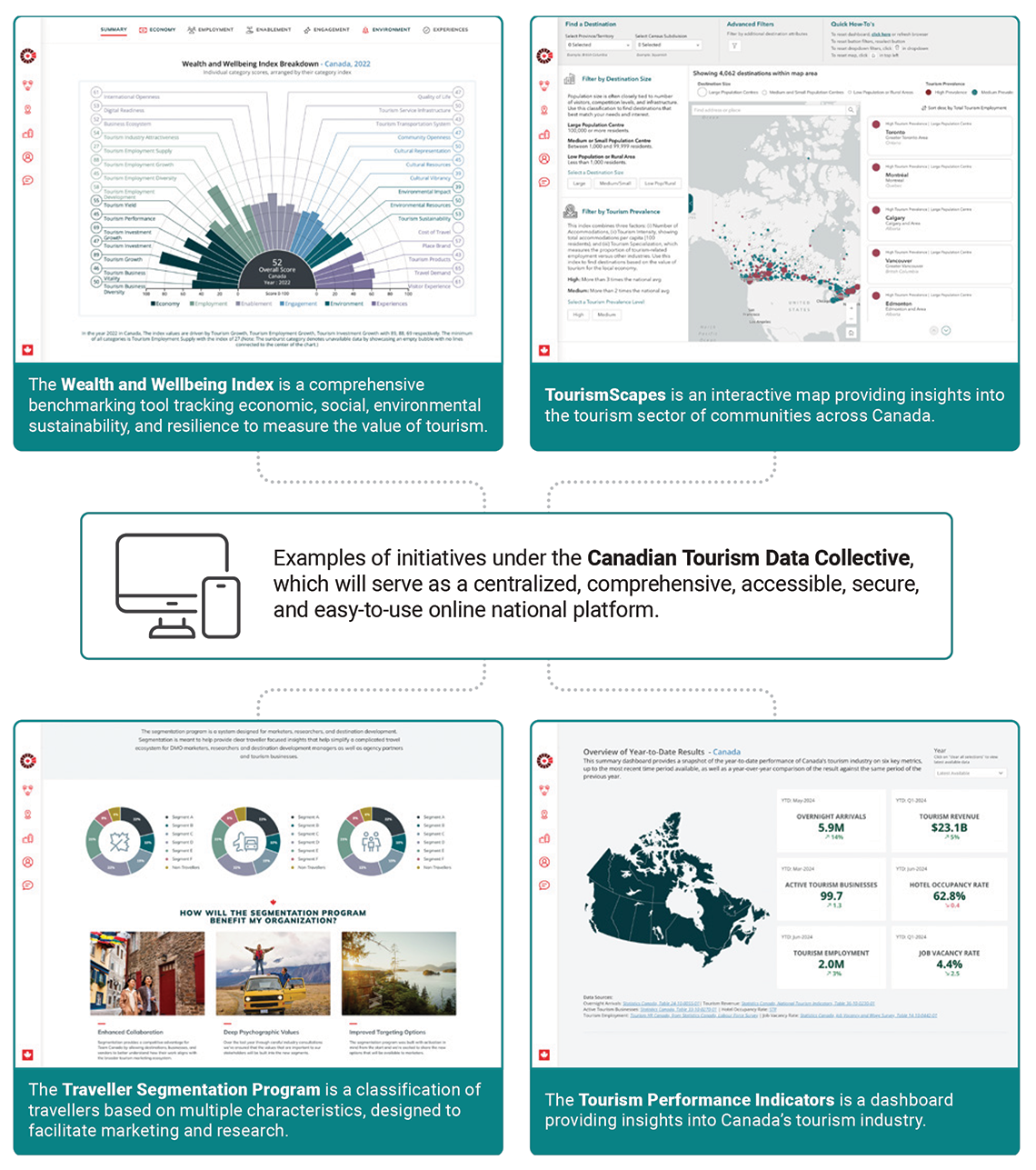
- provide information about Canadian tourism to the private sector and to the governments of Canada, the provinces, and the territories
It currently reports to the Parliament of Canada through the Minister of Tourism and Minister responsible for the Economic Development Agency of Canada for the Regions of Quebec.
2. Canada’s tourism sector plays an important role in generating prosperity and quality of life for Canadians (Exhibit 1). Tourism has a positive impact across many sectors such as hospitality, accommodation, transportation, retail, entertainment, arts, and culture.
Exhibit 1—The tourism sector supports the Canadian economy
| Category | 2019 | 2020 | 2021 | 2022 | 2023 |
|---|---|---|---|---|---|
| Tourism demand (revenue) | $105.0 billion | $51.2 billion | $57.2 billion | $96.2 billion | $113.4 billion |
| Tourism’s contribution to the gross domestic product | $43.6 billion (2.02%) | $20.9 billion (0.99%) | $23.1 billion (0.98%) | $37.2 billion (1.41%) | $42.7 billion (1.59%) |
| Number of Canadian jobs supported by tourism | 2.103 million | 1.628 million | 1.675 million | 1.877 million | 2.022 million |
Source: Estimates provided by the Canadian Tourism Commission
3. During 2023, the corporation was implementing a strategy that focused on the recovery of the tourism industry after the coronavirus disease (COVID‑19) pandemic. At the same time, it developed a new strategic plan to shift away from response and recovery and towards resilience. The plan, which takes effect in 2024, focuses on driving economic prosperity, socio‑cultural vibrancy, and environmental sustainability. The plan keeps the concept of regenerative tourism. The corporation’s regenerative approach to tourism growth is summarized as acting meaningfully in preserving, improving, and repairing Canada’s environment and in supporting social and cultural vibrancy. By advocating for responsible travel, this will help preserve nature and promote economic, social, cultural, and environmental sustainability. The new strategic plan also maintains the corporation’s overall aspiration for tourism to generate wealth and well‑being for Canadians and to enrich the lives of guests. This new plan includes the following 4 strategic drivers:
- Collective intelligence: The corporation plans to expand its data sources of consumer‑based and sector‑specific information. It also plans to increase its performance analysis capabilities. These changes are intended to benefit its decision making and that of Canadian tourism industry interested and affected parties.
- Brand leadership: The corporation plans to focus its marketing strategy on promoting Canada as the premier destination for leisure travel and for hosting international business events.
- Destination development: In promoting Canada as a sought‑after global destination, the corporation intends to help the tourism sector stimulate growth in the supply of experiences and infrastructures for travellers.
- Sector advancement: The corporation aims to make Canada a more successful competitor in the tourism sector. Success will be measured not only by economic terms but also by how much the well‑being of people and the condition of places have improved and by how much sustainable and regenerative tourism has grown.
4. The corporation works with a diverse tourism sector to deliver on its mandate and to implement its strategy. The sector includes the federal government and the governments of the provinces and territories. It also includes Canadian tourism industry interested and affected parties, such as city destination marketing organizations, national tourism sector associations, media outlets, small and medium‑sized enterprises, and those in the transportation and accommodation industries.
5. The corporation is funded primarily by the federal government (Exhibit 2). The corporation’s annual base parliamentary appropriations were around $96 million. However, occasionally it had received additional funding for specific purposes. For example, to help rebuild the tourism industry following the COVID‑19 pandemic, the corporation received $100 million over 3 years from the federal budget 2021 and was to receive $50 million over 3 years from the federal budget 2023 for attracting international business events.
Exhibit 2—The corporation’s main source of funding comes from parliamentary appropriations
| Key financial information | 2019 | 2020 | 2021 | 2022 | 2023 |
|---|---|---|---|---|---|
| Revenues | $24.5 million | $4.5 million | $2.7 million | $3.1 million | $10.6 million |
| Expenses | $131.8 million | $80.5 million | $137.5 million | $151.4 million | $144.9 million |
| Net cost of operations before funding from the Government of Canada | ($107.3 million) | ($76.0 million) | ($134.8 million) | ($148.3 million) | ($134.3 million) |
| Parliamentary appropriations | $102.2 million | $95.7 million | $110.5 million | $156.2 million | $106.4 million |
| (Deficit) surplus for the year | ($5.1 million) | $19.7 million | ($24.3 million) | $7.9 million | ($27.9 million) |
| Accumulated operating surplus (deficit)Note * | $16.9 million | $36.5 million | $12.2 million | $20.1 million | ($7.8 million) |
Source: Canadian Tourism Commission statement of operations
6. The corporation is headquartered in Vancouver, British Columbia, and has a smaller office in Ottawa focused on working with the federal government and with national tourism associations. As of 31 March 2024, it had a workforce of 137 employees, some of whom work in 3 of its 9 specific targeted international geographic markets listed in paragraph 22.
Focus of the audit
7. Our objective for this audit was to determine whether the systems and practices we selected for examination at the Canadian Tourism Commission were providing the corporation with reasonable assurance that its assets were safeguarded and controlled, its resources were managed economically and efficiently, and its operations were carried out effectively, as required by subsection 138(1) of the Financial Administration Act.
8. Also, section 139 of the Financial Administration Act requires that we state an opinion, with respect to the criteria established pursuant to subsection 138(3), on whether there was reasonable assurance that there were no significant deficiencies in the systems and practices we examined. We report significant deficiencies when, in our opinion, the corporation could be prevented from having reasonable assurance that its assets are safeguarded and controlled, its resources are managed economically and efficiently, and its operations are carried out effectively.
9. On the basis of our risk assessment, we selected systems and practices in the following areas:
The selected systems and practices, and the criteria used to assess them, are listed in the exhibits throughout the report.
10. More details about the audit objective, scope, approach, and sources of criteria are in About the Audit at the end of this report.
Findings
Corporate management practices
The corporation had good corporate management practices
11. The corporate management practices that are common to all corporations include those within the areas of corporate governance, strategic planning, and risk management.
12. Corporate governance. The Board of Directors is accountable for the overall stewardship of the corporation and for ensuring that the corporation’s business activities contribute to achieving its mandate. As per the Canadian Tourism Commission Act, the corporation can have up to 12 directors, and the process for appointing directors is outside the corporation’s control. The Deputy Minister of Industry is an ex officioDefinition 1 director. The President is a director holding office on a full‑time basis appointed by the Governor in Council.Definition 2 The Chairperson is also appointed by the Governor in Council. Up to 9 directors are appointed by the Minister of Industry (responsibility currently assigned to the Minister of Tourism and Minister responsible for the Economic Development Agency of Canada for the Regions of Quebec), with the approval of the Governor in Council. At the end of our examination period, 1 board position became vacant and there was 1 term that had expired, which subsequent to the end of our examination period became vacant. This situation did not pose a threat to maintaining quorum.
13. The board was supported by 2 standing committees: the Audit and Risk Committee, and the Human Resources and Governance Committee. The board has the discretion to form formal advisory ad hoc committees for a maximum period of 2 years. Those committees that had previously reported to the board—committees on business events, international leisure marketing, and research—still existed but directly supported management. Some board members attended some of those committee meetings as observers.
14. Strategic planning. The corporation develops a strategy, which guides the corporation over a period of time. The board‑approved strategic direction is translated into a 5‑year corporate plan, which includes descriptions of various activities, performance indicators and targets, and budgets. The board‑approved corporate plan is submitted annually to the responsible minister for approval by the Governor in Council. The corporation’s recently updated strategy charts a path to help the tourism sector grow economically and be both sustainable and regenerative while respecting Indigenous interests.
15. Corporate risk management. Corporations must manage risks, which may threaten the achievement of their objectives. Various risks identified are to be assessed based on the likelihood of occurrence and impact should they occur so that appropriate attention is devoted to their mitigation. Accordingly, putting in place well‑defined mitigation strategies, risk appetite statements and tolerances, and time‑bound, detailed action plans and then monitoring their effectiveness provides the basis for the board and management to ensure that the corporation has effective practices to mitigate such risks. The corporation had identified key corporate risks, which fall within economic, environmental, social, and governance themes.
16. Findings. The corporation had good corporate governance practices (Exhibit 3).
Exhibit 3—Corporate governance—Key findings and assessment
| Systems and practices | Criteria used | Key findings | Assessment against the criteria |
|---|---|---|---|
|
Board appointments and competencies |
The board collectively had the capacity and competencies to fulfill its responsibilities. |
The board developed a skills matrix that listed the various business and management experience, sector connections, and diversity attributes needed to be effective and carry out its responsibilities. The skills matrix included an assessment of each of the board members against the attributes to help assess potential areas that could be strengthened. This assessment was shared with the minister through the responsible department. The corporation provided orientation sessions to board members when they joined the board. The corporation had a newly created director education policy, which supported ongoing training. That support included the corporation providing financial assistance to board members to take appropriate training. Most board members took part in such training during the first year of the policy’s implementation. Board members also received and exchanged information from Canadian tourism industry interested and affected parties, including external experts at their meetings. For example, external experts spoke on conflict‑of‑interest and cybersecurity matters thus providing members with further insights on these topics. | Check mark in a green circle Met the criteria |
|
Board independence |
The board functioned independently. |
The Board of Directors made decisions independently of management and held regular private meetings without management in attendance. The corporation had a code of ethics that applied to both directors and employees. Board members of the corporation submitted an annual conflict‑of‑interest declaration. Furthermore, at the beginning of board meetings, they were asked if they had any conflicts of interest to declare. None were declared according to the minutes of the meetings that we examined. | Check mark in a green circle Met the criteria |
|
Providing strategic direction |
The board provided strategic direction. |
The board participated in the development and approval of strategic and corporate plans, including setting the corporation’s strategic direction. The board was active in setting the President and Chief Executive Officer’s annual objectives and evaluating her performance against those objectives. Performance objectives included policy and program results to be achieved, which aligned with the corporation’s strategic pillars. | Check mark in a green circle Met the criteria |
|
Board oversight |
The board carried out its oversight role over the corporation. |
The roles and responsibilities of the board and its committees were defined in various documents. The board’s and its committees’ oversight activities were supported by an annual workplan. The board and its committees received information on and discussed various topics, including various corporate and tourism performance metrics, the corporation’s financial status, risk management, and progress on various projects and initiatives. The board’s oversight was supported by the internal audit function, which conducted audits based on the corporation’s risk‑based audit plan. Management reported to the board on its progress in implementing responses to the audit recommendations. | Check mark in a green circle Met the criteria |
|
Legend—Assessment against the criteria Check mark in a green circle Met the criteria Exclamation point in a yellow circle Met the criteria, with improvement needed An X in a red circle Did not meet the criteria | |||
17. Findings. The corporation had good strategic planning practices (Exhibit 4).
Exhibit 4—Strategic planning—Key findings and assessment
| Systems and practices | Criteria used | Key findings | Assessment against the criteria |
|---|---|---|---|
|
Strategic planning |
The corporation established a strategic plan and strategic objectives that were aligned with its mandate. |
The corporation had an annual planning process, through which it developed its corporate plan. The plan aligned with its strategic direction, which was consistent with its mandate. The corporate planning process took into account internal and external environments. The corporate plan was based on the strategic plan, which was informed by consultations with interested and affected parties from the Canadian tourism industry. Management communicated the strategic direction and corporate plans to its employees, including in meetings. The corporation placed importance on diversity, equity, and inclusion matters. Among various initiatives, it had a related strategy, a dedicated committee and an accessibility plan. The corporation’s strategic direction promoting regenerative tourism also placed importance on environmental sustainability. The corporation had a roadmap to sustainability, which outlined its sustainability goals and past and future actions and was supported by a dedicated committee. Examples of other initiatives it had undertaken include offering workshops to Canadian tourism industry interested and affected parties to promote the concept of regeneration, which goes beyond sustainability, and recently completing a study of the corporation’s carbon footprint and identifying actions to reduce it. The corporation also had separate human resource and information technology strategies. | Check mark in a green circle Met the criteria |
|
Performance measurement, monitoring, and reporting |
The corporation established performance indicators in support of achieving its strategic objectives and monitored and reported on its progress against those indicators. |
The corporation had a performance measurement framework that explained which key corporate outcomes would be measured, as well as their indicators, targets, and methodology. It also assigned individuals who were accountable for results. Management reviewed the corporate performance through formal processes, such as its quarterly business reviews. It provided performance reports to the board. The corporation published its key corporate outcomes with targets in its corporate plan. It reported the results and described the achievement of various initiatives in its annual report and held an annual public meeting. | Check mark in a green circle Met the criteria |
|
Legend—Assessment against the criteria Check mark in a green circle Met the criteria Exclamation point in a yellow circle Met the criteria, with improvement needed An X in a red circle Did not meet the criteria | |||
18. Findings. The corporation had good corporate risk management practices (Exhibit 5).
Exhibit 5—Corporate risk management—Key findings and assessment
| Systems and practices | Criteria used | Key findings | Assessment against the criteria |
|---|---|---|---|
|
Risk identification and assessment |
The corporation identified and assessed the risks to achieving its strategic objectives. |
The corporation had recently updated its risk management policy. Additionally, its risk management approach consisted of key elements of sound risk management practices, and it had a comprehensive corporate risk register. The corporation identified its corporate risks and assessed their severity according to their likelihood of occurrence and potential impact. | Check mark in a green circle Met the criteria |
|
Risk mitigation |
The corporation defined and implemented risk mitigation measures. |
The corporate risk register identified current and future mitigating actions, their timelines, and the individuals responsible for their implementation. It also included a qualitative assessment of the effectiveness of mitigating actions and included tolerance levels as well as risk appetite statements for different categories of risks. Implemented risk mitigating measures included having a disaster recovery and business continuity plan; succession planning for many management positions; carrying out cybersecurity exercises; and having employees annually confirm their understanding of corporate values and ethics. Other mitigating actions that we selected for examination from the corporate risk register had either been implemented or were being worked on as planned. | Check mark in a green circle Met the criteria |
|
Risk monitoring and reporting |
The corporation monitored and reported on the implementation of risk mitigation measures. |
The content and the completeness of the corporate risk register provided a sound basis for informing management and the board on the corporate risks and their mitigating activities. Discussions of risks and their mitigating actions were conducted regularly by management and the board. | Check mark in a green circle Met the criteria |
|
Legend—Assessment against the criteria Check mark in a green circle Met the criteria Exclamation point in a yellow circle Met the criteria, with improvement needed An X in a red circle Did not meet the criteria | |||
Management of operations
The corporation had good practices for managing operations
19. The corporation delivers upon its strategic plan through its main operational business units:
- The marketing business unit carries out global marketing and brand strategy activities as well as organizes and supports business events.
- The destination development business unit focuses on stimulating growth in the supply of experiences and infrastructures for travellers.
- The insights and analytics business unit provides information for strategic and operational decision making to the rest of the corporation as well as to Canadian tourism industry interested and affected parties, including to the public.
20. Operational planning, and performance measurement, monitoring, and reporting. Operational planning is the result of the corporation’s business units working in coordination to execute the multi‑year strategic plan. The goal is to define the objectives, priority activities, resources, and measures needed for success. The corporation’s business units are to regularly monitor the advancement of operational plans and are to report to senior management and the Board of Directors.
21. Managing marketing activities with agencies. Marketing activities relate to brand strategy, global marketing, and business events (Exhibit 6). These are carried out by different teams within the marketing business unit. The teams conduct marketing campaigns directed to specific countries’ targeted audiences. The corporation consults with its interested and affected parties to establish marketing priorities. It also regularly consults with marketing agencies, which create content and manage campaigns. The agencies report progress and results to the corporation and adjust the campaigns, if needed, to meet set targets. A recent example of the corporation’s marketing is the Northern Lights 2023: Life Changing Lights campaign. It focused on attracting targeted guests to northern communities during off‑peak seasons.
Exhibit 6—The corporation’s marketing activities relate to brand strategy, global marketing, and business events

Canadian Northern Lights media campaign in Times Square, New York City
Photo: Canadian Tourism Commission

Destination CanadaNote * and Canadian destination marketing partners at an international tradeshow in Las Vegas
Photo: Bridget Bennett

Canadian summer and fall media campaign in London, England
Photo: United KingdomUK Rapport Team

Canadian Northern Lights destinations featured on a national broadcast segment of ABC's Good Morning America
Photo: ABC News
22. The corporation is targeting the United States as its main market, while Australia, China, France, Germany, Japan, Mexico, South Korea, and the United Kingdom are key secondary international markets for leisure travel to Canada. The international business events strategy targets sectors of advanced manufacturing, agribusiness, finance and insurance, life sciences, natural resources, and digital industries.
23. In addition to its marketing, the corporation supports Canadian tourism businesses—mainly small and medium‑sized enterprises—by providing them with expertise and tools to attract travellers, and by helping them to connect to international markets so that they can promote their businesses.
24. Providing insights and analytics. The operations of the insights and analytics business unit support both the decision making of the corporation’s core operations as well as provide information to various Canadian tourism industry interested and affected parties. For example, by having access to multiple data sources, the business unit
- prepares information for internal decision making
- measures the effectiveness of the corporation’s programs
- leads projects with the goal of providing information to the interested and affected parties, which directly relates to the corporation’s mandate
25. For example, in 2023, the corporation was developing several of its key initiatives, including the Wealth and Wellbeing Index and the Canadian Tourism Data Collective (Exhibit 7). The Wealth and Wellbeing Index will offer the Canadian tourism industry interested and affected parties multiple metrics that aim to provide a comprehensive and data‑driven measurement of tourism’s contribution to the economic prosperity and overall wellness of various regions within Canada. The data collective—being developed with other federal government partners, Statistics Canada and Innovation, Science and Economic Development Canada—will serve as a centralized, comprehensive, accessible, secure, and easy‑to‑use national platform that will enable Canadian tourism industry interested and affected parties to access tourism data and research results about the industry. It builds on the current products and services and further enhances collaboration among the diverse tourism community.
Exhibit 7—The corporation was developing the Canadian Tourism Data Collective platform and the Wealth and Wellbeing Index to inform interested and affected parties
Source of images: Canadian Tourism Commission
Exhibit 7—text version
Examples of initiatives under the Canadian Tourism Data Collective, which will serve as a centralized, comprehensive, accessible, secure, and easy-to-use online national platform
The Wealth and Wellbeing Index is a comprehensive benchmarking tool tracking economic, social, environmental sustainability, and resilience to measure the value of tourism.
TourismScapes is an interactive map providing insights into the tourism sector of communities across Canada.
The Traveller Segmentation Program is a classification of travellers based on multiple characteristics, designed to facilitate marketing and research.
The Tourism Performance Indicators is a dashboard providing insights into Canada’s tourism industry.
26. Findings. We found that the corporation had good practices in operational planning, managing marketing arrangements with agencies, providing insights and analytics, and operational performance measurement, monitoring, and reporting (Exhibit 8).
Exhibit 8—Management of operations—Key findings and assessment
| Systems and practices | Criteria used | Key findings | Assessment against the criteria |
|---|---|---|---|
|
Operational planning |
The corporation’s operational planning aligned with its strategic objectives. |
The corporation had an operational planning process, formalized in a framework translating the corporate strategy into operations. Business units prepared their individual plans that included planned activities, that demonstrated alignment to the long‑term strategy, and that identified resources required to achieve them. Plans included those for implementing the corporate brand strategy, promoting international business events to be hosted in Canada, supporting the development of Canadian destinations to host visitors, identifying tactics to reach audiences of specific global markets, and developing insights and analytics products. Environmental and sustainability considerations were part of the operational planning process. The corporation developed different documents helping incorporate regeneration and diversity, equity, and inclusion objectives and principles into its operations. The corporation sought input from its key Canadian tourism industry interested and affected parties in various ways. This information was considered when it developed its business units’ plans. | Check mark in a green circle Met the criteria |
|
Managing marketing arrangements with agencies |
The corporation managed its marketing arrangements to achieve set objectives and expected results. |
The corporation had a global market strategy. Focused market and tactical plans targeted specific audiences. The corporation had a detailed and documented process for planning, conducting, and finalizing its significant marketing arrangements. The corporation integrated considerations relevant to environmental and sustainable development and diversity, equity, and inclusion in its marketing projects. The corporation managed the marketing arrangements we selected for examination in accordance with key documented practices, which were aligned with sound project management practices. Management monitored related marketing projects regularly to ensure they were progressing as planned. The corporation communicated key marketing project results to investing partners. | Check mark in a green circle Met the criteria |
|
Providing insights and analytics |
The corporation managed planned insights and analytics initiatives to achieve set objectives and expected results. |
The corporation’s data strategy established its vision and long‑term roadmap. It also included a list of projects for internal and external users to be completed within the next fiscal year and projects’ planned delivery timelines. The corporation had a detailed documented process for planning, conducting, and finalizing its significant insights and analytics projects. The corporation integrated environmental and sustainable development, and diversity equity, and inclusion considerations into its data strategy through the development of specific initiatives—for example, the national Wealth and Wellbeing Index. The corporation managed its insights and analytics projects we selected for examination with documented practices, which were aligned with sound project management practices. The corporation communicated to or obtained feedback from users regularly throughout the development of insights and analytics projects. Management monitored insights and analytics projects regularly to ensure they were progressing as planned. | Check mark in a green circle Met the criteria |
|
Operational performance measurement, monitoring, and reporting |
The corporation established performance indicators to measure its operational performance and monitored and reported on progress. |
The corporation established a performance measurement framework guiding the alignment of operational objectives to corporate key performance indicators. The progress of individual business units’ key initiatives was reported regularly to corporate management and to the Board of Directors. The corporation undertook continuous improvement practices, including conducting regular client surveys, and benchmarking certain parts of its operations to best practices of the industry. | Check mark in a green circle Met the criteria |
|
Legend—Assessment against the criteria Check mark in a green circle Met the criteria Exclamation point in a yellow circle Met the criteria, with improvement needed An X in a red circle Did not meet the criteria | |||
Conclusion
27. In our opinion, on the basis of the criteria established, there was reasonable assurance that there were no significant deficiencies in the corporation’s systems and practices we examined. We concluded that the Canadian Tourism Commission maintained its systems and practices during the period covered by the audit in a manner that provided the reasonable assurance required under subsection 138(1) of the Financial Administration Act.
Additional matter
28. In September 2024, management informed us that they had become aware that the Canadian Tourism Commission’s former chief financial officer had his membership cancelled in the Chartered Professional Accountants of British Columbia in August 2024 due to activities conducted in a manner that fell below the standards expected of a member of that profession. This individual has not been an employee of the Canadian Tourism Commission since August 2023. The activities in question were unrelated to the former chief financial officer’s role with the Canadian Tourism Commission and took place prior to the period covered by our special examination. We determined that this information does not impact the findings and conclusion of this report.
About the Audit
This independent assurance report was prepared by the Office of the Auditor General of Canada on the Canadian Tourism Commission. Our responsibility was to express
- an opinion on whether there was reasonable assurance that during the period covered by the audit, there were no significant deficiencies in the corporation’s systems and practices we selected for examination
- a conclusion on whether the corporation complied in all significant respects with the applicable criteria
Under section 131 of the Financial Administration Act, the corporation is required to maintain financial and management control and information systems and management practices that provide reasonable assurance that
- its assets are safeguarded and controlled
- its financial, human, and physical resources are managed economically and efficiently
- its operations are carried out effectively
Also, subsection 138(2) of the act requires the corporation to have a special examination of these systems and practices carried out at least once every 10 years.
All work in this audit was performed to a reasonable level of assurance in accordance with the Canadian Standard on Assurance Engagements (CSAE) 3001—Direct Engagements, set out by the Chartered Professional Accountants of Canada (CPA Canada) in the CPA Canada Handbook—Assurance.
The Office of the Auditor General of Canada applies the Canadian Standard on Quality Management 1—Quality Management for Firms That Perform Audits or Reviews of Financial Statements, or Other Assurance or Related Services Engagements. This standard requires our office to design, implement, and operate a system of quality management, including policies or procedures regarding compliance with ethical requirements, professional standards, and applicable legal and regulatory requirements.
In conducting the audit work, we complied with the independence and other ethical requirements of the relevant rules of professional conduct applicable to the practice of public accounting in Canada, which are founded on fundamental principles of integrity and due care, objectivity, professional competence, confidentiality, and professional behaviour.
In accordance with our regular audit process, we obtained the following from the corporation:
- confirmation of management’s responsibility for the subject under audit
- acknowledgement of the suitability of the criteria used in the audit
- confirmation that all known information that has been requested, or that could affect the findings or audit conclusion, has been provided
- confirmation that the audit report is factually accurate
Audit objective
The objective of this audit was to determine whether the systems and practices we selected for examination at the Canadian Tourism Commission were providing the corporation with reasonable assurance that its assets were safeguarded and controlled, its resources were managed economically and efficiently, and its operations were carried out effectively, as required by subsection 138(1) of the Financial Administration Act.
Scope and approach
The scope of the Canadian Tourism Commission special examination was based on our assessment of the risks the corporation faced that could affect its ability to meet the requirements set out in the Financial Administration Act and its key management and business activities.
As part of our examination, we interviewed the board directors, senior management, and other employees throughout the corporation to gain insights into its systems and practices. In performing our work, we reviewed key documents related to the systems and practices selected for examination.
We also selected samples in some systems and practices based on our professional judgment to examine whether certain project management requirements had been met. Most significantly, our testing of managing marketing arrangements with agencies, and providing insights and analytics, included sampling of projects at various stages of planning or implementation to conclude on the relevant criteria. This testing did not cover the vendor selection process related to these projects.
In carrying out the special examination, we did not rely on any internal audits.
The systems and practices selected for examination for each area of the audit are found in the exhibits throughout the report.
Sources of criteria
The criteria used to assess the systems and practices selected for examination are listed in the exhibits throughout the report.
Corporate governance
Canadian Tourism Commission Act
Practice Guide: Assessing Organizational Governance in the Public Sector, The Institute of Internal Auditors, 2014
Internal Control—Integrated Framework, Committee of Sponsoring Organizations of the Treadway Commission, 2013
By‑laws for Canadian Tourism Commission Crown Corporation
Strategic planning
Financial Administration Act
Canadian Tourism Commission Act
Guidance for Crown Corporations on Preparing Corporate Plans and Budgets, Treasury Board of Canada Secretariat, 2019
2030 Transformative Growth & Resiliency Strategy, Destination Canada, 2023
2023–2027 Corporate Plan, Destination Canada
Recommended Practice Guideline 3, Reporting Service Performance Information, International Public Sector Accounting Standards Board, 2015
Corporate risk management
Enterprise Risk Management—Integrating with Strategy and Performance: Executive Summary, Committee of Sponsoring Organizations of the Treadway Commission, 2017
International Organization for StandardizationISO 31000—Risk Management—Guidelines, International Organization for Standardization, 2018
Internal Control—Integrated Framework, Committee of Sponsoring Organizations of the Treadway Commission, 2013
Marketing activities
Canadian Tourism Commission Act
A Guide to the Project Management Body of Knowledge (PMBOK® Guide), seventh edition, Project Management Institute IncorporatedInc., 2021
Internal Control—Integrated Framework, Committee of Sponsoring Organizations of the Treadway Commission, 2013
By‑laws for Canadian Tourism Commission Crown Corporation
Contractor Performance Management Program Guide, Destination Canada, 2022
Marketing Planning Cascade, Destination Canada, 2023
Procurement Procedural Manual, Destination Canada, 2022
Insights and analytics
A Guide to the Project Management Body of Knowledge (PMBOK® Guide), seventh edition, Project Management Institute IncorporatedInc., 2021
Internal Control—Integrated Framework, Committee of Sponsoring Organizations of the Treadway Commission, 2013
By‑laws for Canadian Tourism Commission Crown Corporation
Contractor Performance Management Program Guide, Destination Canada, 2022
Procurement Procedure Manual, Destination Canada, 2022
Data Strategy, Destination Canada, 2021 and 2023
Period covered by the audit
The special examination covered the period from 1 May 2023 to 30 April 2024. This is the period to which the audit conclusion applies. However, to gain a more complete understanding of the significant systems and practices, we also examined certain matters that preceded the start date of this period.
Date of the report
We obtained sufficient and appropriate audit evidence on which to base our conclusion on 21 August 2024, in Ottawa, Canada.
Date of the presentation to the Board of Directors
The report was presented to the Board of Directors on 3 December 2024.
Audit team
This special examination was completed by a multidisciplinary team from across the Office of the Auditor General of Canada led by Dusan Duvnjak, Principal. The principal has overall responsibility for audit quality, including conducting the audit in accordance with professional standards, applicable legal and regulatory requirements, and the office’s policies and system of quality management.
Definitions:
OAG reports published in the past are available through Publications.gc.ca.