Ombuds Annual Report: Organizational Well-Being—A Shared Responsibility September 2024 to August 2025
Table of Contents
Message from the Ombuds
This is my sixth and final annual report as the OAG Ombuds. It has been a privilege and a pleasure to establish the ombuds function here at the OAG, and I look forward to passing the torch to my successor when the next OAG Ombuds is named.
The ombuds role is to provide a safe environment for people to discuss work-related issues and explore possible solutions in confidence. An ombuds also tracks the pulse of the organization and provides anonymized upward feedback to encourage a healthy and productive workplace.
The 5 most common issues raised with me this year mirror those of previous years:
- workplace culture, trust, and respect
- leadership and management practices
- organizational and audit processes
- communication and engagement
- wellness, burnout, and stress
This year’s reporting period coincides with significant feedback captured in the 2024 Public Service Employee Survey, published in June 2025. Results reflected notable declines in satisfaction, including a drop in the percentage of respondents who would recommend the OAG as a great place to work—from 87% (2020 survey) to 49% (2024 survey).
I know these results are painful for many who take great pride in and care deeply about this organization, its mandate, and its people. Organizational challenges can be complex and persistent. I hope this report will promote reflection, discussion, ongoing commitment, and optimism for improving our workplace together.
In last year’s report, Moving Forward Together, I made the overall observation that the OAG has the people and the potential to be an exceptional place to work. I believe this as strongly today as I did last year, on the basis of hundreds of conversations and interactions with employees at all levels. The majority of people I speak with express appreciation for their colleagues, the OAG’s mandate, and the work itself. This is a strong foundation for a vibrant, productive workplace culture.
A number of initiatives, underway or planned, encourage employees to get involved and collaborate on improving how we work together:
- The 2025–30 OAG Strategic Plan, launched in May 2025, sets out a 5-year roadmap and identifies our shared priorities.
- Management has held a series of dialogue sessions with different groups across the organization to understand the Public Service Employee Survey results and discuss possible improvements.
- Regular check-in discussions have started, and anonymous pulse surveys are planned.
- Management Link, an internal forum for executives, is being used to address challenging issues together as a management community.
- In response to the government-wide Comprehensive Expenditure Review, management has taken an approach that will avoid the need to eliminate positions but will require us to work together to identify ways to improve efficiency, effectiveness, and productivity.
In this context, more than ever, it is important for employees at all levels to speak up about what needs attention. Therefore, the theme I chose this year is Organizational Well-Being—A Shared Responsibility because I want the report to spark individual reflection at all levels on how we can each contribute to the great place to work we all desire.
Please read on with that spirit in mind. As always, I welcome your feedback.
A Look at the Numbers
More than 186 confidential conversations conducted with 147 participants across 140 cases:
- 111 cases initiated by employees and 29 exit interviews initiated by me
- 129 cases involved first-time visitors for this period, and 11 cases involved returning visitors
- Number of cases in proportion to the number of OAG employees (as of March 31, 2025): 140/800, or 18% (that is, 18 cases per 100 employees)
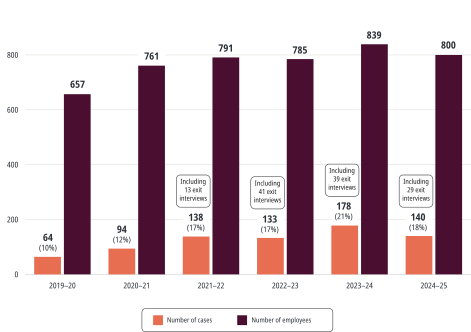
Number of cases in proportion to the number of employees over 6 years
Text version
This bar chart shows the number of cases relative to the number of employees over 6 years, from 2019–20 to 2024–25, and the number of cases that were exit interviews over 4 years, from 2021–22 to 2024–25.
Overall, the number of cases and of employees increased from 2019–20 to 2023–24 and then decreased in 2024–25. The number of exit interviews increased significantly from 2021–22 to 2022–23, then decreased slightly in 2023–24, and then decreased again in 2024–25.
In 2019–20, there were 64 cases for 657 employees, or 10% (that is, 10 cases per 100 employees).
In 2020–21, there were 94 cases for 761 employees, or 12% (that is, 12 cases per 100 employees).
In 2021–22, there were 138 cases for 791 employees, or 17% (that is, 17 cases per 100 employees). The number of cases included 13 exit interviews.
In 2022–23, there were 133 cases for 785 employees, or 17% (that is, 17 cases per 100 employees). The number of cases included 41 exit interviews.
In 2023–24, there were 178 cases for 839 employees, or 21% (that is, 21 cases per 100 employees). The number of cases included 39 exit interviews.
In 2024–25, there were 140 cases for 800 employees, or 18% (that is, 18 cases per 100 employees). The number of cases included 29 exit interviews.
What I Heard This Year: Self-Reported Workplace Issues
A new approach to case analysis
For this year’s report, I tried something new. Using one of our artificial intelligence tools in a Protected B environment, I provided anonymized case descriptions and asked the tool to classify and count the concerns raised. This marks a departure from my previous approach, where I assigned 1 or 2 main topics to each case from a predetermined menu. One advantage of this new method is that it captures a broader range of feedback from each case. A limitation is that it does not allow for quantitative comparison with previous years.
Workplace culture, trust, and respect
(91 mentions)
Visitors shared concerns about their work environment and organizational culture, including low morale, lack of trust between different layers and groups, disengagement, feeling disrespected or devalued, perceived unfairness, bullying, harassment, and discrimination.
Reflection questions
- Do I treat everyone with dignity, civility, and respect at all times?
- What is my preferred communication style? Are my colleagues aware?
- Do I give people the credit they deserve?
- Do I offer trust and assume positive intentions in my interactions with others?
- If I offend someone, or if I feel offended, how do I try to resolve the situation?
Leadership and management practices
(62 mentions)
Visitors described various practices that they found harmful or counter-productive, including micromanagement, abrasive or authoritarian management styles, lack of listening or empathy, lack of authenticity, reactive decision making, and rigid approaches to compliance.
Reflection questions
- What are the impacts of my leadership or interpersonal style on the psychological health of others?
- When the pressure is on, am I able to control my negative or unproductive emotions?
- Do I give clear direction on work expectations while letting employees decide how to get the job done?
- Do I strike a balance between compliance with rules and the ability to be flexible when reasonable exceptions arise?
- As an employee, do I try to understand the working preferences of my manager and adapt my approach to meet their needs whenever possible?
Organizational and audit processes
(42 mentions)
Visitors raised concerns about inefficiency, process bottlenecks, outdated technology, poor planning, bureaucracy, and rigidity. They also highlighted a lack of collaboration, transparency, and clarity around roles and direction. The process most frequently mentioned was the performance audit reporting process. Other processes mentioned included the Workplace Harassment and Violence Prevention Directive notice of occurrence process, the duty to accommodate process, promotion and staffing processes, and the employee resource group application process.
Reflection questions
- How do we currently design and evaluate our processes? Is our approach human-centred?
- Are timelines and resource allocations realistic and flexible?
- Are our processes transparent to those involved or affected by them?
- How do we ensure accountability at each stage?
- Do I get involved in efforts to modernize our processes when there is opportunity to do so?
Communication and engagement
(35 mentions)
Visitors expressed concerns about breakdowns in internal communication, lack of clarity or transparency, challenges with giving or receiving feedback, insufficient consultation opportunities, insufficient commitment to bilingualism, and not feeling safe to raise specific concerns directly to leadership.
Reflection questions
- How do we ensure a range of employee perspectives are considered before deciding on changes?
- Are we communicating key decisions and changes in a timely and understandable way and providing a rationale for the decision?
- As an employee, am I proactive at staying informed about changes in my organization? Am I open to a range of considerations when seeking to understand decisions that impact me?
- How do leaders demonstrate empathy and non‑defensiveness when concerns are raised?
- Do we continuously promote a culture that respects both official languages?
Wellness, burnout, and stress
(24 mentions)
Visitors described feeling overwhelmed or burnt out, facing work-life balance challenges, experiencing emotional distress, and dealing with general stress related to work or job security.
Reflection questions
- Do I take enough time to sleep, exercise, and do activities I enjoy?
- Do I communicate with my supervisor about challenges I am facing, including when it comes to work-life balance?
- Am I aware of and making use of available wellness resources and supports?
- Do I offer support to colleagues who appear to be struggling?
- What organizational or team-level practices or expectations contribute to stress or burnout, and how can they be addressed?
Staffing and career advancement
(22 mentions)
Visitors expressed concerns about unadvertised appointments and promotions, perceived unfairness in staffing, limited career development opportunities, promotion delays, and unclear succession planning.
Reflection questions
- Have I discussed my career plans or aspirations with my supervisor?
- Do I make time to prioritize my career development as a personal responsibility?
- Are staffing and advancement processes designed to be fair and transparent?
- Do hiring managers take the time to explain the rationale behind staffing and organizational design decisions to employees who are impacted?
- In times of organizational change, are we communicating clearly about the impacts of restructuring on career development and succession planning?
Remote work, the return to the office, and hybrid work
(20 mentions)
Visitors described concerns and individual struggles relating to return-to-office requirements, inflexibility in working arrangements, denial of telework agreements, hybrid compliance tracking, and feelings of exclusion for remote workers.
Reflection questions
- Are our work arrangements meeting both personal and organizational needs?
- When these needs collide, are we able to have frank and respectful conversations? Am I able to consider the situation from different perspectives?
- How do we balance flexibility with fairness, consistency, and accountability?
- As the organization’s posture toward flexible work arrangements evolves, are we clearly explaining the rationale for changes?
Your Feedback
I received feedback on the ombuds service this year by means of the September 2025 Client Satisfaction Survey (55 respondents). I found the feedback valuable and informative:
- The majority of respondents were satisfied with the ombuds service and described it as respectful, compassionate, and constructive. This is reassuring, as it affirms the core purpose of the ombuds role: to provide a safe and supportive space for discussing workplace concerns.
- Some respondents suggested a more visible and proactive approach to raising trends with senior management and surfacing systemic pain points. This feedback is important and will be shared with my successor for consideration. Finding the right balance between discretion and visibility is an ongoing challenge—and opportunity—for the Ombuds as the role continues to evolve.
Collaboration among organizational ombuds in the federal public service
Did you know that there are 30 organizational ombuds supporting 57 federal departments and agencies? The OAG Ombuds is an active member of the Organizational Ombuds Council, a forum for organizational ombuds within the Government of Canada, promoting best practices and providing a platform for collaboration.
Spotlight on Equity, Diversity, Inclusion, and Accessibility
In recent years, the OAG has reiterated its commitment to building a workplace that is diverse, inclusive, and equitable—a place where everyone feels a sense of belonging and can achieve their full potential. This commitment has been supported by a range of initiatives, strategies, action plans, consultations, a shadow audit, and a review of employment systems.
The 2024 Public Service Employee Survey Results for Office of the Auditor General of Canada by Demographic Characteristics is a good source of insight into how employees from different groups are experiencing the workplace. An area of concern is the experience of harassment and discrimination, which remains disproportionately high for some groups.
2024 Public Service Employee Survey results for harassment and discrimination by demographic characteristics
| Survey question | OAG as a whole | Anglophones in the OAG | Francophones in the OAG | 2SLGBTQIA+ peopleFootnote 1 in the OAG | Women in the OAG | Racialized people in the OAG | People with disabilities in the OAG | Public service as a whole |
|---|---|---|---|---|---|---|---|---|
| Question 58. Having carefully read the definition of harassmentFootnote 2 . . . have you been the victim of harassment on the job in the past 12 months? | 13% of this group responded Yes | 15% of this group responded Yes | 11% of this group responded Yes | 19% of this group responded Yes | 11% of this group responded Yes | 14% of this group responded Yes | 19% of this group responded Yes | 12% of this group responded Yes |
| Question 65. Having carefully read the definition of discrimination aboveFootnote 3 . . . have you been the victim of discrimination on the job in the past 12 months? | 10% of this group responded Yes | 10% of this group responded Yes | 11% of this group responded Yes | 14% of this group responded Yes | 8% of this group responded Yes | 15% of this group responded Yes | 21% of this group responded Yes | 9% of this group responded Yes |
| Question 81. I would describe my workplace as being psychologically healthy.Footnote 4 | 44% of this group gave positive answers | 41% of this group gave positive answers | 48% of this group gave positive answers | 46% of this group gave positive answers | 46% of this group gave positive answers | 51% of this group gave positive answers | 42% of this group gave positive answers | 59% of this group gave positive answers |
Source: Based on information and data from the 2024 Public Service Employee Survey results
I’ve heard from some employees who have felt tokenized, targeted, or hurt by the words or actions of others. Often, they are reluctant to speak up. Conversations around equity and inclusion can be difficult and delicate, but if we lean in with humility and empathy, often we can achieve new understanding.
Reflection questions
- When I make decisions or interact with colleagues, do I pause to consider whether my own bias might be influencing my assumptions or actions?
- Do I actively seek out and value perspectives from people with different lived experiences than mine?
- When I witness exclusionary behaviour or language, do I speak up respectfully, even when it feels uncomfortable?
- Where in our processes or policies might systemic barriers exist, and what role can I play in identifying and addressing them?
In Closing
It is not easy to say goodbye to the OAG. I am humbled by your dedicated efforts on behalf of Canadians. My time as your ombuds has reinforced one of my core beliefs: People are driven by a need to contribute and to feel seen, heard, and valued—and they do their best work when those conditions are met.
I will close this report with the same sentiment I used to close my first report over 6 years ago, by encouraging employees at all levels to get involved in creating the workplace they want and to find a way to be heard when things are not going well. There are many resources available. Reach out when you need support.
Janet Campbell, Ombuds