
Canada Revenue Agency’s contact centres are not providing taxpayers with timely and accurate information
Canada Revenue Agency Contact Centres

Report metadata
- Tabling date:
- Audited entities:
- Canada Revenue Agency
- Shared Services Canada
- Topics:
- Public service
- Taxation
- Report type
- Auditor General reports
At a glance
Overall, the Canada Revenue Agency did not provide timely and accurate information to callers contacting its 8 contact centres about individual taxes, benefits, and business taxes.
In the 2024–25 fiscal year, the agency’s service standard was to respond to 65% of the calls within 15 minutes or less. We found that just 18% of callers reached an agent within 15 minutes or less. For the month of June 2025, only 5% of the calls met the 15 minutes or less standard. In addition, callers choosing to speak with an agent waited on average about 31 minutes, almost twice as long as they had waited a year earlier. Only callers using the northern contact centre line received timely access to agents.
We placed 167 calls between February and May 2025 to contact centre agents to test the accuracy of their responses to general tax questions. Agent responses to business tax or general benefits questions were accurate just over 54% of the time, while responses to general individual-tax questions were accurate only 17% of the time.
We found that less than 9% of agents’ total performance evaluation score related to the accuracy of information they provided to callers. Such a small emphasis on accuracy does not prioritize quality service to callers seeking assistance.
We found that the Canada Revenue Agency did not provide callers with real-time updates on their queue position. This limited callers’ ability to accurately judge whether to wait, use the self-service options, or disconnect.
The contract for the contact centres’ telephony system, provided by Shared Services Canada, was awarded in 2015 for a minimum value of $50 million over 10 years. We found that as of June 2025, the value of the contract with amendments had reached $190 million.
Canadians are trusting the Canada Revenue Agency to provide answers to their tax and benefit questions that are accurate and complete. Errors in taxes and missed deadlines can be costly to taxpayers.
Why we did this audit
- Many Canadians and Canadian businesses need assistance or guidance to help individuals and businesses meet their tax obligations and access benefits.
- Under the Taxpayer Bill of Rights, taxpayers have the right to complete, accurate, clear, and timely information.
- Canada Revenue Agency is in the process of replacing its contact centre telephony system, which is the system used to manage the interactions between callers and agents. The agency can build on its experiences to ensure that the new system addresses past challenges and enhances service to Canadians while delivering the best value for money.
Highlights of our recommendations
- To increase access to agents and improve its service level, the Canada Revenue Agency should
- review the process, procedures, and tools that agents use to gather information during calls to respond more efficiently
- align staffing levels with call volumes to reduce wait times
- separate and triage system-related enquires for MyAccount from other tax and benefits enquiries
- To improve response accuracy and completeness, the Canada Revenue Agency should
- place greater emphasis on the completeness and accuracy of responses in the performance evaluation of agents answering calls
- improve its quality evaluation results to clearly highlight areas requiring improvement and guide the training and coaching for agents
Key facts and findings
- The Taxpayer Bill of Rights states that callers have the right to complete, accurate, clear, and timely information.
- In the 2024–25 fiscal year, the Canada Revenue Agency received more than 32 million calls. Of those, just over 10 million calls reached an agent at the 8 contact centres.
- In our 2017 audit, the Canada Revenue Agency’s service standard was to have 80% of calls answered by an agent within 2 minutes. Starting in the 2019–20 fiscal year, the agency lowered the standard to 65% of calls answered within 15 minutes.
- The number of complaints relating to the service provided by the contact centres increased by 145% since 2021–22.
Exhibit highlights
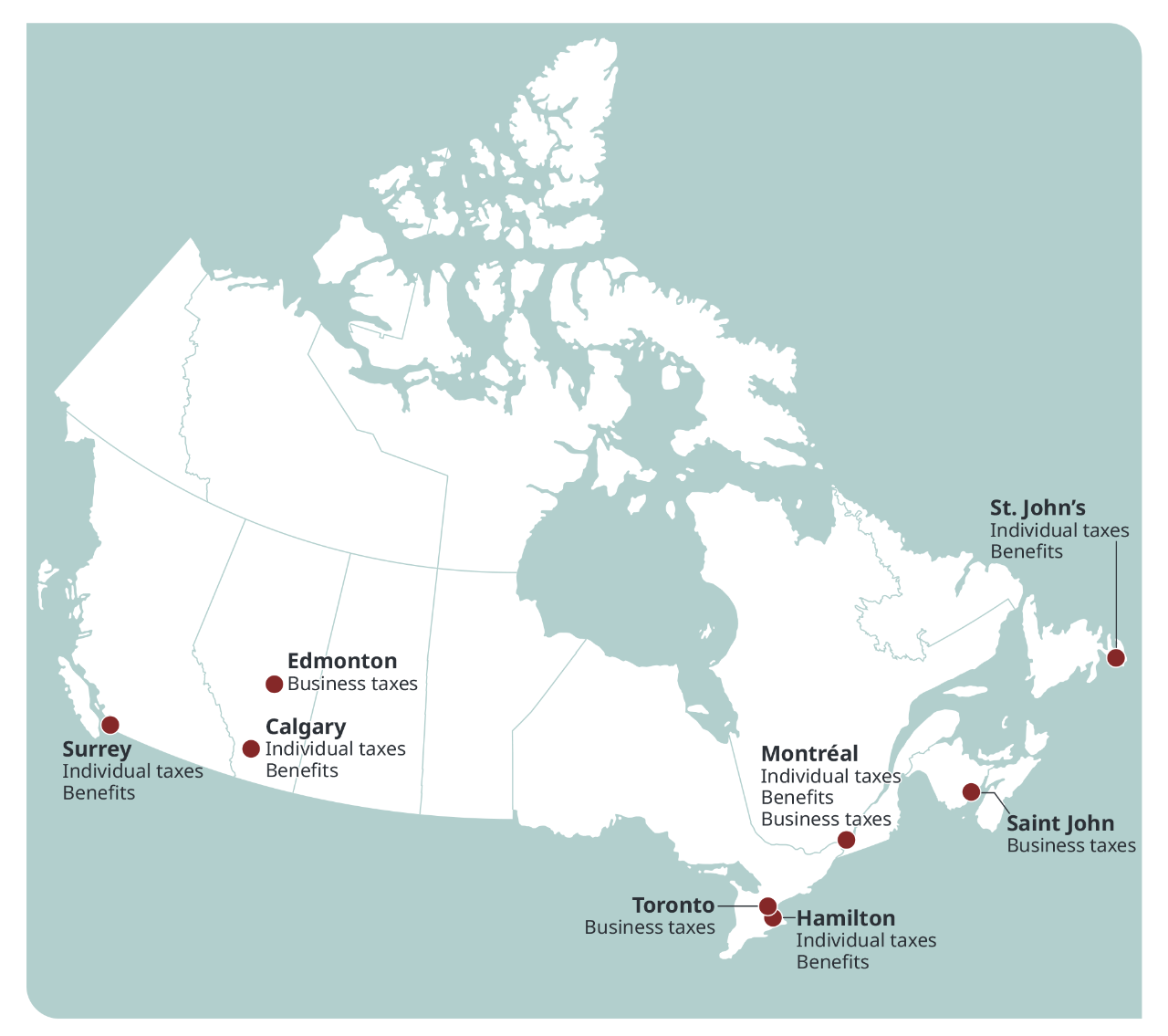
The Canada Revenue Agency’s contact centres for individual taxes, benefits, and business taxes
Text version
This map shows Canada Revenue Agency’s 8 contact centres for individual taxes, benefits, and business taxes. Only the Montréal centre offers all 3 services. The other centres offer 1 or 2 of the services.
In alphabetical order, the contact centres are
- Calgary, Alberta: This is a contact centre for enquiries about individual taxes and benefits.
- Edmonton, Alberta: This is a contact centre for enquiries about business taxes.
- Hamilton, Ontario: This is a contact centre for enquiries about individual taxes and benefits.
- Montréal, Quebec: This is a contact centre for enquiries about individual taxes, benefits, and business taxes.
- Saint John, New Brunswick: This is a contact centre for enquiries about business taxes.
- St. John’s, Newfoundland and Labrador: This is a contact centre for enquiries about individual taxes and benefits.
- Surrey, British Columbia: This is a contact centre for enquiries about individual taxes and benefits.
- Toronto, Ontario: This is a contact centre for enquiries about business taxes.
Source: Based on information from the Canada Revenue Agency as of May 2024
The service-level results and the number of contact centre agents declined from 2022–23 to 2024–25

Text version
This chart compares the number of contact centre agents with service levels over 6 fiscal years from April 1, 2019, to March 31, 2025. The only year in which the call centres achieved the service standard of responding to calls within 15 minutes, 65% of the time, was in the 2022–23 fiscal year, from April 1, 2022, to March 31, 2023. For the next 2 fiscal years, the number of contact centre agents declined and the service levels declined.
In the 2019–20 fiscal year, there were 3,517 contact centre agents, and 43% of the calls were responded to within the service standard of 15 minutes, 65% of the time.
In the 2020–21 fiscal year, there were 5,323 contact centre agents, and 33% of the calls were responded to within the service standard of 15 minutes, 65% of the time.
In the 2021–22 fiscal year, there were 7,186 contact centre agents, and 54% of the calls were responded to within the service standard of 15 minutes, 65% of the time.
In the 2022–23 fiscal year, there were 7,782 contact centre agents, and 70% of the calls were responded to within the service standard of 15 minutes, 65% of the time.
In the 2023–24 fiscal year, there were 5,837 contact centre agents, and 49% of the calls were responded to within the service standard of 15 minutes, 65% of the time.
In the 2024–25 fiscal year, there were 4,547 contact centre agents, and 18% of the calls were responded to within the service standard of 15 minutes, 65% of the time.
Source: Based on data from the Canada Revenue Agency
Breakdown of call times for the calls we made to the Canada Revenue Agency contact centres (in minutes)
| Area of enquiries | Average total duration | Average wait time before reaching an agent | Average time with an agent | Average time on hold after reaching an agent | Percentage of the time on hold after reaching an agent |
|---|---|---|---|---|---|
| All | 50.0 | 32.6 | 17.3 | 4.6 | 27% |
| Individual taxes | 52.0 | 36.0 | 16.0 | 3.0 | 19% |
| Benefits | 58.0 | 39.0 | 19.0 | 6.0 | 32% |
| Business taxes | 40.0 | 23.0 | 17.0 | 5.0 | 29% |
Responses to non‑account-specific calls we made to the Canada Revenue Agency contact centres had low rates of accuracy and completeness
| Areas of enquiry | Accuracy of response | Completeness of response |
|---|---|---|
| Individual taxes | 17% | 17% |
| Benefits | 56% | 33% |
| Business taxes | 54% | 31% |