Auditor General reports
National Defence is not managing housing to meet the needs of the Canadian Armed Forces

Overall, National Defence did not manage living accommodations in a manner that would meet its operational needs and be responsive to the needs of Canadian Armed Forces members. Reporting by the Ombud for the Department of National Defence and the Canadian Armed Forces has identified issues related to living accommodations as a major source of concern raised by Canadian Armed Forces members. This issue has also been highlighted in reporting by the Canadian Armed Forces Chaplain General. National Defence’s own research has shown that housing is an issue that can negatively affect the well‑being of military families, with impacts on retention.
We found that National Defence did not have reliable data about its overall portfolio of quarters, including the number and type of bed spaces and their locations. During the audit, we found quarters were often in poor physical condition and did not meet National Defence’s own standards for enough living space for each person. We found quarters that did not have potable water or properly functioning sanitary waste systems.
The Canadian Forces Housing Agency—which manages the residential housing units on bases—did not provide enough units to meet the Canadian Armed Forces’ needs. In spring 2025, there were only 205 residential housing units available, while 3,706 applicants were on wait lists.
To meet operational needs, Canadian Armed Forces members can be required to move frequently. It is important for their morale and well‑being that they can access affordable housing in good condition with sufficient living space for their needs.


We examined whether National Defence planned and implemented residential construction in a manner that contributes to the Federal Sustainable Development Strategy and the United Nations’ Sustainable Development Goal 13 (Climate Action). We found that National Defence worked with partners to develop an approach to incorporate net zero considerations in new housing designs. This includes updated housing design standards that align with code requirements for energy-efficient housing and prioritizing materials with lower embodied carbon. However, National Defence has not yet completed any living accommodations that incorporate net zero ready considerations.
| Type of quarters | Status of members living in them | Features |
|---|---|---|
|
Residential |
Used as a member’s primary residence |
|
|
Training—Category I |
In basic training |
|
|
Training—Category II |
In skilled or advanced training of less than 6 months |
|
|
Training—Category III |
In skilled or advanced training of more than 6 months |
|
|
Transient |
Visiting base during travel or leave |
|

This bar chart compares the number of active applications for housing units with the number of housing units available. Nearly all of the housing units were occupied or otherwise unavailable.
The total number of residential housing units was 11,741 units as of March 31, 2025. Of these, 205 residential housing units were available to be occupied as of May 7, 2025.
There were 3,706 active applications for housing units as of March 31, 2025.
Notes: The chart uses data from March 31, 2025, for the total number of residential housing units and for the number of active applications. It uses data from May 7, 2025, for the number of residential housing units available to be occupied.
Source: Based on data from the Canadian Forces Housing Agency
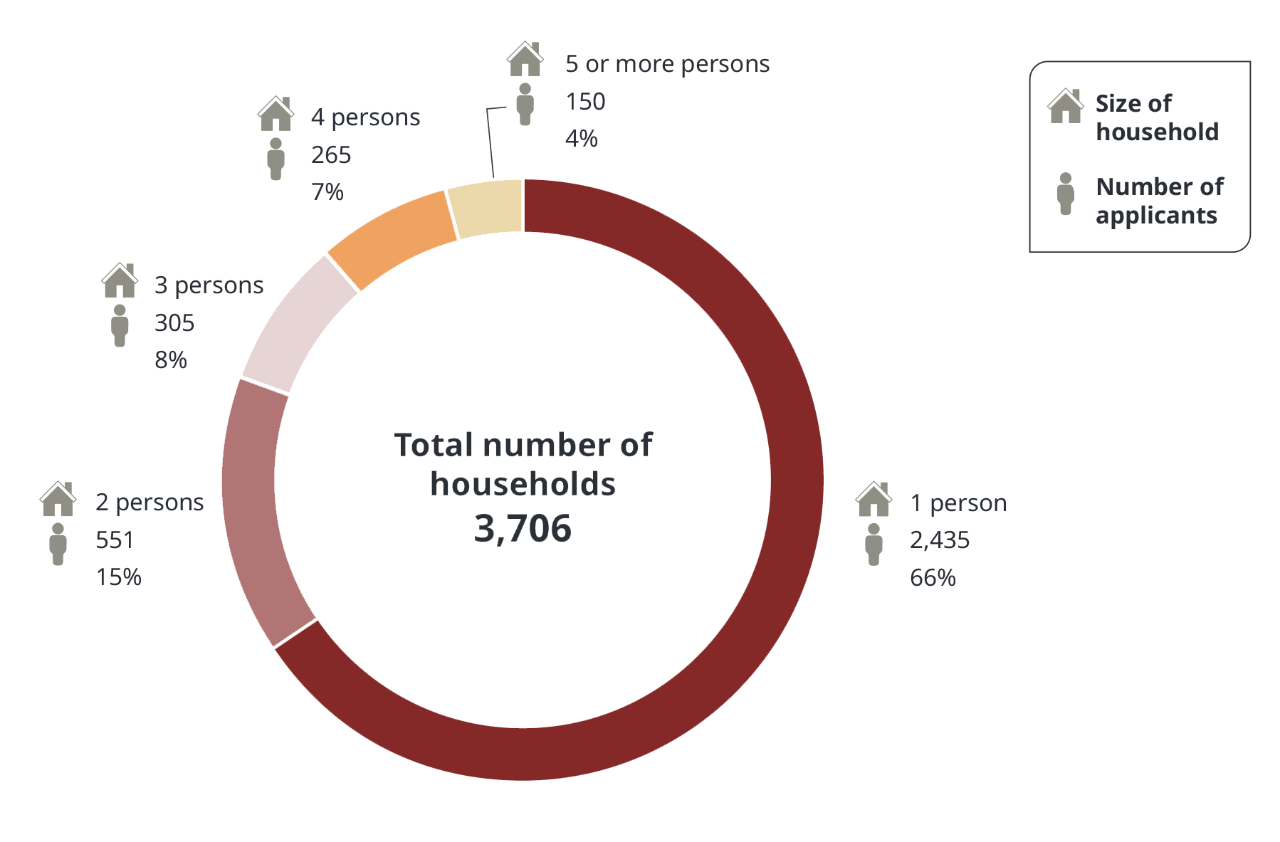
This chart shows the sizes of households of the applicants for housing units. Most applicants were from 1‑person households.
In total, 3,706 households had applied for housing as of March 31, 2025. The number of households by size of household was as follows: