Report 3—Scientific Activities in Selected Water Basins
At a Glance
Why we did this audit
- This audit is important because harmful algal blooms are a significant and growing problem in bodies of water across Canada. These blooms affect the health of humans and ecosystems and have economic consequences. Climate change is expected to contribute to more frequent and severe harmful algal blooms. To contribute to reducing the risk and impact of harmful algal blooms, federal departments need to coordinate—among themselves and with external groups—to address the problem of excess nutrients.
- Having complete information on risks to water quality helps ensure that scientific activities are focused on threats to water quality.
- Despite the differences in the mandates of Environment and Climate Change Canada and Agriculture and Agri-Food Canada, they share a priority of protecting and sustainably managing water resources.
Our findings
- Both departments used information on risks to water quality to guide scientific activities but did not formally share this information with one another.
- Coordination of scientific activities took place but was limited in the Wolastoq, Saint John River.
- Although project coordination was taking place in individual projects, we also found that the departments had missed some opportunities to better coordinate projects in the basins we examined.
Key facts and figures
- For decades, several governments have expressed concern about the levels of excess nutrients and the water quality in all 3 water basins.
- Excess nutrients, in combination with other factors such as a warming climate, can lead to runaway growth of algae, such as the blue-green algae (cyanobacteria) naturally found in many types of water systems.
- The departments established joint watershed science coordination committees in 2018 for Lake Erie, Lake Winnipeg, Missisquoi Bay (a body of water in Quebec and Vermont), and the Atlantic region.
Our recommendations
- To enable comprehensive risk assessment and thus strengthen decision making on where scientific efforts should be directed, Environment and Climate Change Canada should achieve the 4 remaining goals of the risk-based basin-analysis tool.
- Environment and Climate Change Canada and Agriculture and Agri-Food Canada should formally and consistently share with one another information on nutrient management and on current and emerging risks facing each water basin. This sharing would contribute to identifying areas of common interest that could benefit from the departments’ coordinated scientific efforts and ensure that important risks are identified and addressed.

This audit relates to the goal of clean water and sanitation which seeks to ensure availability and sustainable management of water and sanitation for all.
Infographic
Text version
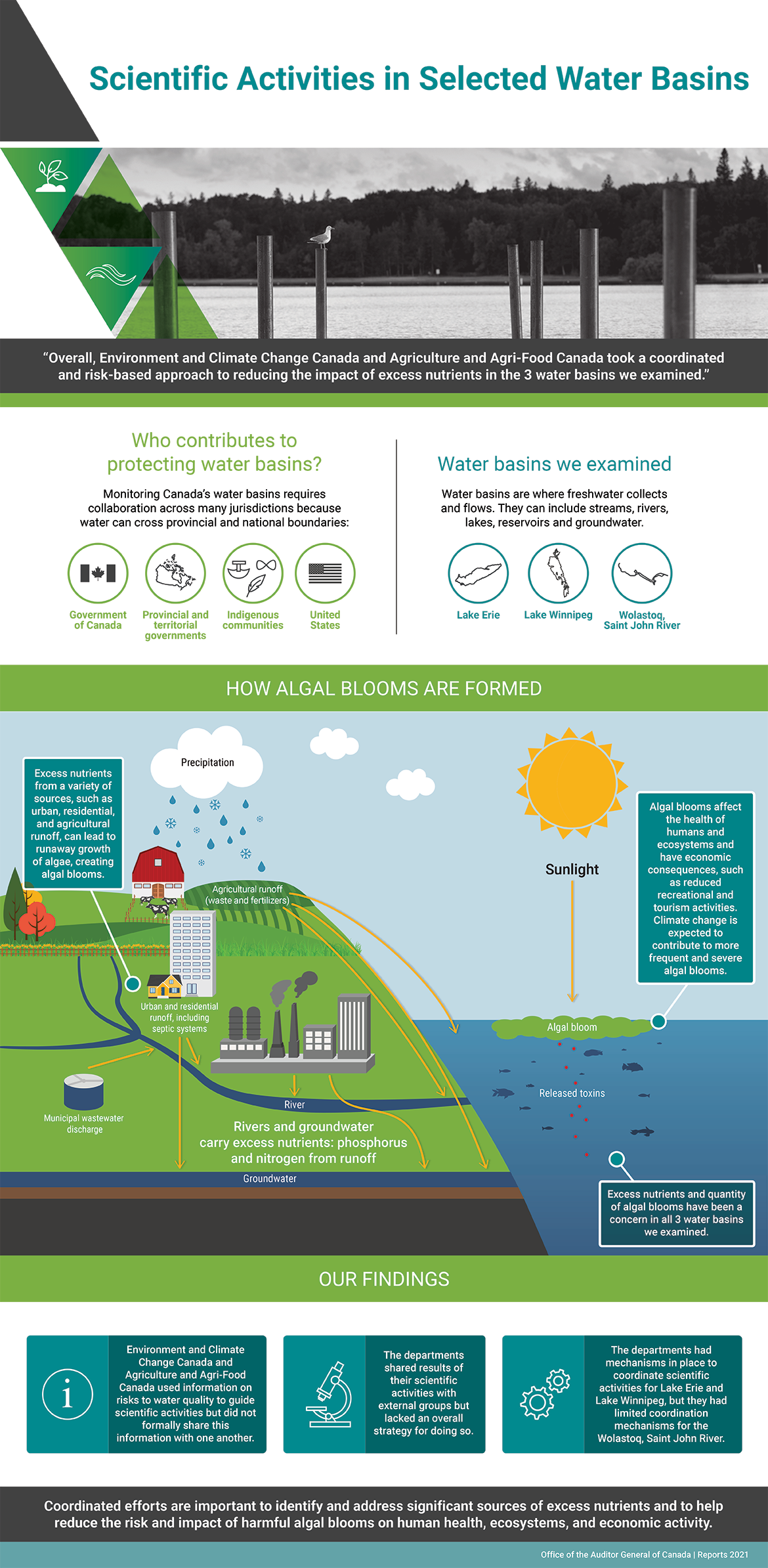
This infographic presents findings from the audit of scientific activities in selected water basins.
Overall message from our 2021 audit
Overall, Environment and Climate Change Canada and Agriculture and Agri-Food Canada took a coordinated and risk-based approach to reduce the impact of excess nutrients in the 3 water basins we examined.
Who contributes to protecting water basins?
Monitoring Canada’s water basins requires collaboration across many jurisdictions because water can cross provincial and national boundaries.
- Government of Canada
- Provincial and territorial governments
- Indigenous communities
- United States
Water basins we examined
Water basins are where freshwater collects and flows. They can include streams, rivers, lakes, reservoirs, and groundwater.
The water basins we examined were Lake Erie, Lake Winnipeg, and the Wolastoq, Saint John River.
How algal blooms are formed
This illustration shows that excess nutrients from a variety of sources, such as urban, residential, and agricultural runoff, can lead to runaway growth of algae, creating algal blooms.
When precipitation falls on agricultural, urban, and residential land, agricultural waste and fertilizers and residential septic systems, among other things, can contaminate the resulting runoff with excess nutrients, such as phosphorus and nitrogen. This runoff then flows into the rivers and groundwater. In addition, industrial releases and municipal wastewater discharge can contaminate rivers and groundwater. The contaminated water from all sources then flows into the water basin, where the combination of the excess nutrients and the sunlight create an algal bloom, which then releases toxins into the water basin.
Algal blooms affect the health of humans and ecosystems and have economic consequences, such as reduced recreational and tourism activities. Climate change is expected to contribute to more frequent and severe algal blooms.
Excess nutrients and quantity of algal blooms have been a concern in all 3 water basins we examined.
Our findings
Environment and Climate Change Canada and Agriculture and Agri-Food Canada used information on risks to water quality to guide scientific activities but did not formally share this information with one another.
The departments shared results of their scientific activities with external groups but lacked an overall strategy for doing so.
The departments had mechanisms in place to coordinate scientific activities for Lake Erie and Lake Winnipeg, but they had limited coordination mechanisms for the Wolastoq, Saint John River.
Moving forward
Coordinated efforts are important to identify and address significant sources of excess nutrients and to help reduce the risk and impact of harmful algal blooms on human health, ecosystems, and economic activity.
Related information
| Entities |
|
|---|---|
| Completion date | 14 May 2021 |
| Tabling date | 25 November 2021 |
OAG reports published in the past are available through Publications.gc.ca.