
Report 3—Hydrogen’s Potential to Reduce Greenhouse Gas Emissions
At a Glance
Why we did this audit
- The potential significant contribution of hydrogen to meeting Canada's emission reduction goals. In addition, it relates to Goal 9 (Industry, Innovation and Infrastructure) and Goal 13 (Climate Action) of the United Nations' Sustainable Development Goals. If the 2 departments do not appropriately project hydrogen's impact on reducing emissions, then there is a risk that Canada will not achieve its emissions reduction targets.
- Canada's greenhouse gas emissions have increased significantly since the United Nations Framework Convention on Climate Change was signed in 1992, making it the worst performer of all G7 nations since that time. Sound modelling is needed to change the trajectory of Canada's greenhouse gas emissions.
Our findings
- Natural Resources Canada overestimated hydrogen's potential to reduce greenhouse gas emissions.
- Environment and Climate Change Canada relied on policies not yet announced to justify that its plan was sufficient to meet the original 2030 target.
- We found the 2 departments used unrealistic assumptions for modelling the potential of hydrogen to reduce greenhouse gas emissions.
- We found that Natural Resources Canada's modelling did not factor in how the supply of hydrogen and associated costs would be deployed to meet the projected demand.
Key facts and figures
- The transformative scenario developed by Natural Resources Canada projected that hydrogen could represent up to 15% of the emission reductions needed to meet the 2030 target. In contrast to this, we found that one of Natural Resources Canada's incremental demand reports projected that in 2030, hydrogen will contribute only 0.5% of the 2030 target and 5.5% of the 2040 target. The department did not find this estimation compelling and chose to use more aspirational numbers in the Hydrogen Strategy for Canada modelling.
- Canada is the world's fourth-largest producer of natural gas, generating 16.6 billion cubic feet per day. It is the sixth largest exporter of natural gas. Natural gas plays a pivotal role in Canada's energy system, providing 35.7% of energy demand.
Our recommendations
- Natural Resources Canada should perform a comprehensive bottom-up modelling for the use of hydrogen. This modelling should account for the following:
- emission reduction efficiencies by sector (cost of emission reductions per megatonne of carbon dioxide equivalent)
- substitutional fuels (for example, biofuel, electrification, credit systems)
- feasible deployment of technologies and supporting infrastructure.
- To improve consistency across departments, Environment and Climate Change Canada and other federal departments should adopt a standard framework to estimate emission impacts of proposed policies, clean technologies, and fuels.



Hydrogen has the potential to make a significant contribution to meeting Canada's emission reduction goals. This report relates to Goal 9 (Industry, Innovation and Infrastructure) and Goal 13 (Climate Action) of the United Nations' Sustainable Development Goals. If the 2 departments do not appropriately project hydrogen's impact on reducing emissions, then there is a risk that Canada will not achieve its emissions reduction targets.
Infographic
Text version
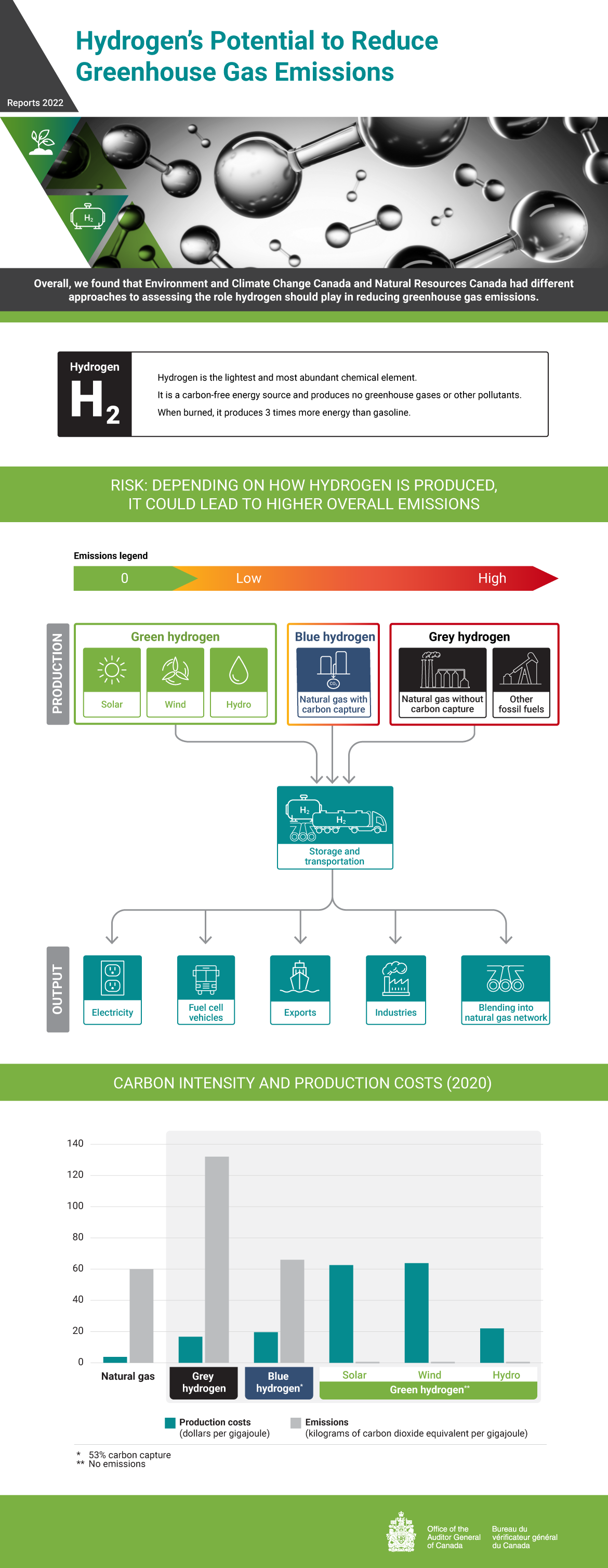
This infographic presents findings from the 2022 audit report on hydrogen’s potential to reduce greenhouse gas emissions.
Overall, we found that Environment and Climate Change Canada and Natural Resources Canada had different approaches to assessing the role hydrogen should play in reducing greenhouse gas emissions.
Hydrogen is the lightest and most abundant chemical element. It is a carbon-free energy source and produces no greenhouse gases or other pollutants. When burned, it produces 3 times more energy than gasoline.
There is a risk that, depending on how hydrogen is produced, it could lead to higher overall emissions.
Green hydrogen is produced using wind, solar, and hydro power. Green hydrogen has the lowest emissions during its production.
Blue hydrogen is produced with natural gas with carbon capture and has low to high emissions during its production.
Grey hydrogen is produced with natural gas without carbon capture or with other fossil fuels. Grey hydrogen has the highest emissions during its production.
Once it is produced, hydrogen is stored and transported to where it will be used. It can be used to generate electricity and to power fuel-cell vehicles. It can be used in exports and in industries. It can also be blended into the natural gas network.
The production costs and carbon intensity vary with the different types of hydrogen.
In 2020, natural gas cost $3.79 per gigajoule to produce, and it produced emissions of 60 kilograms of carbon dioxide equivalent per gigajoule.
Grey hydrogen cost $16.70 per gigajoule and produced emissions of 132 kilograms of carbon dioxide equivalent per gigajoule (2.2 times the emissions from natural gas).
Blue hydrogen with 53% carbon capture cost $19.60 per gigajoule and produced emissions of 66 kilograms of carbon dioxide equivalent per gigajoule (1.1 times the emissions from natural gas).
Green hydrogen produced using solar power cost $62.60 per gigajoule and produced no emissions.
Green hydrogen produced using wind power cost $63.80 per gigajoule and produced no emissions.
Green hydrogen produced using hydro power cost $22.00 per gigajoule and produced no emissions.
Related information
| Entities |
|
|---|---|
| Completion date | 17 February 2022 |
| Tabling date | 26 April 2022 |