Report 1—Access to Benefits for Hard-to-Reach Populations
At a Glance
Why we did this audit
- Benefit programs are intended to reduce poverty and inequality by providing help to low‑income Canadians. The programs can only achieve their goals if those eligible actually receive the benefits.
- Having a clear understanding of the intended populations for a specific benefit is key to designing and implementing effective strategies to reach those populations. By definition, hard‑to‑reach populations present a unique service delivery challenge. Having a clear understanding of the demographics of, and barriers impacting, these people enables departments to tailor their outreach approaches in a responsive and effective manner.
Our findings
- The Canada Revenue Agency and Employment and Social Development Canada had an incomplete picture of potentially eligible people who were not receiving benefits.
- The agency and department did not know whether most of their targeted outreach activities had helped to increase benefit take‑up rates for hard‑to‑reach populations.
- The agency and department did not have a sufficiently integrated approach for people requiring extra help.
Key facts and figures
- We estimated that the department and agency collectively spent more than $18 million in the 2020–21 fiscal year on targeted outreach activities.
- In 2021, the Canada Revenue Agency began analyzing ways to better demonstrate the results of targeted outreach approaches, and Employment and Social Development Canada began developing a logic model to inform their approach to measuring the performance and results of their targeted outreach approaches. At the time of our audit, both of these efforts were at early stages and had not yet resulted in improvements in measuring the impact of outreach approaches.
Highlights of our recommendations
- To better understand the effectiveness of outreach approaches, the Canada Revenue Agency and Employment and Social Development Canada should develop and implement consistent results‑based performance measures for targeted outreach to hard‑to‑reach populations.
- To improve the integration and effectiveness of targeted outreach, the Canada Revenue Agency and Employment and Social Development Canada should collaborate to establish a seamless client service experience to address the needs of those requiring a high level of support to access benefits.
We note that in 2015, Canada committed to achieving the United Nations’ 2030 Agenda for Sustainable Development. The Canada Child Benefit, the Canada Workers Benefit, the Guaranteed Income Supplement, and the Canada Learning Bond represent elements in Canada’s response to achieving the Sustainable Development Goal 1, to “end poverty in all its forms everywhere.” To help achieve this goal, Canada established a target to reduce poverty by half by 2030. As reported by the Commissioner of the Environment and Sustainable Development in our 2021 Report 1, Implementing the United Nations’ Sustainable Development Goals, Canada was on track to meet this goal. However, fully measuring benefit take‑up would help determine what further improvement is possible.
Infographic
Text version
Overall message
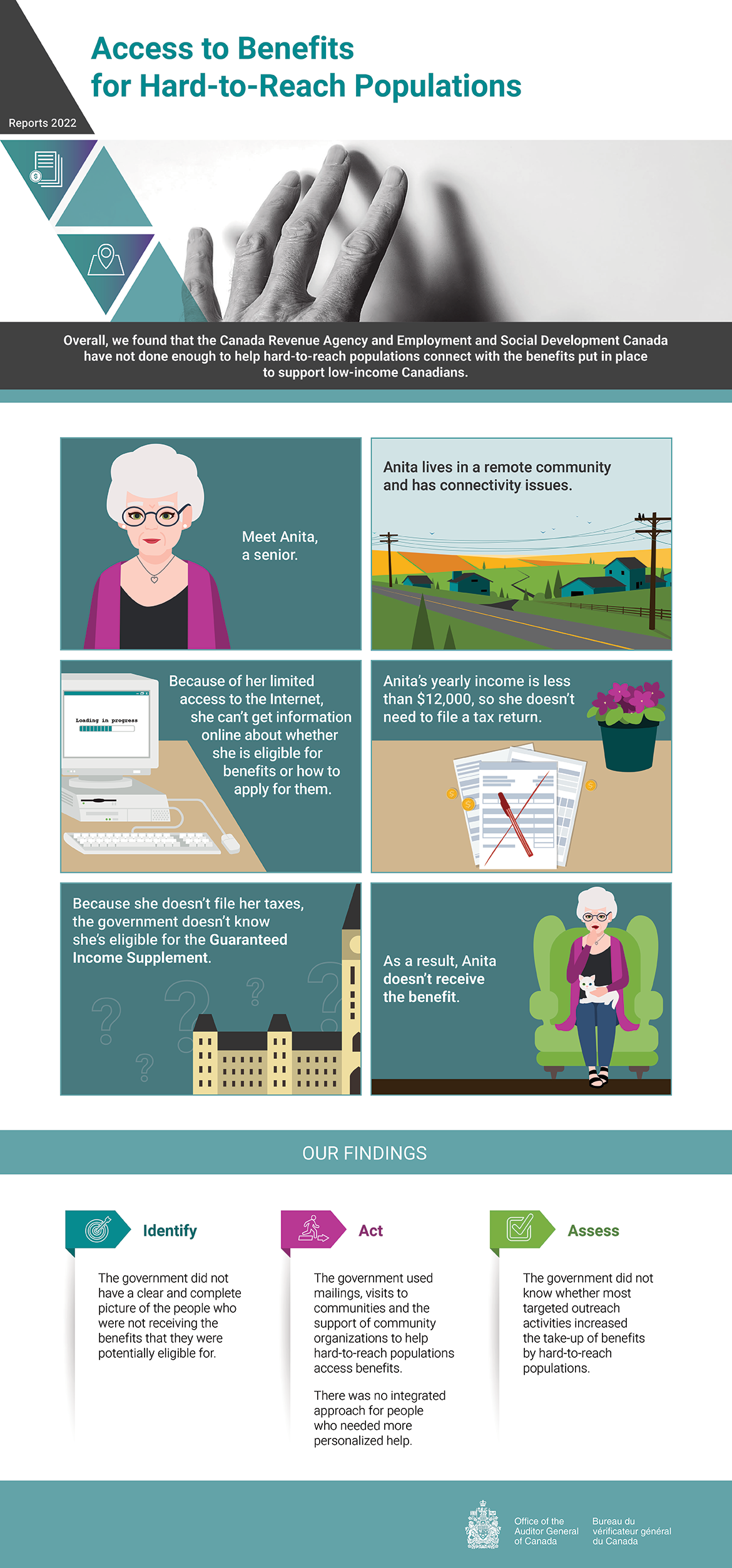
Overall, we found that the Canada Revenue Agency and Employment and Social Development Canada have not done enough to help hard‑to‑reach populations connect with the benefits put in place to support low‑income Canadians.
An example of someone who is hard to reach
Meet Anita, a senior.
Anita lives in a remote community and has connectivity issues.
Because of her limited access to the Internet, she can’t get information online about whether she is eligible for benefits or how to apply for them.
Anita’s yearly income is less than $12,000, so she doesn’t need to file a tax return.
Because she doesn’t file her taxes, the government doesn’t know she’s eligible for the Guaranteed Income Supplement.
As a result, Anita doesn’t receive the benefit.
Our findings
Identify
The government did not have a clear and complete picture of the people who were not receiving the benefits that they were potentially eligible for.
Act
The government used mailings, visits to communities, and the support of community organizations to help hard-to-reach populations access benefits.
There was no integrated approach for people who needed more personalized help.
Assess
The government did not know whether most targeted outreach activities increased the take‑up of benefits by hard‑to‑reach populations.
Related information
| Entities |
|
|---|---|
| Completion date | 16 February 2022 |
| Tabling date | 31 May 2022 |
| Related audits |
|