Mental Health Services in Rural Yukon—Department of Health and Social Services
At a Glance
Why we did this audit
- The 17 rural communities have historically had fewer amenities and supports than are typically available in an urban environment. The availability of and accessibility to mental health services is vital for people living in these communities to live healthy lives: mentally, physically, socially, and spiritually.
- Because of the unique needs and cultural diversity of Yukon communities, the department must understand the extent and types of services needed in each community to be able to provide services to meet those needs.
Our findings
- The department successfully increased access to mental health services in rural communities. It established a permanent presence of mental health services by implementing Mental Wellness and Substance Use hubs in 4 key rural communities.
- Because the department did not measure and report on its efforts, it did not know if the services being provided through the hubs were meeting the needs of Yukoners.
- Though the department has increased access to mental health services, it has struggled to recruit and retain staff to deliver these services. In addition, the department’s mental health services were not always culturally responsive.
- The department and other agencies worked together to maintain access to mental health services while managing the many effects of the pandemic in rural communities.
Key facts and figures
- Yukon has a vast geographic area populated by roughly 42,000 people. While almost 80% live in Whitehorse, the rest of the population lives in 17 rural communities across the territory.
- An estimated 8,400 Yukoners (1 in 5) experience mental wellness or substance use issues every year.
Our recommendations
- The Department of Health and Social Services should regularly consult with a broad representation of residents of rural communities to identify and implement adjustments and improvements so that the department provides the mental health services that are most needed.
- The Department of Health and Social Services should complete and implement a recruitment and retention strategy for mental health service providers that considers the unique challenges faced by the rural communities and propose innovative solutions to address these challenges.
- The Department of Health and Social Services should develop and implement a plan to work with First Nations to improve cultural safety in service delivery on an ongoing basis.
- The Department of Health and Social Services should establish, measure, and report on the performance of its mental health services in rural Yukon.

Canada has committed to implementing the United Nations’ 2030 Agenda for Sustainable Development and its Sustainable Development Goals. One of those goals is to ensure healthy lives and promote well-being for all and at all ages. This includes the mental health of rural Yukoners.
Infographic
Text version
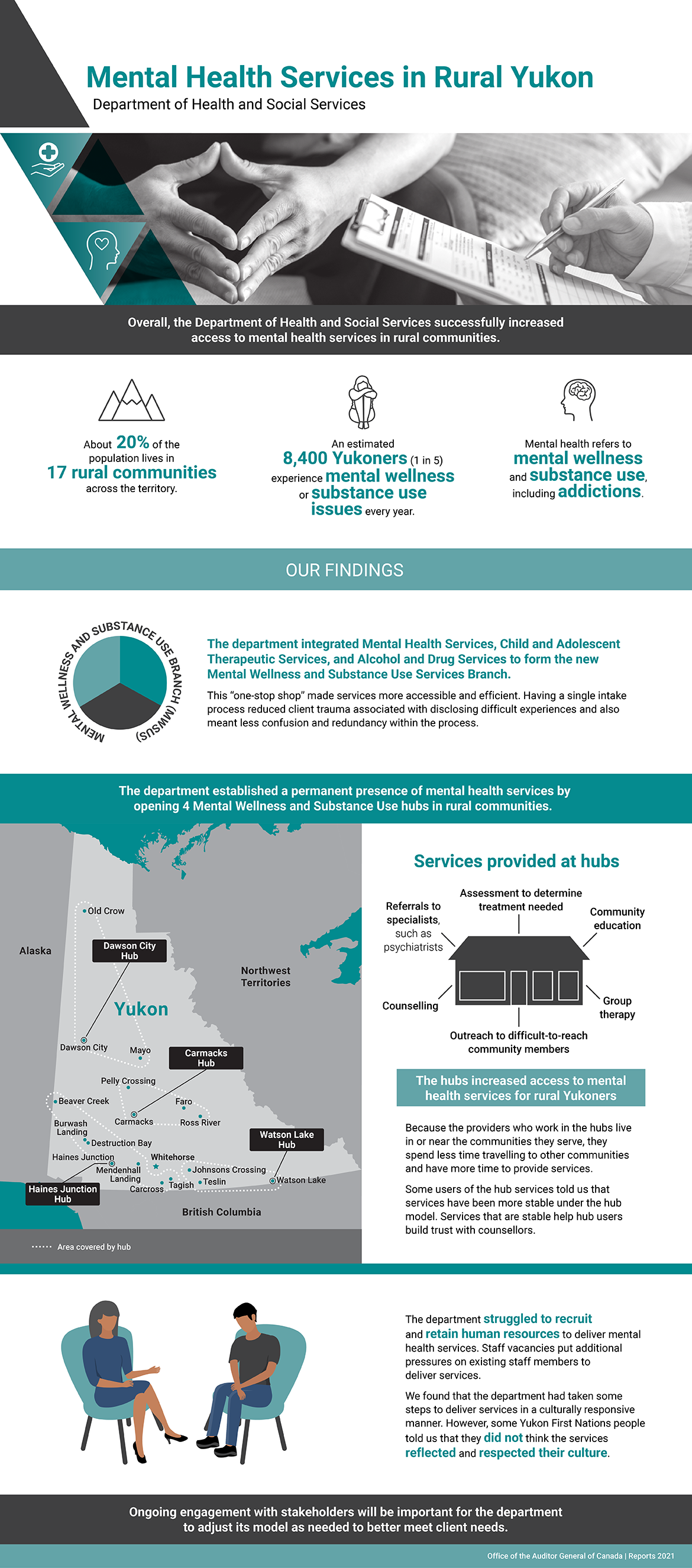
This infographic presents the findings from the audit on mental health services in rural Yukon.
The audit found that, overall, the Department of Health and Social Services successfully increased access to mental health services in rural communities.
Mental health in rural Yukon
About 20% of the population lives in 17 rural communities across the territory, and an estimated 8,400 Yukoners (1 in 5) experience mental wellness or substance use issues each year. In this audit, the term “mental health” refers to mental wellness and substance use, including addictions.
Our findings
Mental Wellness and Substance Use Services Branch
The department integrated Mental Health Services, Child and Adolescent Therapeutic Services, and Alcohol and Drug Services to form the new Mental Wellness and Substance Use Services Branch.
This “one-stop shop” made services more accessible and efficient. Having a single intake process reduced client trauma associated with disclosing difficult experiences and also meant less confusion and redundancy within the process.
Mental Wellness and Substance Use hubs
The department also established a permanent presence of mental health services by opening 4 Mental Wellness and Substance Use hubs to serve the following rural communities:
- In the north of the territory, the Dawson City Hub serves the communities of Dawson City, Mayo, and Old Crow.
- In the centre of the territory, the Carmacks Hub serves the communities of Carmacks, Faro, Pelly Crossing, and Ross River.
- In the southwest of the territory, the Haines Junction Hub serves the communities of Haines Junction, Beaver Creek, Burwash Landing, Carcross, Destruction Bay, Mendenhall Landing, and Tagish.
- In the south of the territory, the Watson Lake Hub serves the communities of Watson Lake, Johnsons Crossing, and Teslin.
These hubs increased access to mental health services for rural Yukoners by providing them with the following services:
- assessment to determine treatment needed
- community education
- group therapy
- outreach to difficult-to-reach community members
- counselling
- referrals to specialists, such as psychiatrists
Because the providers who work in the hubs live in or near the communities they serve, they spend less time travelling to other communities and have more time to provide services.
Some users of the hubs told us that services have been more stable under the hub model. Services that are stable help hub users build trust with counsellors.
Human resources
The department struggled to recruit and retain human resources to deliver mental health services. Staff vacancies put additional pressures on existing staff members to deliver services.
Cultural responsiveness
We found that the department had taken some steps to deliver services in a culturally responsive manner. However, some Yukon First Nations people told us that they did not think the services reflected and respected their culture.
Ongoing engagement with stakeholders will be important for the department to adjust its model as needed to better meet client needs.
Related information
| Entities | Yukon Department of Health and Social Services |
|---|---|
| Completion date | 29 January 2021 |
| Tabling date | 7 June 2021 |