The Northwest Territories has laid the foundation to advance its land conservation priorities
Protected and Conserved Areas in the Northwest Territories

Report metadata
- Tabling date:
- Report type
- Northern legislative assemblies reports
At a glance
Creating a strong network of protected and conservation areas helps governments foster the long-term health of the natural environment, conserve biodiversity, and sustain cultural practices and economic development. Through its 2023–28 Healthy Land, Healthy People work plan, the Government of the Northwest Territories has set priorities that include establishing new protected areas, supporting the effective management of existing areas, and securing long‑term funding for those initiatives.
We concluded that the government was on track to secure sustainable, long‑term funding for protected areas, in line with the renewed Healthy Land, Healthy People plan. In a pivotal first step, the government had worked collaboratively with Indigenous governments to successfully conclude the Northwest Territories Project Finance for Permanence, which created a long‑term financing model for Indigenous‑led conservation activities. This will serve as an important support for Indigenous governments in their efforts to steward the land.
The project will also better position the government and other partners to advance other priorities in Healthy Land, Healthy People, including planning and decision‑making on the establishment of protected areas, particularly in the Dınàga Wek’èhodi and Dehcho regions. We concluded, however, that the government still needed to develop an action plan and timelines to advance the decision‑making process for each candidate area.
We also found that the government’s efforts to develop more effective and equitable systems for managing protected and conservation areas were still in development. While progress was made to implement the plans, we found shortcomings, including a lack of structured monitoring of the implementation agreements and insufficient Indigenous representation in hiring processes.
While important steps have been taken to fund conservation efforts led by Indigenous governments, we found that the Department of Environment and Climate Change had not secured permanent funding to effectively sustain its own activities. This negatively affected the government’s ability to provide stable staffing and other resources to support conservation efforts and collaborate with Indigenous governments and Indigenous organizations.
Why we did this audit
- Protection and conservation of biodiversity is vital for its inherent value and for maintaining essential ecosystem services and benefits, climate stability, and cultural heritage.
- Reliable, sustainable funding for protected areas and conserved areas is essential to support remote communities over long distances and to overcome high operating costs.
- Expanding the conservation network in the Northwest Territories brings greater confidence to all residents of the Northwest Territories and contributes toward national and international goals for biodiversity protection.
Highlights of our recommendations
- Environment and Climate Change, supported by Executive and Indigenous Affairs, should collaborate with Indigenous governments representing Dınàgà Wek’èhodì and the 4 Dehcho region candidate areas to develop a plan of action and timelines to advance the decision‑making process for each candidate area.
- Environment and Climate Change, Industry, Tourism and Investment, and Executive and Indigenous Affairs should collaborate with the management boards and parties to the establishment agreements of each territorial protected area.
Key facts and findings
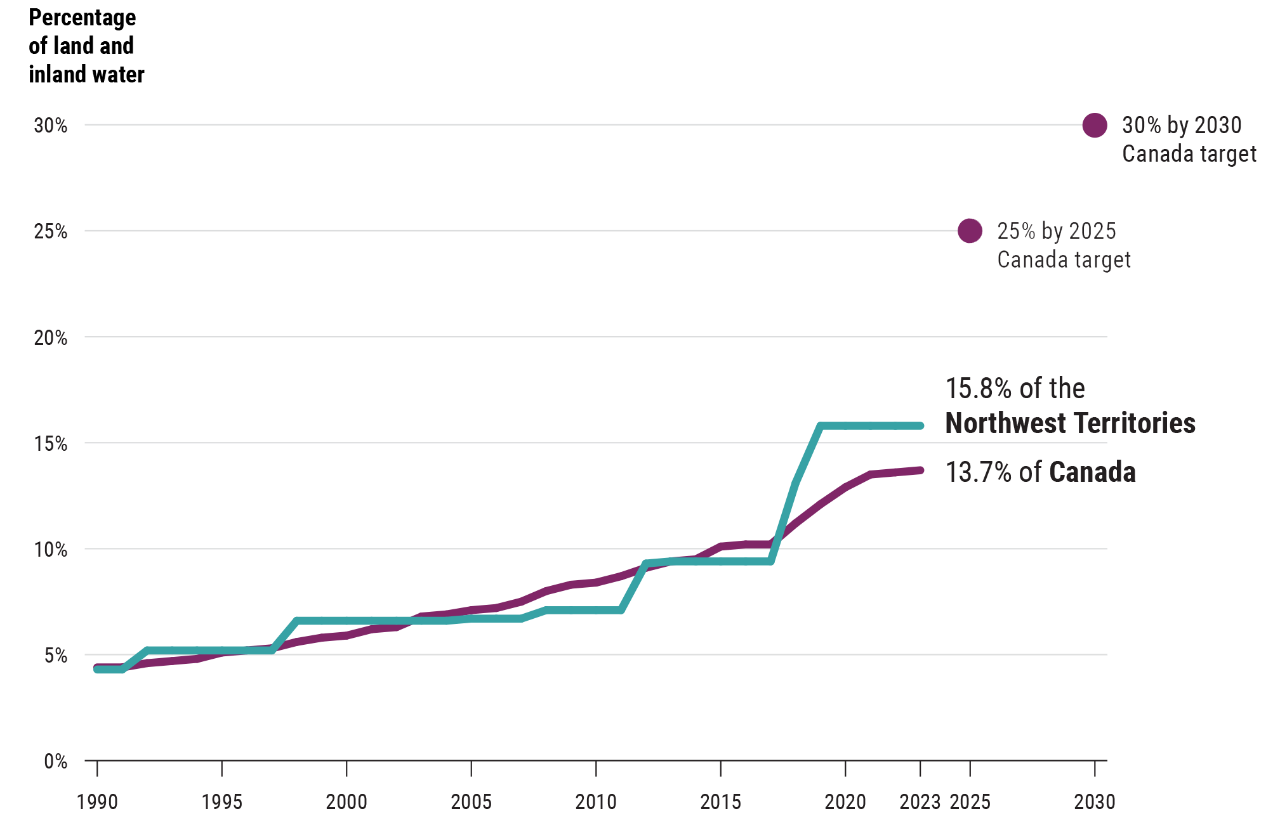
- As of 2023, the Northwest Territories had 15.8% of its terrestrial areas under protection, compared with 13.7% for Canada as a whole.
- If Dınàgà Wek’èhodì and candidate protected areas in the Dehcho region become established protected areas, together these areas could represent up to an additional 23,521 square kilometres of protected land and inland water in the Northwest Territories, which amounts to 1.7% of the total area of the Northwest Territories.
- In the 2023–24 fiscal year, about 41% of funding for the conservation network expenditures came from annual federal funding.
Exhibit highlights
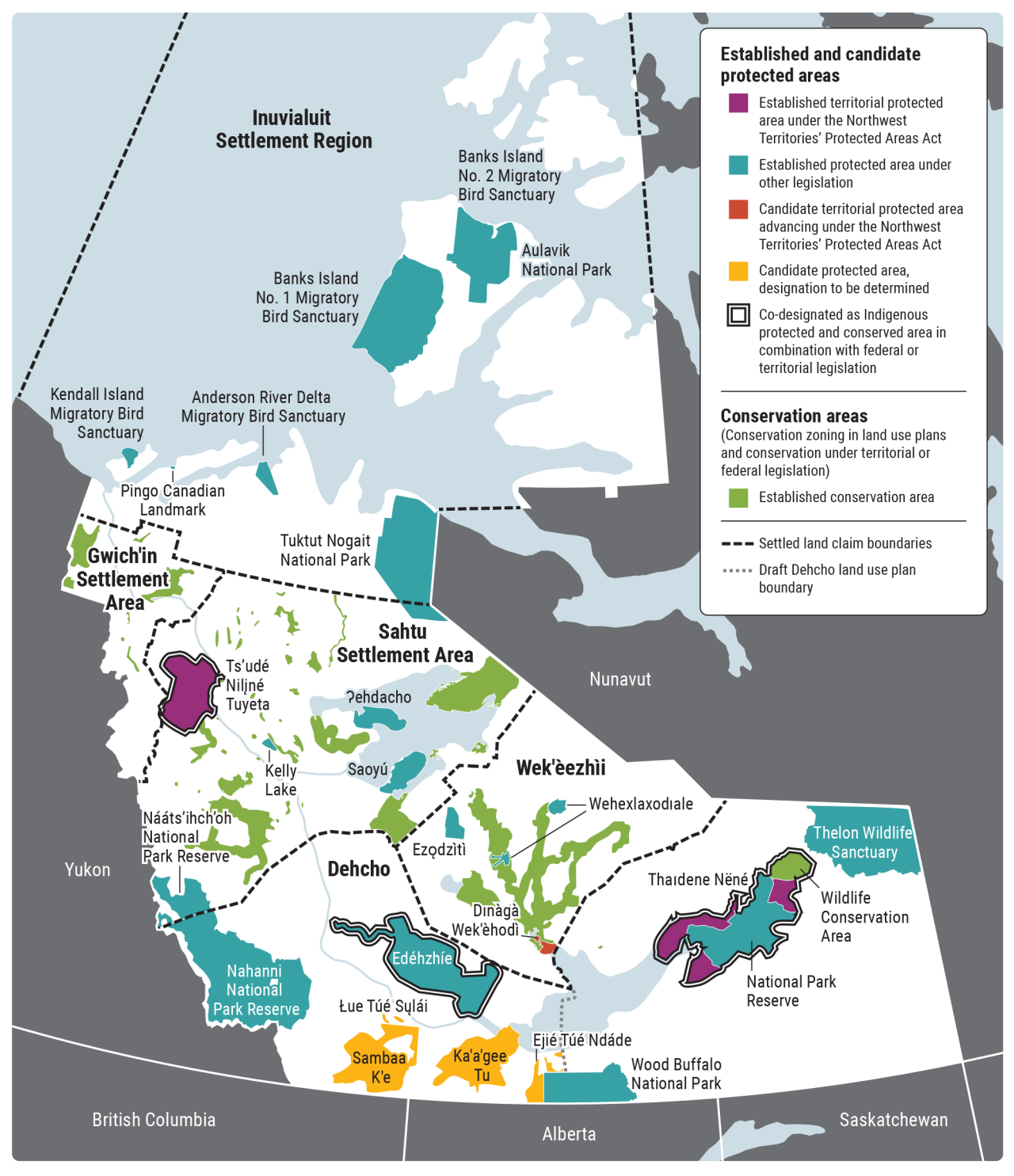
The terrestrial conservation network in the Northwest Territories
Text version
This map shows the terrestrial conservation network in the Northwest Territories. It shows the territory divided into 5 regions according to settled land claim boundaries. The established and candidate protected areas and the conservation areas are shown in each region.
The established and candidate protected areas shown are among the following:
- established territorial protected areas under the Northwest Territories’ Protected Areas Act
- established protected areas under other legislation
- candidate territorial protected areas advancing under the Protected Areas Act
- candidate protected areas whose designations are to be determined
- areas co-designated as Indigenous protected and conserved areas in combination with federal or territorial legislation
Conservation areas shown are conservation zoning in land use plans and conservation under territorial or federal legislation.
The Inuvialuit Settlement Region covers the northern half of the territory. This region has the following established protected areas under legislation other than the Protected Areas Act:
- the Banks Island No. 1 Migratory Bird Sanctuary
- the Aulavik National Park, which includes the Banks Island No. 2 Migratory Bird Sanctuary
- the Kendall Island Migratory Bird Sanctuary
- the Anderson River Delta Migratory Bird Sanctuary
- the Pingo Canadian Landmark
- the Tuktut Nogait National Park (except for the southern tip)
The southern half of the territory has the Gwich’in Settlement Area, Sahtu Settlement Area, Wek’èezhìi, and Dehcho regions.
The region in the northwestern part of the southern half of the territory is the Gwich’in Settlement Area. This region is the smallest of the 5 regions. It has established conservation areas throughout its northern and central parts.
The larger region next to the Gwich’in Settlement Area is the Sahtu Settlement Area. Established conservation areas are found throughout this region. It also has Ts’udé Nilįné Tuyeta, which is an established territorial protected area under the Protected Areas Act. Located in the western part of this region, Ts’udé Nilįné Tuyeta is also co‑designated as an Indigenous protected and conserved area in combination with federal or territorial legislation. This region also has the following established protected areas under legislation other than the Protected Areas Act: ʔehdacho, Saoyú, Kelly Lake, the bottom tip of the Tuktut Nogait National Park, and the Nááts’ihch’oh National Park Reserve.
Dehcho is a large region that covers most of the southern part of the territory. Established protected areas under legislation other than the Protected Areas Act are the Nahanni National Park Reserve, Edéhzhíe, the Wood Buffalo National Park, the Thelon Wildlife Sanctuary, and the Thaıdene Nëné National Park Reserve. Edéhzhíe and Thaıdene Nëné are both co-designated as Indigenous protected and conserved areas in combination with federal or territorial legislation. The rest of Thaıdene Nëné consists of the Wildlife Conservation Area, which is an established conservation area, and established territorial protected areas under the Protected Areas Act. Dehcho also has the following candidate protected areas, whose designations are to be determined: Sambaa K’e, Ka’a’gee Tu, Łue Túé Sųlái, and Ejié Túé Ndáde. Cutting the Dehcho region in half is a draft Dehcho land use plan boundary.
The last of the 5 regions is Wek’èezhìi, which is surrounded by the Sahtu Settlement Area to the northwest, Nunavut to the northeast, and Dehcho to the southwest and southeast. The central part of this region has stretches of established conservation areas. It also has the following established protected areas under legislation other than the Protected Areas Act: Ezǫdzìtì and Wehexlaxodıale. This region also has Dınàgà Wek’èhodì, which is a candidate territorial protected area advancing under the Protected Areas Act.
Source: Adapted from an Environment and Climate Change map
The percentage of land and inland water conserved in the Northwest Territories compared with land and inland water conserved in all of Canada, 1990 to 2023
Text version
This line graph shows the percentage of land and inland water that was conserved in the Northwest Territories and in Canada from 1990 to 2023. The percentage of land has increased in both the territory and Canada during the period; however, the percentages conserved are below the Canada targets of 25% by 2025 and 30% by 2030.
The percentage of land and inland water conserved within the Northwest Territories was higher than the percentage conserved across Canada as a whole. The percentage conserved in the Northwest Territories in 2023 was 15.8%, while the percentage conserved in Canada was 13.7%. Below are the yearly percentages from 1990 to 2023.
Year
Percentage of conserved land and inland water:
Northwest Territories
Percentage of conserved land and inland water:
Canada
1990
4.3%
4.4%
1991
4.3%
4.4%
1992
5.2%
4.6%
1993
5.2%
4.7%
1994
5.2%
4.8%
1995
5.2%
5.1%
1996
5.2%
5.2%
1997
5.2%
5.3%
1998
6.6%
5.6%
1999
6.6%
5.8%
2000
6.6%
5.9%
2001
6.6%
6.2%
2002
6.6%
6.3%
2003
6.6%
6.8%
2004
6.6%
6.9%
2005
6.7%
7.1%
2006
6.7%
7.2%
2007
6.7%
7.5%
2008
7.1%
8.0%
2009
7.1%
8.3%
2010
7.1%
8.4%
2011
7.1%
8.7%
2012
9.3%
9.1%
2013
9.4%
9.4%
2014
9.4%
9.5%
2015
9.4%
10.1%
2016
9.4%
10.2%
2017
9.4%
10.2%
2018
13.1%
11.2%
2019
15.8%
12.1%
2020
15.8%
12.9%
2021
15.8%
13.5%
2022
15.8%
13.6%
2023
15.8%
13.7%
Source: Based on data from Environment and Climate Change and the Canadian Protected and Conserved Areas Database
Most Priority Outcome 2 milestones were partially completed by the Government of the Northwest Territories
| Objective number | Objective | Milestone | Assessment |
|---|---|---|---|
|
2.1 |
Develop regulations for Thaıdene Nëné Indigenous Protected and Conserved Area (IPCA) and Territorial Protected Area and implement regulations for Ts’udé Nilįné Tuyeta IPCA and Territorial Protected Area |
Finalize regulations for Thaıdene NënéFootnote * and draft policies for both Ts’udé Nilįné Tuyeta and Thaıdene Nëné |
Milestone partially completed |
|
2.2 |
Assist with the responsibilities of protected area and conservation area management boards |
Complete the first management plans for both Ts’udé Nilįné Tuyeta and Thaıdene Nëné |
Milestone not yet completed |
|
2.2 |
Assist with the responsibilities of protected area and conservation area management boards |
The Government of the Northwest Territories administrative processes are in place to implement the regulations and establishment agreements |
Milestone partially completed |
|
2.3 |
Work with territorial protected area management boards to monitor protected areas to establish a current baseline |
Develop and deliver monitoring programs for each established protected area |
Milestone partially completed |
|
2.4 |
Support the development and implementation of Guardians programs |
Provide funding, training, or other in-kind support for Guardians programs in protected areas and conservation areas when requested and as available |
Milestone partially completed |


Source: Based on our analysis of information from Healthy Land, Healthy People: GNWT Priorities for the Northwest Territories Conservation Network 2023–2028, Government of the Northwest Territories
Funding sources for the conservation network's expenditures in the 2023-24 fiscal year

Text version
This donut chart shows the 2 funding sources for the conservation network’s total expenditures of $2.54 million in the 2023–24 fiscal year:
- the Government of the Northwest Territories program budget was $1.50 million, or 59% of total expenditures
- the annual federal funding was $1.04 million, or 41% of total expenditures
Source: Based on data from Environment and Climate Change
The Government of the Northwest Territories was on track to advance a key goal of the renewed Healthy Land, Healthy People plan but needed to implement changes to achieve 2 other goals.
Protection and conservation of biodiversity is vital for its inherent value and for maintaining essential ecosystem services and benefits, climate stability, and cultural heritage.
Infographics
Infographic 1

Text version
A protected and conserved area fosters
- the environment
- food security
- cultural practices
Infographic 2

Text version
The Government of the Northwest Territories and partners committed funding through the Our Land for the Future agreement to support 22 Indigenous governments
≤$375 million over 10 years
Funding sources
- Government of Canada: ≤$300 million
- private donors: ≤$75 million
Infographic 3

Text version
Without permanent, sustained funding for Government of Northwest Territories operations, there can be challenges in
- staffing
- long-term planning
- strained partner relationships
Infographic 4

Text version
Candidate area establishment shows limited progress
Dehcho region in discussions since the early 2000s
Dınàgà Wek’èhodì negotiations stalled in late 2022
If established, Dınàgà Wek’èhodì and Dehcho region candidate areas could increase the network by 23,521 km2
- That’s 1.7% of the territory!