Northern legislative assemblies reports
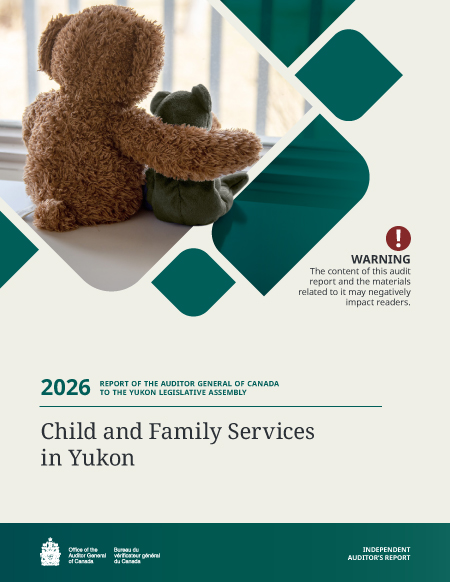
Child and Family Services in Yukon

Report metadata
- Tabling date:
- Topics:
- Health
- Indigenous Affairs
- Report type
- Northern legislative assemblies reports
WARNING
The content of this audit report and the materials related to it may negatively impact readers.
At a glance
Overall, we concluded that Yukon’s Department of Health and Social Services did not provide timely, effective, and inclusive services to protect the safety and well-being of at-risk children and young adults. The audit found serious gaps across a range of child protection services, from responding to reports of suspected harm, to completing investigations and following up with children in care and young adults receiving support services.
The department failed to assess the need for protective intervention within the mandated 24-hour window in 37% of child harm allegations. Moreover, in cases where assessments identified the need for further investigation, the department did not complete these investigations within the required 30 days in 41% of the cases examined.
We found that there were gaps in screening homes before the department placed children with extended family members or in foster homes. For example, criminal record checks were not completed for all adults in the extended family homes in 22% of the cases examined. We also found that the department did not meet the requirement to have face-to-face contact at least once a month with children in care in 74% of the cases examined, and it did not meet that requirement in any of the cases of young adults receiving support services.
We found that group homes were operating at capacity, and many of the children were living with a disability. In addition, while group homes are meant for children aged 12 and older, we found that about a third of children were under 6 years of age. These factors impacted the ability of staff to provide supervision tailored to the needs of the children and increased safety risks for all children.
We found a number of issues contributed to the gaps in timely assessments, interventions, and monitoring. These included poor management of staffing, insufficient tracking of mandatory safety and cultural training, a lack of reporting on compliance with child welfare standards, and the department’s failure to use functions of its case management system; for example, actioning automated reminders and reporting on outcomes for children and families.
Considered together, these findings reveal a child and family services system that is not effectively protecting the young people who depend on it most. Yukon’s Department of Health and Social Services must act urgently to strengthen its child protection services to support the well-being of children and their families.
Key facts and findings
- When there were concerns about a child’s safety in their home setting, the department did not maintain the required monthly face-to-face contact with the child and their family in 55% of the cases in our sample.
- Annual reviews of foster homes were not completed by the department to verify that the homes remained safe for children in 58% of cases in our sample.
- The department did minimal tracking of the human and financial resources required to deliver child protection services, resulting in poor governance oversight, and a lack of informed decision‑making capacity.
- Only 62% of social worker and supervisor positions were staffed as of March 2025.
- Despite the staffing shortages, payroll costs increased, with overtime and casual staff spending rising by more than 75% from April 2022 through March 2025.
- Many group home staff did not have complete or up-to-date training in Indigenous awareness, or in health and safety topics such as non-violent crisis intervention.
Why we did this audit
- The Department of Health and Social Services is responsible for protecting the safety and well-being of children when their parents or guardians are unable
to do so. - The department is responsible for supporting and monitoring children, young adults, and their families who are receiving services.
- When protective services fall short, vulnerable children can remain in harmful environments or may not get the support they need to thrive physically, emotionally,
and mentally.
Highlights of our recommendations
- The Department of Health and Social Services should conduct a thorough and immediate analysis of all active foster and extended family care homes. This analysis should verify the completion of all screening requirements and annual reviews. Any identified deficiencies should be promptly addressed to validate the ongoing safety of these environments for children.
- The Department of Health and Social Services should actively collaborate with all Indigenous partners to establish timelines for the completion and ongoing updating of cultural plans for every Indigenous child
in its care.
Please see the full report to read our complete findings, analysis, recommendations and the audited
organizations’ responses.
Exhibit Highlights
Exhibit 1—Required actions were not timely after a report of suspected harm was received by the Department of Health and Social Services

Text version
Exhibit 1—Required actions were not timely after a report of suspected harm was received by the Department of Health and Social Services—Text description
This flow chart shows:
A text box at the top titled “Report of suspected harm.” On the left-hand side, it states that reports must be assessed within 24 hours to determine the level of risk. A clock is beside the words. To the right is a triangle illustration with an exclamation point inside it. To the right of the triangle, it is stated, “In the 134 reports that were reviewed in the audit, 37% were not assessed within 24 hours.” Below that in smaller print, it states that 11 out of 12 highest-risk reports were assessed on time.
Three arrows flow down out of the text box to 3 text boxes that state:
55 reports screened out.
33 reports were screened in for alternative responses. Footnote 1 states that alternative responses did not have a timeline for completion before July 2024. After that date, alternative services had to be completed within 30 days.
46 reports were screened in for intervention. Footnote 2 states that interventions include all investigations and any alternative responses after July 2024.
An arrow points down from the third box to a larger text box with the title “Intervention.” On the left, an illustration of a calendar is accompanied with the statement that interventions must be completed within 30 days. To the right, a statement says 41% of the 46 interventions did not meet the 30-day threshold for completion.
Source: Based on the Child and Family Services Policy Manual and case file data from the Department of Health and Social Services
Exhibit 2—Options available with increasing levels of government involvement when a child needs to be placed in out-of-home care

Text version
Exhibit 2—Options available with increasing levels of government involvement when a child needs to be placed in out-of-home care—Text description
This flow chart shows:
First box: an illustration of a child and 2 adults who appear to be seniors. Text states child moves into extended family care (minimal government involvement).
Second box: an illustration of an adult with a clipboard. Text states child is placed with extended family, and department supervises.
Third box: an illustration of a child with 2 adults. Text states child is placed in a foster home in Yukon.
Fourth box: An illustration of a building and 3 children. Text states child is placed in a group home in Yukon.
An arrow below the 4 boxes points from the first to the fourth box and says “increasing level of government involvement.”
Source: Adapted from the Child and Family Services Policy Manual
Exhibit 5—Group home staff had not completed mandatory training

Text version
Exhibit 5—Group home staff had not completed mandatory training—Text descriptionThis horizontal bar chart shows 7 categories of mandatory training requirements and the percentage of non-compliance:Standard first aid/CPR: 22% not met.
Non-violent crisis intervention: 62% not met.
Safe transportation of clients in cold weather: 95% not met.
Suicide intervention training: 95% not met.
Yukon First Nations 101: 84% not met.
Introduction to cultural safety: 92% not met.
Residential school awareness: 89% not met.
Source: Based on data from the Department of Health and Social Services’ staff training completion documentation as of March 31, 2025
Exhibit 6—Social workers had not completed mandatory training

Text version
Exhibit 6—Social workers had not completed mandatory training—Text description
This horizontal bar chart shows 4 categories of mandatory training requirements for social workers and the percentage of non-compliance:
Delegation of authority to deliver child welfare services: 5% not met.
Signs of safety for child protection: 8% not met.
Safe transportation of clients in cold weather: 68% not met.
Yukon First Nations 101: 72% not met.
Source: Based on data from the Department of Health and Social Services’ staff training completion documentation as of March 31, 2025
Related report(s)
Northern legislative assemblies reports
COVID-19 Vaccines in Yukon
Read more →
Northern legislative assemblies reports
Yukon Housing
Read more →
Northern legislative assemblies reports