Follow-up Audit on Corrections in Nunavut—Department of Justice
At a Glance
Why we did this audit
- Providing programs and supports to inmates in a safe and secure environment helps promote their healing and reintegration into their communities.
- Rehabilitation programs and mental health services are intended to address the underlying factors that led inmates to be incarcerated, and to reduce their likelihood of reoffending. These programs and services can also improve overall inmate well‑being and help prepare them for successful reintegration into the community after being released.
- Without adequate capacity in facilities, inmates may not be housed according to their assigned security ratings, or overcrowding may occur, both of which can put staff and inmates at risk of harm. Overcrowding can present even more risk during emergencies and events, such as the COVID‑19 pandemic.
- Without proper compliance with directives for cell searches, fire drills and evacuations, and fire inspections, the safety and security of inmates and staff is at risk.
Our findings
- The Department of Justice did not provide the case management services needed to help rehabilitate inmates.
- Progress was made in addressing a lack of capacity.
- The department continued to face high staff‑vacancy rates and could not determine whether its staff were provided with adequate training.
Key facts and figures
- According to Statistics Canada, Nunavut had the highest adult incarceration rate (the average number of adults in custody per day for every 100,000 individuals in the adult population) among the provinces and territories in the 2018–19 fiscal year.
- Rehabilitative programming at the 4 adult secure custody facilities was being delivered primarily in English and not in Inuktitut, the mother tongue of most inmates.
- The overall staffing vacancy rate for the department was 28% as of 31 March 2020.
Our recommendations
- The Department of Justice should complete and implement case management standards and a case management manual and related guidance for staff. It should also make case management training mandatory for Corrections Division staff who do case management and ensure this training is provided to staff.
- The Department of Justice should provide the resources needed to plan and consistently deliver rehabilitation programming to inmates, and it should provide training to staff who deliver the programming.


This audit contributed to Canada’s actions in relation to the United Nations’ Sustainable Development Goal 16, which is, “Promote peaceful and inclusive societies for sustainable development, provide access to justice for all and build effective, accountable and inclusive institutions at all levels”.
Infographic
Text version
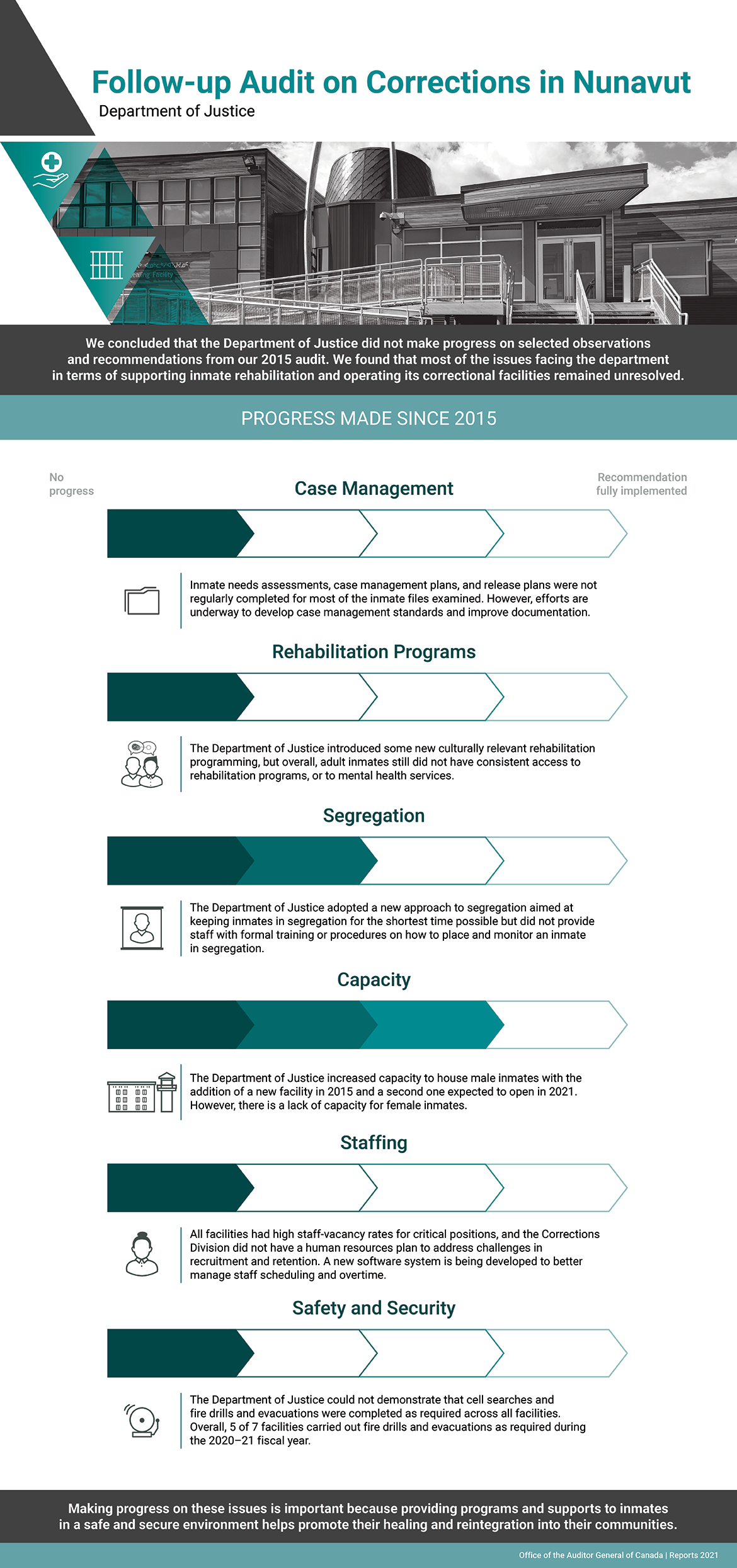
We concluded that the Department of Justice did not make satisfactory progress on selected observations and recommendations from our 2015 audit. We found that most of the issues facing the department in terms of supporting inmate rehabilitation and operating its correctional facilities remained unresolved.
Case management: Inmate needs assessments, case management plans, and release plans were not regularly completed for most of the inmate files examined. However, efforts are underway to develop case management standards and improve documentation.
Rehabilitation programs: The Department of Justice introduced some new culturally relevant rehabilitation programming, but overall, adult inmates still did not have consistent access to rehabilitation programs, or to mental health services.
Segregation: The Department of Justice adopted a new approach to segregation aimed at keeping inmates in segregation for the shortest time possible but did not provide staff with formal training or procedures on how to place and monitor an inmate in segregation.
Capacity: The Department of Justice increased capacity to house male inmates with the addition of a new facility in 2015 and a second one expected to open in 2021. However, there is still a lack of capacity for female inmates.
Staffing: All facilities had high staff-vacancy rates for critical positions, and the Corrections Division did not have a human resources plan to address challenges in recruitment and retention. A new software system is being implemented to better manage staff scheduling and overtime.
Safety and security: The Department of Justice could not demonstrate that cell searches and fire drills and evacuations were completed as required across all facilities. Overall, 5 of 7 facilities carried out fire drills and evacuations as required during the 2020–21 fiscal year.
Concluding message: Continuing to make progress on these issues is important because providing programs and supports to inmates in a safe and secure environment helps promote their healing and reintegration into their communities.
Related information
| Entities | Department of Justice (Nunavut) |
|---|---|
| Completion date | 11 June 2021 |
| Tabling date | 9 September 2021 |