
Report 5—Carbon Pricing—Environment and Climate Change Canada
At a Glance
Why we did this audit
- This audit is important because carbon pricing is broadly recognized as one of the most efficient policy approaches to reducing greenhouse gas emissions. Emission reductions therefore depend strongly on ensuring that the pan-Canadian approach to carbon pricing is implemented effectively—which in turn requires that it be applied broadly and promptly, and becomes increasingly stringent. Transparent implementation helps to demonstrate what measures are most effective over time, guiding future adjustments. Finally, fairness helps provinces, territories, and Canadians across the country appreciate that they are not being disproportionately burdened by carbon pricing.
- Weak or non‑existent carbon pricing systems in some provinces or territories could contribute to significant harmful effects on the environment, on human health and safety, and on economic prosperity. Establishing minimum national standards for pricing carbon pollution is of concern for Canada as whole.
Our findings
- Weak requirements for large-emitter programs reduced the effectiveness of the carbon price.
- Environment and Climate Change Canada ensured that all jurisdictions had carbon pricing in place by 2019. Although there were shortcomings in the initial criteria, the department strengthened them in August 2021.
- Some groups remained disproportionately burdened by carbon pricing.
Key facts and figures
- In 2019, the oil and gas industry amounted to 26% of Canada’s emissions, while heavy industry (such as cement and paper) amounted to 11%.
- Environment and Climate Change Canada did not establish criteria in the federal benchmark that would require jurisdictions to assess and identify measures to mitigate the disproportionate burden of carbon pricing on vulnerable groups.
- Public information needed to compare provincial or territorial systems against the benchmark criteria was limited.
Our recommendations
- Environment and Climate Change Canada should work with provinces and territories to determine an approach to minimizing domestic competitiveness risks while improving effectiveness. This work should:
- assess setting minimum performance standards
- assess aligning average costs
- engage an expert to independently assess risks to effectiveness and domestic competitiveness from federal, provincial, and territorial pricing systems
- To address the disproportionate burden that carbon pricing may have on certain groups and Indigenous peoples, Environment and Climate Change Canada should work with provinces and territories to
- assess the burden of carbon pricing systems on certain groups, including Indigenous people
- report publicly on measures implemented in jurisdictions to mitigate the burden of carbon pricing on these groups


In 2015, Canada committed to achieving the United Nations’ 2030 Agenda for Sustainable Development. Goal 13 (climate action) calls for countries to take urgent action to combat climate change and its effects. The strengthened 2020 federal climate plan, A Healthy Environment and a Healthy Economy, included a commitment to concrete actions to advance the 2030 Agenda. As a measure to reduce emissions, carbon pricing contributes to Goal 13.
Infographic
Text version
This infographic presents findings from the 2022 audit report on carbon pricing.
Overall message
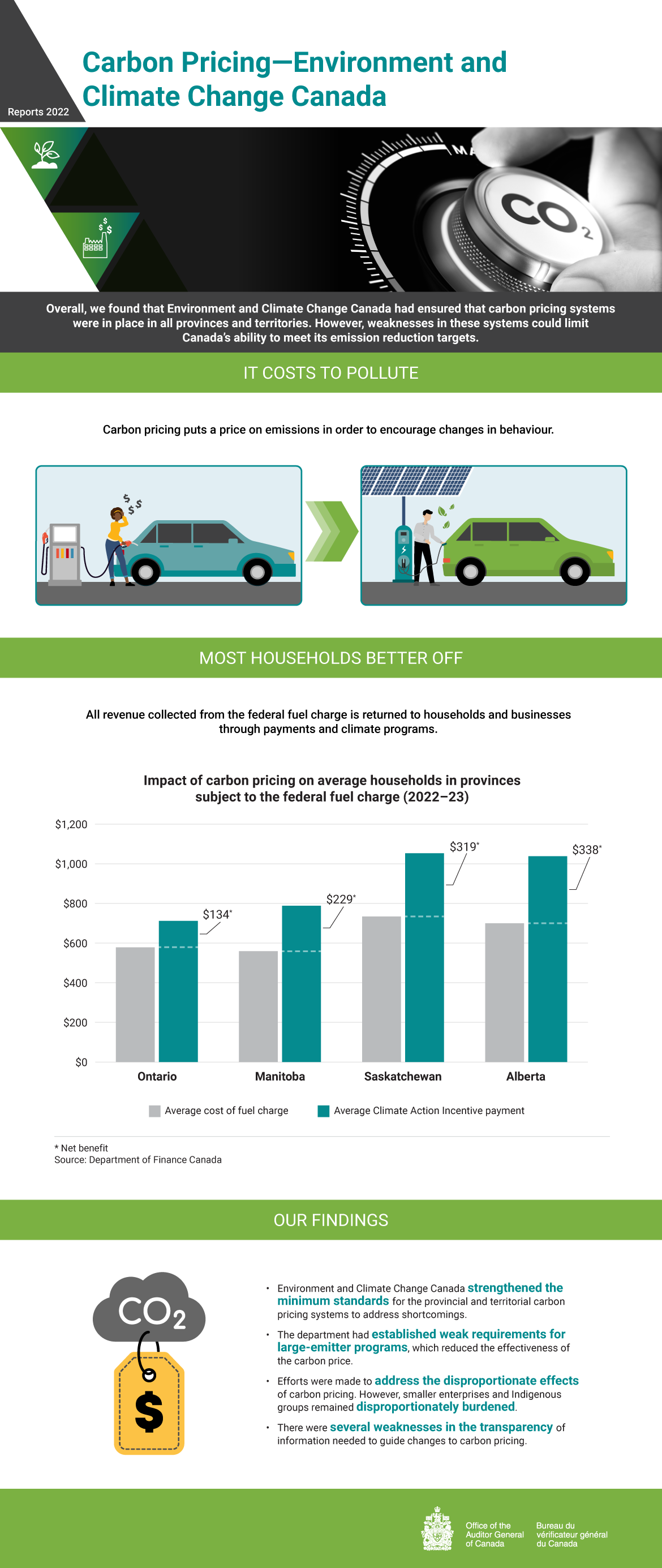
Overall, we found that Environment and Climate Change Canada had ensured that carbon pricing systems were in place in all provinces and territories. However, weaknesses in these systems could limit Canada’s ability to meet its emission reduction targets.
It costs to pollute
Carbon pricing puts a price on emissions in order to encourage changes in behaviour. An example of a change in behaviour is charging an electric vehicle at a solar-powered charging station instead of filling up a gas‑powered vehicle at the pump.
Most households better off
All revenue collected from the federal fuel charge is returned to households and businesses through payments and climate programs.
According to the Department of Finance Canada, the impact of carbon pricing on average households in provinces subject to the federal fuel charge was as follows in 2022–23, in ascending order of net benefit received:
- In Ontario, the average cost of fuel charge was $578 and the average Climate Action Incentive payment was $712. Therefore, the average Ontario household received a net benefit of $134.
- In Manitoba, the average cost of fuel charge was $559 and the average Climate Action Incentive payment was $788. Therefore, the average Manitoba household received a net benefit of $229.
- In Saskatchewan, the average cost of fuel charge was $734 and the average Climate Action Incentive payment was $1,053. Therefore, the average Saskatchewan household received a net benefit of $319.
- In Alberta, the average cost of fuel charge was $700 and the average Climate Action Incentive payment was $1,038. Therefore, the average Alberta household received a net benefit of $338.
Our findings
- Environment and Climate Change Canada strengthened the minimum standards for the provincial and territorial carbon pricing systems to address shortcomings.
- The department had established weak requirements for large-emitter programs, which reduced the effectiveness of the carbon price.
- Efforts were made to address the disproportionate effects of carbon pricing. However, smaller enterprises and Indigenous groups remained disproportionately burdened.
- There were also several weaknesses in the transparency of information needed to guide changes to carbon pricing.
Related information
| Entities |
|
|---|---|
| Completion date | 11 March 2022 |
| Tabling date | 26 April 2022 |