Canadian Armed Forces did not recruit enough members to meet operational requirements
Recruiting for Canada’s Military

Report metadata
- Tabling date:
- Audited entities:
- National Defence
- Topics:
- Education and training
- National Defence
- Report type
- Auditor General reports
At a glance
Overall, the Canadian Armed Forces did not recruit and train enough applicants to meet its operational requirements. While thousands applied annually, only 1 out of 13 applicants were successfully recruited. The Canadian Armed Forces did not always know why applicants abandoned their applications during the recruitment process.
We found that the Canadian Armed Forces was experiencing a challenge of attracting and training enough highly skilled recruits to reach full staffing levels for many occupations, such as pilots and ammunition technicians.
During our audit period, the Canadian Armed Forces implemented changes designed to increase the number of recruitments. It was able to recruit more Indigenous and visible minority members, but the representation of women remained below its goals.
We found ineffective decision making for recruitment and training. Committees and groups managing recruitment and training activities lacked authority and clear accountability, leading to disjointed ownership of the recruiting process. During the period of our audit, the Canadian Armed Forces implemented changes, such as creating the Recruiting Campaign Board in June 2024 to improve decision making for the recruitment process. The board started to transform and modernize recruitment, including amending the security screening requirements.
We also found that the information technology systems used to support recruitment and training activities were not linked and required staff to manually input significant amounts of information, which contributed to inefficiencies and bottlenecks. The Canadian Armed Forces’ development and deployment of new systems for recruiting and training encountered significant delays and did not meet applicant and Canadian Armed Forces personnel needs.
The continuing gaps in Canadian Armed Forces personnel could affect the Canadian Army’s, the Royal Canadian Navy’s, and the Royal Canadian Air Force’s abilities to respond to threats, emergencies, or conflicts and to accomplish their missions.
Key facts and findings
- Almost 192,000 people applied to the Canadian Armed Forces between April 1, 2022, and March 31, 2025. Applicant numbers increased each year of the audit period.
- During the period of the audit, the Canadian Armed Forces planned to recruit just over 19,700 new recruits but recruited only around 15,000, falling short by about 4,700 recruits.
- The Canadian Armed Forces recruitment target time was between 100 and 150 days, but it often took twice as long to recruit. The median number of days it took for an applicant to be recruited for the 3‑year period was between 245 and 271.
- During the period of the audit, the backlog of pending security quality checks rose from around 20,000 to almost 23,000
Why we did this audit
- Canadian Armed Forces’ inability to recruit and train enough new members impacts its capacity to sustain operational readiness and respond to threats, emergencies, or conflicts and can jeopardize its ability to accomplish its missions.
- Canadian Armed Forces needs to recruit and train enough members while maintaining well‑functioning operations. Recruitment and training need to be done in a way that does not waste time, effort, or resources.
Highlights of our recommendations
- To support operational readiness, the Canadian Armed Forces should implement and monitor actions to address understaffed occupations, in particular those that are in demand.
- The Canadian Armed Forces should take action to ensure sufficient investments in instructors, training infrastructure, and equipment to increase the number of recruits who can be trained; create a more stable, long‑term training system; and better align the Strategic Intake Plan with long‑term personnel needs.
Exhibit highlights
The Canadian Armed Forces recruitment and training pathway

Text version
This flow chart shows the Canadian Armed Forces recruitment and training pathway from recruitment to training to trained and effective member.
The recruitment stage has 5 steps:
- Pre-apply—During this step, the applicant visits the website and learns about the Canadian Armed Forces.
- Apply—During this step, the applicant creates an account and submits an application.
- Process—During this step, the applicant completes an aptitude test, a medical, a Reliability security clearance, and an interview.
- Offer—During this step, the applicant receives and accepts an offer.
- Enroll—During this step, the applicant participates in the enrolment ceremony.
The training stage has 2 steps:
- Basic training—During this step, the applicant completes mandatory basic training and applies for Secret security clearance.
- Occupation training—During this step, the applicant completes occupation‑specific training.
After training, the applicant is now a trained and effective member of the Canadian Armed Forces.
Note: This was the process for successful applicants for the majority of our audit period. Changes to the process are discussed in paragraph 39 of the report.
Source: Based on information from the Canadian Armed Forces
From April 1, 2022, to March 31, 2025, most applicants voluntarily left the recruitment process

Text version
This flow chart shows the outcomes of applications to the Canadian Armed Forces during the recruitment process from April 1, 2022, to March 31, 2025. It shows that most applicants voluntarily left the recruitment process during the period.
During this period, there were 191,981 total applicants. Of these, there were 43,934 applicants in the 2022–23 fiscal year, 70,616 applicants in the 2023–24 fiscal year, and 77,431 applicants in the 2024–25 fiscal year.
Of the 191,981 total applicants, 73,196, or 38%, were viable; 103,684, or 54%, involved applicant-driven file closures (for example, voluntary withdrawal and no further contact); and 15,101, or 8%, involved recruiter-driven file closures (for example, applicants did not meet criteria).
Of the 73,196 viable applicants, 58,250, or 80%, were still going through the recruitment process and 14,946, or 20%, were recruited. There were 3,927 applicants recruited in the 2022–23 fiscal year, 4,313 applicants recruited in the 2023–24 fiscal year, and 6,706 applicants recruited in the 2024–25 fiscal year.
Source: Based on data from the Canadian Armed Forces
Average applicant to recruitment ratios did not always meet targets

Text version
This chart shows the target and actual applicant-to-recruitment ratios by fiscal year.
In 2022–23, the target was to have a ratio of 1 in 8. The actual ratio was 1 in 11.
In 2023–24, the target was to have a ratio of 1 in 8. The actual ratio was 1 in 16.
In 2024–25, the target was to have a ratio of 1 in 12. The actual ratio was 1 in 12.
The overall average actual ratio was 1 in 13.
Source: Based on data from the Canadian Armed Forces
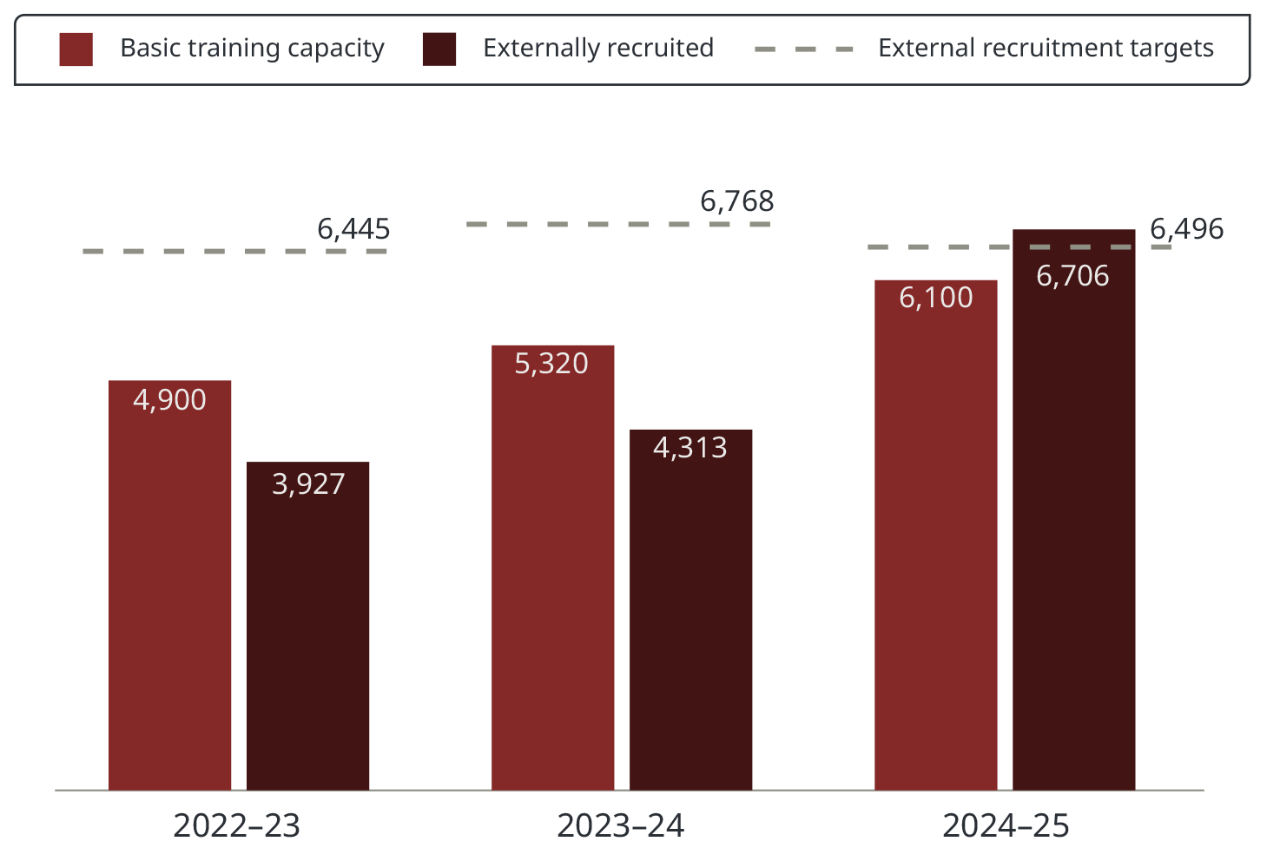
Basic training capacity did not cover external recruitment targets
Text version
This chart shows the basic training capacities, external recruitments, and external recruitment targets for the 2022–23 to 2024–25 fiscal years.
In 2022–23, the basic training capacity was 4,900. The number of people externally recruited was 3,927. The external recruitment target was 6,445. This target was not met.
In 2023–24, the basic training capacity was 5,320. The number of people externally recruited was 4,313. The external recruitment target was 6,768. This target was not met.
In 2024–25, the basic training capacity was 6,100. The number of people externally recruited was 6,706. The external recruitment target was 6,496. This target was met.
Source: Based on data from the Canadian Armed Forces