Commissioner of the Environment and Sustainable Development reports
Canada is not meeting its commitments to protect and conserve land and inland water
Canada is not meeting its commitments to protect and conserve land and inland water

Overall, we concluded that Environment and Climate Change Canada and Parks Canada were not on track to establish protected and conserved areas covering 25% of terrestrial land and inland water by 2025. We also concluded that they had not planned to ensure these areas were well-connected, ecologically representative, and protecting areas of importance for biodiversity and ecosystem services. Protecting ecologically important areas helps prevent habitat loss, a main cause of the biodiversity crisis. It is also an important nature-based solution for addressing climate change.
The federal government has committed to conserving 25% of terrestrial areas (land and inland water) in Canada by 2025, and 30% by 2030. By the end of 2024, Environment and Climate Change Canada’s database indicated that less than 14% of Canada’s land and inland water had been protected and conserved. We found that the 2 federal organizations had undertaken the foundational work needed to establish and expand the network of protected and conserved areas by working with provincial, territorial, Indigenous, and other partners. However, they had not met the majority of the targets in the 13 programs we examined. Progress relies in part on numerous factors, including on the capacity and willingness of partners to participate and on requirements related to land transfers and private land acquisition.
Improving the system of protected and conserved areas requires more than reaching a quantitative goal: The overall network is stronger, in a qualitative sense, if areas are well-connected, are representative of Canada’s ecological diversity, promote biodiversity, and support key ecosystems. We found, however, that the 2 federal organizations did not consistently consider or track progress on meeting qualitative goals, which would help them prioritize areas for protection. The 2 federal organizations also did not specifically track progress or report on the conservation of inland waters.
Establishing a strong, countrywide network of protected and conserved areas of high ecological value preserves biodiversity, safeguards ecosystems, provides food security, and supports cultural continuity. It also helps create certainty with respect to infrastructure planning and decision making as the federal government seeks to expedite approvals for projects of national importance. Given that the federal government must work with provincial, territorial, Indigenous, and other partners to meet its targets, urgent and cooperative action is needed among all parts of society if Canada is to meet its 2030 biodiversity goals.
Over the past several decades, Canada has committed to targets for protected and conserved areas. These targets have increased over time due to heightening concerns internationally about the continued loss of biodiversity and the threat that this poses to nature and human well-being. The Kunming‑Montreal Global Biodiversity Framework aims to halt and reverse biodiversity loss by 2030, building upon the United Nations’ Sustainable Development Goal 15 to take urgent and significant action to reduce the degradation of natural habitats and halt the loss of biodiversity. In 2024, Canada finalized Canada’s 2030 Nature Strategy: Halting and Reversing Biodiversity Loss in Canada, which serves as the country’s action plan for the Kunming‑Montreal Global Biodiversity Framework.
| Year | Commitment | Context |
|---|---|---|
|
2010 |
Conserve 17% of land and inland water by 2020 |
Canada, as a signatory to the United Nations’ Convention on Biological Diversity, committed to this target through the Aichi Biodiversity Targets adopted in 2010. This target was incorporated in 2016 in the 2020 Biodiversity Goals and Targets for Canada. |
|
2019 |
Conserve 25% of land and inland water by 2025 |
This target was introduced in the 2019 Speech from the Throne. Federal Budget 2021 allocated $2.3 billion over 5 years to support this conservation commitment. |
|
2022 |
Conserve 30% of land and inland water by 2030 |
Canada adopted the United Nations’ Kunming‑Montreal Global Biodiversity Framework under the Convention on Biological Diversity. The framework sets out 23 targets aiming to halt and reverse biodiversity loss by 2030, with a vision of living in harmony with nature by 2050. This included the commitment to the target that by 2030, at least 30% of Canada’s land and inland water, “especially areas of particular importance for biodiversity and ecosystem functions and services, are effectively conserved and managed through ecologically representative, well-connected and equitably governed systems of protected areas and other effective area-based conservation measures,” while respecting the rights of Indigenous peoples. This commitment was incorporated into Canada’s 2030 Nature Strategy: Halting and Reversing Biodiversity Loss in Canada. |
Source: Based on information from Environment and Climate Change Canada
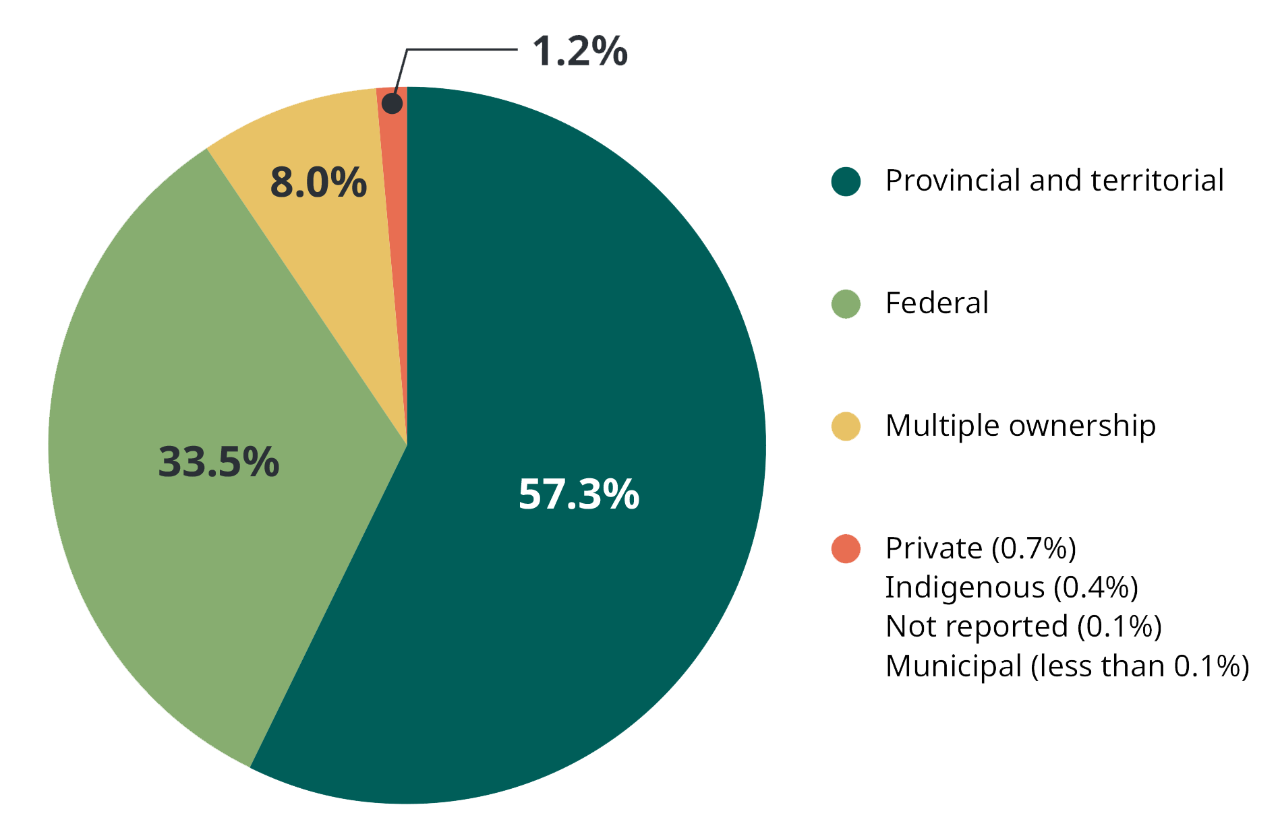
Note: The calculation is based on square kilometres in 2024.
Source: Based on information from the Canadian Protected and Conserved Areas Database, Environment and Climate Change Canada, 2024
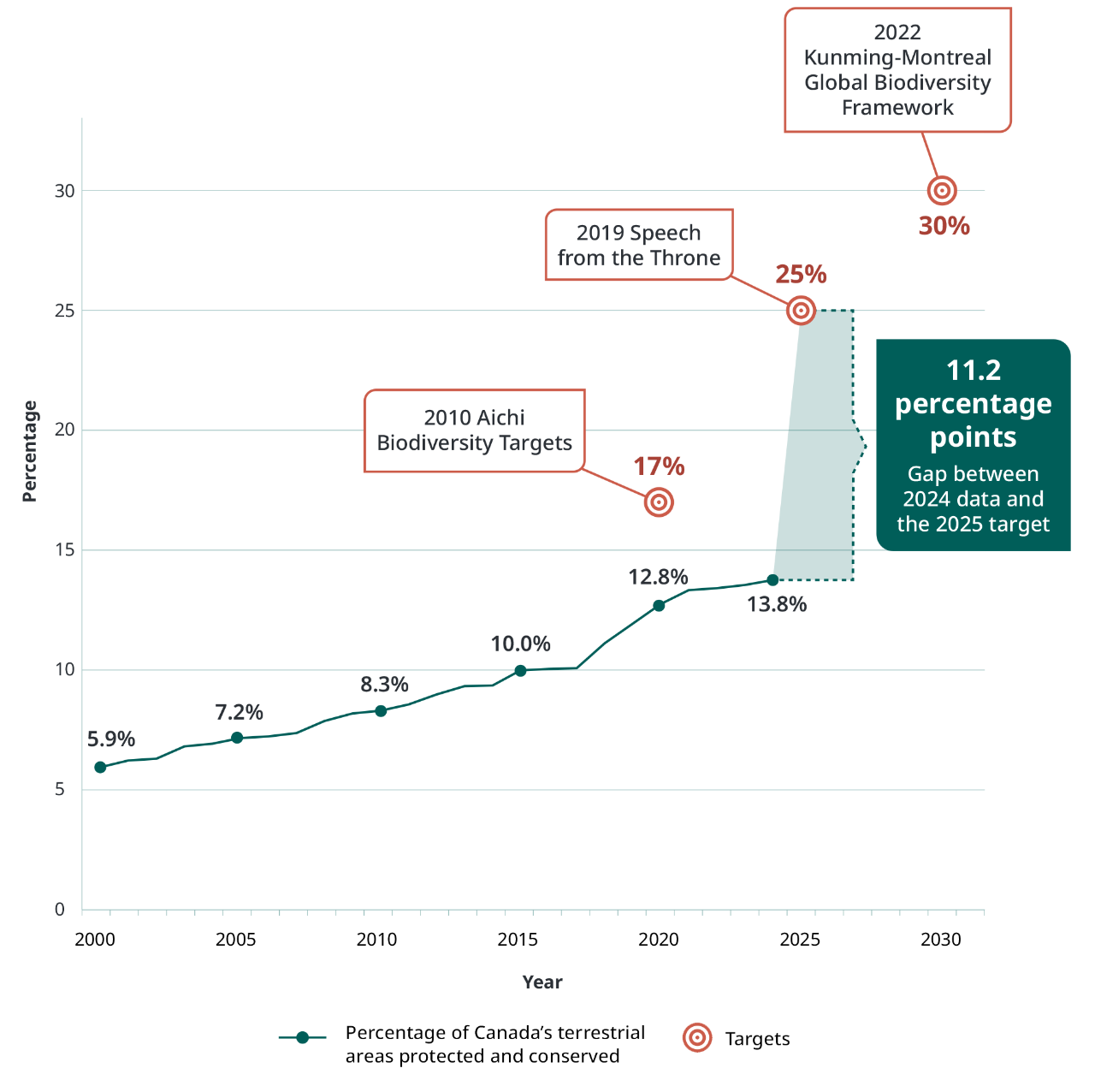
Source: Based on information from the Canadian Protected and Conserved Areas Database, Environment and Climate Change Canada, 2024
Environment and Climate Change Canada
| Program | Program-level target | Date to achieve | Source of target | Number completed during audit period |
|---|---|---|---|---|
|
National wildlife areas, migratory bird sanctuaries, and conservation areas (establishment and expansion) |
Establish 6 new national wildlife areas and finalize the designation of 7 national wildlife areas (13 total) |
End of 2025 |
Federal Sustainable Development Strategy 2022 to 2026 |
10 new national wildlife areas established 0 designations finalized (10 total) |
Parks Canada
| Program | Program-level target | Date to achieve | Source of target | Number completed during audit period |
|---|---|---|---|---|
|
National park or national park reserve |
10 |
End of 2026 |
Federal Sustainable Development Strategy 2022 to 2026 |
1 Pituamkek National Park Reserve |
|
Expansions of national parks or national park reserves |
None |
Not applicable |
Not applicable |
6 expansionsNote 1 |
|
Freshwater national marine conservation area |
4 |
End of 2026 |
Federal Sustainable Development Strategy 2022 to 2026 |
0 |
|
National urban park |
6 |
End of the |
Parks Canada’s 2023 to 2027 Departmental Sustainable Development Strategy |
0 |
Source: Based on information from Environment and Climate Change Canada and Parks Canada