Commissioner of the Environment and Sustainable Development reports
Canada is not meeting its commitments in establishing protecting and conserved marine and coastal areas
Canada is not meeting its commitments in establishing protecting and conserved marine and coastal areas

Overall, we concluded that Fisheries and Oceans Canada, Parks Canada, and Environment and Climate Change Canada were not on track to establish protected and conserved areas covering 25% of marine and coastal ecosystems by 2025. We also concluded that the 3 federal organizations had not developed an updated, collaborative plan to establish a network of protected and conserved marine areas by 2030 that are ecologically representative and of significance to biodiversity and ecosystem functions and services.
Oceans support a significant portion of the planet’s biodiversity, regulate climate, and produce most of the oxygen we breathe. To help safeguard these critical systems and contribute to the battle against climate change, Canada committed to conserving 25% of marine and coastal areas in Canada by 2025, and 30% by 2030. However, as of March 2025, only 15.5% of Canada’s marine and coastal areas were protected and conserved.
The 3 federal organizations have completed important steps to reach the 2030 target, such as identifying new areas of interest, undertaking site feasibility assessments, and engaging with Indigenous governments and organizations and interested parties. They also designed new approaches to protect and conserve areas with Indigenous governments and organizations to advance cooperative management, and they have formalized the requirement to consider and incorporate Indigenous Knowledge when establishing new areas.
Despite these important advances, the 3 federal organizations had not developed clear guidance to implement the Federal Marine Protected Areas Protection Standard to prohibit harmful activities such as oil and gas exploration, mining, bottom trawling, and disposal of waste, dumping of fill, and vessel discharge.
Urgent action is needed worldwide to address the biodiversity and climate crises. Given the years required to properly consult on and establish protected and conserved marine and coastal areas, the federal government must pick up the pace to meet its 2030 commitments.
Over the past several decades, Canada has committed to marine conservation, and important international targets have been established since 2010. These targets have increased over time due to heightening concern internationally about the continued loss of biodiversity and the threat that this poses to nature and human well‑being. The Kunming‑Montreal Global Biodiversity Framework aims to halt and reverse biodiversity loss by 2030, building upon the United Nations’ Sustainable Development Goal 14 to conserve and sustainably use the oceans, seas, and marine resources for sustainable development.
| Year | Commitment | Context |
|---|---|---|
|
2010 |
Conserve 10% of marine and coastal areas by 2020 |
Canada, as a signatory to the United Nations’ Convention on Biological Diversity, committed to this target through the Aichi Biodiversity Targets adopted in 2010. This target was incorporated in 2016 in the 2020 Biodiversity Goals and Targets for Canada. |
|
2019 |
Conserve 25% of marine and coastal areas by 2025 |
This target was introduced in the 2019 Speech from the Throne. Federal Budget 2021 allocated nearly $1 billion over 5 years to protect the health of our oceans. |
|
2022 |
Conserve at least 30% of Canada’s marine and coastal areas by 2030 |
In December 2022, Canada adopted the United Nations’ Kunming-Montreal Global Biodiversity Framework under the Convention on Biological Diversity. The framework sets out 23 targets aiming to halt and reverse biodiversity loss by 2030, with a vision of living in harmony with nature by 2050. This commitment to the 30% by 2030 target was incorporated in 2022 in the Federal Sustainable Development Strategy 2022 to 2026 and in 2024 in Canada’s 2030 Nature Strategy: Halting and Reversing Biodiversity Loss in Canada. |
Source: Based on information from Environment and Climate Change Canada

Source: Based on information from the Canadian Protected and Conserved Areas Database, Environment and Climate Change Canada, 2024

Source: Based on information from Fisheries and Oceans Canada
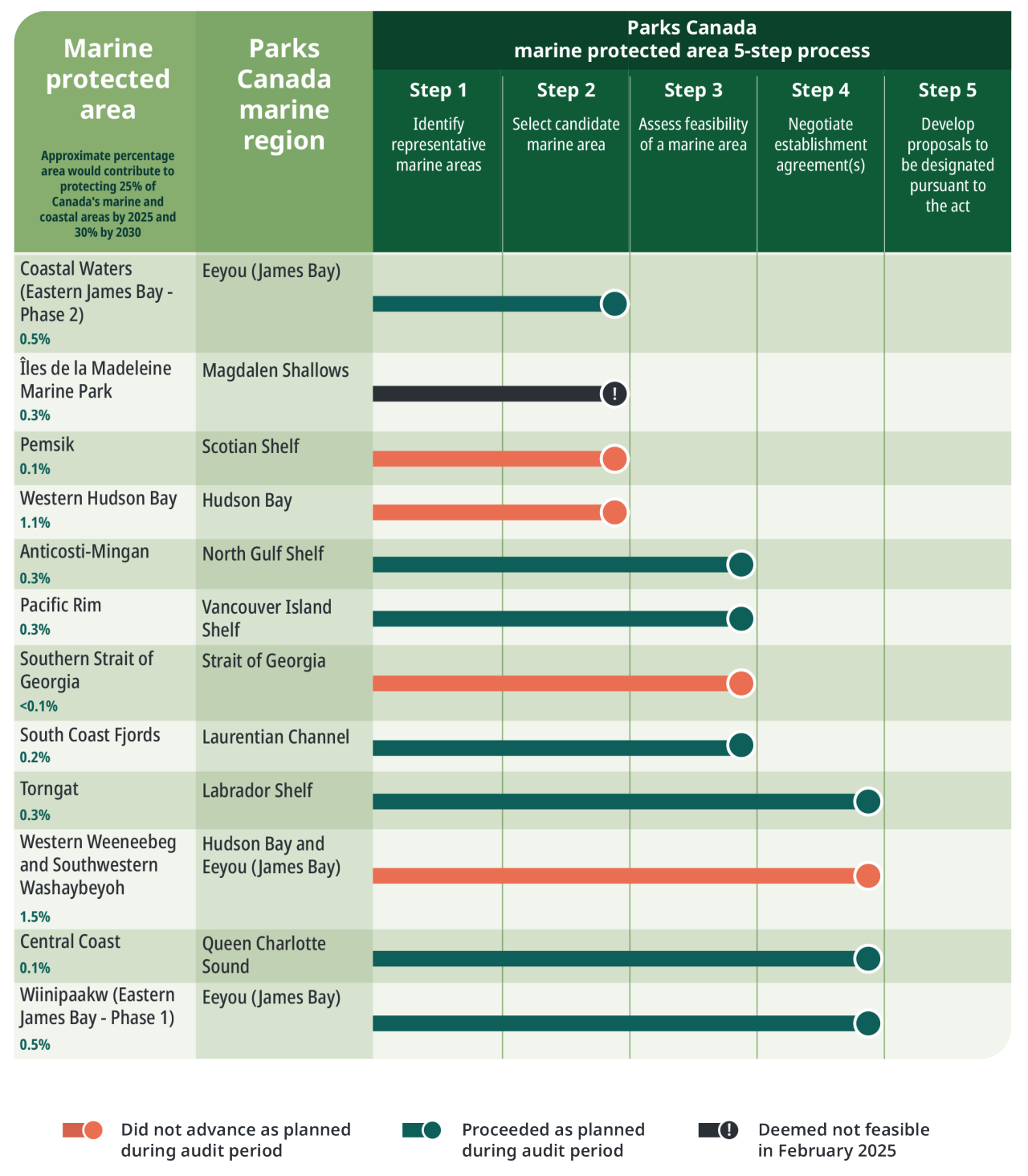
Source: Based on information from Parks Canada