
Licensing security program evaluation
1. Introduction
1.1 Evaluation purpose
This report presents the results of a program evaluation of the Canadian Grain Commission’s Licensing and Security Program.
The evaluation was conducted in accordance with the Treasury Board’s Policy on Results, which requires departments to measure and evaluate performance and use the resulting information to manage and improve programs, policies and services. The Audit and Evaluation Services team of the Canadian Grain Commission conducted this evaluation during the 2024 to 2025 fiscal year, as part of the Canadian Grain Commission’s Risk-Based Audit and Evaluation Plan. The evaluation focused on the following areas:
- relevance
- performance
- efficiency and enhancement
In addition, the Business Process Owner identified the following areas of interest:
- gaps in policy or processes in Licensing, Audit and Compliance units
- program efficiency improvements and whether updates to program structure and utilization of resources within the program would achieve this
- exploring difficulties in collecting correct and timely required documentation (including, but not limited to, forms, reports, certificates and financial information) from licensees as per licence requirements that are currently impacting resources and timeliness of operations
- recommendations on specific licensee audit and risk evaluation procedures
- identify activities not related to program outcomes in support of other Canadian Grain Commission areas or initiativesFootnote 1
An internal audit of Licensing and Compliance was conducted in 2012 and is referenced in this report. At the time of writing, a number of significant projects related to this program were not in the evaluation timeframe as they were underway or in early stages, including licensing modernization, external model reviews and regulatory review. Evaluation findings and recommendations are intended to inform current and future program and policy decisions. A complete list of findings recommendations and management action plans (MAPs) can be found in Appendix 1.
1.2 Evaluation scope
This evaluation, conducted during the 2024 to 2025 fiscal year, encompassed the Licensing, Audit and Compliance units of the program. Activities of the Producer Car unit were excluded from this evaluation. Historical relevant information from a variety of sources including legislation, policy papers and media articles were used to inform this evaluation. Program data for the period between 2018 and 2024 was analyzed. Evaluation scope includes evaluating the program within its current legislated format. Other potential producer protection models were not reviewed.
2. Program profile
2.1 Background
The work of the Canadian Grain Commission benefits Canadian grain producers, other stakeholders in the grain sector, and all Canadians in an evolving and competitive grain sector. One important aspect of the grain sector in Canada is producer protection. The Canadian Grain Commission’s Licensing and Security Program plays a vital role supporting the organization’s mandate as set out in the Canada Grain Act (the Act) to “…in the interests of the grain producers, establish and maintain standards of quality for Canadian grain and regulate grain handling in Canada, to ensure a dependable commodity for domestic and export markets.”Footnote 2 The program also supports the organization’s key goal of working to promote farmers receiving fair compensation for their grain.
The program’s authority stems from the Act and the authority delegated to them by the Commission. In By-law No.5,Footnote 3 enacted 2022 and amended on June 27, 2025, the Commission delegates some powers, duties and functions to the Licensing and Security Program to carry out on their behalf.
The Act requires most grain companies that deal in or handle grain grown in western Canada, including elevators and grain dealers, to be licensed.
This licensing framework establishes and maintains standards for grain quality and safety. The Act established the following classes of licenses:
- primary elevator (for elevators that receive grain directly from producers)
- process elevator (for elevators that process grain)
- terminal elevator (for elevators that receive grain from primary elevators or other terminal) elevators
- grain dealers
Licensees (i.e. grain companies and dealers) must apply for the appropriate licence, including the submission of proper support and payment of the associated fees. Once licensed, they are required to adhere to regulations and standards, accurately report grain transactions and maintain proper records and documentation.
In addition, licensed grain companies must provide security (in the form of bonds, letters of credit or guarantee, payables insurance or a combination of these instruments) in the amount specified by the Canadian Grain Commission. The amount of security required for every licence (first-time applicants or otherwise) is based on the company’s grain volume projection and verified price(s) per tonne and the company’s financial data and financial risk score. Once licensed, required security levels are reviewed via monthly reporting of liabilities to producers. In case of a default, the security held by the Canadian Grain Commission is used to compensate eligible producers for unpaid grain deliveries.
The Canadian Grain Commission’s Licensing and Security Program plays a vital role in maintaining the stability and reliability of Canada’s grain handling system. By enforcing stringent licensing requirements and providing financial safeguards, the Canadian Grain Commission promotes fair treatment of grain producers and mitigates against potential risks.
2.2 Program objectives
The main objectives of the program are:
- licensing eligible grain dealers and grain elevators to promote fair compensation, through fair grading and deductions
- providing financial protection to eligible grain producers against non-payment
- delivering the Canadian Grain Commission’s Grain Quality Program
Program logic model
A logic model is a visual roadmap of how the program is expected to achieve its intended outcomes. It illustrates the intended causal relationships between the program activities, outputs and outcomes. The program logic model in Figure 1 was developed jointly by the evaluator and the evaluation working group. It outlines the program activities and outputs as well as immediate and long-term outcomes.
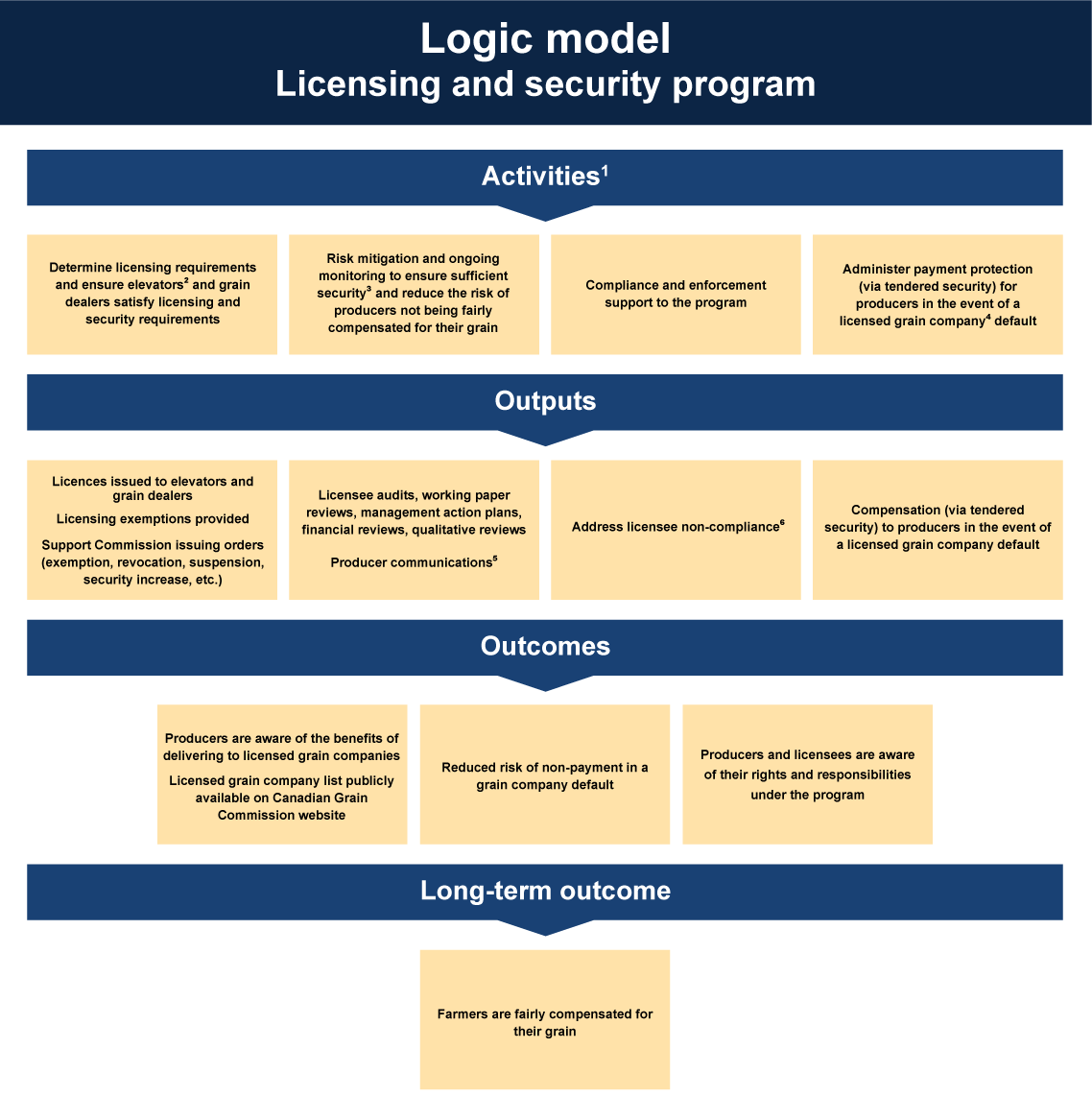
Text description and footnotes
Logic Model Licensing & Security Program
ActivitiesFootnote 1
- Determine licensing requirements and ensure elevatorsFootnote 2 and grain dealers satisfy licensing and security requirements
- Risk mitigation and ongoing monitoring to ensure sufficient securityFootnote 3 and reduce the risk of producers not being fairly compensated for their grain
- Compliance and enforcement support to the program
- Administer payment protection (via tendered security) for producers in the event of a licensed grain companyFootnote 4 default
Outputs
- Licences issued to elevators and grain dealers
Licensing exemptions provided
Support Commission issuing orders (exemption, revocation, suspension, security increase, etc.) - Lcensee audits, working paper reviews, management action plans, financial reviews, qualitative reviews
Producer communicationsFootnote 5 - Address licensee non complianceFootnote 6
- Compensation (via tendered security) to producers in the event of a licensed grain company default
Outcomes
- Producers are aware of the benefits of delivering to licensed grain companies
Licensed grain company list publicly available on Canadian Grain Commission website - Reduced risk of non-payment in a grain company default
- Producers and licensees are aware of their rights and responsibilities under the program
Long-term outcome
- Farmers are fairly compensated for their grain
2.3 Program description and activities
The Licensing and Security Program has 3 main units: Licensing, Audit and Compliance. These 3 units work closely together to administer the program.
The main activities of the Licensing unit include determining licensing eligibility of grain company applicants, issuing and renewing licences, and monitoring payment risk to producers by comparing reported liabilities with posted security. Licensing decisions remain with the Commission which has unfettered discretion in this area and is under no obligation to issue or renew a licence.
The main activities of the Audit unit include conducting audits and working paper reviews of licensed grain dealers and elevators. They also review financial statements of licensees to determine each company’s financial risk score. This score is used to determine security for first-time applicants, adjust or maintain ongoing security requirements, and to help determine a risk-based audit plan and other risk-mitigating actions.
The Compliance unit’s main role is to investigate producer or licensee complaints, to support producers in receiving fair compensation for their grain deliveries. This authority to investigate resides with the Commission and has been delegated to the program via By-Law 5.
The Compliance unit also supports the Licensing and Audit units by following up when licensees do not submit the required documents and/or information on time. Complaints may be escalated to the Compliance unit if needed for enforcement of licensees’ compliance with the Act, the Regulations, orders, and policies. The Act makes it a regulatory (quasi-criminal) offence to contravene any provision of the Act or Regulations or any order of the Commission, with the possibility of prosecution (see section 107(2) of the Act). The Canadian Grain Commission may refer a matter for prosecution, however, the decision to prosecute (or not) lies solely with the Public Prosecution Service of Canada.
When a licensee fails or refuses to pay producer(s), and there is a claim on security, all 3 units within the Licensing and Security Program work closely to determine which producer claims are eligible for compensation and the total that may be eligible for compensation. The Audit unit leads the claims process and conducts a final audit to determine if there are any outstanding liabilities to producers. The Licensing unit realizes on the posted security. The Licensing and Audit units work with the receiver of trustee in bankruptcy, if one is appointed. The Compliance unit takes calls from claimants and assists in collecting documentation needed for the claims process.
2.4 Program resources and funding
The program is housed within the Industry Services division and reports to the Director, Industry Services. Based on discussions with program staff, the program has evolved over time. In 2012, the program had approximately 14 staff plus 2 casual employees. After workforce adjustment in 2013, this dropped to approximately 7 staff. Since that time, the grain industry has evolved, and the activities of the program have evolved with it. As corporate structures and modes of operation of grain companies have become more complex, program resources needed to ensure the licensing program is applied appropriately have increased. Assessment of licensing requirements has become more complex and time-consuming, adding to the program’s administrative and analytical workload. Monitoring and audits of licensees has become more thorough, requiring more comprehensive financial information from companies. The program is also applying legislation and policy more thoroughly. Several new policies have been developed.
At the time of this evaluation there were a total of 18 employees working in the program and 2 vacancies:
- program manager
- senior program advisor (product owner for the Licensing Modernization Project)
- 6 staff in the Licensing unit
- 8 staff in the Audit unit
- 2 staff in the Compliance unit
The program receives a high level of support from Communications, Policy and Planning, Legal Counsel and the Commission. Finance also provides support in terms of fee setting and collection. Information Management and Technology Services (IMTS) provides support of software modernization. These supports are key to program service delivery.
The Commission has the authority and discretion to make key decisions that affect the program (including licensing and communication) and does so after consulting with Licensing and Security Program members.
A review of program activities showed that the program is involved in activities supporting other units including Statistics, Policy and Planning, Finance, Grain Inspection and Weighing.
2.5 Program budget
The Canadian Grain Commission is currently conducting a fee review and costing exercise. Estimated full costs by activity for the 2023 to 2024 fiscal year includes costs that have been broken down into 3 categories: direct program costs, program support costs and internal services.
Direct program costs are those costs assigned exclusively to the program. This includes salaries/over-time, and non salary elements such as travel, training, professional services, repair and maintenance, materials and supplies.
Program support costs include administration and management support, IMTS costs, and capital expenses allocated to supporting the program.
Internal services costs are allocated proportionately across all business lines and include senior management (Commissioners and Chief Operating Officer), Human Resources, IMTS, Statistics, Finance, Procurement, Policy and Planning, Internal Audit and Evaluation Services, Communications and the Project Management Office.
This estimate indicates full costs allocated to the program of approximately $5.4 million with approximately $2 million collected in revenue for the same year. The program is currently not fully cost-recovered. The Canadian Grain Commission’s fee-setting authority comes from:
- Canada Grain Act – Paragraph 116(1)r
- Canada Grain Regulations (C.R.C., c. 889) – Schedule I
The Canadian Grain Commission’s fee-setting authority was introduced in 1912 and last amended in 2024.Footnote 4
The program’s fee structure is tied to the Canadian Grain Commission’s cost recovery model to ensure that licensing fees reflect the administration costs of the program. This includes costs related to processing applications, ongoing compliance monitoring and audits, and financial risk assessments and related activities. The fee is set by allocating costs evenly to all licenses held. The Canadian Grain Commission periodically reviews and adjusts fees to align with operational costs and policy objectives. Licencing fees have not been adjusted since 2018 and as such no longer reflect current operating requirements of the program.
| Category of cost | Program Funds |
|---|---|
| Direct program | 2,043,697 |
| Program support | 1,420,877 |
| Internal services | 1,931,561 |
| Full costs | 5,396,135 |
| Revenues | 2,033,955 |
3. Methodology
This evaluation used multiple lines of evidence and triangulated findings to ensure reliability and validity of data and information. The evaluation team investigated the following lines of evidence:
- program information review
- document review
- existing data
- key informant interviews with staff, and internal and external stakeholders
The review of existing data and documents included internal documents, relevant legislation and guidance documents, reports and articles.
The evaluator interviewed program staff, management, producers, farm groups and licensees. Multiple attempts to reach producers were made by partnering with farm groups who sent invites to their membership using their communications channels. Other methods used to reach producers included direct Canadian Grain Commission promotion via organic posts on X (formerly Twitter), verbal invitations from the Commission, the Canadian Grain Commission’s website (grainscanada.gc.ca) and word of mouth. While this evaluation was conducted, several licensed grain company failures occurred with producers seeking compensation under the program. Despite efforts to reach these groups, the evaluator was only able to secure a small number of interviews with individual producers. No interviews were completed with producers who disclosed having experienced a failure and applying for compensation under the program. As a result, this evaluation is limited in its ability to comment on the experience of producers seeking compensation under the Licensing and Security Program. Views and opinions were collected from farm groups and from a small number of producers who were willing to participate. These views and opinions were used as proxy to inform the findings and recommendations in this report.
For a complete list of data sources and additional insight into the information gathered, refer to Appendix 2: Methodology.
4. Evaluation findings
4.1 Relevance
4.1.1 Continued need for the program
The program evaluation found significant evidence from multiple sources that the program is utilized and that there is a continued need for the program. While recent public consultations show strong support overall for maintaining the Licensing and Security Program,Footnote 5 feedback collected from internal and external stakeholders identified areas for improvement.
When asked during key informant interviews, producers and farm groups felt that the program is important and working well. In addition to producer protection, interviewees noted the value of using of official grain grades when buying and selling grains, Final Quality Determination, and following up on producer complaints regarding non-payment for grain deliveries.
Licensees reported during key informant interviews that there were significant program benefits to producers. Almost 60% of those interviewed felt that there were also benefits to licensees in terms of branding, reputation and producer confidence in dealing with licensed grain companies. Some felt the program offered few or no benefits to licensees. Those who felt there were little program benefits to licensees typically felt the costs outweighed the benefits and that a lack of producer awareness of the program eroded potential reputational and producer confidence benefits of being licensed.
Internal and external stakeholders interviewed also felt that the program is unique and does not duplicate any other programs or initiatives offered within the program’s jurisdiction. Other jurisdictions offer different programs, and the Licensing and Security Program recently completed a comparative analysis of programs in the United States and eastern Canada for the purposes of program improvement, such as informing future direction on establishing agreements with other jurisdictions and providing clarity to producers involved in claim processes in two or more jurisdictions. This comparative analysis is ongoing, and this evaluation makes no recommendations in this area.
Finding (R1): There is a continued need for the program. Several areas for improvement were identified
Recommendation (R1): Continue to improve the program with the recommendations noted in the report for improvement and/or enhancement.
4.2 Alignment with government priorities, roles and responsibilities
The program supports the Canadian Grain Commission’s mandate and federal government roles and responsibilities. The Act requires that most elevators and grain dealers that purchase or handle grain from western Canadian producers be licensed. The objectives of the licensing system are to provide the framework for establishing and maintaining Canada's grain quality assurance system, safeguards for producers, and data collection. The Canadian Grain Commission licensing system establishes a framework that allows the organization to establish the standards and procedures for handling, transporting and storing grain and the facilities used for those purposes.Footnote 5
The Canada Grain Act is federal legislation that establishes the Canadian Grain Commission and defines and outlines the authorities and responsibilities of the Commission. The ActFootnote 6 gives the Commission the discretion to issue licences to primary, process and terminal elevators and grain dealers, and when doing so to “fix” an appropriate amount of security. Subsection 49(2) of the Act gives the Commission the discretion and authority to realize on the security, if a licensed grain company refuses or fails to pay a producer. In a failure, the program uses the security to pay eligible producers what is owed to them. In addition, the ActFootnote 7 authorizes the Canadian Grain Commission to revoke or suspend a licence if a licensee does not maintain sufficient security, and to make regulations and orders pertaining to security.Footnote 8
By-Law No. 5 of the Canadian Grain Commission also supports program delivery. This by-law delegates the Commission’s authority, under the Act, to manage licensing and security.
The Canadian Grain Commission’s 2023 to 2024 Departmental results report identifies the organization’s core responsibility as grain regulation. To fulfill this responsibility, the Canadian Grain Commission works to achieve 2 departmental results:
- domestic and international markets regard Canadian grain as dependable and safe
- farmers are fairly compensated for their grain.Footnote 9
The Licensing and Security Program is highlighted in the Departmental results report as a key initiative to provide financial protection to grain producers and directly supports the Canadian Grain Commission’s mandate and core responsibility by acting to promote fair compensation for farmers for their grain.
Finding (R2): Program aligns with government priorities, roles and responsibilities.
Recommendation (R2): Continue to improve the program with the recommendations noted in the report for improvement and/or enhancement.
4.3 Performance
This program evaluation assesses the performance of the Canadian Grain Commission’s Licensing and Security Program and the extent to which it achieves its intended outcomes. It also reviews program performance against performance metrics. This assessment relies on a review of key documents, existing policy and program information and key informant interviews with program staff, and internal and external stakeholders. Overall, this evaluation sought evidence to indicate whether the program was meeting its main goals:
- reduced risk of non-payment in a grain company default
- licensee awareness of their rights and responsibilities under the program
- producer awareness of their rights and responsibilities under the program
- producers are fairly compensated for their grain
4.3.1 Unintended Consequences of the Program
Key informant interviews with program staff and external stakeholders highlighted unintended consequences of this program.
Restricted and lack of enforcement of unlicensed operators and grain dealers exempted from licensing due to the limited classes of licenses that do not reflect current industry practices have left some producers without protection. (As a statutory body, changes to the Canadian Grain Commission’s mechanisms for enforcement and licensing classes, such as strengthening enforcement and updating licensing classes, require changes to the Act).
The program may provide a false sense of security to some producers and a resulting lack of diligence in dealing with licensed grain companies and meeting other program eligibility requirements.
Some licensees feel that the program has facilitated an unfair playing field when they must incur the costs of Canadian Grain Commission licensing and compete at a cost disadvantage with unlicensed operators who may be operating in contravention of the Act.
Some licensees and farm groups interviewed perceived the onerous and costly nature of the program as a barrier to entry for new and smaller licensees. New licensees may have a higher risk level, and small licensees may bear licensing costs as a higher percentage of total overhead costs when compared to larger operators.
Farm groups have reiterated this concern and feel that a wider choice of licensed operators is preferable for producers.
4.3.2 Reduced risk of non-payment in a grain company default
This evaluation found evidence that the program is effective in addressing non-payment to producers in the event of a licensed grain company default. Between 2018 and 2024, eligible producers have received compensation for unpaid deliveries via the program in 9 instances. Compensation has been paid at 100% of eligible claims in 7 of those instances, 80% in one instance and 77% in 1 instance.Footnote 10 Without the program in place as it exists now, producers would not have received compensation for these deliveries. The Licensing and Security Program continues to seek ways to attain 100% payout and further improve program delivery. Total value in claims paid out over this period was approximately $42 million, with an additional $1.65 million paid from the proceeds of inventory and payments made under the Bankruptcy and Insolvency Act.Footnote 11
| Company | Crop year | Percentage payout | Number of producers paid |
|---|---|---|---|
| Global Food and Ingredients Inc. | 2024-2025 | 77% | 33 |
| LSM Grain Ltd. | 2024-2025 | 100% | 9 |
| Purely Canada Foods Corp | 2024-2025 | 100% | 78 |
| Zeghers Seed Inc o/a Zeghers Canada | 2023-2024 | 100% | 27 |
| W.A. Grain & Pulse Solutions | 2021-2022 | 80% | 126 |
| Pipeline Foods, ULC | 2021-2022 | 100% | 49 |
| CanPulse Foods Ltd. | 2020-2021 | 100% | 39 |
| Global Grain Canada Ltd. | 2020-2021 | 100% | 13 |
| Ilta Grain Inc. | 2018-2019 | 100% | 222 |
Source: History of payments to producers
An analysis of eligible claims over the period from 2018 to 2024 shows only two instances where 100% payout did not occur (W.A. Grain & Pulse Solutions and Global Food and Ingredients Inc.)). This was due to insufficient security in place. In these cases, the licensee had liabilities in excess of security at time of failure. This is a residual risk of the program, as liabilities are not monitored in real time and the program does not guarantee 100% coverage of liabilities at all times.
Producers may not have received compensation from this program in the event of a failure when they have not met the eligibility requirements (such as timeframes or type of grain) or have dealt with either an exempted or unlicensed operator.
Eligibility requirements are clearly outlined on the Canadian Grain Commission website and through communication outreach activities, and it is the producer’s responsibility to ensure that they meet these requirements.Footnote 12 In addition, conditions that must be met to qualify for a licence exemption are also clearly outlined on the Canadian Grain Commission website.Footnote 13
Moreover, the program has taken the following steps to protect producers from unlicensed companies operating in contravention of the Act:
- maintaining an up-to-date list of licensed grain companies on the Canadian Grain Commission’s website and encouraging producers to consult this list prior to conducting businessFootnote 14
- undertaking the 2006 Licensing Compliance Review, which many specialty crops companies cooperated with and became licensedFootnote 15
- developing, in 2012, a protocol regarding dealings with unlicensed operators with limited enforcement tools in place for operating without a licence, in part because the Act provides limited mechanisms for enforcement and strengthening enforcement requires changes to the Act.Footnote 16
Despite these efforts, some companies that may need to be licensed continue to conduct business without a licence or exemption. In 2012, an internal Audit of Licensing and Compliance was conducted. This audit recommended (high impact) furthering the program’s commitment to producer protection by addressing unlicensed operators:
“…recommend that the Canadian Grain Commission further pursue compliance with the Canada Grain Act by exercising the authorities granted by the Canada Grain Act to investigate and/or sanction operations that are in contravention”.Footnote 17
It should be noted that the Act does not give the Commission authority to sanction unlicensed grain companies. Being unlicensed is a regulatory offence under the Act and the only mechanism for enforcement is prosecution by the Public Prosecution Service of Canada.
This audit referenced consultations and highlighted the recommendation to support enforcement and compliance with licensing requirements:
"…consider introducing changes to make use of administrative penalties such as the “Administrative Monetary Penalties Act” (or AMs), in order to help promote compliance with the Canada Grain Act”Footnote 18
While the Agriculture and Agri-Food Administrative Monetary Penalties Act creates administrative monetary penalties for certain “agri-food” Acts, it is unclear if it can be amended to include the Canada Grain Act. This issue would have to be examined further in consultation Agriculture and Agri-Food Canada. As a result, new legislation or at least an amendment to the Agriculture and Agri-Food Administrative Monetary Penalties Act may be required to create administrative monetary penalties for offences under the Canada Grain Act.
The continued existence of unlicensed operators was one of the chief concerns highlighted during key informant interviews with producers and farm groups conducted during this evaluation. Producers interviewed reported that, in some cases, unlicensed companies offer a price premium as they do not pay Canadian Grain Commission licensing fees. Producers and farm groups interviewed during this evaluation, reported that the lack of enforcement has allowed an inequity into the market with licensed operators facing a cost disadvantage when competing with unlicensed operators.
Licensees interviewed also expressed similar concerns, noting they face a competitive disadvantage when unlicensed operators are allowed to compete without incurring the costs associated with holding a Canadian Grain Commission licence. They noted costs in terms of licensing fees as well as time and labour for reporting and audit requirements. This group expressed concern about unlicensed operators and the Canadian Grain Commission’s lack of enforcement and felt that this inequity creates a competitive disadvantage and erodes other benefits to being licensed by the Canadian Grain Commission such as brand recognition and producer confidence.
In addition, feedback collected during the recent Canada Grain Act Review public consultation highlighted the need to address licensing classes and a desire to go even further by:
- expanding producer payment protection to unlicensed buyers so that producers are protected for all deliveries
- conducting a comprehensive review of the current security-based model and consideration of other modelsFootnote 5
Grain statistics indicate that the majority of grain deliveries are to Canadian Grain Commission licensed facilities (when compared to unlicensed facilities). For the program to work, it is important that grain farmers have licensed facilities to sell grain to. The Canadian Grain Commission target for this measure is at least 86%. This target is typically met and was exceeded (87%) in the 2022 to 2023 crop year.Footnote 19 Despite the high percentage of grain deliveries to licensed companies, the existence of unlicensed operators continues to be a concern for external stakeholders.
Since the last comprehensive Act update in 1971, new types of grain businesses have joined the sector. Some operations are not licensed as they do not neatly fit into the existing classes or are exempt.Footnote 5 Feed mills, container loading facilities, producer car loading facilities and sales to eastern Canada were most frequently identified as a concern.
Interviews with program staff and management highlighted the need for internal policy development, potentially amendments to the Act and Regulations to address unlicensed operators while balancing the need to refuse licences to grain companies that are assessed as having a high level of financial risk. The following internal policy gaps were identified:
- internal escalation policy regarding unlicensed grain companies
- policy regarding publishing the names of unlicensed grain companies
- policy for licence refusals due to grain company high financial risk
- policy for setting minimum security and a threshold for licensing
- policy for refusal to issue a licence to extreme risk grain companies even if they can post the security
- opinion/guidance from Public Prosecution Service of Canada related to enforcement options (enforcement cannot be addressed by policy alone, but requires legislative change)
- policy clarifying existing licence exemptions and applicability
Finding (P1): Despite the high percentage of grain sales to licensed operators, the continued presence of unlicensed grain companies operating in contravention of the Act is highlighted as a stakeholder concern. At the time of this evaluation, stakeholders felt that this undermines the program’s ability to provide producer protection and facilitates a competitive advantage to unlicensed grain companies, which incur lower costs compared with licensed grain companies. Supporting internal policy development, amendments to the Act, and regulatory changes are needed to address unlicensed operators.
Finding (P2): External stakeholders are concerned that licence classes have not kept pace with the evolving industry, leading to an increase in exempt or unlicensed operators. New types of businesses have developed over time that do not fit into the prescribed licence classes. Under the existing program, producers dealing with these exempt operators are not eligible for compensation in the event of a failure. The Commission does not have authority under the Canada Grain Act to change the licence classes under the Act. Changes to the licence classes in section 42 of the Act will require legislative amendment. However, section 43 does allow the Commission, with approval of the Governor in Council to make regulations to create subclasses of licences.
Recommendation (P1): Develop and implement a revised enforcement plan to address unlicensed operators. This will require:
- for the regulatory area related to unlicensed operations, identification of further related policy gaps and development of internal supporting policy to allow the program to act within the limitations of the current Act.
- balancing the need to enforce licensing with the Commission’s discretionary authority to refuse a licence to any operator.
Recommendation (P2): Review and recommend updates to existing licence classes and their fit with the current environment with a focus on exemptions. As this will require Act/Regulatory changes which are within the authority of Agriculture and Agri-Food Canada, this will require:
- submitting a copy of this evaluation to the team at Agriculture and Agri-Food Canada responsible for the Canada Grain Act Review.
- for the regulatory areas related to licence classifications, development of internal supporting policy to allow the program to take action.
4.3.3 Licensee awareness of their rights and responsibilities under the program
Interviews were conducted with licensees regarding their program knowledge. Program staff views were also incorporated.
Licensees interviewed felt they were familiar with the requirements and their rights under the program. Many also reported that the program processes and documentation requirements (such as licence applications and renewals, liability reporting and audits/review) were not clear at the outset, took many years to learn, and can be onerous and costly for licensees in terms of person hours.
Reported areas causing the most confusion:
- licensing and security/bond requirements and reporting requirements for licensees who deal in multiple crops, some of which are exempt
- licensing classes for new types of grain businesses that have joined the industry since the last update to the Act, which may not fall into a licensing class or may be exempt (this may require further amendments to the Act or Regulations)
- requirement to be within security levels at all times, not merely at the end of the month or when liability reports are submitted
- how to report deferred producer payments when completing liability reports
- confusion over the eligibility of stocks in store
- requirements regarding transloading and special bins
- some licensees found audits onerous and confusing
- the difference between a working paper review and a full audit
Program staff reported a significant amount of time spent collecting the required documentation from licensees during licence applications, renewals, liability reporting and during audits/reviews. Time spent following up on late, incomplete, or incorrect information was highlighted as an area of interest for this evaluation.
Overall, the evaluation found that licensees reported a high level of satisfaction with the new MyCGC portal for submitting liability reports online. The portal alleviated confusion and reduced time spent on reporting. Some licensees indicated that they did not fully understand the liability reporting requirements and that their knowledge was greatly improved after an in-person audit. Others found that while the Canadian Grain Commission website and manuals were useful as training tools, in-person or phone support was more effective and that licensees would benefit from more substantial reference materials and video tutorials. Licensees interviewed also noted that turnover among their own staff results in an ongoing need for training regarding the Licensing and Security Program. Program staff reported a significant amount of resources currently spent on collecting, tracking and storing required documents (for licence applications and renewals, liability reporting and audits/reviews) due to lack of understanding of documents and format required and errors in reporting by licensees.
In addition, many licensees felt they would benefit from greater understanding and transparency around how their risk levels are assessed and scored and how security requirements are calculated. This was a key licensee concern with some feeling they are over insured and that new licensees are automatically assigned a high risk score and higher security requirements which may not be required in all cases. An external review of risk and security models is currently underway. (See Sec 4.4.4 for more detail.)
Licensees and some program staff felt that communications efforts have been focused on producers and may not effectively reach licensees. Licensees reported a preference for email over other communications channels and felt that email alerts issued when there are program-related updates posted on the Canadian Grain Commission website would be helpful.
Finding (P3): Recent significant improvements in this area and high level of satisfaction with program staff were reported. There is a need for licensee training on licence applications and renewals, liability reporting and audit review processes to address licensee program understanding, to improve service delivery and to reduce program resources spent on obtaining the required documentation from licensees.
Finding (pending external review): Key licensee concern was lack of clarity regarding how security and risk levels are set and whether they are fair and equitable. Risk and security models are currently under external review.
Recommendation (P3): Develop enhanced training and instruction activities for new licensees and new staff at existing licensees with consideration given to stakeholder requested methods of more in-person contact, phone support, enhanced reference materials and video tutorials. This will improve service delivery and better utilize program resources by reducing the number of errors in submitted reports. Specifically, licensees requested an improved information package to be provided to licensees prior to onsite audits and working paper reviews. This will require support from Communications.
Recommendation (P4): Develop and implement a licensee communication strategy to engage licensees with email focus and email alerts when new information relevant to the program is available on the Canadian Grain Commission website. This will require support from Communications.
4.3.4 Producer awareness of their rights and responsibilities under the program
A review of program history and legislation indicates that the program and the environment have evolved significantly over time. Part of this evolution has included a greater emphasis on producer responsibility and the need for producers to do their due diligence in their dealings with grain companies. Producers and farm groups interviewed show a low level of awareness of this evolution and the program’s current eligibility requirements. This may have led to misunderstood expectations of the program. A history of this evolution is outlined below.Footnote 20
- 1899: The Royal Commission on Grain Handling found a lack of competition and provided for licensing, bonding and supervision of grain dealers and railways via passing of the Manitoba Grain Act to promote producers receiving fair compensation for their grain
- 1912: The Canada Grain Act was created to maintain control over grain handling and trading in Canada
- 1930: The Canada Grain Act was revised to give the federal government greater control over grain handling and trading in Canada; this revision prohibited unlicensed elevators from accessing rail service and buying and selling grain using grade names (amongst other things)
- 1971: The Canada Grain Act was significantly overhauled to strengthen the licensing and security provisions in the Act, establish licence classes, and require, for the first time, Canadian Grain Commission licensing of all grain elevators and dealers to buy and sell grain grown in western Canada. These revisions also required the Canadian Grain Commission to establish applicants’ financial ability to do business prior to issuing a licence and placed some onus on the producers to obtain documentation (cash purchase ticket or elevator receipt) to be eligible for compensation in the event of a failure
While no significant Canada Grain Act changes have been implemented since 1971, the following targeted amendments and regulatory efforts were conducted:
- 1995: further targeted amendments to the Canada Grain Act included
- clarification of producers’ responsibility to deal with licensed operators (and determine licensing status)
- removal of the Canadian Grain Commission’s statutory obligation to satisfy a “financially able” standard for licensees (even though the Canadian Grain Commission would not have knowingly licenced a non-financially viable entity)
- clarification that the Canadian Grain Commission is not responsible for producer losses related to dealing with unlicensed grain buyers
- the Canadian Grain Commission is no longer held liable for producer losses due to licensee insolvency with insufficient security in place
- require producers to provide the required documentation (such as a cash purchase ticket) to make a valid claim under the program and notify the Canadian Grain Commission of a failure or default within 90 days of the delivery or 30 days from when the cash purchase ticket or cheque was issued (the lesser of the 2 applies)
- 2005: Parliament enacted an amendment to the Canada Grain Act that required an independent and comprehensive review of the Act and the Canadian Grain Commission
- 2007 and 2009: Bill C-39 and C-13 both proposed changes to the Act that included termination of the payment security program but were not passed
- 2012: The Jobs and Growth Act included targeted amendments to the Canada Grain Act to reduce regulatory burden and costs to producers. These amendments also enabled the Canadian Grain Commission to implement an insurance-based producer payment security model for licensees with the goal of providing more cost-effective liability coverage for farmers. However, while passed by Parliament, these specific amendments did not move forward due to unsuccessful negotiations for an insurance provider
- 2014: The Fair Rail for Grain Farmers Act, made amendments to the Canada Grain Act that allow the Canadian Grain Commission to regulate provisions in grain contracts between licensees and farmers to improve contract compliance
- 2014: Bill C-48 proposed amendments targeted at enhancing producer protection through the introduction of a producer compensation fund. The producer compensation fund would have protected producers in the event that a licensee failed to pay for grain deliveries. Bill C-48 did not pass before Parliament was dissolved for the 2015 general election.
- 2020: Amendments to the Act made it mandatory for anyone who sells grain to a licensed grain company to complete a declaration of eligibility.
- 2021: Agriculture and Agri-Food Canada launched a consultation regarding a review of the Act. Agriculture and Agri-Food Canada continues to explore next steps to modernize the Act and ensure that it meets the needs of the sector now and in the future.
Overall, the evaluation found that producer levels of understanding of the program vary widely with low levels of awareness amongst many producers. Producers who reported that they were aware of how to determine licensing status using the Canadian Grain Commission website also reported that not all producers choose to do this. Factors such as proximity and convenience of delivery, past history of dealings, trust and price were the main factors that determine who producers sell their grain to, sometimes superseding licensing status. The evaluator also found that producer understanding of program eligibility requirements and the 30/90-day eligibility windows varied. This was based on information collected from producers, farm groups, licensees and program staff. In addition, contracts that outline payment at the end of a series of deliveries may place producers out of the eligibility windows for earlier deliveries. Some producers are intentionally delaying receipt of payment for purposes of tax deferral without understanding the impacts on their eligibility to make a claim under the program. Licensees overwhelmingly reported a preference to pay via electronic funds transfer and to issue payment within the 30-day window. Licensees also reported that deferred payments and cheques were often at the request of the producer.
The evaluation analyzed confidential program claims data on claims and payouts under the program from 2018 to 2024. The analysis showed that approximately 17% of all claims were deemed ineligible. Of that total 17% of ineligible claims, about 74% were due to primary elevator receipts or grain receipts outside of the 90-day window. Another 18% were claims for ineligible grain.Footnote 21 The remainder of ineligible claims were due to deferred cheques or cheques outside of the eligibility window (approximately 8%).Footnote 22
Program staff and licensees were also asked about producer program awareness. Program staff and licensees both have frequent dealings with producers and reported that while there have been significant past efforts to increase producer program knowledge and communications by the Canadian Grain Commission and Licensing and Security Program, producers are not a homogenous group. Communications are not reaching all producer demographics. Producer demographics vary by factors including size of farm, years of operation, crops produced, use of technology, level of engagement with the Canadian Grain Commission’s Licensing and Security Program, geographical location and those who have or have not experienced the claims process. These different demographic groups have different levels of program understanding and different preferences for communications. Any efforts at producer communications or to increase producer knowledge about the program must account for the heterogeneous nature of western Canadian grain producers. It should also be recognized that some producers do not wish to engage with the program. The evaluator was not able to reach all segments of producers for interviews. Some farm groups also report similar challenges. The Licensing and Security Program does not have a comprehensive producer contact information database.
Preferred communications channels identified during this evaluation include the following:
- partnering with farm groups willing to share program information with their membership via their websites, newsletters and mailing lists and in-person events with producers
- continued presence at agricultural tradeshows
- local radio and podcasts during harvest season
- in-person local outreach meetings
- email alerts when Canadian Grain Commission communications are posted on the website (for farm groups)
- concise educational materials focused on the producer eligibility requirements (for producers)
Program elements that are commonly misunderstood:
- misconception that the program is responsible for covering claims that do not meet eligibility requirements
- producer is responsible to ensure they are meeting eligibility requirements
- while the Canadian Grain Commission would not knowingly licence a non-financially viable entity, it is not the responsibility of the program to determine financial viability of licensed grain companies
- it is not a requirement of the program to predict grain company failures, rather to estimate and set sufficient licensee security requirements to cover liabilities in the event of a failure
Finding (P5): There is a need to clarify and communicate the role of the program and producer responsibilities under the program. Specifically, the program does not cover ineligible claims, and the producer is responsible to ensure they are meeting eligibility requirements.
Finding (P5): There is a need to increase producer knowledge of the program and operational communications with the understanding that there are different producer demographics that prefer different communications channels. Producers are not a homogeneous group. Some producers may choose not to engage with the program and by doing so, may render themselves ineligible for compensation. Despite the Canadian Grain Commission’s significant past efforts in this area, program information is not reaching all producers.
Recommendation (P5): Implement improved producer program knowledge and communication plan focused on producer responsibilities and eligibility. The plan should use a segmented multi-prong approach to reach different producer demographics using new and targeted communications channels. Information gained during this evaluation will provide insight.
4.3.5 Producers are fairly compensated for their grain
Section 4.3.1 addressed the critical role of the program in reducing the risk of non-payment during a licensee failure to meet payment obligations to producers. Activities outside of a failure situation were also reviewed.
According to GC InfoBase grain statistics, farmers have been fairly compensated for their grain 99.99% of the time over the past 10 years. Fair compensation is defined as “Farmers are fairly compensated if they are treated in accordance with the rules and processes set out in the Canada Grain Act and the Canada Grain Regulations. Notes: All complaints received from farmers are investigated to facilitate compensation in accordance with the requirements under Canada Grain Act and Canada Grain Regulations. While the results will be close to 100 percent, the indicator provides evidence that Canadian Grain Commission programs and services are achieving the intended result.”Footnote 19
The Compliance unit responds to producer complaints and assists in producer payments and requests for Final Quality Determination.Footnote 23 Building on a medium-impact recommendation from the 2012 Audit of Licensing and Compliance to record complaints and inquiriesFootnote 24 records of these interactions could be better collected and reported to highlight the value of compliance activities and inform future program decisions.
Finding (P6): The program provides support so that producers are fairly compensated for their grain outside of a failure and claims situation. Due to a lack of activity tracking and metrics, it is difficult to demonstrate the value of this unit.
Recommendation (P6): Compliance unit to develop a new activity tracking tool to collect metrics on payments to producers with whom they have worked to facilitate payments and other ways in which they have supported producer protection and the Licensing and Audit units.
4.4 Efficiency and enhancements
There is perceived high cost to this program. Current revenues do not cover program costs, and a fee review is underway. Simultaneously, the program has indicated it is constrained by current resource levels. Prior to recommendation of additional resources, the evaluation reviewed utilization of existing resources, highlighting areas for efficiency improvements.
4.4.1 Database requirements
The Licensing and Security Program assigned 1 full time equivalent employee to advise on the MyCGC portal project beginning in January 2021 and the recent Licensing Modernization Project. This became a permanent appointment in March 2025. In addition, several other program staff have provided their input as subject matter experts, as needed.
The roll-out of the MyCGC portal for licensees to submit liability reports has been well received. Licensees interviewed reported a high level of satisfaction with the portal and a high level of satisfaction overall with the support they have received from Licensing and Security Program staff in all units. The portal functionality, however, has not been timely and does not currently address other licensee reporting such as licence applications and renewals, audits/reviews or compliance and enforcement activities.
The evaluator was able to collect limited documentation regarding the MyCGC project. Information collected verbally indicates that the MyCGC portal project began during the 2020 to 2021 fiscal year and started providing full liability reporting functionality in October 2023. The automation of the majority of additional critical functions has a timeline that extends beyond 2 years. The Hub, the internal interface of MyCGC, is in the early stages of development. During key informant internal interviews, program leads/management reported concerns about the suitability and functionality of the Hub for future internal systems requirements and the timeliness of delivery. The more recent Licensing Modernization Project has made advances after the completion of information collection for this evaluation and continues to address these internal systems requirements.
In the interim, the program maintains separate systems and spreadsheets for internal information management. This includes new licence applications, renewals, fee payments, risk scoring, liability reports, setting and monitoring security levels, audits/reviews, claims, claim eligibility, payouts, compliance and enforcement activities and producer and licensee contact information management. During the evaluation, users reported that some of the legacy systems currently in use do not reflect modernized program processes, are based on outdated coding and are at high risk of losing IT support. Some of these legacy systems are sensitive to connectivity interruptions and loss of data, resulting in re-entry. As a result, program staff have created numerous spreadsheets to work around these legacy systems and program staff are manually entering the same information into these multiple spreadsheets repeatedly. This duplication of manual data entry utilizes significant resources. In addition, program staff and management cannot easily pull up information collected by other units and summarize it in one place. The Head of Audit must manually open multiple files to check the status of ongoing audits rather than having a dashboard view that reports audit status as is standard practice with current audit software. This patchwork system of information management limits the program’s ability to produce meaningful and comprehensive reports for decision making. The lack of a contact management system creates situations where Licensing, Audit and Compliance units may not be aware of each other’s ongoing contacts and communications with licensees which sometimes interferes with seamless service delivery.
Staff consistently reported the need for a customized centralized database using a licensee identifier that combines the existing systems and spreadsheets into one source, enabling the program to make timely and accurate decisions regarding licensees and licensing status. This would require an updated needs assessment focused on finding a system that maintains the current high level of data security and confidentiality. The following functionalities were highlighted as requirements for any new database:
- records and document management
- reporting and look-up functionality based on licensee identifier
- ability to display all licensee contacts and records in one place (such as licensing status and contact information, liability reporting, licensee risk scoring and monitoring, audits/review tracking and status, contact management, producer complaints, claims, eligibility and payouts)
- dashboard reporting
The Licensing Modernization Project, which aims to address this, is jointly managed by different groups. The Project Management Office is responsible for managing the scope, schedule and budget. IMTS oversees technology development and related timelines. The senior program advisor within the Licensing and Security Program is the product owner with responsibility for setting user needs and priorities for development. These roles and responsibilities are sometimes overlapping or are unclear.
The following are currently in development:
- project charter and timelines for Licensing Modernization Project completion
- maintenance of MyCGC and the Hub
- additional functionality and reports within MyCGC
- Requirements for training and internal skill development
Finding (E1): Project is underway with a focus on business process improvement and modernization. The Project Management Office, IMTS, and the Licensing and Security Product Owner jointly manage the project roles, responsibilities and timelines, which are sometimes unclear. Concerns about consistency of approach, project charter and internal skill sets and systems training were reported during the evaluation. Current efforts are not meeting program needs.
Recommendation (E1): Leveraging technology to support modernization and program delivery is a key priority to increase program efficiency, improve quality of service delivery, enhance producer protection, reduce errors and optimize program resource utilization. This project is a key organizational priority. Identify project roadblocks and create an implementation plan to address these roadblocks with a focus on further project efficiency and advancing deadlines and delivery and meeting the program’s service delivery needs. This may require extra support or fast tracking.
4.4.2 International Organization for Standardization (ISO) certification and quality management system
During Canadian Grain Commission workforce adjustments in the 2013 to 2014 fiscal year, the Licensing and Security Program was moved from Corporate Services into Industry Services. As Industry Services was seeking International Organization for Standardization (ISO) certification for the division, gaining ISO certification for the Licensing and Security Program became a priority for divisional leadership. In addition, a 2012 Audit of Licensing and Compliance recommended (low impact) implementation of an enhanced internal quality management system. At that time, there was a cultural shift due to two high-profile licensed grain company failures and resulting court proceedings, which highlighted the need to bring rigor to the program and its licensing processes.
Since then, the program has focused on its quality management system while also completing ISO certification in 2024. According to discussions with internal stakeholders and program staff interviews, the quality management system has brought significant and ongoing improvement to the program, including completion of manuals and work instructions. These are now completed and evergreen. Internal service standards have been implemented for each unit. External service standards are in place for the licensing function.Footnote 25 All full-term and short-term licence service standards have been exceeded since tracking began in 2020.
Program staff and internal stakeholders felt that ISO certification, however, has offered limited value for this program and uses a significant amount of program resources that could be better utilized. According to the ISO website, benefits of ISO certification include better process integration, time savings and improved decision making. It was felt that these benefits have been achieved by the internal quality management system. Another stated benefit of ISO certification is consumer confidence, credibility and reputational value. Program staff report that external parties do not inquire about ISO certification, are typically not aware of it and certification has not provided any reputational benefits (one of the generally accepted benefits of ISO certification).Footnote 26
Finding (E2): Efforts to pursue ISO certification for this program have been consuming the program’s limited resources and provide little value to the program or stakeholders.
Recommendation (E2): Discontinue ISO certification to reduce demands on existing staff, improve service delivery and better utilize existing resources. Continue with current quality management system which has been implemented and is providing ongoing value.
4.4.3 Resource utilization
Several recent efficiency improvements were noted during the evaluation that have reduced demands on existing staff:
- reduction and streamlining of Commission reporting
- MyCGC portal (e-services) improvements for submitting liability reports, which has reduced questions received from licensees and the amount of time program staff spend following up on report information
- implementation of templates for collecting licensee information where possible
- streamlining of audit review processes where possible
The evaluation highlighted additional areas for potential efficiency gains to reduce demands on existing staff:
- streamline the approvals processes for program-related public communications
- further streamline audit/review processes
- improve connectivity and tech support when conducting onsite audit; there are currently an insufficient number of mobile Wi-Fi units and staff must share them when conducting onsite audits
- the current solution for onsite connectivity when conducting onsite audits is use of mobile Wi-Fi units; insufficient number of these mobile units is currently causing inefficient use of resources; program efficiency could be improved by ensuring sufficient units are available
- if needed, assign supplemental resources during a licensed grain company failure
- support for policy development related to the program
- revisit program resources and responsibilities around information collection for other departments, such as weighing certificates for initial licensing, penalty clause, Canada-United States-Mexico Agreement (CUSMA) declarations of eligibility and monitoring, etc.
While these activities may be program-related and key to other units within the Canadian Grain Commission, the program has not been resourced for these additional activities potentially impacting service delivery.
Finding (E3): Areas highlighted for efficiency improvements to reduce demands on staff, further improve service delivery and move towards reducing program costs.
Recommendation (E3): Implement program changes to improve resource utilization as follows:
- streamline audit processes
- implement a connectivity solution that provides readily available connectivity for onsite audits (the current status of Mobile Wi-Fi units for on-site audits is not meeting program needs)
- examine the internal communications approvals processes for opportunities to streamline the process
- revisit program resources and responsibilities around information collection
- provide additional resources, if needed, to the program during an active failure to facilitate continuity of service delivery
- examine the level of policy support to the program, seeking opportunities to further free up program resources
4.4.4 Risk scoring and security model external review
An external review of the risk scoring and security setting models utilized by the program is currently underway with the following goals considering applicable best industry practices:
- review both models’ current performance
- look for further enhancement opportunities
- improve efficiency of both models for timely service delivery
Licensees have expressed concerns about lack of transparency in how risk scores are calculated and how security is set. Some licensees feel that they are over-insured, and some new licensees feel that they have received an unfairly high risk score simply because they are new, which may not be true in all cases and may not reflect their financial strength/risk profile.
Finding (E4): In the interests of continuous program improvement and improved service delivery, the program has initiated a review of risk scoring and security model methodology. This review is currently underway.
Recommendation (E4): Forward licensee feedback regarding transparency of risk and security models for consideration as part of the external review that is currently underway. (No management action plan needed)
5. Conclusion
This evaluation found significant evidence to support the continued need for the Canadian Grain Commission’s Licensing and Security Program. The program is well-utilized, is achieving its intended outcomes, and aligns with government priorities, roles and responsibilities.
Areas for program improvement were found. The continued presence of unlicensed grain companies operating in contravention of the Canada Grain Act undermines the program’s ability to provide producer protection. It also facilitates a competitive advantage to unlicensed grain companies, which incur lower costs compared with licensed operators. The costs to licensees to comply with the program were seen as a potential barrier to entry for new and small operators. There are significant opportunities to improve the program through continued communication with producers to increase their program knowledge, and communication with and training of licensees.
This evaluation also provides several recommendations to improve program efficiency and resource utilization. The most significant of these recommendations is related to the timely implementation of a customized, centralized database that uses licensee identifiers, combines the existing systems and spreadsheets into one source, and includes functions for reporting and contact management.
6. Acknowledgement
The Chief Audit and Evaluation Executive would like to thank the evaluation working group, Finance department, evaluation team and individuals who contributed insights and input to this evaluation.
7. Use of artificial intelligence (AI)
Artificial intelligence (Microsoft Copilot) was used in the production of this report to summarize and analyze publicly available documents and to produce and refine written sections of report. The final report was professionally reviewed by humans for accuracy.
Appendix 1: Findings, recommendations and management action plans
The Director Industry Services is responsible for implementation of management action plans (MAPs) other than where specifically noted. Management agrees with all recommendations.
| Relevance (2) | Observation and findings | Potential impact | Recommendations | Management action plans |
|---|---|---|---|---|
| (R1) 4.1.1 Continued need for program | There is a continued need for the program. Several areas for improvement were identified. | Continuous program improvement | Continue to improve the program with the recommendations noted in the report for improvement and/or enhancement. | No MAPs required |
| (R2) 4.2 Alignment with government priorities, roles and responsibilities | Program aligns with government priorities roles and responsibilities. | Continuous program improvement | Continue to improve the program with the recommendations noted in the report for improvement and/or enhancement. | No MAPs required |
| Performance (6) | Observation and findings | Potential impact | Recommendations | Management action plans |
| (P1) 4.3.2a Address unlicensed operators | Despite the high percentage of grain sales to licensed operators, the continued presence of unlicensed grain companies operating in contravention of the Act is highlighted as a stakeholder concern. Stakeholders feel that this undermines the program’s ability to provide producer protection and facilitates a competitive advantage to unlicensed grain companies which incur lower costs compared with licensed grain companies. Supporting internal policy development, amendment to the Act, and regulatory changes may be needed to address unlicensed operators. | Service delivery impacts. | Develop and implement a revised enforcement plan to address unlicensed operators. This will require
| Management agrees with this recommendation. Director of Industry Services and the Executive Director, Innovation and Strategy are jointly responsible for implementation of this MAP. In fall 2025 the Canadian Grain Commission will commence a broad regulatory review of the activities and parameters of the safeguards program that will encompass the following elements relating to unlicensed operators:
These deliverables will be developed within the context of the existing legislative framework. These deliverables will be approved by Chief Operating Officer by December 30, 2026. Note – as Act changes are outside of the Canadian Grain Commission’s control, any recommendations for legislative changes that are identified as a result of this analysis will be shared with Agriculture and Agri-Food Canada’s Strategic Policy Branch in its capacity as lead on Canada Grain Act review. |
| (P2) 4.3.2b Review of licence classes | External stakeholders are concerned that licence classes have not kept pace with the evolving industry leading to an increase in exempt or unlicensed operators. New types of businesses have developed over time that do not fit into the prescribed licence classes. Under the existing program, producers dealing with these exempt operators are not eligible for compensation in the event of a failure. | Service delivery impacts. | Review and recommend updates to existing licence classes and their fit with the current environment with a focus on exemptions. As this will require Act/Regulatory changes which are within the authority of Agriculture and Agri-Food Canada, this will require:
| Management agrees with this recommendation. Director, Industry Services and the Executive Director, Innovation and Strategy are jointly responsible for implementation of MAP. In fall 2025 the Canadian Grain Commission will commence a broad regulatory review of the activities and parameters of the Safeguards for Grain Farmers Program that will encompass the following elements relating to licence classes:
These deliverables will be developed within the context of the existing legislative framework. These deliverables will be approved by Chief Operating Officer by December 30, 2026. Note – as Act changes are outside of the Canadian Grain Commission’s control, any recommendations for legislative changes that are identified as a result of this analysis will be shared with Agriculture and Agri-Food Canada’s Strategic Policy Branch in its capacity as lead on Canada Grain Act review. |
| (P3) 4.3.3a Licensee training | Recent significant improvements in this area and high level of satisfaction with program staff were reported. There is a need for licensee training on licence applications and renewals, liability reporting and audit review processes to address licensee program understanding, to improve service delivery and to reduce program resources spent on obtaining the required documentation from licensees. | Service delivery impacts. | Develop enhanced training and instruction activities for new licensees and new staff at existing licensees with consideration given to stakeholder requested methods of more in-person contact, phone support, enhanced reference materials and video tutorials. This will improve service delivery and better utilize program resources by reducing the number of errors in submitted reports. Specifically, licensees requested an improved information package to be provided to licensees prior to onsite audits and working paper reviews. This will require support from Communications. | Director, Industry Services is responsible for implementation of this MAP with support from the Executive Director, Innovation and Strategy
Management will incorporate reporting on the status of support and training for licensees, as part of regular reporting on the MyCGC Licencing Modernization project to DAC, twice yearly until December 2027 |
| (P4) 4.3.3b Licensee communication plan | (same as above) | Service delivery impacts | Develop and implement a licensee communication strategy to engage licensees with email focus and email alerts when new information relevant to the program is available on the Canadian Grain Commission website. This will require support from Communications. | Management agrees with this recommendation. Executive Director, Innovation and Strategy is responsible for implementation of this MAP. The Canadian Grain Commission will implement an email subscription service that will be available to licensees. This deliverable will be implemented by March 30, 2026 Canadian Grain Commission will implement the MyCGC message centre to communicate information directly to licensees. This deliverable will be completed by March 30, 2027 |
| (P5) 4.3.4 Producer communications and program knowledge |
| Service delivery impacts | Implement improved producer program knowledge and communication plan focused on producer responsibilities and eligibility. The plan should use a segmented multi-prong approach to reach different producer demographics using new and targeted communications channels. Information gained during this evaluation will provide insight. | Management agrees with this recommendation. Executive Director Innovation and Strategy will be responsible for implementation of this MAP with support from Director, Industry Services.
These deliverables will be completed by March 30, 2027
|
| (P6) 4.3.5 Tracking compliance activities and results | The program provides support so that producers are fairly compensated for their grain outside of a failure and claims situation. Due to a lack of activity tracking and metrics, it is difficult to demonstrate the value of this unit. | Program decision making. | Compliance unit to develop a new activity tracking tool to collect metrics on payments to producers with whom they have worked to facilitate payments and other ways in which they have supported producer protection and the Licensing and Audit units. | Management agrees with this recommendation. Director, Industry Services is responsible for implementation of this MAP
|
| Program Efficiency & Enhancement (4) | Observation and findings | Potential impact | Recommendations | Management action plans |
| (E1) 4.4.1 Database requirements | Project is underway with a focus on business process improvement and modernization. The Project Management Office, IMTS, and the Licensing and Security Product Owner jointly manage the project roles, responsibilities and timelines, which are sometimes unclear. Concerns about consistency of approach, project charter and internal skill sets and systems training were reported during the evaluation. Current efforts are not meeting program needs. | Resource Utilization | Leveraging technology to support modernization and program delivery is a key priority to increase program efficiency, improve quality of service delivery, enhance producer protection, reduce errors and optimize program resource utilization. This project is a key organizational priority. Identify project roadblocks and create an implementation plan to address these roadblocks with a focus on further project efficiency and advancing deadlines and delivery and meeting the program’s service delivery needs. This may require extra support or fast tracking. | Management agrees with this recommendation. Chief Operating Officer is responsible for implementation of this MAP.
|
| (E2) 4.4.2 ISO certification | Efforts to pursue ISO certification have been consuming the program’s limited resources and provide little value to the program or stakeholders. | Resource Utilization | Discontinue ISO certification to reduce demands on existing staff, improve service delivery and better utilize existing resources. Continue with current quality management system which has been implemented and is providing ongoing value. | Management agrees with this recommendation. Director, Industry Services is responsible for implementation of this MAP.
|
| (E3) 4.4.3 Resource utilization | Areas highlighted for efficiency improvements to reduce demands on staff, further improve service delivery and move towards reducing program costs. | Resource Utilization | Implement program changes to improve resource utilization as follows:
| Management agrees with this recommendation.
|
| (E4) 4.4.4 External review risk scoring and security model | In the interests of continuous program improvement and improved service delivery, the program has initiated a review of risk scoring and security model methodology. This review is currently underway. | Increased risk to the organization / adherence to best practices | Forward licensee feedback regarding transparency of risk and security models for consideration as part of the external review that is currently underway. (No MAPs needed). | No MAPs required. |
Appendix 2: Methodology
Program information review
- Framework and flowchart
- Work instructions and manuals
- Service standards and performance metrics
- Staffing information
- Discussions with the program manager and unit managers
Document review
The documents reviewed include:
- Canada Grain Act
- Canadian Grain Commission By-Law No.5
- Relevant internal policies and briefs
- Legal opinions and documents
- Canadian Grain Commission’s 2023 to 2024 Departmental results report
- 2025 to 2028 Strategic Plan
- Commission documents
- Publicly available mandate letters from the period in scope (2022)
- Public consultation documents (Canada Grain Act Review)
- Relevant news articles (over 100)
- Farm group websites and policy papers
Existing data
- Claims data
- Licensee data
- Fees review and costing exercise information
- Past audit and reviews
Key informant interviews
Key informant interviews were conducted with relevant groups to capture a wide range of views and opinions regarding the program. Interviews were conducted during 2024 to 2025 and 2025 to 2026 fiscal years.
Invitations to interview were sent externally to producers, farm groups and licensees and were conducted virtually or in person and offered in both official languages. Interviews with key informants consisted of both open-ended and scale questions. The interview questions were designed to gather key informant views on relevance and program performance. Responses were collected, analyzed and summarized and used to inform recommendations made in this report. Names of interview respondents and their responses were kept confidential.
25 interviews with producers and farm groups were conducted by the evaluator. These two groups were combined for analysis to represent producer views. As the Canadian Grain Commission does not have a comprehensive database of all producers the evaluator is unable to provide a response rate for this external stakeholder group.
Multiple interviews were conducted with licensees representing 36 separate licensed companies. At the time of evaluation, this represented over 20% of total Canadian Grain Commission licences with some grain companies having multiple licences.
The evaluator found multiple instances of cross-over where interviewee had multiple roles (licensee, producer and farm group). The key informant was interviewed in the role that they self selected.
Invitations to interview internally were sent to Licensing and Security Program staff, and internal stakeholders including, Finance, Project Management Office and IMTS. 100% of these invitations resulted in an interview.
Constraints and limitations
The following methodological constraints and limitations were identified during the evaluation. Steps taken to mitigate their impacts are included.
Constraint: Difficulty reaching producers for key informant interviews. Extensive efforts were made to reach this group of key informants. Invitations were delivered through several different channels:
- via farm groups representing various locations and crop types
- promotion via organic posts on X (Twitter)
- Invitations from Commission and Executive Director, Innovation and Strategy, during public meetings
- snowball approach – asking interviewees to pass on the invitation to other producers
Response was limited and resulting sample sizes were small. It should be noted that none of the producers interviewed disclosed having participated in a claims event. This limits the ability of this evaluation to make recommendations regarding the claims process.
Mitigation: Views and opinions from farm groups and producers interviewed and program claims data were used to support findings in this area. Other sources of information were used to supplement these findings.
Constraint: Lack of activity tracking and impact of the Compliance unit. This group is involved in many activities that support producers and support other units in the program. Due to the lack of tracking data, the evaluator was not able to fully assess the benefits provided by this group and their effectiveness.
Mitigation: Evaluator conducted key informant interviews to collect information in this area.
Constraint: Other initiatives and reviews concurrently underway such as the Portal Project, External Review of the Program’s Security and Risk Model and the Canadian Grain Commission Fee Review impact the evaluator’s ability to make recommendations in these areas.
Mitigation: Evaluation deferred to findings pending from these other engagements.
Constraint: Potential for self-selection bias in the key informant interviews of external stakeholders could means some demographic groups are over or under represented.
Mitigation: Other supporting sources of information were used to support finding and recommendations. (Canada Grain Act Review public consultations, media articles and publicly available policy documents from farm groups)