
Official Grain Grading Guide
Rye: Grading factors
Full list of grading factors
- Broken (BKN)
- Contaminated grain
- Degermed kernels (DGM)
- Earth pellets
- Ergot (ERG)
- Excreta (EXCR)
- Extraneous material
- Fertilizer pellets (FERT PLTS)
- Fireburnt kernels (FBNT)
- Foreign material (FM)
- Fusarium damage (FUS DMG)
- Heated kernels (HTD)
- Matter other than cereal grains (MOTCG)
- Mineral matter (MIN MAT)
- Odour (ODOR)
- Other cereal grains excluding wheat (OCGXWHT)
- Rotted (ROT)
- Sclerotinia sclerotiorum (SCL)
- Smudge (SM)
- Soft earth pellets (SEP)
- Sprouted kernels (SPTD)
- Stones (STNS)
- Test weight (TWT)
- Treated seed and other chemical substances
- Varieties
- Wheat (WHT)
Important: Images may vary in appearance due to factors such as monitor settings, viewing distance/angle and surrounding light.
B
Broken (BKN)
Broken kernels are pieces of rye that are less than three-quarters of a whole kernel.
- If the broken kernel has been chewed by insects, it is also considered broken for grading purposes if no mould is evident on the exposed endosperm.
- If the broken kernel has mould on exposed endosperm, it is graded relative to the degree of soundness.
Procedure
- In samples graded ‘Rye, Sample CW/CE Account Broken Grain’ or ‘Rye, Sample Broken Grain’, handpick any broken rye removed in cleaning but remaining on top of the numberNo. 4.5 round-hole hand sieve. Return it to the cleaned sample.
C
Contaminated grain (CONTAM GRN)
Important: Wear gloves and a mask to handle any sample that is suspected of containing contaminated grain.
Grain is contaminated for the purposes of the Canada Grain Act if the grain contains any substance in sufficient quantity that the grain is either
- adulterated for the purposes of the Food and Drugs Act; or
- contaminated within the meaning of the regulations made under section 51 of the Safe Foods for Canadians Act.
Treated seed
Treated seed is grain that has been adulterated with an agricultural chemical for agronomic purposes. The types of agricultural chemicals used to treat seed include pesticides, fungicides and inoculants. These seed dressings contain a dye to render the treated seed visually conspicuous. The colour of the dye varies depending upon the type of treatment and the type of grain. The current Canadian colour standard for pesticide and fungicide seed treatments for cereal (including corn) is red or pink. The colour standard for pesticide and fungicide seed treatments for canola is blue; however, green has also been used. Pulse crop (including soybeans) pesticide and fungicide seed treatments are typically blue or green. The coatings or stains may appear greasy or powdery and the surface area covered may range from tiny flecks to complete coverage.
Other chemical substances
Other chemical substances refers to any chemical residues either adhering to the kernel or remaining in the sample and to samples having a chemical odour of any kind.
Extraneous material
Can be defined as glass, metal, wood (including wood pellets), plastic or any other material not already defined in the Official Grain Grading Guide.
Procedure
If a sample is suspected of being coated with a pesticide, desiccant, inoculant or if the sample contains evidence of extraneous material, including any foreign chemical substance other than fertilizer pellets (FERT PLTS), the sample shall be graded ‘Rye, Held IP Suspect Contaminated Grain’ and submitted to the Canadian Grain Commission. Determination as to whether grain is contaminated will be made by the Grain Research Laboratory in consultation with the Chief Grain Inspector for Canada.
Samples deemed to be contaminated are graded ‘Rye, Sample Condemned’.
D
Degermed kernels (DGM)
-
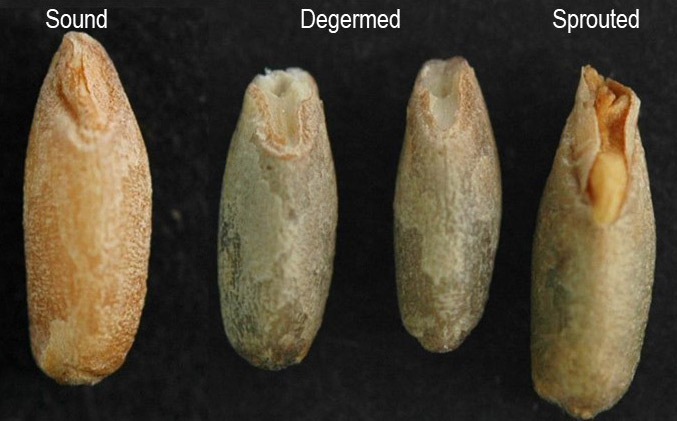
Degermed rye kernels: kernel on left is sound for comparison. Kernel on right is sprouted for comparison.
Degermed kernels
- Are considered Sprouted (SPTD) if the sample contains other sprouted kernels
- Are considered sound if the sample contains no other sprouted kernels
E
Earth pellets
- Hard earth pellets are pellets that do not crumble under light pressure. See Stones (STNS).
- Soft earth pellets are pellets that crumble under light pressure. See Soft earth pellets (SEP).
Ergot (ERG)
Ergot is a plant disease producing elongated fungal bodies that have a purplish-black exterior, a purplish-white to off-white interior, and a relatively smooth surface texture.
Excreta (EXCR)
Excrement from any animal including mammals, birds and insects.
Important : Wear gloves and a mask to handle any samples that you suspect may contain excreta.
Extraneous material
F
Fertilizer pellets (FERT PLTS)
Fertilizer pellets are a manufactured plant nutrient product used by producers in the production of grain. They are typically small, round or irregular shaped and usually white, grey, brown, pink or reddish in colour.
Procedure
- Handpick any fertilizer pellets and determine the concentration in the net working sample.
- Fertilizer pellets are assessed as stones (STNS) when the concentration does not exceed 1.0% of the net sample weight.
- Samples containing fertilizer pellets in excess of 1.0% of the net sample weight are graded 'Rye, Held IP Suspect Contaminated Grain'. The sample should be submitted to the Canadian Grain Commission. Determination as to whether grain is contaminated will be made by the Grain Research Laboratory in consultation with the Chief Grain Inspector for Canada. Samples deemed to be contaminated are graded 'Rye, Sample Condemned'.
Fireburnt kernels (FBNT)
Fireburnt kernels are charred or scorched by fire. A cross-section of a fireburnt kernel resembles charcoal with numerous air holes. The air holes result in a low-weight kernel which crumbles easily under pressure.
Foreign material (FM)
Foreign material in rye includes all material other than whole or broken rye kernels that remain in the sample after the removal of dockage.
Fusarium damage (FUS DMG)
Fusarium-damaged kernels in rye are chalk-like in appearance and frequently have a fibrous growth in the kernel crease. Rye has a shallow crease and therefore the fibrous growth is frequently removed during handling.
Procedure
Separate all kernels showing any evidence of fusarium damage, including any kernels that have a chalk-like appearance. Apply the following guidelines.
Fusarium-damaged kernels include
- Chalk-like kernels in combination with a fibrous mould
- Chalk-like kernels without the fibrous mould if the mould is present on other chalk-like kernels in the sample
Do not include
- Chalk-like kernels without the fibrous mould if there are no other chalk-like kernels with mould in the sample
H
Heated kernels (HTD)
Heated kernels are red or orange and have the odour typical of grain that has deteriorated in storage or has been damaged by artificial drying. Heated rye is not easily detected because of the natural colour variations that occur in sound rye.
Rotted kernels are included in the tolerance for heated kernels.
Heated seeds of other grains are included in the tolerance for heated kernels.
M
Matter other than cereal grains (MOTCG)
Matter other than cereal grains includes the following material remaining in the cleaned sample:
- Seeds such as ragweed, Tartary buckwheat, rye grass, wild oats
- Non-cereal domestic grains such as canola, flaxseed, corn, peas, buckwheat or lentils
Mineral matter (MIN MAT)
Mineral matter refers to stones (STNS), earth pellets (EP), fertilizer pellets (FERT PLTS) and screening pellets that may be found in samples of grain.
O
Odour (ODOR)
There is no numeric tolerance for odour. Consider
- The basic quality of the sample
- The type and degree of the odour
- The presence of visible residue causing the odour
| If odour is the grade determinant and there is: | Then the grade is: |
|---|---|
| A distinct, objectionable odour, not associated with the quality of the grain, but not heated or fireburnt | Rye, Sample CW/CE Account Odour |
| A distinct, heated odour | Rye, Sample CW/CE Account Heated |
| A distinct, fireburnt odour | Rye, Sample CW/CE Account Fireburnt |
Other cereal grains excluding wheat (OCGXWHT)
Other cereal grains, excluding wheat in rye are barley, triticale, oats and groats, including wild oat groats. For wheat, See Wheat (WHT).
For grading purposes, spelt and Kamut® are considered as other cereal grains in samples of rye.
R
Rotted (ROT)
See Heated (HTD).
S
Sclerotinia sclerotiorum (SCL)
Sclerotinia sclerotiorum is a fungus producing hard masses of fungal tissue, called sclerotia. The sclerotia vary in size and shape, have a coarse surface texture, vary in exterior color from dark black to gray to white and have a pure white interior.
Smudge (SM)
Smudge describes the discolouration caused by disease. The dark kernels often found in rye are similar in appearance to wheat kernels which has been affected by blackpoint or smudge.
Procedure
When grading, consider the incidence and severity of the discolouration. There is no specific numeric tolerance. This factor is considered under degree of soundness, as defined in the primary and export grade determination tables.
Soft earth pellets (SEP)
Soft earth pellets are
- Earth pellets that crumble into fine dust under light pressure, using a finger only—if they do not crumble, they are considered stones (STNS).
- Any non-toxic material of similar consistency
Procedure
- Handpick soft earth pellets from a representative portion of the cleaned sample.
- Soft earth pellets constituting 10.0% or less of the sample are assessed as dockage.
- Where soft earth pellets represent more than 10% of the net weight, the sample is graded 'Rye, Sample CW/CE Account Admixture'.
Sprouted kernels (SPTD)
Sprouted kernels show definite signs of germination. Degermed kernels are considered sprouted when the sample contains other sprouted kernels. See Degermed (DGM).
-
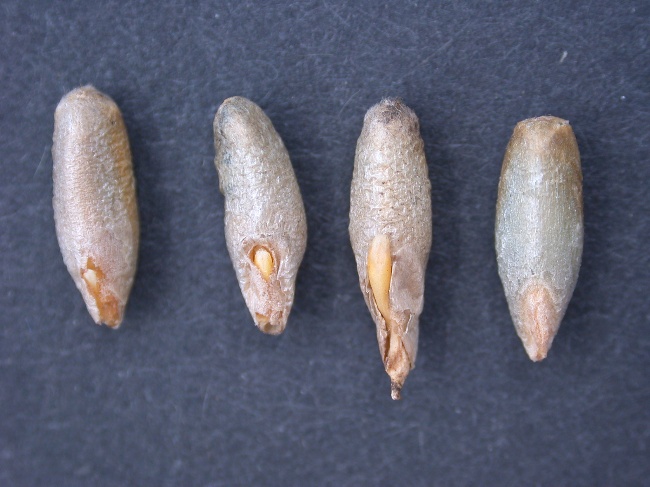
Sprouted kernels: kernel on right is sound for comparison
Important: Kernels with long sprouts which clean out over the numberNo. 25 or numberNo. 1 riddle are either
- Included in dockage, as described in Composition of dockage
- Returned to the sample and become a grading factor, in samples graded 'Rye, Sample CW/CE, Account Sprouted'
Stones (STNS)
Stones are hard shale, coal, hard earth pellets, and any other non toxic materials of similar consistency. Fertilizer pellets are assessed as stones when constituting 1.0% or less of the net sample weight. See Fertilizer pellets (FERT PLTS) for the specific procedure to be followed when samples contain fertilizer pellets.
Procedure
- Handpick stones from a representative portion of the cleaned sample.
- Determine stone concentration in the net sample.
- Samples of grain grown in western Canada containing stones in excess of basic grade tolerances, up to 2.5%, are graded ‘Rye, Rejected (basic grade) Account Stones’. The ‘basic grade’ refers to a grade established in the Canada Grain Regulations (grades listed in the first column in grade determination tables) that would have been assigned to the sample if it contained no stones.
- Samples of grain grown in eastern Canada containing stones in excess of grade tolerances are degraded to lower grades. Samples containing stones in excess of the tolerance of the lowest grade established by regulation, up to 2.5%, are graded ‘Rye, Sample Canada Eastern Account Stones’.
- Samples of western and eastern Canadian grain containing more than 2.5% stones are graded 'Rye, Sample Salvage'.
Examples: Western Canada
Excerpt from grade determination tables for Rye, Canada Western Grade name Stones % numberNo. 1 CW 0.03 numberNo. 2 CW 0.03 numberNo. 3 CW 0.06 - Basic grade: Rye, numberNo. 2 CW
- Reason for basic grade: 1.0 % Sprouted
Grade in Western Canada if stones found. If the above sample contained Grade in western Canada 0.05% stones Rye, Rejected numberNo. 2 CW Account Stones 1.0% stones Rye, Rejected numberNo. 2 CW Account Stones 3.0% stones Rye, Sample Salvage Examples: Eastern Canada
Excerpt from grade determination tables for Rye, Canada Eastern Grade name Stones % numberNo. 1 CE 0.03 numberNo. 2 CE 0.03 numberNo. 3 CE 0.06 - Basic grade: Rye, numberNo. 2 CE
- Reason for basic grade: 1.0 % Sprouted
Grade in Eastern Canada if stones found. If the above sample contained Grade in eastern Canada 0.05% stones Rye, numberNo. 3 CE 1.0% stones Rye, Sample CE Account Stones 3.0% stones Rye, Sample Salvage
T
Test weight (TWT)
Test weight is the weight of a known volume of grain expressed in kilograms per hectolitre. For the procedure, see Chapter 1 of this guide, Test weight.
Treated seed and other chemical substances
V
Variety (VAR)
Only varieties registered in Canada under the Seeds Act are eligible for the top grades of rye.
The Canadian Food Inspection Agency (CFIA) is responsible for the registration of varieties in Canada. Consult the CFIA’s database of varieties registered in Canada online to determine if a given variety is registered in Canada.
W
Wheat (WHT)
Wheat is considered foreign material (FM) in rye.