Book Review - Architecture, Urban Space and War: The Destruction and Reconstruction of Sarajevo - Mirjana Ristic
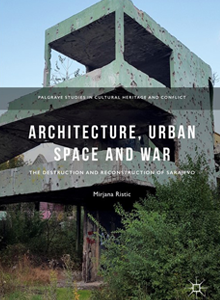
RISTIC, Mirjana. Palgrave Macmillan Cham, 2018, 260 pages.
ISBN: 978-3-319-76770-3
Reviewed by Noorulain Naseem and Muneeba Nawaz Khan, Pakistan-based research analysts
In Architecture, Urban Space and War, Dr. Mirjana Ristic examines the intricate interplay of architecture, cultural heritage, urban design and sociopolitical conflict. Focused on the civil war in the Former Yugoslavia (1992–1995) in the Republic of Bosnia–Herzegovina, the book utilizes Sarajevo as a case study to analyze the relationship between those factors. Ristic’s work is part of an emerging literature in war studies that aims to highlight the alarming increase in civilian casualties in modern conflicts.
The book explores how cities serve as stages for societal change and resistance against violence and oppression through the adaptation, appropriation and transformation of architectural elements and public spaces. Ristic makes a valuable contribution to the literature on the Bosnian–Serbian–Croatian war that resulted in the disintegration of the Former Yugoslavia. The carnage unleashed during the war took a heavy toll on civilian lives and led to gruesome crimes, including the genocide in Srebrenica. The International Criminal Tribunal for the former Yugoslavia found that hundreds were killed and thousands injured between September 1992 and August 1994.
Ristic explains how the destruction of urban spaces in the city of Sarajevo by the Bosnian Serb Army (BSA) was a military strategy resulting in the social segregation of ethnic groups. She argues that architecture and urban design were instrumentalized during the conflict in Sarajevo to sow violence, fear and division. The city’s geography and urban morphology were used to spread violence and transform the city into a “landscape of fear.” Sniping, shelling and terrorism were employed to target people and buildings to create terror and as a means of pressuring the Bosnian–Herzegovinian political leadership to accept the BSA’s ethnic division of Sarajevo. Although not qualified as genocide, the siege of Sarajevo involved the systematic killing of unarmed civilians and the destruction of the city’s architecture as a war strategy. That approach aimed to undermine the collective resilience of the people of Sarajevo and suggests an overarching strategy by the Serbian military to isolate, segregate and target Bosnians without distinguishing between combatants and non-combatants.
The author has built on the work of Deleuze and Guattari (1987), using the concept of assemblage, which explores the relationship between social change and social networks. She relies heavily on the mapping of urban architecture destroyed during the conflict. This helps gauge the impact of war on civilian infrastructure and the subsequent effects of community resilience and experiences in Sarajevo. The book delves into the term “warchitecture,” examining how and why the Serbian Army targeted civilian urban facilities to terrorize, demoralize and traumatize the civilian population. According to the author, the aim was to victimize collective identity and political ideologies embedded in the infrastructure of religious, communal and national importance. Since urban and community spaces posed no direct military threat,  targeting them was an attempt to instill fear and to isolate and marginalize the civilian population. The blurred lines of combat in Sarajevo ensnared non-combatants, making them one of the primary targets of the Serbian military. Ristic employs the term “urbicide” to convey the idea that the targeting of urban infrastructure was intended to extinguish the essence of urban life and the collective spirit of the population.
Specific buildings, including City Hall and the Oslobodjenje newspaper, were targeted due to their multi-ethnic significance, with their damage or destruction exacerbating the fragmentation of the city along ethnic lines. The targeting of Bosniak (Bosnian Muslim)–Islamic heritage buildings, including mosques, underscores that Muslims were the primary focus. The mosques served as “meeting places for a community’s secular activities” and were also places where residents could obtain humanitarian aid.
The attacks were seen as an attempt to erase the communities’ identity and create a situation where people have no memory of their past. Such violence has been understood as a “cultural dimension of genocide,” or ethnic cleansing by other means. By burning cultural documents, razing mosques and Catholic churches, and bulldozing the graveyards, the nationalist forces aimed to safeguard against potential future claims by those they displaced and dispossessed.
The book also investigates the improvised and adaptive responses of civilians to modern warfare. One significant aspect explored is the “adaptive resilience” of Sarajevo’s population during the siege. In the face of relentless violence and terror, residents became self-taught architects, modifying their living spaces for protection. Civilian resistance to wartime terror and violence involved various spatial patterns and practices, including the adaptation of underground, semi-underground and above-ground spaces. That led to the creation of new spaces and patterns of urban life, such as exhibitions, theatres, movies and concerts. Residents safeguarded themselves during travel by walking quickly and by running at crossroads. Sporting attire was commonly worn, and bicycles served as a means of transporting goods. Cars were often camouflaged in military colours, displayed bullet holes, and lacked windows. Public transport was rarely in operation.
Additionally, the book focuses on the aftermath of the conflict, examining the reconstruction efforts and the controversies surrounding them. For example, the reconstruction of Oslobodjenje proved challenging in the post-war period due to the building’s double erasure—representing the loss of both past significance and the pre-war ideals of brotherhood and unity. The reconstruction of mosques provoked debate and opposition among religious and secular Bosniaks and residents of other ethnicities. The war impacted the language as well. Before the war, the official language in Bosnia–Herzegovina was Serbo-Croatian. However, after the war, each group renamed it to correspond to their ethnic title: Bosnian (linked to Bosniaks), Serbian (used by Serbs), and Croatian (used by Croats). Roman script became the official script for Bosnian and Croatian, while Cyrillic was used for Serbian. The wartime strategies aimed at targeting cultural, social and societal monuments of architecture led to the entrenchment of conflict and ethnic violence at the group level, forever altering the socio-cultural integration potential of Sarajevo.
Overall, Architecture, Urban Space and War provides a multi-disciplinary approach to understanding the spatial dimensions of political conflict. Sarajevo is a crucial case study for analyzing the difference between civic nationalism and ethno-nationalism. The book combines theoretical frameworks, urban mapping, and empirical analysis to shed light on the complex interplay between architecture, urban space, and the dynamics of war. It provides valuable insights for scholars, urban planners, architects and anyone interested in the profound impact of conflict on cities and societies. It underscores the enduring significance of architectural and urban spaces in shaping collective memory, identity and resilience in the face of adversity.
This article first appeared in the November 2025 edition of the Canadian Army Journal (21.2).