Back to the Future: Revisiting the Use of “Neutralizing Overmatch” to Prevail and to Mitigate Overall Destruction in Urban War
At Groningen, however, the 2nd Canadian Infantry Division would face significantly stiffer resistance. They would also face new restraint … [the Canadians] would not employ artillery and air support against the city, with the understanding that damage to the city was to be prevented whenever possible. This marked a departure from the bombardment tactics the Canadians had used in previous urban attacks such as Ortona and Caen, and would require the 2nd Division to not only adjust their tactics to account for the loss of firepower, but to also minimize civilian casualties and collateral damage.Footnote 1
Introduction
The conflict in Ukraine has brought urban areas into focus, while in Gaza the fighting is intensely urban. In Ukraine, what started as an invasion and a confrontation between two conventional armies unprepared for urban combat has degenerated into tactics and expenses reminiscent of the Great War. Despite the Israeli army’s advanced technology, its operations in Gaza have caused significant political and physical damage, highlighting the severe consequences of urban warfare.
When attackers are unable to manoeuvre, they often resort to firepower and incremental assault, leading to high civilian casualties and massive collateral damage. This pattern, seen in recent urban battles such as Mariupol and Bakhmut, mirrors conflicts in Fallujah, Raqqa and Mosul, where defenders prompted attackers to use bombardments. In Ukraine, with both sides employing artillery on an industrial scale and making use of armoured vehicles, the attacking combatants have paid just as high a price.
The question arises: Can the Western forces avoid the kind of destructive conventional urban combat seen in Ukraine? Analysts suggest that urban warfare will persist, given the political and tactical incentives it offers.Footnote 2 Although British and US military leaders recognize the need to prepare to fight in cities,Footnote 3 Western armies, shaped by decades of counterinsurgency and preparation for manoeuvre warfare on the plains of Europe, show signs of erratic investment in capability for urban warfare. For instance, while the Germans, French and Singaporeans have each built excellent training “towns,” that does not address their lack of appropriate munitions and platforms. Overall, this situation leaves Western armies potentially vulnerable, especially if Anthony King’s assessment that our armies are too small to prevail in cities proves accurate.Footnote 4
However, this problem is fixable. Historical success stories suggest that focused applications of greater firepower, even if used in limited numbers, may offset force size limitations. Paradoxically, such an approach can reduce total urban destruction and suffering. This article proposes that Western armies should look to past success in combined arms urban warfare and return to applying the war principle of concentration of force to achieve neutralizing overmatch. The focus should be on equipping leading elements with capabilities to immediately neutralize points of resistance. The key is availability. While the use of overwhelming firepower is standard in open terrain, it is not part of the current thinking for urban fighting. Decades of counterinsurgency have led to a cautious, infantry-focused mindset that is often unsustainable. Typically, when a constrained force suffers casualties, it reverts to less discriminate and more destructive indirect fire.
This article highlights that, historically in some cases, the use of overwhelming direct force locally reduced overall casualties and collateral damage. It suggests that restoring potent, assured capability to penetrate and neutralize threats behind structures is crucial. Additionally, there are other ways to neutralize (i.e. to render ineffective or unusable) an urban enemy, including engineering systems to reshape the battlefield and developing the capability to fight within obscuration.
The case for change is made by reviewing the likelihood, nature and challenges of urban operations, then examining a British Commonwealth example of neutralizing-overmatch capability, discussing its nature, looking at lessons from the historical use of uncrewed ground vehicles (UGV), explaining relevant obscuration technology, and concluding by describing the elements of needed urban capability. It is important to note that although uncrewed aircraft systems have recently been radically changing combat, including in urban centres, this article specifically draws insight from historical contexts in which UGVs were featured at scale.
Urban War: Likelihood and Challenges
Urban warfare is both increasingly likely and challenging for Western armies. Analysts have long warned that “the future of war is in cities.”Footnote 5 This follows logically from Kilcullen’s four megatrends—population growth, urbanization, littoralization and connectedness—which together dictate an urban future for the planet.Footnote 6 The notion that armies can avoid engaging in a disadvantageous fight in cities is disproven by cases such as the initial, politically motivated, US attack on Fallujah in 2004.Footnote 7 The attack was largely an emotionally charged kneejerk response to pictures of the gruesome mutilation of the bodies of four American private military contractors. It was conducted despite forceful and prescient military advice against it, and it had disastrous strategic consequences for the broader conflict.Footnote 8
The seemingly unavoidable violence in humanity’s urban future can be understood by examining three key drivers: urban cover, community conflict and urbanization. However, these are not the sole factors. Cities will continue to be military objectives because they are centres of communication, resources and political power. With most of the global population living in rapidly growing, underserved urban areas, rural space is more limited now than it was in past conflicts. In addition, as communities are concentrated, friction between them and competition for scarce resources drive conflict. Overlaying this, adversaries avoiding the gaze of overhead sensors may seek out the physical cover of the urban fabric, while asymmetric enemies of the West may seek the proximity of civilians to inhibit the full power of modern weapons. Cities have become their preferred battlespaces.Footnote 9
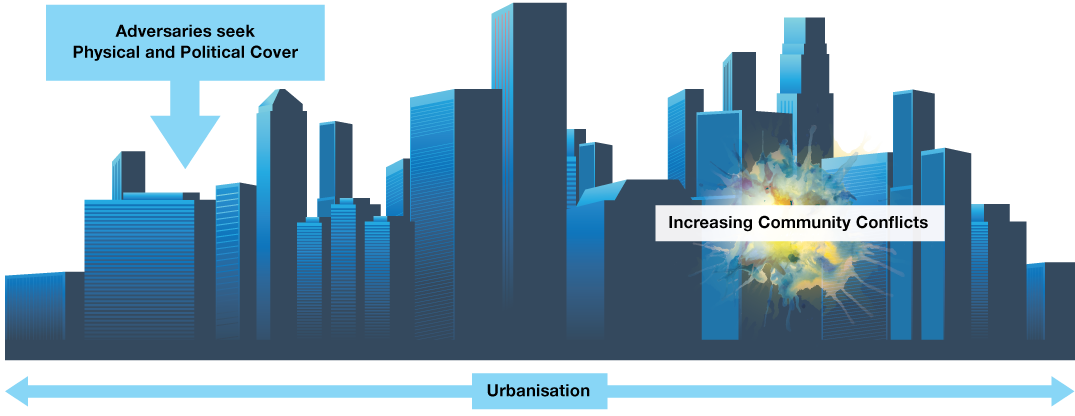
Contemporary combat in urban areas presents a range of military and political issues, including the question of non-preparation.Footnote 10 It might be useful to recognize that there are potential complications caused by the physical terrain and complexities stemming from the presence of populations.Footnote 11 Military operations lead populations to take on roles ranging from dependents to adversaries, influencing the narrative of informational warfare with unpredictable political consequences. Thus, while walls make urban war complicated, populations make it truly complex.Footnote 12
The Close Urban Fight: Default to Bombardment
There is no doubt that buildings enable ambush. Historically, clearing determined defenders from buildings, be it in Jerusalem in AD 60 or Marawi in 2017, has imposed an attritional blood cost. Fighters must again and again enter enclosed spaces, often fighting at 1:1 ratio without support from comrades as they step inside. Once within, the fighters may be ambushed or encounter traps. To avoid this, a favoured response was to remove the threat by destroying the buildings with fire or projectile artillery. Since the late 19th century, there has been another method: high explosives (HE). With decreasing precision and user risk, HE can be placed, thrown, fired directly on a flat trajectory from cannons, fired indirectly at high elevation by mortars and howitzers, or dropped from aircraft.
HE freefall aircraft bombs and indirectly fired shells and mortar bombs disperse in flight, distributing lethal effects over an area and thus spreading urban destruction. While air supremacy in recent conflicts has allowed Western armies the greater discrimination of air-delivered precision guided munitions, devastation has not been prevented: Amos Fox has labelled this “precision paradox.”Footnote 13 In the past 60 years, there have been few cases of an army overcoming a determined and capable urban defence without extensive artillery and/or air bombardment.
Often indirect firepower has been the only way to strike enemy within urban terrain or support an isolated element. For example, in the 2017 attempted takeover of Marawi by ISIS–Maute, when soldiers of the Armed Forces of the Philippines responded, they were ambushed and their armoured vehicles were knocked out, leaving the survivors trapped. Only protective air and artillery fire over several days prevented the soldiers from being overrun.Footnote 14 Marawi is an unusual case where such firepower was used quickly and constraints came later. Typically, in populated areas there are initially tight restrictions on firepower that get relaxed as friendly casualties occur. In urban battles in Chechnya, Iraq and the Levant, there are examples where it appears that once attackers suffered a section to a platoon’s worth of fatalities, there was an official or unofficial shift to more robust tactics.Footnote 15 In situations where attackers possessed overwhelming direct firepower and/or armoured bulldozers, they used them. Otherwise, they relied on indirect artillery and air power. The military, ethical and political challenges of such area bombardment remain acute.
Tactically, a city reduced to rubble becomes a continuous obstacle within which a defender can fight, move and hide. Operationally, and sometimes strategically, its facilities, routes and supplies are denied to the attacker. Infrastructure and resource destruction can generate both political issues, such as a shift in the war narrative against the attacker, and moral challenges with the potential for immediate casualties and reverberative civilian harm from disease, food shortages and refugee flows.Footnote 16 Catastrophic levels of harm from urban war have been driving civil society and international humanitarian law (IHL) initiatives to restrict the use of “wide area effect explosive weapons” which, if adopted, are likely to impose additional tactical constraints.Footnote 17 In any event, while indirect bombardment degrades and temporarily suppresses defenders, it frequently fails to neutralize them.
As this article argues, there are better ways to conduct the urban fight, because our armies once used them. From the second half of 1944 onwards, the Western Allied armies eschewed urban area bombardment for political reasons yet overcame thoroughly prepared urban defences. Paradoxically, local concentration of firepower at neutralizing-overmatch levels, including flame warfare, proved to be ethically as well as tactically superior: civilian harm was drastically reduced.
Combined Arms and Direct Neutralization
The Second World War taught that effective urban fighting demands focused firepower and combined arms: the low-level and synergistic integration of infantry, armour, engineers and other arms. Each ‘arm’ countered its companions’ vulnerabilities and reinforced their strengths: infantry protected tanks from enemy infantry; tank firepower systematically destroyed infantry-located enemy positions; and engineers cut or blasted new routes for tanks and infantry through buildings and rubble, using large demolitions to destroy obstacles and strong points. Just as on open terrain, applying the principle of concentration of force produced mission success, speed, and reduced casualties. The main mechanism was enemy neutralization by
- destroying enemy positions in buildings, but also less obviously by
- opening new routes avoiding fields of fire and mines, and
- creating physical or obscurant screens for manoeuvre.
Urban combined arms had to be learned. In the late 1930s (as perhaps now), most armies considered cities an infantry fight, having noted the loss of tanks to urban ambushes in Spain and China. They discovered that buildings limited the ability of a superior infantry force to concentrate on its small arms fire on overwhelming enemy positions. This heightened the significance of more powerful support weapons fire, particularly direct fire because it could be precise and immediately available.
The value of armoured-protected fire support became evident during the invasions of Poland, France and the USSR. German infantry made relatively rapid progress, aided by artillery Begleitbatterien equipped with 75 mm gun-armed self-propelled armoured vehicles known as Sturmgeschuetz. In response, the Soviets fielded the similarly armed SU-76. By the latter half of the battle of Stalingrad, both armies’ doctrine emphasized intimate direct HE fire. The Western allies reached the same conclusion, exemplified by the Canadian use of tanks and anti-tank guns in the 1943 battle of Ortona, in which, whenever possible, infantry assaults on buildings were conducted into rooms shattered by HE shells or hand-placed explosives.
Infantry technique in the Second World War combined arms battle evolved to be the antithesis of contemporary dismounted “surgical” close quarter battle (CQB). Entry was preceded by the liberal prophylactic use of grenades and small arms fire through walls, floors and ceilings. Non-combatant casualties were not a key consideration. The Wehrmacht fired 30 mm Schiessbecher rifle grenades through windows and doors.Footnote 18 The US Army taught that it was “suicidal” to enter a room without first ensuring that all enemy within were dead or disabled. They emphasized techniques such as shooting holes in interior walls to “post” grenades, preferably M3 concussion grenades with four times the explosive fill of the fragmentation type.Footnote 19 Similarly, the British Commonwealth section-level clearing drill revolved around a section trailing and supporting the two bombers who systematically bombed all the rooms of a building. Their assaults conformed to not just machine gun but HE, 2-inch mortar, launcher, or tank fire from outside the building directed by the platoon commander. Tellingly, a British officer commanding troops during the 1945 Battle of Goch observed, “we hardly ever saw a live German,” indicating that the defenders withdrew or were dead before clearing teams entered buildings or rooms.Footnote 20 Crucially, all armies learned to concentrate force and reduce the need for clearing by using HE munitions, preferably delivered from a survivable armoured platform and with the immediacy and relative precision of direct fire.
Decisive Direct Fire
Urban combat on the Eastern front taught the opposing armies that although guns of about 75 mm calibre with a (typical) 500 g HE fill could neutralize defenders within lighter buildings, reducing and ending effective resistance in prepared strongpoints, stone and ferro-concrete structures demanded at least medium-calibre shells with about 5 kg of HE. Both sides developed heavily armoured self-propelled guns for street fighting. The German experience with the 150 mm gun–armed Sturmpanzer led to the Sturmtiger, which, as demonstrated in Warsaw in 1944, could destroy large building strongpoints by using a single 380 mm rocket mortar projectile with a 125 kg HE fill. The Soviet ISU-152, known for its heavy armour and reliability, could be considered one of the most effective urban fire support platforms ever fielded. Delayed fused concrete-penetrating rounds from its 152 mm high-velocity gun could punch through multiple walls and detonate deep inside defended buildings.
The decisive tactical effects of large HE warheads against defended buildings also inspired the Soviets to improvise means of firing individual M13/M30 Katyusha rockets from within buildings at adjacent objectives, at ranges down to 30 m. During the battle for Berlin, those rockets destroyed more than 120 buildings. One modification encased the original rocket with a further 50 kg of TNT to create a “land torpedo” able to “eliminate a building’s garrison” with a single shot.Footnote 21
In contrast, prior to the invasion of Europe, the Western allies did not anticipate needing more powerful armoured direct fire weapons other than for breaching Atlantic Wall concrete defences. Only when commanders ignored doctrine was those weapons’ potency discovered. For example, during the 1944 battle of Aachen, a combined arms assault force based on two US infantry battalions struggled to advance against a resolute German defence. The employment of an unarmoured 155 mm self-propelled gun specifically brought forward for direct fire had immediate and significant effect. Defenders quickly withdrew from buildings struck by its delayed action shells; it created successive breaches in internal walls, allowing infantry concealed progress. Finally, it began to batter the concrete bunker command post. To quote the German commander, Colonel Wilck: “When the Americans start using 155 mm guns as sniper rifles it is time to give up.”Footnote 22
Allied Constraints on Indirect Fire
As is the case for the Russian Army today, the Red Army during the Second World War regarded artillery as the “God of war” on all terrains, with massive area bombardments preceding urban attacks. In the wide roads and avenues of the industrial cities of the Western USSR, rubble obstruction was rarely prohibitive. In the denser old cities of Poland, timber-framed construction dominated and burned readily, forcing defenders to evacuate. In cases such as the assault on the medium-sized town of Insterburg (now Chernyakhovsk), resistance in the ruins lasted only a few hours. The Western allies, however, had to learn to fight without relying on such firepower. Attacks on urban areas following D-day, including those on Caen, Le Havre and Boulogne, were preceded by air bombardment, killing many French civilians and creating continuous obstacles. The political and tactical consequences obliged the Allies to change tactics, avoiding air bombardment and restricting heavier indirect artillery fire. Despite those restraints, by late 1944, British Commonwealth armies had mastered combined arms operations on urban terrain and were able to repeatedly and steadily clear well-defended towns, with modest casualty levels.Footnote 23
Neutralizing Overmatch with Direct Fire: A Canadian Example
In late 1944 and 1945, Canadian infantry formations advanced through the Netherlands into Germany. Manoeuvring through defensive fire and minefields in their turretless-tank Kangaroo armoured personnel carriers, they conducted successive successful urban assaults at modest cost by closely integrating the fight with British armoured assault engineer units from General Percy Hobart’s 79th Armoured Division.Footnote 24
While limits on air bombardment meant that streets were no longer blocked with rubble, the defender’s positions and fields of fire remained intact. German skill at engaging from lateral defilade presented a particular challenge. Smoke obscuration supported the Canadians’ advance. They employed white phosphorus (WP) hand grenades and 2-inch mortar bombs to enable tanks and infantry to bound unseen to new fire positions—a refinement of a technique learned at the Battle of Ortona. Nevertheless, as they advanced, the 75 mm gun-armed tanks were vulnerable to ambushing anti-tank guns, especially when exposed while firing multiple rounds to neutralize defended buildings. The lack of an armoured self-propelled gun was sorely felt, but another capability filled the gap. Tank-based engineer armoured fighting vehicles with dozer blades, flamethrowers, or demolition guns that had been designed to overcome obstacles on D-day proved key to systematically prevailing on urban terrain.Footnote 25
The Churchill tank-based Crocodile flamethrower and Assault Vehicle Royal Engineers (AVRE) were heavily armoured and slow, yet they had exceptional ability to climb over urban obstacles and rubble, while Centaur armoured bulldozers could clear new paths to avoid enemy killing areas. The Canadians developed a potent assault technique. Whenever leading infantry encountered resistance, they would take cover and a Crocodile would fire a demonstration burst of flame down the street. The burning, smoking trail obscured the line of sight of enemy anti-tank guns, while radiant heat deterred infantry with handheld anti-armour weapons. An AVRE would then advance and fire a 12.7 kg demolition bomb. The munition, designed to breach heavy concrete emplacements, would collapse buildings and create clouds of smoke and dust that maintained obscuration. The following Crocodile would then flame the shattered target. The pattern became that normally resolute German defenders withdrew.Footnote 26
Flame as Neutralizing Overmatch
The neutralizing-overmatch nature of flame weapons is intuitive and was demonstrated in all theatres of the Second World War by the changes such weapons induced in the behaviour of attacked troops.Footnote 27 For example, the protracted pace of the 1944 US Army fight to capture the fortified port of Brest accelerated when 15 British armoured flamethrowers arrived.Footnote 28 Similarly, later that year, when fighting to eliminate the encircled Allied paratroopers around Arnhem, the Germans initially suffered heavy casualties while clearing buildings. By employing self-propelled assault guns and flamethrowers, the Germans were able to drive the paratroopers from strong positions.Footnote 29
There is a counterintuitive moral paradox. Flame is a horrific weapon and arguably causes excessive suffering. However, while its use in the 1945 Low Country battles burned target buildings and those adjacent to them, there was far less destruction and fewer casualties of all kinds compared to the 1944 urban artillery and air bombardment of Normandy. This article does not argue for the return of flame capability, despite its utility being underlined by current Chinese developments of flame weapons.Footnote 30 Rather, successful Commonwealth use of armoured flame demonstrates the tactical potency of combined arms that synergistically applies effects against which the enemy cannot protect themselves.
Delivering Neutralizing Overmatch
The crux of neutralizing overmatch is psychological. All combined arms seek to overwhelm the enemy with concurrent effects and tactical dilemmas, but in the physically protective urban environment, the concept emphasizes generating “military impotence.” The idea of inexorable effects is well illustrated by Israeli use of large, heavily armoured D30 “Doobi” bulldozers to collapse buildings rather than clear them during 2002 operations in Jenin. Islamist resistance fighters, apparently intent on martyrdom, surrendered unexpectedly. One explained that he did so because he could not achieve his ideological obligation to kill an enemy soldier.Footnote 31 Some Israelis drew a lesson from this: that in such close-quarters urban fighting, the ratio of tanks to bulldozers should be 1:1. Mass may not be a prerequisite. At Aachen, “making resistance futile” was the decisive psychological contribution of a single 155 mm unarmoured self-propelled gun.
The vital idea is for leading elements to quickly render points of resistance ineffective or untenable. This requires destroying them outright, distributing rubble across their fields of fire and minefields, blinding their fields of fire, or creating routes to advance within cover. Such reshaping requires explosives and machines. This understanding is missing from the Western “counterinsurgency” understanding of urban war represented by uncritical adoption of special operations forces SOF CQB techniques.
Anthony King coined the term “Special Forcification” to describe misappropriation of methods developed for counter-terrorism (CT) recovery operations.Footnote 32 The swift crowded assaults developed by SOF for CT are vulnerable to explosive devices or counter-attacks and difficult to coordinate with intimate explosive firepower from outside the building: a decisive advantage forgone. Ironically, while conventional forces have enthusiastically adopted CQB methods, in urban battles such as in Mosul, SOF have shifted their tactics for the urban fight, specializing in the application of large, guided munitions. History offers few examples of infantry “overmatching” to rapidly clear determined defenders from buildings without supporting direct fires or heavy casualties, and those examples highlight the importance of explosive effects.
During the 1945 Battle of Berlin, the Soviets made local use of captured stocks of Panzerfaust to advance rapidly by successively breaching internal walls. Similarly, in the 1960s, successive detonations of bulk high explosives (often equivalent to several kilos of TNT) enabled Vietnamese sapper attacks using satchel charges, as well as Rhodesian assaults on insurgent headquarters using “hulk charges.” Recognition of the utility of dismounted troops having a potent neutralizing tool led to the Soviet development of the RPO-A launcher, with a thermobaric warhead delivering the blast effect of a medium artillery round. In the later 1995 battles of Grozny, these weapons changed Russian urban tactics, techniques and procedures, with three-person fire support firing volleys that eliminated all resistance from buildings, obviating the need for combat clearance. The potential lesson is that infantry require stand-off weapons with warheads considerably more potent than the 40 mm, 66 mm or even 84 mm launchers that predominate in Western militaries. However, explosive effects alone, even when delivered by precision munitions, do not defeat an agile enemy like the Islamists in Mosul. That required armoured machines.
The great value of the now retired British Centurion AVRE and the American M60 Combat Engineering Vehicle (CEV) was that they reshaped the battlefield both explosively and mechanically. These dozer-fitted vehicles were armed with 165 mm guns firing a projectile with four times as much explosive as the largest tank round (18 kg versus the 4 kg of 120 mm HESH). Contemporary Western CEVs no longer have such capabilities, and contemporary reliance on main battle tanks (MBT) for urban fire support may represent risking a high-value platform to deliver smaller explosive effect than alternatives. The World War II Soviet employment of large-payload, short-range demolition rockets that could breach concrete walls, as described above, was not unique, and the Chinese have returned to the concept on their latest CEV. Most belligerents in the Second World War experimented with demolition rockets mounted on armoured vehicles, and the concept of a small platform with multiple weapon tubes able to “pop” and fire a volley was convincingly shown by the 6 × 106 mm Ontos that supported US Marines during the battle of Hue. Importantly, such capabilities no longer require crews: they can be UGVs.
Robotic neutralization
UGVs have self-evident potential for transforming ground combat.Footnote 33 However, notwithstanding rapid US adoption of UGVs during the Iraq insurgency, subsequent massive research and development efforts and impressive remote weapon station (RWS) demonstrations, Western armies have been hesitant to adopt them. The reluctance can be attributed to a number of reasons including uncertainty regarding radio frequency control links, especially in the face of electronic countermeasures, and threat from enemy anti-radiation munitions.
In Ukraine, the transformation of combat by drones in the air is being followed on the ground. Both sides have been observed to be successfully using UGVs for demolition and electronic warfare tasks, although the effectiveness of RWSs on UGVs deployed close to the frontline is less clear. In urban environments, however, factors including proximity of operators to UGVs and shorter engagement ranges mitigate technical challenges. We know that right now, basic UGVs can mitigate some of the acute risks of urban combat, as they did more than 70 years ago.
UGVs were first used operationally and for neutralizing defences during the Winter War of 1939. The Soviets deployed two battalions of Tele-tanks, optionally crewed radio-controlled T-26 tanks delivering smoke, flame or 500 kg demolition charges. Despite control problems, they played a role in the breakthrough of the Mannerheim defensive line. Stalin’s purges of the Ostehburo development agency and execution of senior engineers saw the Tele-tank capability flounder. However, independently, a wire-guided demolition UGV designed by the military engineer, Alexander Petrovich Kazantsev, saw brief successful Soviet use on several fronts in 1941.Footnote 34
During the Second World War, the Wehrmacht’s fielding of 10,000 remote control assault engineering Funklenkpanzer UGV is better known, especially their Goliath.Footnote 35 This compact, rhomboid-shaped, tracked, wire-guided demolition vehicle delivered 60 or 100 kg of HE. The other main UGV was the Borgward B-IV, a car-sized, tracked armoured vehicle which was driven to the target area by a soldier and then controlled by radio from another AFV. Its function was to drop a 500 kg charge. While UGVs fell short of German hopes for minefield clearing, both types proved to be useful tools in urban settings for breaching and destroying strong points. In the 1942 assault on Sevastopol, they destroyed 36 bunkers and 12 gun positions, and during the 1944 Warsaw rising they played a key role in eliminating key Polish fortifications.Footnote 36 German and Soviet reporting on the use of UGVs in an urban context during the Second World War highlights that UGVs should be
- large enough to have adequate hull clearance, step and gap crossing capability on rubble and urban obstacles,
- armoured or resilient enough to survive engagement with ordinary small arms,
- controlled by an operator able to directly overwatch its path,
- provided with resilient means of control, and
- employed in an all-arms context.
These insights not only influenced the development of the car-sized Springer demolition UGV towards the end of the Second World War, but also remain relevant even today. Though disposable like the Goliath, the Springer was larger and relatively narrow with high sprocket wheels to cross urban obstructions. As a distillation of several thousand urban engagements, it represents a good guide for general-purpose urban UGV configuration enabled with the control systems developed over 50 years of robotic bomb disposal. An electric-powered contemporary version could be built for less than the price of a Javelin missile. It would have the interior volume for evacuating a casualty or moving stores, smoke generation equipment or ammunition for a weapon system. Like the Springer, it would be driven to the area of operations and, from there, operated by tether until broken and then by low-signature radio signal. It would be capable of direct mechanical and explosive-assist breaching and other engineering tasks. However, rather than carrying demolition charges it could mount short-range demolition rockets, providing the capability for “tank-like” neutralization overmatch even to air-portable forces.
UGV-delivered neutralization is not limited to explosive effects. It may also reshape the battlefield to render defenders irrelevant. Several countries have successfully converted obsolete MBT hulls to uncrewed CEV. By fitting new gearboxes, larger drive wheels and a dozer blade, they offer a bulldozer-like capability with many uses beyond the urban battlefield. Those “low silhouette” types without turrets or significant superstructure are particularly suitable for rapidly pushing manoeuvre pathways through buildings with minimal risk of dislodging horizontal support beams.
Smoke neutralization
Smoke has been used for millennia to obscure in war, yet massive use during urban combat operations has escaped popular awareness, perhaps due to (necessarily) little imagery of it. In the battle of Cherbourg, one US mortar battalion fired 11,899 4.2-inch WP bombs. During the Second World War, all armies had dedicated chemical/smoke units, which were routinely employed to provide obscuration to cover the break into an urban area and subsequently to enable troops to cross open areas to assault strongpoints.Footnote 37 The Germans emphasized their Nebelwerfer smoke rockets for this while the Red Army teams used smoke pots and mortar bombs; both armies used pyrotechnic smoke grenades within buildings. The Western allies routinely used WP shells, mortar bombs and hand grenades—not only to screen movement in the open but also to strike and neutralize defended buildings by blocking their already restricted fields of view. The tactical use of smoke techniques has been neglected, despite viewing technologies that increase their utility.
For many years, the Western armies have had armoured capability to fight within thermal imagery (TI) translucent smoke and dust, as demonstrated convincingly during the 1991 Gulf War battle of the 73 Easting. This remarkable advantage has recently been given to infantry with TI systems that are head-mounted, or weapon-mounted with cable connections to head-mounted displays, allowing “shooting around corners.” Yet, apparently, only the Israeli Defence Force has exploited fighting in smoke as a dismounted urban combat method.
In contrast, since the 1980s, Western armies have reduced stocks of and training with smoke munitions. Certainly, urban manoeuvre within effective smokescreens is almost never practised. This may variously reflect recognition of IHL concerns about WP use in urban areas, the lethal hazard to non-combatants from both base-ejection and base-emission smoke shells, or safety considerations around carcinogenic smoke inhalation and risk aversion flowing from unfamiliarity with WP grenades.
Technology offers a way forward. While conventional respirators do not offer protection, rebreather versions do—they filter exhaled breath to extract the carbon dioxide as small quantities of oxygen are supplied from a cylinder or chemical generator. Troops using rebreathers and TI systems can enter closed (and subterranean) spaces saturated with smoke to move and engage while the adversaries cannot see. Provided that the primary purpose of using the smoke is to obscure and that explicitly toxic compounds are avoided, this use should not breach the chemical weapons convention.
Further addressing humanitarian concerns, some obscurants present dramatically reduced hazard to non-combatants. These include vapour-based electro-mechanical smoke generators (as used in nightclubs), heat glycol, or oily mixtures to generate large volumes of innocuous condensing mist. Drogue obscurant delivery systems can use solid-fuel, lightweight-bodied, low-cost rockets to deliver payloads over many kilometres. A simple fuse deploys a drogue chute to slow the carrier to nonhazardous velocity, which scatters a payload of low-temperature burning smoke pellets. The combination of low-hazard smoke, rebreathing and TI equipment offers the unprecedented opportunity to fight “one-eyed in the kingdom of the blind.”
The way ahead
This paper has discussed the nature of urban close combat using historical examples to highlight the value of neutralizing overmatch capability. Importantly, it identifies that without such capabilities, and given technological advances that favour defenders, an urban offensive fight is likely to become one of attrition that small Western armies cannot sustain. However, we can gain remarkable tactical advantage if we combine proven methods with contemporary technologies as follows:
1) Obscuration – The means to impose visual and thermal obscuration and fight within it should be an accelerated development priority. It can be expected to deliver great psychological advantage, restore scope for urban manoeuvre, and enable interior and subterranean combat. Perhaps most significantly, it offers Western forces the political benefits of the means to fight effectively in urban areas with reduced collateral harm. There is potential to integrate TI opaque smoke munitions with translucent ones to blind enemy systems in a more sophisticated plan.
- In the near term, there is an urgent need for instant obscuration means to replace the WP grenade at the lowest level. The 40 mm handflammpatrone (hand smoke launcher) is an exemplar.
- Pyrotechnic smoke rockets offer a low-cost, proven, and low-hazard means of delivering obscurants. They may be launched from simple trailers or vehicle-mounted modules.
- Thermal sighting and rebreather systems have been proven in service. Mastering their integrated use in an obscured environment is demanding but offers a niche that skilled Western soldiers will occupy more easily than challengers.
2) UGVs – Robotic systems offer huge future promise, but today many of the acute risks of urban warfare could be mitigated by swiftly fielding systems based on urban-proven, existing mechanical configurations, integrated with robust electronic systems.
- Contemporary CEVs are sophisticated high-performance platforms that can be controlled remotely. Their value for urban operations is underappreciated. Arguably, an urban combined arm force should have as many CEVs as MBTs.
- Medium, Springer-sized, basic armoured UGVs offer a tool to breach new manoeuvre pathways through buildings, move stores and casualties and mount weapons, especially short-range rockets capable of penetrating ferro-concrete walls with large explosive charges.
3) Infantry explosive firepower – Munition technology has created the opportunity to place very significant firepower in the hands of dismounted troops to attack or breach walls at a standoff. Neither these tools nor easy-to-use demolition charges are in widespread service. This should change, in order to allow enemy positions to be rapidly destroyed and a mobile defence defeated, and to limit the risks of and need for assault clearance. In addition, command detonation devices paired with cameras will improve discrimination when clearing among civilians and allow legitimate attack in blind spaces during the defence.
- A shoulder-launched, confined-space weapon capable of delivering a warhead equivalent to several kilos of TNT into a building offers decisive urban combat capability.
- A stand-off wall-breaching munition that can be fired remotely provides the opportunity to rapidly relay-breach a series of walls or barrier obstacles.
- A modular demolition charge system with cameras and both radio and command wire initiation as well as “throwbot” camera-fitted devices that eject blast grenades offer improved tactical options and IHL compliance.
The adoption and integration of the above capabilities offers Western armies the opportunity to transform urban close combat to ethical and tactical advantage. It would not cease being gruelling, dangerous and psychologically exhausting, but pursuing neutralizing overmatch can be expected to deliver the same benefits it did in 1944/45: steady tactical success and fewer friendly, civilian and even enemy casualties.
About the Author
Dr. Charles Knight has spent four decades studying urban combat methods, focusing on uncrewed systems and media portrayals of urban warfare. He teaches strategic security, unconventional warfare, and terrorism at Charles Sturt University, the University of New South Wales, and the Thereisian Military Academy in Austria. His Ph.D. researched coercion in counterinsurgency, and his master's thesis examined urban vulnerabilities, informed by fieldwork in the Lebanese civil war and Cambodia, as well as operational service with various militaries. In Australia, he commanded 2/17RNSWR and has over a decade of experience with special operations forces, currently serving as a reservist in the Australia Army Research Centre.
This article first appeared in the November 2025 edition of the Canadian Army Journal (21.2).