
Canadian Grain Commission’s 2021-2022 Departmental Results Report
International Standard Serial Number: 2560-9955
Canadian Grain Commission
The Honourable Marie-Claude Bibeau
Privy Councillor, Member of Parliament,
Minister of Agriculture and Agri-Food
From the Minister

The Honourable Marie‑Claude Bibeau,
Privy Councillor, Member of Parliament,
Minister of Agriculture and Agri‑Food
The year 2021-22 brought unprecedented challenges for Canada’s grain farmers, from the ongoing COVID-19 pandemic, to trade fluctuations, to extreme weather events including historic droughts and flooding, to labour shortages and rising costs. All the while, they were investing in sustainable farm practices and technologies to ensure a strong future for the next generation and our planet.
In the face of these challenges the Canadian Grain Commission continued to be a strong partner for Canada’s grain farmers, while ensuring dependable, high-quality grain for consumers around the globe, thanks to its programs and services. Through the Harvest Sample Program, for example, farmers can request a kit to submit grain samples, which the Canadian Grain Commission will evaluate for traits such as oil and protein content.
Canada’s economic recovery, and the long-term stability and growth of the grain sector, rely on trade. Canadian grain farmers continued to benefit from our Government’s ambitious diversification of our trade markets. Trade deals with our largest trading partners, in North America, Europe, and the Pacific, provide grain farmers with preferential access to two thirds of the global market. In 2021-22, we continued to advocate for a predictable, science-based trade, while helping the sector innovate to meet changing consumer demands.
Our government is committed to the long-term sustainability of the agriculture sector. Through historic investments in new programming, such as the Agricultural Climate Solutions and Agricultural Clean Technology programs, our government is helping farmers and agri-food businesses implement sustainable practices and technologies that help mitigate the impacts of climate change and extreme weather events, and meet sustainability goals.
As Canada’s Minister of Agriculture and Agri-Food, I remain committed to working with the Canadian Grain Commission and stakeholders across the sector to modernize the Canada Grain Act.
The future is bright for Canada’s grain sector, as the world increasingly looks to Canada to strengthen global food security. Together, we will continue to build an innovative, sustainable and prosperous future for Canadian grain farmers and the entire value chain for years to come.
From the Chief Commissioner

Doug Chorney
Chief Commissioner
Canadian Grain Commission
I am very proud of the work we do at the Canadian Grain Commission to benefit Canadian grain farmers, the grain sector, and, ultimately, all Canadians. The 2021-22 Departmental Results Report illustrates the great work of Canadian Grain Commission staff in delivering results for a dynamic and competitive grain sector, while meeting our mandate under the Canada Grain Act.
In partnership with our stakeholders, the Canadian Grain Commission has built a Canadian Grain Quality Assurance System that ensures customers around the world can count on Canadian grain to meet their evolving needs for quality and safety. As the grain sector changes, we continue to update and improve our approach to quality, with a commitment to supporting Canada’s export growth.
The Canadian grain sector is as dynamic as ever, and thanks to efforts all along the value chain, Canadian grain production and exports have increased significantly over the past decade. However, in 2021-22 crop year, Canadian grain farmers were hit hard by extreme weather, including the drought across western Canada and northern Ontario, which resulted in reduced grain production and export levels. The Canadian Grain Commission’s programs were more important than ever in this challenging time. We continued to protect Canadian producers from non-payment risk and moved quickly to respond to payment failure situations as they occurred and ensured market access through our grain quality research and testing.
The Canadian Grain Commission consistently goes above and beyond in providing high-quality programs and services. Through this work, and diligent modernization and stakeholder engagement efforts, I know that the Canadian Grain Commission will continue to respond to needs throughout the entire grain value chain.
Results at a glance
What funds were used?
- Total actual spending for 2021-22 was $66,403,837
- Spending was funded by annual voted and statutory appropriation of $6,440,236 and fees revenue of $50,357,723
- The revenue shortfall was covered by revolving fund surplus accumulated since 2018
Who was involved?
- The Canadian Grain Commission had 464 total actual full-time equivalents for 2021-22.
Key results achieved in 2021-22
The Canadian Grain Commission’s Core Responsibility is to regulate grain handling in Canada and to establish and maintain science-based standards for Canadian grain. The Departmental Results of this Core Responsibility are that domestic and international markets regard Canadian grain as dependable and safe and that farmers are fairly compensated for their grain.
In 2021-22, the Canadian Grain Commission continued to draw on innovative working practices adopted during the pandemic and integrated them as part of the future of its work to further improve and streamline business processes in all of the Canadian Grain Commission’s operations. This included adopting innovative working practices for stakeholder engagement and program delivery.
The Canadian Grain Commission also continued to undertake the necessary steps to transition towards a flexible work environment with the appropriate infrastructure that meets current operational needs and delivers on its strategic priorities and program commitments. In 2021-22, the Canadian Grain Commission supported its employees to effectively complete their assigned tasks in the remote workplace, laboratory, licensed terminal elevators, or office settings through strategies designed to ensure their health and safety. In June 2021, the Canadian Grain Commission established a temporary position a Future of Work Director to lead a project team tasked with creating a plan to support the Canadian Grain Commission’s transition towards a modern work-place that puts quality of service and employee experiences at the core of its operations.
Additionally, the Canadian Grain Commission continued to ensure Canadian producers were protected from non-payment risk and moved quickly to respond to two claim situations in 2021-22. As a result of Canadian Grain Commission’s Safeguards for Grain Farmers Program, the eligible farmers in these two situations received, respectively, 100 and 80 percent compensation for unpaid deliveries of grains covered by the Canada Grain Act.
The Canadian grain sector continued to thrive through the pandemic and saw unprecedented grain export levels during 2020-21 and into the first quarter of fiscal year 2021-22. However, drought conditions across most of the western Canadian grain production area resulted in significantly decreased yields and exports during the last three quarters of 2021-22. This created wide-spread supply challenges for the sector and impacted the volume of grain inspected and weighed by the Canadian Grain Commission in fiscal year 2021-22. As a result, the Canadian Grain Commission faced a revenue shortfall of $9.61 million, necessitating a draw down on its revolving fund.
The Canadian Grain Commission also continued to deliver on day-to-day operational activities and made significant progress on the initiatives identified within its key strategic areas of focus for 2021-22:
- Reviewing the Canadian Grain Commission regulatory framework;
- Modernizing Canadian Grain Commission programs and services; and
- Providing technical guidance to mitigate risks to market access for Canadian grain exports.
For more information on the Canadian Grain Commission’s specific initiatives, priorities and results achieved, see the “Results: what we achieved” section of this report.
Results: what we achieved
Core Responsibility
Grain Regulation
Description:
The Canadian Grain Commission regulates grain handling in Canada and establishes and maintains science-based standards for Canadian grain.
Results:
The Departmental Results of the Canadian Grain Commission’s Core Responsibility are that domestic and international markets regard Canadian grain as dependable and safe and that farmers are fairly compensated for their grain. The delivery of programs and services is in accordance with the Canada Grain Act, and the Canadian Grain Commission identifies key areas of focus and initiatives to ensure it can continue to deliver upon its mandate and departmental results in the evolving grain sector environment. Key initiatives, activities, and actions the Canadian Grain Commission has taken to achieve results for each area of focus are as follows:
Reviewed the Canadian Grain Commission regulatory framework
An efficient, effective, science-based regulatory framework is essential to capitalize on innovation and to meet the evolving needs of the grain sector. The Canadian Grain Commission supported Agriculture and Agri-Food Canada to conclude consultations on the Canada Grain Act Review and publish the report “What We Heard: Canada Grain Act Review Consultations”, including supporting engagement with sector stakeholders and developing a path forward for modernization involving both legislative and non-legislative pathways. The Canadian Grain Commission continued to provide significant technical and policy support to Agriculture and Agri-Food Canada through evidence-based analysis and advice for a modernized regulatory framework.
The Canadian Grain Commission also continued to put forward regulatory amendment packages to deliver on established grain grading and producer protection modernization goals. In 2021-22, the Canadian Grain Commission finalized three regulatory amendment packages: housekeeping amendments to improve clarity and transparency of the Canada Grain Regulations; adding canary seed as a designated grain under the Canada Grain Act; and reducing four official inspection and weighing fees by 29 percent.
Additionally, in December 2021, the Canadian Grain Commission launched public consultations on a proposal to update and improve producers’ access to grain grading dispute resolution, commonly known as ‘Subject to Inspector’s Grade and Dockage’. Consultations concluded in February 2022. All feedback received during the consultation will be considered as the Canadian Grain Commission proposes regulatory changes.
The Canadian Grain Commission also sought sector input on how to implement grain delivery declarations on a consistent national basis. Based on the feedback received, the Canadian Grain Commission moved to simplify declaration requirements to only apply to those grains where variety registration includes quality factors. This regulatory change was finalized in April 2022.
Modernized Canadian Grain Commission programs and services
During 2021-22, the Canadian Grain Commission continued to make progress on developing and implementing digital services, including the MyCGC Portal for clients and creating a Digital Operations Strategic Plan. Through successful collaborations with other government departments, the Canadian Grain Commission has developed a strategy for seamless delivery of online services to meet the Policy on Service and Digital requirements. In the first quarter of 2021-22, the Canadian Grain Commission established a project team to implement the first phase of the MyCGC Portal. This included developing a solution to leverage a customer relationship management system to streamline internal processes, and increase efficiencies and capabilities for external services to be accessed through a user friendly client portal. The initial platform release will serve as a foundation for continued efforts to modernize and to add additional services in future years. Additionally, the platform will use cloud services and technology, which aligns with the Government of Canada’s Cloud Adoption Strategy to reduce costs with less reliance on physical infrastructure.
The Canadian Grain Commission implemented a Data Strategy to support accessible data and self-serve analytical tools. This strategy was initiated by adopting MS Power-BI for visualizing data (i.e., statistics at a glance) and formalizing a working group tasked with keeping the Canadian Grain Commission compliant with the Open Government mandate. Further, the Canadian Grain Commission released an online calculator for determining official grain test weight and other grain weights and volumes. The Canadian Grain Commission enhanced the online statistical reporting application for Primary & Process Elevator Weekly Reporting with changes that meet Government of Canada standards and requirements for user access and security.
An initiative to modernize the grain grading system to strengthen the quality and dependability of Canadian grain was launched in 2017 to review all aspects of the Canadian grain grading system and take the required actions for improvement. In 2021-22, the Canadian Grain Commission continued to evaluate components of the grain grading system to ensure a strong scientific basis and that they align with the needs of the Canadian grain sector. The Canadian Grain Commission also started evaluating a sustainable staffing model to ensure accurate and efficient delivery of official inspection and weighing. A sustainable staffing model involves ongoing work with regional service delivery managers and the national manager of training and Future of Work unit. The model considers pandemic restrictions, anticipated increases to grain volumes, growing grain shipping capacity, new terminal construction, inspector attrition, and ongoing inspector training and development needs.
In 2021-22, the Canadian Grain Commission started work to develop a Science Strategy to support innovative grain research and science based activities and provide a vision for the future. To help inform the Science Strategy, the Canadian Grain Commission held a stakeholder engagement process in February and March 2022. All feedback received during the engagement process will be considered as the Canadian Grain Commission moves forward with developing its Science Strategy.
Additionally, the Science Strategy will direct mid and long-term decision making and guide future investments in research and monitoring at the Canadian Grain Commission. To further enhance and support grain science, the Canadian Grain Commission assessed options and started to seek authorities for a building a new laboratory. This project will address aging infrastructure and limited functional space at the current location, and invest in new technologies for innovation and efficiencies in its Grain Research Laboratory.
In turn, a short-term investment strategy was developed to make required improvements to the Grain Research Lab to maintain and improve research capacity over the next five years. This also included initiating a project to integrate laboratory custom databases and manual systems into an automated, central Laboratory Information Management System. Furthermore, the Canadian Grain Commission continued to engage with Public Service and Procurement Canada, who leads the laboratory building project, to explore next steps in securing a long-term accommodation solution. The Canadian Grain Commission completed an evaluation of existing surplus federal facilities in Winnipeg, and none meet the department’s requirements.
Provided technical guidance to mitigate risks to market access for Canadian grain exports
Canadian grain is exported into an international marketplace characterized with discerning importers and stringent regulators in which the ability to provide assurance and demonstrate compliance with grain quality and safety requirements is increasingly important. To support continued access to markets around the world, the Canadian Grain Commission conducts monitoring with respect to Maximum Limits for naturally occurring toxins and trace elements, Maximum Residue Limits for pesticides, and the presence of certain genetically modified events. Incidents of non-compliance can result in widespread cost ramifications for the value-chain, therefore robust data, monitoring and assurance processes are critical to the sector.
In 2021-22, the Canadian Grain Commission continued to collaborate with government partners, academia, and sector stakeholders to provide data-driven, science-based responses to market access issues. For example, the Canadian Grain Commission continued to deliver an enhanced testing program to help exporters pre-screen grain shipments for residues and thereby mitigate risks to market access in certain sensitive markets. Additionally, the Canadian Grain Commission, working along with other federal departments and agencies, led efforts to successfully reduce discriminatory testing requirements on Canadian grain into a major market, which improved access and reduced costs for Canadian exporters. Throughout 2021-22, the Canadian Grain Commission initiated and undertook targeted surveillance efforts to generate data and knowledge on the prevalence of a naturally occurring contaminant subject to tightening regulations in a major export market. The Canadian Grain Commission continued to also provide sampling services to the Canadian Food Inspection Agency to support the issuance of phytosanitary certificates. The Canadian Grain Commission continues to consider opportunities to increase access to grain samples and enhance testing and monitoring capabilities to support market access. In parallel, the Canadian Grain Commission commenced plans to expand data sharing and accessibility to demonstrate Canadian grain quality and safety.
Gender-based analysis plus
Results for the Canadian Grain Commission’s Core Responsibility do not directly contribute to the government-wide priorities of gender quality, diversity, and inclusiveness. However, the Canadian Grain Commission contributes to these priorities by incorporating gender-based analysis plus into its employment equity and diversity goals and framework. The Gender-based analysis plus supplementary information table details these initiatives.
United Nations 2030 Agenda for Sustainable Development and the Sustainable Development Goals
The Canadian Grain Commission became subject to the Federal Sustainable Development Act in December 2020, adheres to the principles of the Federal Sustainable Development Strategy (FSDS) by complying with the Policy on Green Procurement , and has developed a Departmental Sustainable Development Strategy (DSDS)Footnote 1. The Policy on Green Procurement supports the Government of Canada’s effort to promote environmental stewardship. In keeping with the objectives of the policy, the Canadian Grain Commission supports sustainable development by integrating environmental performance considerations into the procurement decision making process through the actions described in the 2019 to 2022 FSDS “Greening Government” goal.
Experimentation
In alignment with the federal government’s evidence-based approach to achieve planned results and address problems that traditional approaches have been unable to solve, the Canadian Grain Commission is committed to innovation and experimentation. In 2021-22, the Canadian Grain Commission continued to integrate technical expertise, data analytics, and information to help mitigate market access issues for Canadian grain exports. Increased grain volume moving through Canadian ports has created an increased need for Canadian Grain Commission documentation. Additionally, a demand for government assessment of grain quality and variety traits, and safety issues like chemical residues and toxins has grown, often requiring government assurance to gain market access. The Canadian Grain Commission worked closely with stakeholders to address these changing grain sector needs and facilitate continued market access for Canadian exporters.
For example, a two-year pilot was initiated in 2019-20, whereby the Canadian Grain Commission collaborated with Pulse Canada to pilot a voluntary testing program that supported smalllot exporters of Canadian pulses in meeting regulatory and contractual requirements. Under this program, participants voluntarily submit samples of pulses to the Canadian Grain Commission for analysis. This analysis allows small-lot exporters, on a voluntary basis, to undertake the necessary measures to ensure that all export shipments meet importing country requirements. The program was reviewed annually by the Canadian Grain Commission based on agreed-upon performance indicators and outcomes.
Results achieved
The following table shows, for Grain Regulation, the results achieved, the performance indicators, the targets and the target dates for 2021–22, and the actual results for the three most recent fiscal years for which actual results are available.
| Departmental results | Performance indicators | Target | Date to achieve target | 2019–20 Actual results | 2020–21 Actual results | 2021–22 Actual results |
|---|---|---|---|---|---|---|
| Domestic and international markets regard Canadian grain as dependable and safe | Percentage of stakeholders who regard Canadian grain as dependable and safe | TBDFootnote 2 | TBDFootnote 3 | Not availableFootnote 4 | Not availableFootnote 5 | Not availableFootnote 6 |
| Value of Canadian grain exports | $30.6 billionFootnote 7 | April 2025Footnote 8 | $20.9 billionFootnote 9 | $25.3 billionFootnote 10 | $22.3 billionFootnote 11 | |
| Farmers are fairly compensated for their grain | Percentage of sales where farmers are compensated for their grain | 100% | April 2021 | 100% | 100% | 100% |
| Percentage of outstanding liabilities paid to farmers in the event of a default by a Canadian Grain Commission-licensed grain company | 100% | April 2021 | 100%Footnote 12 | 100%Footnote 13 | 83%Footnote 14 |
Budgetary financial resources (dollars)
The following table shows, for Grain Regulation, budgetary spending for 2021–22, as well as actual spending for that year.
| 2021–22 Main Estimates | 2021–22 Planned Spending | 2021–22 Total Authorities Available for Use | 2021–22 Actual Spending (authorities used) | 2021–22 Difference (Actual spending minus Planned spending) |
|---|---|---|---|---|
| 6,524,580 | 6,524,580 | 7,088,928 | (6,136,888) | (12,661,469) |
- Planned spending is net of respendable revenues. For planning, revenue forecasts are allocated to both Grain Regulation and Internal Services as required.
- The difference between 2021-22 actual spending and 2021-22 planned spending is primarily due to decreased actual revenue. The actual revenue decrease, as compared to planned revenue, was due to lower than anticipated grain volumes caused by extreme weather conditions.
The Canadian Grain Commission reports all revenues collected under its Grain Regulation Core Responsibility. These revenues also support the costs of internal services.
Details on the organization’s overall expenditure distribution can be found in the 2020-21 Budgetary Actual Gross Spending Summary (dollars) table.
Financial, human resources and performance information for the Canadian Grain Commission’s Program Inventory is available in GC InfoBase.
Human resources (full-time equivalents)
The following table shows, in full time equivalents, the human resources the department needed to fulfill this core responsibility for 2021–22.
| 2020–22 Planned full-time equivalents | 2020–22 Actual full-time equivalents | 2020–22 Difference (Actual full-time equivalents minus Planned full-time equivalents) |
|---|---|---|
| 317 | 319 | 2 |
Financial, human resources and performance information for the Canadian Grain Commission’s Program Inventory is available in GC InfoBase.
Internal Services
Description
Internal services are those groups of related activities and resources that the federal government considers to be services in support of programs and/or required to meet corporate obligations of an organization. Internal services refers to the activities and resources of the 10 distinct service categories that support program delivery in the organization, regardless of the internal services delivery model in a department. The 10 service categories are:
- Acquisition Management Services
- Communications Services
- Financial Management Services
- Human Resources Management Services
- Information Management Services
- Information Technology Services
- Legal Services
- Material Management Services
- Management and Oversight Services
- Real Property Management Services
Internal Services support the Canadian Grain Commission’s Core Responsibility by enabling organizational program delivery. During 2021-22, a key priority was to draw on the innovative practices adopted during the pandemic and integrate these into the Canadian Grain Commission’s post-pandemic operating environment and vision for the future of work. In June 2021, the Canadian Grain Commission established a temporary position - a Future of Work Director to lead a project team tasked with creating a strategy to support the Canadian Grain Commission’s transition towards a modern workplace that puts employee experiences and quality of service at the core.
This focused work addresses short-term reintegration needs as well as supports the longer-term strategies including modifying workspaces, establishing a framework for reoccupancy, virtual work strategy, and long-term facility decisions. In 2021-22, the Canadian Grain Commission continued to address pandemic related health and safety challenges while further developing strategies and tools to support staff returning to the physical office in the hybrid workforce model, and staff who have been onsite nationally during the pandemic due to the nature of their work. Throughout the pandemic, the Canadian Grain Commission endeavoured to ensure the health, safety, and well-being of all staff and clients. This included compliance with various federal, provincial, and municipal policies and public health regulations.
Additionally, in 2021-22, the Canadian Grain Commission started converting workspaces in its Winnipeg headquarters to meet the GCworkplace standards. GCworkplace offers all employees shared use to a variety of work points, allowing them to choose the optimal setting to perform their tasks and functions. This project focusses on three key areas to create a positive work experience: people, technology and workplace. The 9th floor at the Canadian Grain Commission head-quarters building in Winnipeg was the first area to be renovated based on GCworkplace standards. The overall goal of the Future of Work initiative is to effectively achieve the Canadian Grain Commission’s mandate through an engaged, dynamic, empowered and healthy workforce using advanced and innovative digital services and technology and being supported by optimal infrastructure.
The implementation of the multi-year Information Management and Technology Services Strategic Plan remained a top priority for the Canadian Grain Commission in 2021-22. The goal of this plan is to provide innovative information technology management services to meet operational needs and enhance enduser experience in a secure operational environment. The development of the strategic plan led to the following strategic priorities for the 2019-2022 period:
- Transform program delivery to utilize a digital services model;
- Implement solutions to support digital collaboration; and
- Re-invest in science infrastructure.
In 2021-22, the Canadian Grain Commission completed implementation of an enhanced Information Management and Technology Services security awareness training program. This program was in response to a greater number of Canadian Grain Commission employees working remotely and in the interest of maintaining a secure and integrated infrastructure that protects information and data and enables the delivery of reliable programs and services. Additionally, due to the increase in cyber attacks directed at Government of Canada infrastructure, the Canadian Grain Commission engaged in an audit of cyber security. This audit informed the department of key risks and investments required to maintain a robust information technology security posture. The Canadian Grain Commission also continued to take advantage of digital resources to improve digital collaboration within the department. These efforts have accelerated due to COVID-19 and have led to the development of a Canadian Grain Commission Cloud Strategy, which Information Management and Technology Services began to roll out in 2020-21 and continued into 2021-22 with the implementation of Protected B guardrails for cloud adoption.
An Information Management and Technology Services priority in 2021-22 was to develop a portal to provide online, secure access and data protection for the Canadian Grain Commission clients. The Canadian Grain Commission collaborated with the GCcase Expert Services team at Public Service and Procurement Canada and with the Canadian Food Inspection Agency to build on their established digital infrastructure and services. The GCcase team has led several government initiatives using the MS Dynamics Case Management Tool, while the Canadian Food Inspection Agency has successfully developed and implemented similar strategies and is also in the process of moving to the cloud services. Additionally, the work to integrate disparate laboratory information systems into a single laboratory information management system is the centrepiece of the reinvestment in science infrastructure for Information Management and Technology Services. Work achieved to date in this multi-year project include the validation of the physical equipment asset list, and the development of a requirements matrix and statement of sensitivity for the programs involved.
The Canadian Grain Commission has an internal audit and program evaluation services unit that focuses on government-wide priorities and major corporate initiatives. This unit provides professional, independent and objective consulting, evaluation and assurance activities designed to aid in protecting and enhancing organizational value. In addition to several advisory engagements, the Audit and Evaluation Services Unit conducted two engagements in the area of IT security and general controls. An Evaluation of the Information Conflict Management System was commenced in 2021-22. The focus of this evaluation is on relevance, performance, and efficiency of the program. This engagement will also examine program awareness, impacts of the future of work, and any implications related to Bill C-65 New Regulations on the Prevention of Harassment and Violence in the Workplace. The release of this evaluation report, including management action plans, is anticipated in 2022-23.
Budgetary financial resources (dollars)
The following table shows, for internal services, budgetary spending for 2021–22, as well as spending for that year.
| 2021–22 Main Estimates | 2021–22 Planned Spending | 2021–22 Total Authorities Available for Use | 2021–22 Actual Spending (authorities used) | 2021–22 Difference (Actual spending minus Planned spending) |
|---|---|---|---|---|
| 245,000 | 245,000 | 245,000 | 22,183,002 | 21,938,002 |
- Planned spending is net of respendable revenues. For planning, revenue forecasts are allocated to both Grain Regulation and Internal Services as required.
The Canadian Grain Commission reports all revenues collected under its Grain Regulation Core Responsibility. However, these revenues also support the costs of internal services.
Details on the organization’s overall expenditure distribution can be found in the 2021-22 Budgetary actual gross spending summary (dollars) table..
Human resources (full-time equivalents)
The following table shows, in full time equivalents, the human resources the department needed to carry out its internal services for 2021–22.
| 2021–22 Planned full-time equivalents | 2021–22 Actual full-time equivalents | 2021–22 Difference (Actual full-time equivalents minus Planned full-time equivalents) |
|---|---|---|
| 133 | 145 | 12 |
- The difference between actual and planned FTEs for Internal Services is primarily due to the increase of resources to support strategic initiatives such as Future of Work, MyCGC Portal, and the Canadian Grain Commission’s laboratory project.
Spending and human resources
Spending
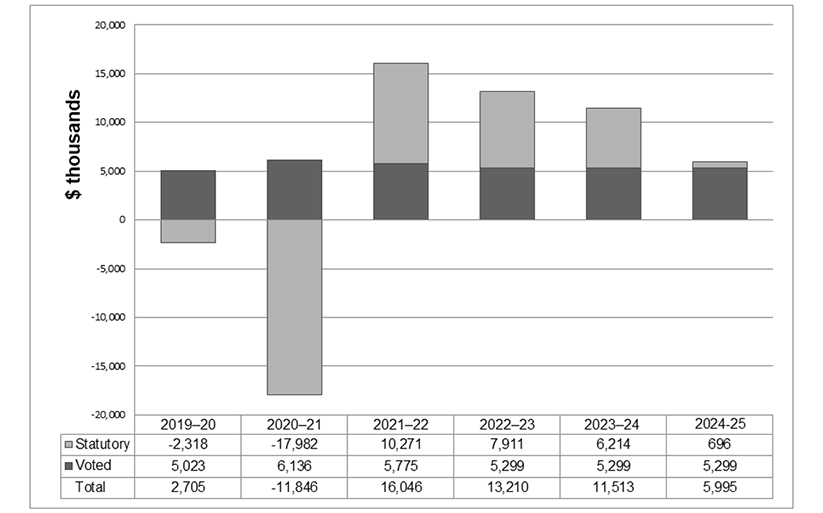
The following graph presents planned (voted and statutory spending) over time.
Spending 2019–20 to 2024–25
-
Spending
Spending 2019–20 to 2024–25 2019-20 2020-21 2021-22 2022-23 2023-24 2024-25 Statutory -2,318 -17,982 10,271 7,911 6,214 696 Voted 5,023 -6,136 5,775 5,299 5,299 5,299 Total 2,705 -11,846 16,046 13,210 11,513 5,995
Note: Statutory amounts are net of respendable revenues and contain employee benefits plan funding.
Budgetary performance summary for core responsibility and internal services (dollars)
The following “Budgetary performance summary for core responsibility and internal services” table presents the budgetary financial resources allocated for the Canadian Grain Commission’s core responsibility and for internal services.
| Core Responsibility and Internal Services | 2021-22 Main Estimates | 2021-22 Planned Spending | 2022-23 Planned Spending | 2023–24 Planned Spending | 2021-22 Total Authorities Available for Use | 2019-20 Actual Spending (authorities used) | 2020-21 Actual Spending (authorities used) | 2021-22 Actual Spending (authorities used) |
|---|---|---|---|---|---|---|---|---|
| Grain Regulation | 6,524,580 | 6,524,580 | 12,914,594 | 11,217,701 | 7,088,928 | (17,673,850) | (33,438,499) | (6,136,888) |
| Subtotal | 6,524,580 | 6,524,580 | 12,914,594 | 11,217,701 | 7,088,928 | (17,673,850) | (33,438,499) | (6,136,888) |
| Internal Services | 245,000 | 245,000 | 295,356 | 295,356 | 245,000 | 20,379,041 | 21,592,592 | 22,183,002 |
| Total | 6,769,580 | 6,769,580 | 13,209,950 | 11,513,057 | 7,333,928 | 2,705,191 | (11,845,907) | 16,046,114 |
Note: Planned spending is net of respendable revenues. For planning, revenue forecasts are allocated to both Grain Regulation and Internal Services as required. The Canadian Grain Commission reports all revenues collected under its Grain Regulation core responsibility; however, these revenues also support the costs of internal services. Details on the overall organization’s expenditure distribution can be found in the 2021-22 Budgetary actual gross spending summary (dollars) table below.
Canadian Grain Commission revenues are dependent on annual grain volumes that can fluctuate considerably from year-to-year and are not fully known prior to the commencement of the fiscal year. This can result in significant variances between projected and actual revenues. The Canadian Grain Commission could accumulate surpluses in years with higher-than-average grain volumes and may be required to draw on its accumulated surplus funds in years with lower-than-average volumes.
From 2013 to 2018, unprecedented increases in Canadian grain production and relatively stable operating costs led to an accumulated revolving fund surplus of approximately $130 million as of March 31, 2018. To invest the accumulated revolving fund surplus into the Canadian grain sector, the Canadian Grain Commission announced an Investment Framework on August 1, 2018. The Investment Framework retains $40 million of the accumulated surplus for a contingency operating reserve to guard against the possibility of future declines in revenues, while committing $90 million for strategic investments.
When the Investment Framework was announced, the Canadian Grain Commission committed to consulting the sector on further surplus investment initiatives. At that time, the Canadian Grain Commission envisioned rolling out investments over a two-year timeframe. However, this time-line was subsequently delayed as a result of Budget 2019’s announcement of the Canada Grain Act review to ensure alignment between the two processes.
Since 2018, Canadian grain export volumes continued to grow, and some of the factors leading to recent increases were not anticipated by the current grain forecasting model. Combined with relatively stable operating costs, this led to further surplus growth in 2018 to 2021, the majority of which occurred in 2020-21 due to extraordinary grain export volumes. Prior to 2020-21, the Canadian Grain Commission realized relatively small surpluses which are reasonable in a revolving fund environment. To address this situation and mitigate the risk of further surplus growth, the Canadian Grain Commission updated its model for forecasting annual grain volumes and revenue projections. Proposed changes were published in the Canada Gazette, Part I, on May 22, 2021. Effective August 1, 2021, the four fees for official inspection and weighing that generate most of the surplus were reduced by 29 percent and realigned with the adjusted grain volume forecast of 48.10 million metric tonnes.
However, excessively hot and dry growing conditions across most of the western Canadian grain production area in 2021 resulted in significantly decreased yields. This in turn resulted in reduced grain volumes at export position, as despite growing infrastructure capacity, there was simply not sufficient grain supply this year to match previous expectations. As such, the volumes inspected and weighed by the Canadian Grain Commission in the 2021-22 fiscal year were lower than the recent adjusted forecast and resulted in reduced revenues. The Canadian Grain Commission utilized its position as a revolving fund to draw down on surplus revenue accumulated since 2018 to cover this revenue shortfall.
Despite the revenue shortfall position, actual spending for 2021-22 remained relatively consistent to spending in 2019 through 2021. Slight increases in expenditures were primarily the result of projects related to the Investment Framework that helped ensure the Canadian Grain Commission continued to deliver on its key areas of focus. As part of the Investment Framework, the Canadian Grain Commission allocated $4 million to fund enhancements to the Harvest Sample Program for five years. Additionally, in 2021-22, the Canadian Grain Commission made modest surplus investments in:
- a pulse testing program;
- developing a suite of integrated program delivery systems to provide seamless digital service to Canadian Grain Commission clients;
- renewal of laboratory infrastructure; and
- strategic investments to strengthen research and innovation.
Going forward, the Canadian Grain Commission will consider investment initiatives within the broader context of the Canada Grain Act Review outcomes and any holdover drought impacts on grain volumes and fee revenue.
2021–22 Budgetary actual gross spending summary (dollars)
The following table reconciles gross planned spending with net spending for 2021–22.
| Core Responsibility and Internal Services | 2021-22 Actual gross spending | 2021-22 Actual revenues netted against expenditures | 2021–22 Actual net spending (authorities used) |
|---|---|---|---|
| Grain Regulation | 44,202,149 | 50,339,037 | (6,136,888) |
| Subtotal | 44,202,149 | 50,339,037 | (6,136,888) |
| Internal Services | 22,201,688 | 18,686 | 22,183,002 |
| Total | 66,403,837 | 50,357,723 | 16,046,114 |
Note: The Canadian Grain Commission does not have any specified purpose accounts to report against. Funding structure is based on budgetary authorities that are comprised of both voted and statutory authorities. The statutory authorities include employee benefit plan authority for appropriation-funded personnel costs and Canadian Grain Commission revolving fund authority, which allows the Canadian Grain Commission to respend fees that it has collected. The organization’s revenue is based on fees for services as per the Service Fees Act.
Human resources
The following “Human resources summary for core responsibility and internal services” table presents the full-time equivalents allocated to each of the Canadian Grain Commission’s core responsibility and to internal services.
| Core Responsibility and Internal Services | 2019-20 Actual full-time equivalents | 2020-21 Actual full-time equivalents | 2021-22 Planned full-time equivalents | 2021-22 Actual full-time equivalents | 2022-23 Planned full-time equivalents | 2023-24 Planned full-time equivalents |
|---|---|---|---|---|---|---|
| Grain Regulation | 322 | 306 | 317 | 319 | 317 | 317 |
| Subtotal | 322 | 306 | 317 | 319 | 317 | 317 |
| Internal Services | 125 | 130 | 133 | 145 | 133 | 133 |
| Total | 447 | 436 | 450 | 464 | 450 | 450 |
Planned full-time equivalents for 2021-22 was 450. The actual number of full-time equivalents was 464. The difference is primarily due to the increase of resources to support strategic initiatives such as Future of Work, MyCGC Portal, and the Canadian Grain Commission laboratory project.
Expenditures by vote
For information on the Canadian Grain Commission’s organizational voted and statutory expenditures, consult the Public Accounts of Canada 2022.
Government of Canada spending and activities
Information on the alignment of the Canadian Grain Commission’s spending with the Government of Canada’s spending and activities is available in GC InfoBase.
Financial statements and financial statements highlights
Financial statements
The Canadian Grain Commission’s financial statements (unaudited) for the year ended March 31, 2022, are available on the departmental website.
Financial statements highlights
| Financial information | 2021–22 Planned results | 2021–22 Actual results | 2020–21 Actual results | Difference (2021–22 Actual results minus 2021–22 Planned results) | Difference (2021–22 Actual results minus 2020–21 Actual results) |
|---|---|---|---|---|---|
| Total expenses | 62,795,419 | 66,735,402 | 65,882,041 | 3,939,983 | 853,361 |
| Total revenues | (59,431,767) | (45,439,557) | (81,221,451) | 13,992,210 | 35,781,894 |
| Net cost of operations before government funding and transfers | 3,363,652 | 21,295,845 | (15,339,410) | 17,932,193 | 36,635,255 |
The Canadian Grain Commission’s Future-Oriented Statement of Operations and notes for 2021-22 are located on the departmental website.
2021-22 Actual to 2021-22 Planned
The net cost of operations before government funding and transfers for 2021-22 was a deficit of $21.30 million. This represents an increase of $17.94 million from the 2021-22 planned results of $3.36 million in net cost. This is a result of:
- Actual expenditures increasing by $3.94 million compared to 2021-22 planned expenses. This was primarily due to an increase in spending on corporate strategic initiatives such as Future of Work, MyCGC Portal and the Canadian Grain Commission laboratory project.
- Actual revenues earned decreasing by $13.99 million compared to 2021-22 planned revenue due to extreme weather in 2021 resulting in lower-than-expected grain volumes.
2021-22 Actual to 2020-21 Actual
The net cost of operations before government funding and transfers for 2021-22 was a deficit of $21.30 million. This represents an increase of $36.64 million from the 2020-21 actual result of $(15.34) million in net cost. This is primarily due to:
- 2021-22 actual expenditures increasing by $0.85 million compared to 2020-21 actual expenses. This was primarily the result of an increase in payments to consultants for strategic initiatives.
- 2021-22 actual revenues earned decreasing by $35.78 million over 2020-21 due to a reduction in service fees for official inspection and weighing effective August 1, 2021 and extreme weather in 2021 resulting in lower than expected grain volumes.
| Financial Information | 2021–22 | 2020–21 | Difference (2021–22 minus 2020–21) |
|---|---|---|---|
| Total net liabilities | 11,308,413 | 12,751,796 | (1,443,383) |
| Total net financial assets | 3,737,956 | 9,094,101 | (5,356,145) |
| Departmental net debt | 7,570,457 | 3,657,695 | 3,912,762 |
| Total non-financial assets | 12,372,880 | 12,773,269 | (400,389) |
| Departmental net financial position | 4,802,423 | 9,115,574 | (4,313,151) |
The 2021–22 planned results information is provided in the Canadian Grain Commission’s Future-Oriented Statement of Operations and Notes 2021-22.
The Canadian Grain Commission’s net financial position in 2021-22 was $4.80 million, a decrease of $4.31 million from the 2020-21 net financial position of $9.12 million. This is a result of:
- Decreased total net liabilities of $1.44 million primarily resulting from:
- A decrease to accounts payable to external vendors due to procurement capacity and supply chain issues causing items to be deferred and significant scientific and IT equipment for the Mobile Device Strategy received in March 2021
- A decrease to employee severance benefits liability due to the timing of payments made to employees on retirement
Decreased total financial assets of $5.36 million resulting from a decrease in accounts receivable due to a reduction in user fees for official inspection and weighing effective August 1, 2021 and decreased grain volumes inspected and weighed.
Corporate information
Organizational profile
Appropriate Minister: The Honourable Marie-Claude Bibeau, P.C., M.P.
Institutional Head: Doug Chorney, Chief Commissioner
Ministerial Portfolio: Agriculture and Agri-Food (AAFC)
Enabling Instrument: Canada Grain Act, R.S.C. 1985, c. G-10
Year of Incorporation / Commencement: 1912
Other: The Canadian Grain Commission’s head office is in Winnipeg, Manitoba. The Canadian Grain Commission operates two regional offices and eight service centres and provides service at more than 30 terminal elevator delivery points across Canada. A combination of revolving fund (fees) and appropriation sources fund Canadian Grain Commission programs and services. The Canadian Grain Commission aims to recover approximately 91 percent of its costs through fees and approximately nine percent through appropriation.
Raison d’être, mandate and role: who we are and what we do
“Raison d’être, mandate and role: who we are and what we do” is available on the Canadian Grain Commission’s website.
For more information on the department’s organizational mandate letter commitments, see the Minister’s mandate letter.
Operating context
Information on the operating context is available on the Canadian Grain Commission’s website.
Reporting framework
The Canadian Grain Commission’s Departmental Results Framework and Program Inventory of record for 2021-22 are shown below.
| Departmental Results Framework | Core Responsibility: Grain Regulation | Internal Services | |
|---|---|---|---|
| Departmental Result: Domestic and international markets regard Canadian grain as dependable and safe | Indicator: Percentage of stakeholders who regard Canadian grain as dependable and safe | ||
| Indicator: Value of Canadian grain exports | |||
| Departmental Result: Farmers are fairly compensated for their grain | Indicator: Percentage of sales where farmers are compensated for their grain | ||
| Indicator: Percentage of outstanding liabilities paid to farmers in the event of a default by a Canadian Grain Commission licensed grain company | |||
| Program Inventory | Program: Grain Quality | ||
| Program: Grain Research | |||
| Program: Safeguards for Grain Farmers | |||
Supporting information on the program inventory
Financial, human resources and performance information for the Canadian Grain Commission’s Program Inventory is available in GC InfoBase.
Supplementary information tables
The following supplementary information tables are available on the Canadian Grain Commission’s website:
Federal tax expenditures
The tax system can be used to achieve public policy objectives through the application of special measures such as low tax rates, exemptions, deductions, deferrals and credits. The Department of Finance Canada publishes cost estimates and projections for these measures each year in the Report on Federal Tax Expenditures. This report also provides detailed background information on tax expenditures, including descriptions, objectives, historical information and references to related federal spending programs as well as evaluations and GBA+ of tax expenditures.
Organizational contact information
Canadian Grain Commission
600-303 Main Street
Winnipeg, Manitoba R3C 3G8
Telephone: 204-984-0506
Toll free: 1-866-317-4289
Facsimile: 204-983-2751
Teletypewriter (TTY, toll free): 1-866-317-4289
Email: contact@grainscanada.gc.ca
Canadian Grain Commission’s website.
Appendix: Definitions
- appropriation
- (crédit): Any authority of Parliament to pay money out of the Consolidated Revenue Fund.
- budgetary expenditures
- (dépenses budgétaires): Operating and capital expenditures; transfer payments to other levels of government, organizations or individuals; and payments to Crown corporations.
- core responsibility
- (responsabilité essentielle): An enduring function or role performed by a department. The intentions of the department with respect to a core responsibility are reflected in one or more related departmental results that the department seeks to contribute to or influence.
- Departmental Plan
- (Plan ministériel): A report on the plans and expected performance of an appropriated department over a 3 year period. Departmental Plans are usually tabled in Parliament each spring.
- departmental priority
- (priorité): A plan or project that a department has chosen to focus and report on during the planning period. Priorities represent the things that are most important or what must be done first to support the achievement of the desired departmental results.
- departmental result
- (résultat ministériel): A consequence or outcome that a department seeks to achieve. A departmental result is often outside departments’ immediate control, but it should be influenced by program-level outcomes.
- departmental result indicator
- (indicateur de résultat ministériel): A quantitative measure of progress on a departmental result.
- departmental results framework
- (cadre ministériel des résultats): A framework that connects the department’s core responsibilities to its departmental results and departmental result indicators.
- Departmental Results Report
- (rapport sur les résultats ministériels): A report on a department’s actual accomplishments against the plans, priorities and expected results set out in the corresponding Departmental Plan.
- experimentation
- (expérimentation): The conducting of activities that seek to first explore, then test and compare the effects and impacts of policies and interventions in order to inform evidence-based decision-making, and improve outcomes for Canadians, by learning what works, for whom and in what circumstances. Experimentation is related to, but distinct from innovation (the trying of new things), because it involves a rigorous comparison of results. For example, using a new website to communicate with Canadians can be an innovation; systematically testing the new website against existing outreach tools or an old website to see which one leads to more engagement, is experimentation.
- full time equivalent
- (équivalent temps plein): A measure of the extent to which an employee represents a full person year charge against a departmental budget. For a particular position, the full time equivalent figure is the ratio of number of hours the person actually works divided by the standard number of hours set out in the person’s collective agreement.
- gender-based analysis plus (GBA+)
- (analyse comparative entre les sexes plus [ACS Plus]): An analytical tool used to support the development of responsive and inclusive policies, programs and other initiatives; and understand how factors such as sex, race, national and ethnic origin, Indigenous origin or identity, age, sexual orientation, soci-oeconomic conditions, geography, culture and disability, impact experiences and outcomes, and can affect access to and experience of government programs.
- government-wide priorities
- (priorités pangouvernementales): For the purpose of the 2021–22 Departmental Results Report, government-wide priorities refers to those high-level themes outlining the government’s agenda in the 2020 Speech from the Throne, namely: Protecting Canadians from COVID-19; Helping Canadians through the pandemic; Building back better – a resiliency agenda for the middle class; The Canada we’re fighting for.
- horizontal initiative
- (initiative horizontale): An initiative where two or more federal organizations are given funding to pursue a shared outcome, often linked to a government priority.
- non-budgetary expenditures
- (dépenses non budgétaires): Net outlays and receipts related to loans, investments and advances, which change the composition of the financial assets of the Government of Canada.
- performance
- (rendement): What an organization did with its resources to achieve its results, how well those results compare to what the organization intended to achieve, and how well lessons learned have been identified.
- performance indicator
- (indicateur de rendement): A qualitative or quantitative means of measuring an output or outcome, with the intention of gauging the performance of an organization, program, policy or initiative respecting expected results.
- performance reporting
- (production de rapports sur le rendement): The process of communicating evidence based performance information. Performance reporting supports decision making, accountability and transparency.
- plan
- (plan): The articulation of strategic choices, which provides information on how an organization intends to achieve its priorities and associated results. Generally, a plan will explain the logic behind the strategies chosen and tend to focus on actions that lead to the expected result.
- planned spending
- (dépenses prévues): For Departmental Plans and Departmental Results Reports, planned spending refers to those amounts presented in Main Estimates.
A department is expected to be aware of the authorities that it has sought and received. The determination of planned spending is a departmental responsibility, and departments must be able to defend the expenditure and accrual numbers presented in their Departmental Plans and Departmental Results Reports. - program
- (programme): Individual or groups of services, activities or combinations thereof that are managed together within the department and focus on a specific set of outputs, outcomes or service levels.
- program inventory
- (répertoire des programmes): Identifies all the department’s programs and describes how resources are organized to contribute to the department’s core responsibilities and results.
- result
- (résultat): A consequence attributed, in part, to an organization, policy, program or initiative. Results are not within the control of a single organization, policy, program or initiative; instead they are within the area of the organization’s influence.
- statutory expenditures
- (dépenses législatives): Expenditures that Parliament has approved through legislation other than appropriation acts. The legislation sets out the purpose of the expenditures and the terms and conditions under which they may be made.
- target
- (cible): A measurable performance or success level that an organization, program or initiative plans to achieve within a specified time period. Targets can be either quantitative or qualitative.
- voted expenditures
- (dépenses votées): Expenditures that Parliament approves annually through an appropriation act. The vote wording becomes the governing conditions under which these expenditures may be made.