
Quarterly Financial Report for the quarter ended December 31, 2025
1.0 Introduction
This quarterly financial report should be read in conjunction with the Main Estimates and Supplementary Estimates. It has been prepared by Canadian Grain Commission (CGC) management as required by section 65.1 of the Financial Administration Act and is in the form and manner prescribed by the Treasury Board. This quarterly report has not been subject to an external audit or review.
1.1 Authority, Mandate and Program Activities
The CGC was established in 1912 and is the federal government department responsible for administering the provisions of the Canada Grain Act.
The CGC's mandate as set out in the Act is to, "in the interests of the grain producers, establish and maintain standards of quality for Canadian grain and regulate grain handling in Canada, to ensure a dependable commodity for domestic and export markets".
The CGC's vision is "To be a world class, science-based quality assurance provider". The Minister of Agriculture and Agri-Food is responsible for the CGC.
The CGC's Core Responsibility is grain regulation, or, to regulate grain handling in Canada and to establish and maintain science-based standards for Canadian grain. The CGC regulates the handling of 21 grainsFootnote 1 grown in Canada to protect producer rights and to ensure the integrity of grain transactions.
The CGC's departmental results are that domestic and international markets regard Canadian grain as dependable and safe, and that farmers are fairly compensated for their grain. The CGC has 3 programs: grain quality, grain research and safeguards for grain farmers. Internal Services supports these programs.
Further details on the CGC's authority, mandate, and programs may be found in the Departmental Plan, the Departmental Results Report, and the Main Estimates.
1.2 Basis of Presentation
This quarterly report has been prepared by management using an expenditure basis of accounting (modified cash) and a special purpose financial reporting framework designed to meet financial information needs with respect to the use of spending authorities. The accompanying Statement of Budgetary Authorities compares the department's spending authorities granted by Parliament to those used by the department. Information in the Statement of Authorities is consistent with that in the Main Estimates and Supplementary Estimates.
The authority of Parliament is required before moneys can be spent by the government. Approvals are given in the form of annually approved limits through appropriations acts or through legislation in the form of statutory spending for specific purposes.
As part of the Parliamentary business of supply, the Main Estimates must be tabled in Parliament on or before March 1 preceding the new fiscal year. However, when Parliament is dissolved for the purposes of a general election, section 30 of the Financial Administration Act, authorizes, under certain conditions, the preparation of a special warrant to be signed by the Governor General, authorizing payments to be made out of the Consolidated Revenue Fund. Special warrants are deemed to be an appropriation for the fiscal year in which they are issued. Special warrants issued during the first quarter (Q1) 2025-26 were included in the total appropriations in Main Estimates 2025-26.
The CGC uses the full accrual method of accounting to prepare and present its annual departmental financial statements included in the Departmental Results Report. However, the spending authorities voted by Parliament are on an expenditure basis (modified cash) of accounting.
1.3 Canadian Grain Commission Financial Structure
Unlike most other government departments, which rely primarily on annual budget appropriations, the CGC operates as a fee-based revolving fund. This means it collects the majority of its revenues from fees charged for its services and can carry amounts forward to future years. In total, more than 90% of the CGC’s funding comes from fees, while the remainder comes from parliamentary appropriations focused on supporting grain research.
The CGC’s revenue is mainly based on grain volumes inspected and weighed, which can fluctuate from year-to-year (See Section 3.1 Cost Recovery and Revenue Uncertainty). Since fiscal year 2019-20, the CGC has adjusted fees annually on April 1, in accordance with the Canada Grain Regulations. For fiscal year 2025-26, the fee adjustment is based on the April 2024 All-Items Consumer Price Index for Canada, which was 2.7%. The CGC also reviews its fee structure every 5 years to ensure alignment with the cost of service delivery. Current fees are available on the CGC's website under Services and fees.
The CGC's parliamentary appropriations include both voted and statutory authorities.
- The voted authority (Vote 1 – Program Expenditures) includes the annual appropriation authority and any one-time, ad hoc appropriations for the fiscal year.
- Statutory authorities include the employee benefit plan authority, which covers personnel costs funded through appropriations, and the revolving fund authority, which allows the CGC to re-spend revenues collected through service fees.
As of March 31, 2025, the CGC’s accumulated revolving fund surplus balance was $102.1 million. Surplus spending plans including revenue projections, expenditures, and full-time equivalents (FTEs) for fiscal year 2025-26 and beyond are detailed in the CGC’s 2025-26 Departmental Plan.
2.0 Highlights of Fiscal Year to Date
This section highlights any significant items that affected the year-to-date results and/or contributed to the net change in resources available for the year and actual expenditures. It should be read in conjunction with the Statement of Budgetary Authorities and the Departmental Budgetary Expenditures by Standard Object, which can be found at the end of this report.
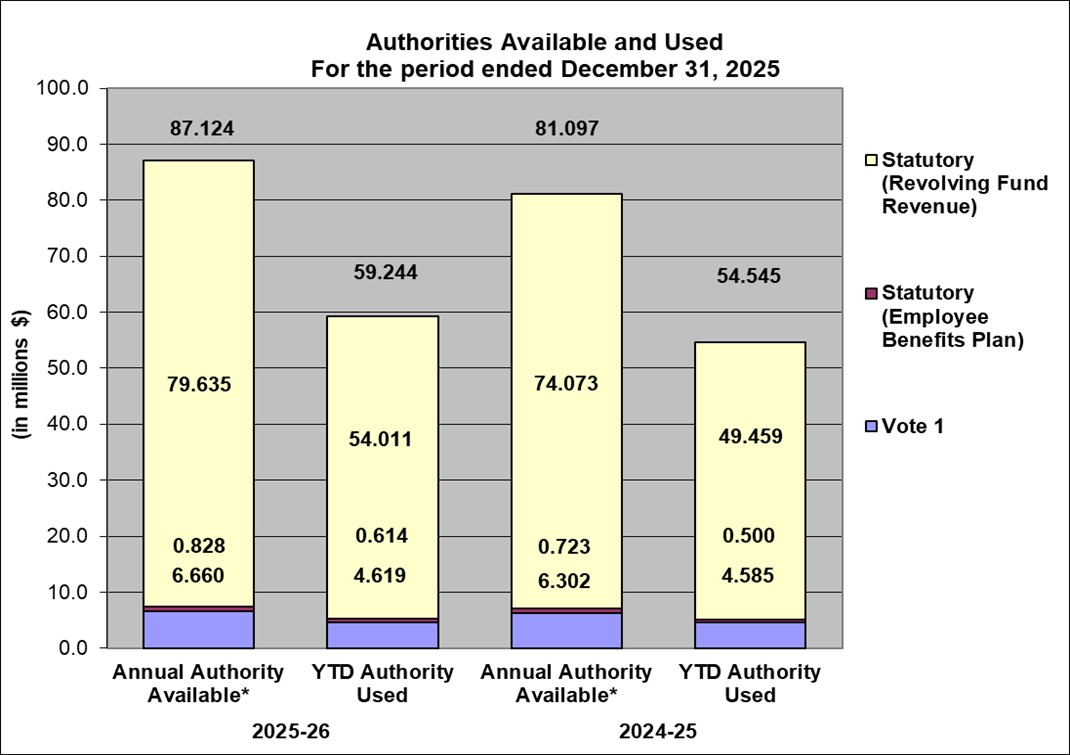
Details
| Authority | 2025 to 2026 | 2024 to 2025 | ||
|---|---|---|---|---|
| Annual authority availabletable 1 note * | YTD Authority used | Annual authority availabletable 1 note * | YTD Authority used | |
| Vote 1 | 6.660 | 4.619 | 6.302 | 4.585 |
| Statutory (Employee Benefits Plan) | 0.828 | 0.614 | 0.723 | 0.500 |
| Statutory (Revolving Fund Revenue) | 79.635 | 54.011 | 74.073 | 49.459 |
| Total | 87.124 | 59.244 | 81.097 | 54.545 |
Table 1 Notes
| ||||
2.1 Authority Available Analysis
As reflected in the Statement of Budgetary Authorities, the department's total budgetary authority available for use (net of revolving fund revenue) in the fiscal year as at December 31, 2025, is $28.8 million, as compared to $12.6 million as at December 31, 2024. The $16.2 million increase in total budgetary authority is primarily due to plans to utilize the accumulated surplus to address anticipated grain volume shortfalls, support commitments to organizational sustainability, and to fund strategic investments rather than raising fees.
2.2 Authority Used Analysis
Used during the quarter
As reflected in the Departmental Budgetary Expenditures by Standard Object, the department’s total net budgetary expenditures used during the quarter ended December 31, 2025, is $1.1 million, as compared to $3.4 million for the same period last year. The change of $2.3 million in total net budgetary expenditures used can primarily be attributed to the following variances:
- The overall increase of $2.9 million in revolving fund revenues received, primarily due to timing for payment of inspection and weighing invoices.
- The overall increase of $0.6 million in gross budgetary expenditures, primarily a result of the following variances:
- Increase of $0.2 million in expenditures for repairs and maintenance due to strategic investments in infrastructure for the Grain Research Lab.
- Increase of $0.2 million in expenditures for personnel due to known collective agreement bargaining increases and higher estimated employee benefit plan expenses.
- Increase of $0.2 million in expenditures for acquisition of machinery and equipment due to infrastructure upgrades.
Used year-to-date
The department’s total net budgetary expenditures used year-to-date at quarter ended December 31, 2025, is $12.4 million, as compared to $14.3 million for the same period last year. The change of $1.9 million in total net budgetary expenditures used can be attributed to the following variances:
- The overall increase of $6.5 million in revolving fund revenues received, primarily due to stronger market demand at export position during the first quarter resulting in year-to-date grain volumes exceeding prior year by 1.9 million metric tonnes, or 5.6%.
- The overall increase of $4.6 million in gross budgetary expenditures, primarily a result of the following variances:
- Increase of $2.2 million in expenditures for repair and maintenance due to strategic investments in infrastructure for the Grain Research Lab.
- Increase of $1.9 million in expenditures for personnel due to known collective agreement bargaining increases and higher estimated employee benefit plan expenses.
- Increase of $0.5 million in expenditures for acquisition of machinery and equipment due to infrastructure upgrades.
3.0 Risks and Uncertainties
Risk management is an essential part of strategic planning and decision making at the CGC. The CGC has an established process to identify, monitor, mitigate and manage corporate level risk. As identified in the 2025-26 Departmental Plan, the key corporate risks that could affect achieving planned results under the CGC's Core Responsibility are:
- the capacity to deliver on the core mandate and to respond to grain sector needs due to resource constraints
- maintaining efficient and relevant program and service delivery to stay current with evolving grain sector needs for grain quality assurance
- the impact to organization and public trust if a major cybersecurity incident or information breach occurs
To mitigate program risk and ensure long-term success in delivering the departmental results, the CGC is working to deliver 3 key priorities to ensure domestic and international markets regard Canadian grain as dependable and safe, and that Canadian farmers are fairly compensated for their grain. These priorities are described in the CGC’s 2025-26 Departmental Plan at a glance.
3.1 Cost Recovery and Revenue Uncertainty
A significant risk to the CGC's financial plan is revenue uncertainty due to grain volumes which can fluctuate from year-to-year due to external factors. Variances can arise between projected and actual revenues since grain handling volumes are estimated based on historical averages while operational costs are relatively fixed.
Climate change and extreme weather events, such as droughts, floods, or forest fires, can significantly impact grain production and consequently increase the CGC's revenue risk. The Canadian grain sector can also face export volume uncertainty regarding access to international markets due to market sensitivity to actual or perceived grain quality and food-safety issues.
The Outlook for Principal Crops published by Statistics Canada on December 17, 2025, forecasts an increase in production from 97.0 million metric tonnesFootnote 2 for 2024-25 crop yearFootnote 3 to 107.0 million metric tonnes for the 2025-26 crop year. An increase of 10.1 million metric tonnes or 10% as compared to 2024 levels and 16% above the previous 5-year average.
In fiscal year 2024-25, the CGC completed a comprehensive review of its revenues, costs, grain volume forecasting model and service standards, and determined that its fees do not reflect the costs of providing the organization’s services and licences. This is due to a combination of lower-than-expected grain volume exports, changed assumptions regarding licencing costs, outdated fee alignment, and growing costs for labour and digital service delivery.
In fall 2024, the CGC announced plans to address revenue shortfalls by drawing on its accumulated surplus until the end of fiscal 2026-27, targeting fee amendments for April 1, 2027. Since then, the draw on surplus has been less than expected, resulting in additional financial capacity. In fall 2025, the CGC announced plans to defer proposing regulatory changes to adjust fees for one additional year, through fiscal year 2027-28. The CGC plans to implement reassessed fees and grain volume forecasts for fiscal year 2028-29 to ensure a sustainably funded organization into the future. Stakeholders will be consulted prior to implementing any fee amendments.
The CGC’s annual budget is reviewed throughout the year to accommodate shifting needs and priorities, including risk mitigation strategies that enable the CGC to accommodate up to a 20% variance in forecasted grain volumes. The CGC will continue to monitor and assess impacts and uncertainties associated with grain volumes and the potential impact on fiscal year 2025-26 revenues.
3.2 Surplus and Canada Grain Act Review
From fiscal years 2013-14 through 2020-21, unprecedented increases in Canadian grain production and relatively stable operating costs led to an accumulated revolving fund surplus of $156.0 million as of March 31, 2021. On August 1, 2021, to limit further accumulation of surplus, the CGC adjusted its grain volume forecast upwards from 34.4 to 48.1 million metric tonnes and reduced major fees by 29%. In recent years, the CGC faced challenging financial conditions primarily related to drought conditions, lower-than-forecasted grain volumes and growing costs for labour, technology and materials. This, in addition to planned strategic investment spending, resulted in a drawdown of accumulated surplus for fiscal years 2021-22 through 2024-25, which decreased the surplus balance to $102.1 million as at March 31, 2025.
Projected surplus draws in subsequent years are expected to reduce the available surplus balance to approximately $57.0 million by March 31, 2028. This includes $40.7 million previously set aside as an operating contingency.
Between 2018-19 and 2024-25, the CGC invested approximately $11.2 million of accumulated surplus funds into strategic investments. This includes:
- Harvest Sample Program enhancements - $3.6 million
- Grain Research Laboratory investment plan - $3.4 million
- MyCGC portal - $1.8 million
- Investment in science capacity - $1.6 million
- Mineral oil project - $0.4 million
- Pulse Canada research project - $0.2 million
In fiscal year 2025-26, the CGC intends to spend $3.5 million to continue investments in technology (digital solutions) and infrastructure, including the MyCGC portal and the Grain Research Laboratory investment plan.
Timeline and potential impacts of the Canada Grain Act review, led by Agriculture and Agri-Food Canada, on the CGC’s funding model and accumulated surplus are unknown at this time. Going forward, the CGC will consider investment initiatives within the broader context of the CGC’s strategic plan, modernization initiatives, the Canada Grain Act review outcomes and any impacts of grain volumes on fee revenue.
4.0 Significant Changes to Operations, Personnel, and Programs
In October 2025, the CGC updated its strategic plan for fiscal years 2026-27 through 2027-28. While most CGC resources continue to be dedicated to day-to-day delivery of programs and services, the remainder are dedicated to modernizing the CGC through the following 3 areas of focus:
- Sustainable funding and operations
- Technology and scientific innovation to advance program delivery
- Fair grain transactions and a competitive sector
Additional details are available in the CGC's 2025-26 Departmental Plan.
Under the recently announced Comprehensive Expenditure Review (CER), the CGC must reduce voted appropriation spending by 15% over 3 years. While the direct impact of CER to the CGC is limited, the CGC plans to review all spending and pursue opportunities for efficiency and potential cost-savings into the future.
There were no significant changes to operations, personnel, or programs in the third quarter of 2025-26.
Approval by Senior Official
Approved by:
David Hunt
Deputy Head
Winnipeg, Manitoba
February 26, 2026
Cheryl Blahey
Chief Financial Officer
Winnipeg, Manitoba
February 24, 2026
Statements of Budgetary Authorities (Unaudited)
| (in thousands of dollars) | Fiscal Year 2025-26 | Fiscal Year 2024-25 | ||||
|---|---|---|---|---|---|---|
| Total available for use for the year ending March 31, 2026Footnote * | Used during the quarter ended December 31, 2025 | Year-to date used at quarter end | Total available for use for the year ending March 31, 2025Footnote * | Used during the quarter ended December 31, 2024 | Year-to date used at quarter end | |
| Vote 1 | ||||||
| Appropriation including ad hoc | 6,660 | 1,571 | 4,619 | 6,302 | 1,771 | 4,585 |
| Statutory Authorities: | ||||||
| Revolving Fund Gross Expenditures | 79,635 | 18,419 | 54,011 | 74,073 | 17,661 | 49,459 |
| Revolving Fund Gross Revenues | (58,369) | (19,098) | (46,827) | (68,519) | (16,156) | (40,283) |
| Revolving Fund Net Expenditures | 21,266 | (678) | 7,184 | 5,554 | 1,505 | 9,176 |
| Employee Benefit Plan | 828 | 212 | 614 | 723 | 169 | 500 |
| Total Statutory Authorities | 22,094 | (466) | 7,798 | 6,276 | 1,673 | 9,676 |
| Total Budgetary Authorities | 28,755 | 1,105 | 12,417 | 12,578 | 3,444 | 14,261 |
Table 3 footnotes
| ||||||
Departmental Budgetary Expenditures by Standard Object (Unaudited)
| Expenditures (in thousands of dollars) | Fiscal Year 2025-26Footnote * | Fiscal Year 2024-25 | ||||
|---|---|---|---|---|---|---|
| Planned Expenditures for the year ending March 31, 2026Footnote * | Expended during the quarter ended December 31, 2025 | Year-to date used at quarter end | Planned Expenditures for the year ending March 31, 2025Footnote * | Expended during the quarter ended December 31, 2024 | Year-to date used at quarter end | |
| Personnel | 60,254 | 15,331 | 44,106 | 51,744 | 15,044 | 42,204 |
| Transportation and communications | 4,732 | 789 | 1,814 | 4,406 | 954 | 1,931 |
| Information | 215 | 25 | 77 | 232 | 74 | 179 |
| Professional and special services | 4,782 | 515 | 2,095 | 5,616 | 542 | 2,201 |
| Rentals | 8,263 | 1,430 | 4,435 | 8,492 | 1,418 | 4,159 |
| Repair and Maintenance | 2,796 | 1,154 | 4,168 | 3,015 | 896 | 1,854 |
| Utilities, materials and supplies | 1,506 | 239 | 1,023 | 2,087 | 220 | 1,096 |
| Acquisition of machinery and equipment | 4,577 | 687 | 1,498 | 5,505 | 451 | 962 |
| Other Subsidies and payments | - | 33 | 28 | - | 2 | (40) |
| Total Gross Budgetary Expenditures | 87,124 | 20,202 | 59,244 | 81,097 | 19,601 | 54,545 |
| Revolving Fund Revenue (To be credited to Vote) | (58,369) | (19,098) | (46,827) | (68,519) | (16,156) | (40,283) |
| Total Net Budgetary Expenditures | 28,755 | 1,105 | 12,417 | 12,587 | 3,444 | 14,261 |
Table 3 footnotes
| ||||||