
A rapid and efficient micro-scale extraction procedure for total yellow pigments in durum semolina and wholemeal
L. Schlichting and B.X. Fu
Abstract
Total yellow pigment (TYP) content is one of the most important quality factors in durum wheat and semolina because of its relationship to pasta colour. The standard methods used to measure TYP content require large amounts of sample and solvent and a 16 to 18 hour extraction time, which limits their use as a screening tool in breeding programs and for routine quality assurance. To that end, a rapid micro-scale procedure was developed to measure TYP. Semolina or wholemeal (200 mg) was homogenized with 1 ml water-saturated butanol (WSB) in a micro-centrifuge tube containing a steel bead. Pigments were allowed to extract for one hour, followed by centrifugation and measurement of absorption of the supernatant. TYP contents obtained using the new extraction procedure were 3 to 9% higher compared to values obtained with the standard method. This indicates that the new procedure increases extraction efficiency in addition to significantly reducing sample and solvent quantity and extraction time.
Objectives
The objective of this study was to develop a rapid method using a very small quantity of material and solvent (in a micro-centrifuge tube) to quantify TYP in semolina or wholemeal samples.
Materials and methods
The materials used in this study were six registered Canada Western Amber Durum (CWAD) wheat varieties grown in 2009 in Saskatchewan, Canada. All wheat samples were graded as No. 1 CWAD. Semolina was generated on a four stand Allis Chalmers mill in conjunction with a laboratory purifier as reported by Dexter et al (1990). Wheat samples were tempered to 16% moisture overnight before milling. Wholemeal was prepared by grinding 300 g of the durum wheat sample on a Perten 3100 laboratory mill (Perten Instruments, Springfield, IL, USA) equipped with a 0.8 mm sieve.
The Approved Method 14 to 50.01 (AACC International 2010) was used as a reference for the measurement of TYP content in semolina and wholemeal. For the micro-scale method, the sample size was reduced from 8.0 g to 0.2 g, and 150 ml flasks were replaced with 2.0 ml micro-centrifuge tubes. The solvent to material ratio (5:1) was kept the same as the standard method. WSB (1 ml) was added to a micro-centrifuge tube containing 200 mg of sample and a 2 mm stainless steel bead. The mixture was homogenized at 30 Hz for 5 minutes on a TissueLyser II bead mill (Qiagen, Hilden, Germany), followed by resting (1 hour), vortexing (15 seconds), and centrifugation (at 15 000 g for 10 minutes). Absorbance of the supernatant was measured with a spectrophotometer at 436 nm and converted to yellow pigment content as specified in AACC 14-50.01. TYP content was determined in triplicate for all samples.
Statistical analysis was performed using SAS 9.1 (SAS Institute, Cary, NC).
Results
Table 1 shows the TYP contents as determined with the AACC standard method and the micro-scale method for all the semolina samples. Table 2 shows the TYP contents as determined with the AACC standard method and the micro-scale method for all the wholemeal samples.
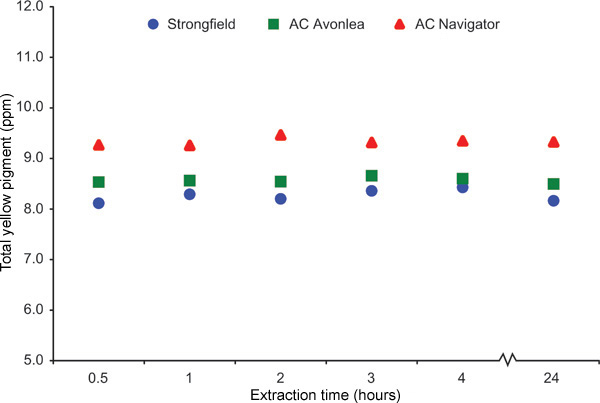
Tables 1 and 2 show the TYP contents as determined with the AACC standard method and the micro-scale method for all the semolina and wholemeal samples. Both methods were very reproducible, indicating that a 40 x reduction in sample size did not affect the reliability of the micro-scale method. The TYP values obtained using the new extraction procedure were significantly higher than those determined with the standard method for all samples, i.e., an increase of 3 to 5% for semolina and 6 to 9% for wholemeal. These results indicated that the new micro-scale procedure was more efficient in extracting pigments from semolina and wholemeal. Homogenization creates more surface area for the solvent to access and allows the solvent to penetrate faster inside the particles. As a result, extraction time can be reduced. Figure 1 and Table 3 show that one hour of resting was sufficient to extract all pigments in the semolina after 5 minutes of homogenization. Extended extraction time did not result in an increase in pigment recovery. The standard method extracted less pigments even after 16 hrs of resting, especially in wholemeal samples which usually have larger particle size.
The micro-scale extraction procedure results in significant saving of time, sample and solvent for TYP measurement (Figure 2 A to C). Using the micro-centrifuge tubes, semolina/wholemeal can be mixed simply by homogenizing with WSB and pigment extracts recovered by centrifugation, thus avoiding filtration. Micro-centrifuge tubes can be handled easily and are disposable, requiring less time and space than the 150 ml flasks described in the AACC method. The micro-method increases the throughput significantly, so a large number of samples can be analysed easily at one time. The limiting factor is the time required to weigh the samples.
| Sample | Total yellow pigment in semolina (ppm) | ||
|---|---|---|---|
| Standard method | New micro method | Increase in extractable TYP (%) | |
| AC Avonlea | 7.38 ± 0.03 | 7.81 ± 0.03 | 5.1 |
| Brigade | 8.70 ± 0.03 | 9.05 ± 0.02 | 3.3 |
| Commander | 8.63 ± 0.00 | 8.98 ± 0.03 | 4.4 |
| Eurostar | 7.68 ± 0.01 | 7.99 ± 0.06 | 3.8 |
| AC Navigator | 8.13 ± 0.02 | 8.53 ± 0.05 | 4.7 |
| Strongfield | 7.08 ± 0.02 | 7.51 ± 0.02 | 5.3 |
| Mean ± standard deviation | 7.93 ± 0.02 | 8.31 ± 0.03 | 4.8 |
| Coefficient of variation, % | 0.21 | 0.41 | not available |
| t test | not available | * | not available |
| * significant at P < 0.0001 | |||
| Sample | Total yellow pigment in semolina (ppm) | ||
|---|---|---|---|
| Standard method | New micro method | Increase in extractable TYP (%) | |
| AC Avonlea | 8.19 ± 0.12 | 8.78 ± 0.06 | 6.8 |
| Brigade | 9.62 ± 0.07 | 10.34 ± 0.03 | 8.1 |
| Commander | 9.47 ± 0.06 | 10.04 ± 0.06 | 7.1 |
| Eurostar | 8.65 ± 0.09 | 9.17 ± 0.05 | 6.5 |
| AC Navigator | 8.79 ± 0.09 | 9.25 ± 0.06 | 6.4 |
| Strongfield | 7.74 ± 0.05 | 8.39 ± 0.16 | 8.7 |
| Mean ± standard deviation | 8.74 ± 0.08 | 9.33 ± 0.07 | 6.5 |
| Coefficient of variation, % | 0.90 | 0.73 | not available |
| t test | not available | * | not available |
| * significant at P < 0.0001 | |||
Figure 1
| Sample | Extraction time (hours) | |||||
|---|---|---|---|---|---|---|
| 0.5 | 1 | 2 | 3 | 4 | 24 | |
| Strongfield | 8.1 | 8.3 | 8.2 | 8.4 | 8.4 | 8.2 |
| AC Avonlea | 8.5 | 8.6 | 8.5 | 8.7 | 8.6 | 8.5 |
| AC Navigator | 9.3 | 9.3 | 9.5 | 9.3 | 9.3 | 9.3 |
Figure 2
Figure 2a. Sample and solvent requirements


Figure 2b. Pigment extraction conditions


Figure 2c. Extract recovery


Conclusions
The micro-scale pigment extraction procedure described in this study is fast, reproducible and efficient for determining TYP content. It is useful as a tool for early generation screening in breeding, as a rapid test in routine quality assurance programs, and in preparation of pigment extracts for biochemical analysis.
References
- AACC International. 2010. Approved Methods of Analysis, 11th edition. Method 14-50.01.
- Dexter, J.E., Matsuo, R.R., and Kruger, J.E. 1990. Cereal Chemistry. 67:405-412.
Acknowledgements
The authors acknowledge the technical assistance of S. Nam, D. Taylor and D. Turnock.