
Digital Strategy
Table of contents
About this document
This document serves as the evolution of the Administrative Tribunals Support Service of Canada (ATSSC)’s digital strategy that was first released in 2021. The majority of the digital initiatives within the first strategy have successfully completed and transitioned to operations. Building on its past achievements, the ATSSC is now positioned to renew its digital roadmap for the next three years.
This strategy takes into account the role of the ATSSC as a support organization to Tribunals, while respecting their principle of judicial independence. It has a broad scope, exploring how digital services can continue to support Tribunals in improving access to justice and modernizing operations through innovation.
The success of this digital strategy is contingent on funding availability, governance approval, and Tribunal agreement.
Message from the ATSSC Chief Administrator

Orlando Da Silva, LSM
Chief Administrator
Tribunals play a key role in Canadian society by resolving disputes and settling conflicts on important issues that touch people’s lives in vital ways. Now more than ever, Canadians rely heavily on digital services to gain fair and transparent access to justice.
The ATSSC provides high-quality support services to 12 federal administrative tribunals and the National Joint Council. In 2021, the Department launched its Digital Strategy to support Tribunals in enabling access to justice.
Today, I am happy to announce that, in collaboration with the Tribunals, the ATSSC has successfully implemented a majority of the digital initiatives outlined in the initial strategy. The ATSSC has completed new E-Filing portals, websites, virtual hearings, and a Guided Pathway. These efforts promote a digital justice system that responds to the needs of those whom Tribunals serve.
Additionally, the ATSSC has invested in modern operational solutions. The implementation of fully operational case management systems and a powerful data analytics platform within the Tribunals marks a significant milestone leading to ongoing operational sustainability and efficiencies.
I invite you to read this renewal of our digital strategy for further details on our recent accomplishments and the path ahead that positions us to continue to build a department that is responsive in meeting the needs of our stakeholders, Tribunals and Canadians while safeguarding trust, transparency, and accountability.
Orlando Da Silva, LSM
Chief Administrator,
Administrative Tribunals Support Service of Canada
1 ATSSC Digital Vision
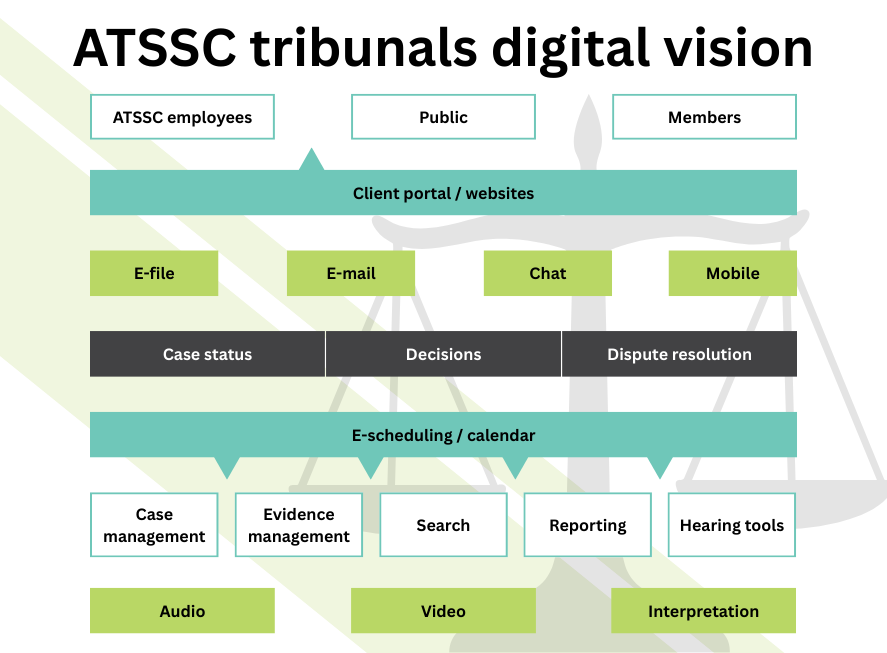
The following document is aligned with the Government of Canada (GC) Policy on Service and Digital with a shift to becoming more agile, open, and user focused. The document considers the design principles of GBA+, inclusion and accessibility. It also aligns with the ATSSC 2023-24 Departmental Plan commitment to service excellence by augmenting its digital capacity. Please consult Annex A for more information on the ATSSC’s mandate, and Annex B for more information on how A2J will be enabled and measured for results.
Canadians expect convenient, trusted, and easy to use digital government services.
The ATSSC digital vision was developed in 2021 to guide the department in implementing innovative digital solutions that respond to the growing needs and expectations of stakeholders, Tribunals, and Canadians.
The ATSSC digital vision supports Tribunals in enabling access to justice (A2J). A2J is linked to greater client-centered design, but not synonymous with it. To many Tribunals, client-centered design alone is not sufficient, A2J has to reach the broadest swath of actors, and the most vulnerable ones.
Digital@ATSSC means transforming service delivery, through a client-centered approach, making services easier to access, use and navigate. It also capitalizes on deploying new automation and capabilities that yield ongoing sustainability and efficiencies.
2 ATSSC Digital Strategy
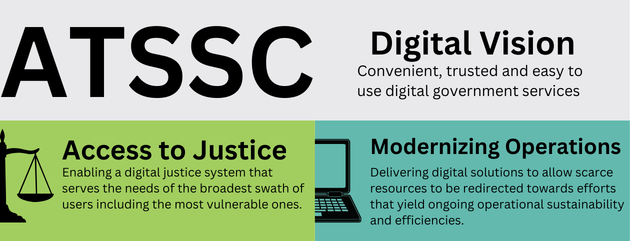
One of the ATSSC’s top priorities is to work in partnership with Tribunals to develop a digital justice system that is more accessible, inclusive, and effective in serving the needs of actors, stakeholders, and the public.
This Digital Strategy sets out renewed digital initiatives for the next three years that will continue to enable access to justice and modern operations moving beyond the traditional justice system by capitalizing on new digital technologies in the most efficient way possible.
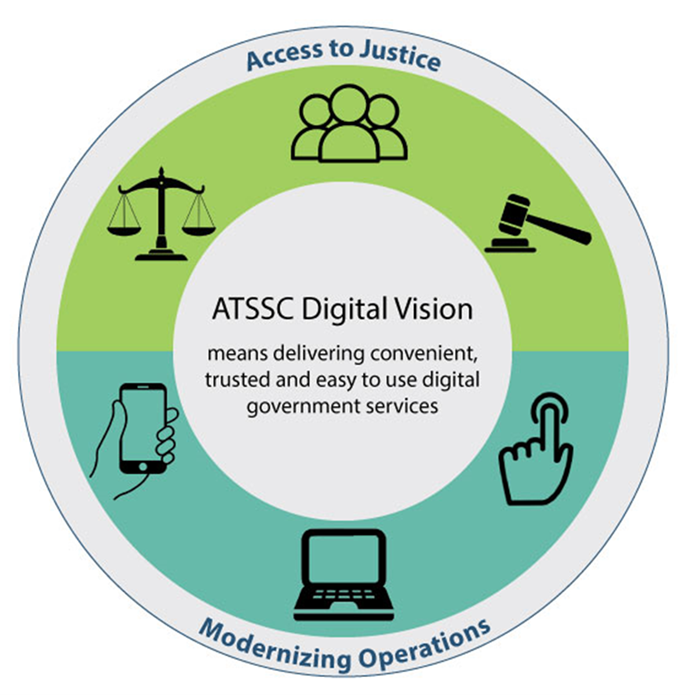
The ATSSC Digital Strategy is centered around two key priorities:
A2J: A2J is linked to greater user-centered design, but not synonymous with it. For some, but not all Tribunals, there is a greater need to enable unrepresented and underrepresented parties to participate effectively. If the client-centered focus is only on lawyers who represent parties, then the unrepresented and underrepresented may be left out and A2J will not be advanced. To many Tribunals, client-centered alone is not sufficient, it must reach the broadest swath of actors, and the most vulnerable ones.
Modernizing Operations: The ATSSC is modernizing operations to support Tribunals in more effectively serving the needs of actors, stakeholders, and the public. New technologies are being deployed in a smart, safe, and secure manner to support Tribunals in efficient case workload management, and ultimately in exercising their duties to oversee the administration of the rule of law. The ATSSC is leveraging innovation to allow scarce resources to be redirected towards efforts that yield ongoing operational sustainability and efficiencies.
3 Progress Report on Key Achievements 2021-2023
Since the launch of the ATSSC’s Digital Strategy in 2021, the Department has been consistent in driving its overall vision to deploy innovation and digital change. Today, the ATSSC’s digital services and tools are broader and more powerful than they were three years ago, when the strategy was started.
The ATSSC’s success has been primarily based on working in partnership with Tribunals with a strong focus on helping them achieve their interests in promoting an accessible and effective digital justice system.
A2J Key Achievements 2021-2023
The following access to justice achievements highlight the progress the ATSSC has made in delivering on its diverse digital innovation strategy:
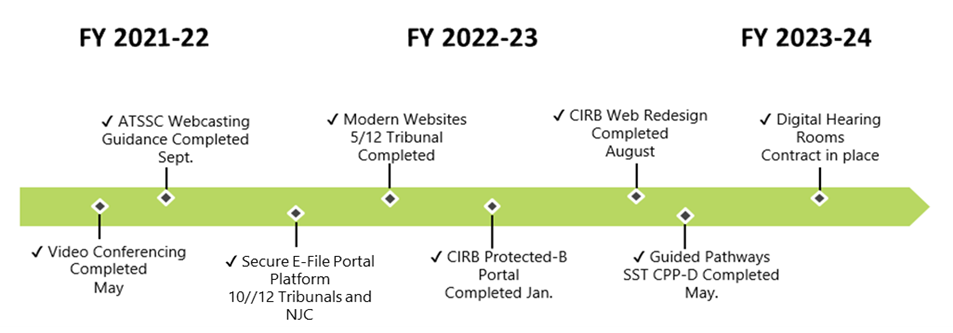
E-Filing Portals – Prior to 2020, only one Tribunal had an active E-Filing portal. As of 2023, nine (9) out of the twelve (12) Tribunals, as well as the National Joint Council secure bilingual self-serve E-Filing portals. These portals allow the public, actors and stakeholders to file important documents and access case information. The E-Filing portals have been designed with all parties needs in mind, and respect privacy and security requirements, such as disclosures. They support A2J considerations including but not limited to; plain language, guides for self-represented appellants that have demonstrated time and cost savings typically associated with traditional filing through courier and paper-based approaches. The portals are accessible 24/7 and are easy to use for those who are not technologically savvy.
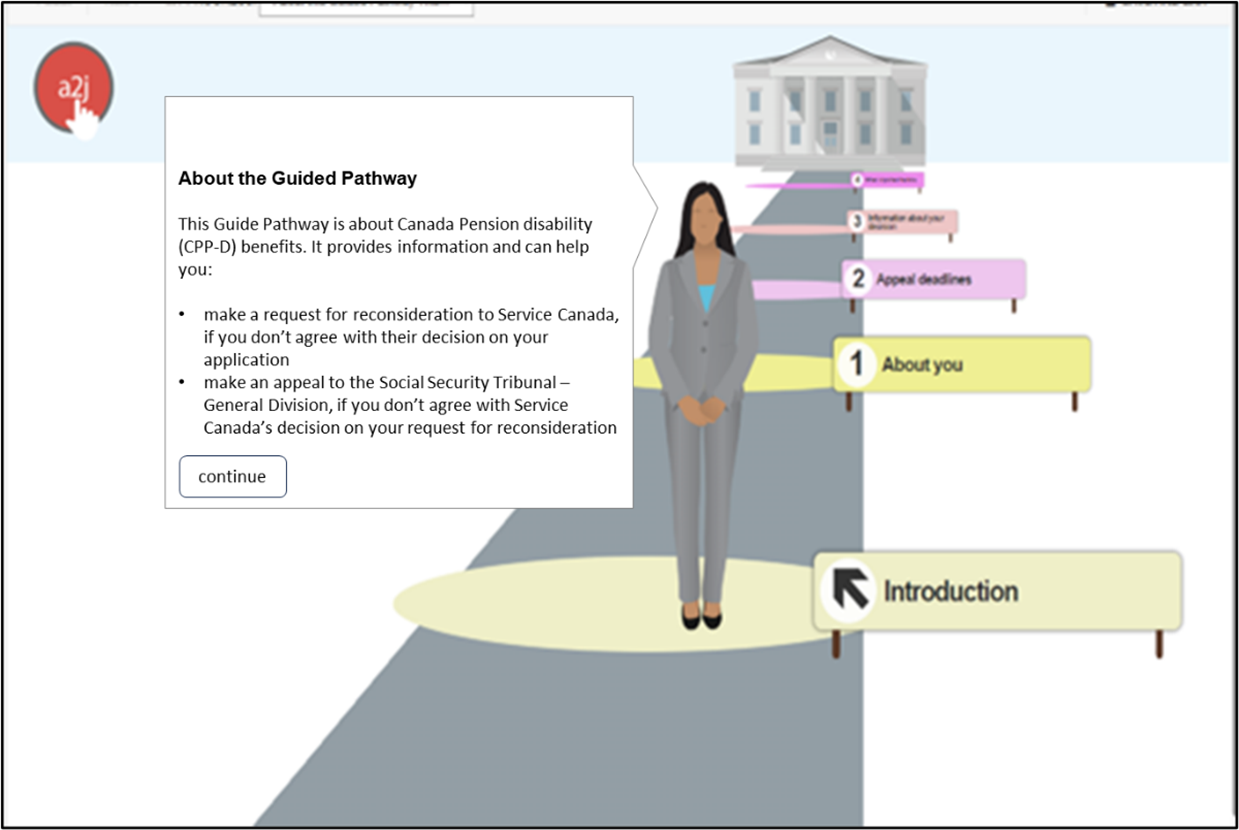
Guided-Pathways – In May 2023, the Social Security Tribunal (SST) launched a new innovative pilot to help the public and actors navigate through the complex legal appeal process and fill auto-generate forms easily along the way. The solution was delivered in partnership with Community Legal Education Ontario (CLEO). It enables a “guided pathway” for appellants filing an appeal under the Canada Pension Plan Disability (CPP-D) program. This achievement is a particularly important step in helping self-represented appellants who often experience challenges in understanding the rules and procedures for appeals. The guided pathway helps reduce the frustration experienced by appellants and the demand and growing need for assistance, repeated returns for information and often document refiling. Please see the Guided Pathways URL link for more information: CPP-D Guided Pathway URL: Welcome to the Guided Pathways
Modern Websites – Since 2020, the ATSSC has updated the websites of seven (7) out of the twelve (12) Tribunals it provides services to by taking an appellant or citizen-centric design approach. The websites are being redesigned to provide quick, easy to use access to information to help appellants navigate through a complex quasi-judicial process to improve access to justice. The new websites support A2J by providing plain language access to legal information, forms, and decisions online as well as provide information on the key steps to make the process more comprehensible.
Video Conferencing for Proceedings – In 2020, the ATSSC deployed Zoom, Webex and MS Teams to support Tribunals in holding virtual proceedings. Video conferencing provides digital service options for the public, actors and stakeholders to appear remotely generating benefits to Canadians such as lowering transportation and travel costs, improving security and safety, and introducing overall quicker hearing processes and proceedings. Although the rates vary widely from Tribunal to Tribunal, up to 100% of oral hearings now take place by videoconference. Going forward these web-based solutions will be integrated within the modern hearing room initiative to provide more options for those appearing and participating in hearings. As well, in 2022, the ATSSC produced a best practice guideline entitled Important Considerations When Webcasting Hearings in conjunction with the University of Montreal, CyberJustice Lab.
Modernizing Operations Key Achievements 2021-2023
The following achievements highlight the progress the ATSSC has made in modernizing operations:
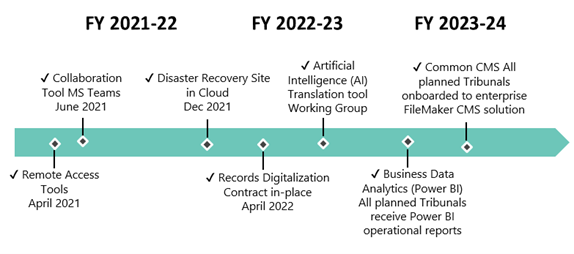
Case Management Systems – In 2019, several Tribunals lacked Case Management Systems (CMS). Nine (9) of twelve (12) Tribunal CMS were at risk because of aging IT and/or failure to meet mandatory legislative requirements. In 2020, the ATSSC worked in partnership with Tribunals to approve a CMS Strategy that was founded on the principle of leveraging an enterprise technology platform that would be uniquely deployed and customized to meet the distinct requirements of each Tribunal. Today, the ATSSC is pleased to announce that all the Tribunals have fully functional CMS. Note: NJC and the Social Security Tribunal remain using their legacy CMS.
Data Analytics – Over the last few years, the ATSSC has fully deployed a new secure data analytics platform that has been uniquely deployed to all Tribunals, except the National Joint Council. Social Security Tribunal continues to use PowerBI hosted by ESDC to enable strategic decision making. The data analytics performance reporting informs decision-making regarding case workload and Tribunal operations, as well as preparation of Annual Reports.
Other Modernization Achievements – As of recently the Canadian Cultural Property Export Review Board is now onboarded onto the ATSSC network. As well, the Canadian Human Rights Tribunal, the Canadian Industrial Relations Board, the Canadian International Trade Tribunal, and the SST websites were modernized, and also now hosted by the Department. To explore efficiencies, the ATSSC piloted Artificial Intelligence (AI) solutions for translation. It deployed a secure remote access solution and Microsoft Office 365/MS Teams as the internal collaboration platform. The ATSSC completed the Cloud Disaster Recovery Project as one of the first departments within the federal public service to have implemented a secure back-up site to ensure business continuity during a disruption. The ATSSC also advanced the replacement of its human resources system through migration to the government’s MyGCHR platform. The Department introduced a new Access to Information (ATIP) Express solution. It also implemented a new Corporate Services PowerBI reporting solution, as well as an Intranet redesign and new solutions for facilitating Return to the Office (e.g., a new booking system, OWL cameras, etc.).
4 Renewed Digital Priorities 2024-2027
As the ATSSC looks ahead, it will continue to explore each new opportunity for innovation accessibility and inclusion, while working closely with the Tribunals that the Department serves.
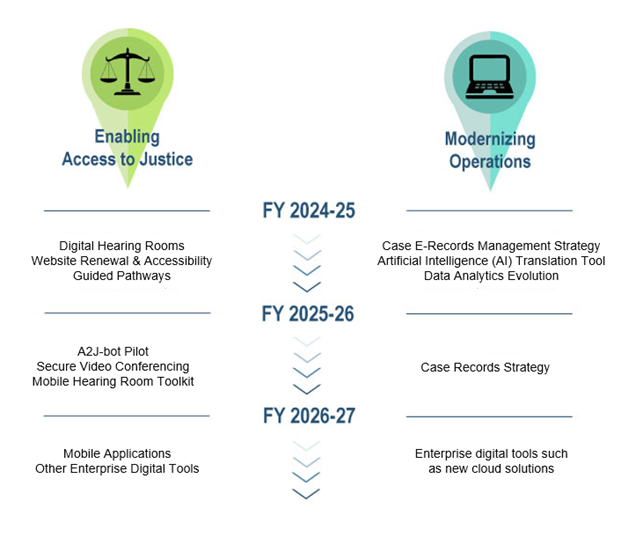
The newly refreshed ATSSC Digital Priorities, for the next three years, will continue to support the Department’s two priorities of enabling access to justice and modernizing operations as follows:
- Enabling Access to Justice (A2J): the ATSSC is taking a citizen-centric focused approach by building new digital services that are secure, easy to use and navigate, including the following initiatives:
- Chatbot Pilot
- Digital Hearing Rooms
- Guided Pathways
- Mobile Applications
- Mobile Hearing Room Toolkit
- Website Renewal & Accessibility
- Secure Video Conferencing Strategy
- Modernizing Operations: the ATSSC is adopting or studying new digital tools and modular, scalable enterprise solutions to make operations more resilient, efficient, and effective:
- Case E-Records Management Strategy
- Artificial Intelligence (AI) Translation Tool
- Data Analytics Evolution
Enabling Access to Justice (A2J) 2024-2027
The ATSSC is taking a citizen-centric focused approach to digital service design and delivery. The following section provides more information on each initiative that falls under the A2J priority:
Chatbot Pilot
The ATSSC is exploring implementing a chatbot pilot to assist the public, actors and stakeholders in finding information about Tribunals and to provide assistance through an interactive interface. The chatbot pilot will support A2J by making information more accessible and available to a broader audience of claimants and appellants thereby improving the digital user experience. At this time, the Department is not exploring use of chatbots that incorporate artificial intelligence or GPT to avoid risks of data privacy and security, potentially misdirecting or providing misinformation to appellants.
Digital Hearing Rooms
In 2024, the ATSSC plans to complete its modernization of aging hearing rooms with state-of-the-art technology and connectivity to support the needs of the public, actors and stakeholders by holding hearings either virtually, on-site or in a hybrid fashion. Having modern hearing rooms enable Tribunals to meet the public’s expectations and perform their duties in accordance with their unique legislation and rules. The modern hearing rooms will be outfitted with new technologies such as integrated video conferencing equipment, upgraded interpretation booths, new monitors, wireless capabilities and WIFI.
Guided Pathways
The ATSSC will continue to study further implementation of “guided pathways” via a public website interface that helps stakeholders navigate through a complex legal process and also find and auto-generate forms easily along the way. Leveraging the use of logic and smart form technology, the solution will be providing appellants with a platform that poses a series of questions that guides actors along pathways tailored to their situation. Implementing the new logic based smart-forms that auto-populate information and emails the forms to appellants will result in an improved digital user experience with fewer errors and greater access to justice.
Mobile Applications
The ATSSC will explore deploying a mobile application with the goal to improve A2J by increasing the efficiency of access to legal information and services. The mobile application will assess opportunities that help reduce informational barriers and improve knowledge about the legal system by providing key resources to actors, stakeholders, and the public. Opportunities such as providing information on court proceedings, case status or libraries of key forms will be explored as potential candidates. The mobile application will be developed to address risks to data privacy and security.
Mobile Hearing Room Toolkit
Marginalized and/or physically isolated groups may face larger access to justice barriers in rural and remote areas. To address these barriers, when requested by an actor or stakeholder, and where remote facilities and services are not readily accessible, the ATSSC is exploring the creation of a mobile hearing room toolkit. This toolkit will consist of a grab-and-go portable digital hearing room technology that allow for easy and quick set-up, access to digital case files, and will yield time and cost savings associated with trying to locate and secure external audio-visual service providers. This initiative will support promoting A2J in remote regions where there are difficulties in engaging external service providers due to the location and/or not having sufficient internet bandwidth.
Secure Video Conferencing Strategy
The ATSSC will develop a Secure Video Conferencing Strategy to improve the security posture of its web-based video platform used by Tribunals to hold virtual and hybrid hearings. The Strategy is a proactive measure that will allow the ATSSC to anticipate and pre-empt potential cyber threats, thereby minimizing the risk of potential data or cyber breaches. It will evaluate and address technical security enhancements while identifying supplementary measures to mitigate external threats, ultimately enhancing the overall security of virtual and hybrid proceedings to maintain public trust.
Website Renewal & Accessibility
The ATSSC will continue to support Tribunals in modernizing their websites by taking an appellant or citizen-centric design approach that includes inclusivity and accessibility in its design. The websites are being redesigned to provide quick, easy to use access to information to help appellants navigate through a complex quasi-judicial process to improve access to justice. The new websites provide plain language legal information, forms, and decisions online as well as provide information on the key steps to make the process more comprehensible. The websites include information for unrepresented and underrepresented parties with clear communication in form of plain language to ensure inclusiveness of vulnerable or marginalized groups within the justice system.
Modernizing Operations 2024-2027
The ATSSC is leveraging enterprise solutions and emerging technologies to help modernize the administration of justice. The ATSSC is promoting new legal tech tools in a secure and smart manner to automate repetitive tasks and redirect scarce resources towards higher value work to increase the sustainability and efficiency of support services. The following section provides more information on the initiatives that fall under this priority:
Case E-Records Management Strategy
Since the onset of the pandemic, there has been a proliferation of electronic case management records. Many E-Records have different sources and formats which contributes to unwarranted complexity when remotely accessing the appropriate records to conduct casework. The ATSSC will develop a strategy to better enable the capture, storage, and retrieval of the Tribunal electronic case records to integrate and manage electronic case records. The strategy will address the integration required between various solutions and processes resulting in improved access to case E-Records seamlessly with full confidence in the integrity of the records. Any in-scope paper documents not available in electronic format will be digitally converted and secured in accordance with the ATSSC-mandated security policies.
Artificial Intelligence (AI) translation tool
The Department will continue to pilot the adoption of different AI tools to explore options and accelerate translations. The ATSSC typically uses translation services and undertakes a manual review within the Tribunal context. During the pilots, the AI tools will be taught by users to select key terms to apply them automatically to new translations. The AI applies advanced semantic understanding of legal terms, to remember and suggest proper translation terms resulting in savings relating to time spent on translations. It should be noted however that the ATSSC will still ensure to carry out manual reviews of the translations to ensure accuracy. The results of the AI translation pilots will inform the next steps for the Department in determining an enterprise solution.
Business Data Analytics Evolution
The ATSSC will continue to evolve its powerful enterprise data analytics reporting that leverages a data warehouse and database logic relationships to enable strategic decision-making to help improve Tribunal operations, including providing information to address case workloads and back-logs. The tool’s dashboards and charts can be extended to provide metrics against performance standards, timelines, and budgets. The business data analytics tool leverages a cloud platform to generate real-time reports and analytics that can be drilled down, further manipulated, and analyzed by users.
5 Digital Roadmap
The following image outlines the ATSSC roadmap of initiatives over the next three years that are aligned to the digital strategic priorities that are subject to prioritization, sufficient resources, change management and project management.
Annex A: ATSSC’s Mandate and Operating Context
Tribunals play an important role in the Canadian justice system by resolving disputes and settling conflicts. The ATSSC is responsible for providing administrative support services and facilities to 12 federal tribunals and the National Joint Council. The Department supports Tribunals in exercising their judicial powers and in performing their duties in accordance with their legislation and rules.
Each of the federal Tribunals supported by the ATSSC has a unique mandate, each operating under different statutes, regulations, and rules. Each Tribunal operates separately from the other Tribunals and maintains specialized expertise in their respective fields.
ATSSC support services are provided to the National Joint Council and the following twelve Tribunals: Canada Agricultural Review Tribunal; Canada Industrial Relations Board; Canadian Cultural Property Export Review Board; Canadian Human Rights Tribunal; Canadian International Trade Tribunal; Competition Tribunal; Environmental Protection Tribunal of Canada; Federal Public Sector Labour Relations and Employment Board; Public Servants Disclosure Protection Tribunal; Specific Claims Tribunal; Social Security Tribunal; and Transportation Appeal Tribunal of Canada.
The Tribunals supported by the ATSSC have demanding and dynamic workloads. Their legislative and policy mandates are highly sensitive to external demands and changing landscapes. As a result, it is fundamental that the work of the ATSSC have a dual focus. On the one hand, the ATSSC must ensure that it has the capacity to align and realign in a constantly changing environment with diverse demands. On the other hand, the ATSSC must ensure service predictability and consistency, marked by specialized and expert services, effective and responsive internal services, and efficient and effective use of its resources.
The ATSSC services include specialized services required to support the mandate of each Tribunal (Registry Services, Legal Services and Mandate, and Member Services), as well as internal services (e.g., human resources, financial services, information management and information technology, accommodation, security, planning, and communications). Through these specialized services, the ATSSC supports improving access to justice for Canadians.
The ATSSC has approximately 660 employees and a planned Departmental annual expenditure of approximately $100M. More information can be found here: https://www.canada.ca/en/administrative-Tribunals-support-service.html.
Annex B: Measuring Results
The ATSSC will explore options to measure the efficiency of the digital investments outlined in this document. This will include assessing forms of metrics to measure whether the proposed technological changes are or will be beneficial for stakeholders, most importantly, the benefits for the appellants who will appear before one of the Tribunals supported by the ATSSC. As the new digital investments can have an impact on processes and interactions, the ATSSC will incorporate key metrics, such as stakeholder analysis and benchmarking upfront to identify and measure these benefits and impacts.
In terms of enabling A2J, the ATSSC will support Tribunals in implementing their specific models to measure results against the expectations of stakeholders and actors. Leveraging existing best practices, such as the Access to Justice BC, Access to Justice Measurement Framework, and other similar frameworks, the Tribunals will choose their most desirable measurement framework, selecting the indicators and methodology specific to their actors and stakeholders. Recognizing that there is no one-size-fits-all outcome measurement model, the Tribunals assess the stakeholder and actors’ access, experience and costs associated with the service with the goal of improving access to justice.
See the following Access to Justice BC, Access to Justice Measurement Framework image / table as an example of an A2J measurement framework model:
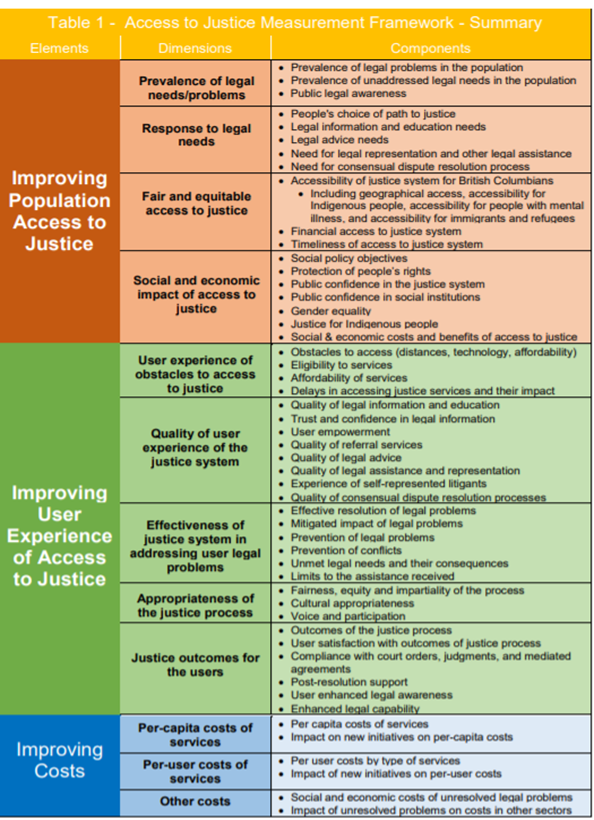
Figure 1 : Access to Justice BC, Access to Justice Measurement Framework
Reference: https://icclr.org/wp-content/uploads/2019/06/Access-to-Justice-Measurement-Framework_Final_2017.pdf?x48887#:~:text=A2JBC%20is%20proposing%20a%20measurement,developed%20in%20the%20health%20sector.