
AI at ATSSC - Artificial Intelligence Transformation Strategy
Table of contents
- About this document
- Message from the Chief Administrator
- 1. ATSSC Digital Vision
- 2. ATSSC Digital Strategy 2024-2027
- 3. AI at ATSSC principles
- 4. AI at ATSSC priorities
- 5. AI at ATSSC leadership
- 6. AI at ATSSC governance
- 7. Digital literacy, talent and training
- 8. Next steps
- Annex A: ATSSC mandate and operating context
- Annex B: Measuring results and providing value to Canadians
About this document
The AI at the Administrative Tribunals Support Service of Canada Artificial Intelligence Transformation Strategy (Strategy) focuses on the responsible and ethical adoption of artificial intelligence (AI). It compliments the ATSSC’s Digital Strategy by explaining how we will use AI to improve efficiency and access to justice.
This artificial intelligence adoption Strategy:
- considers the ATSSC’s role as a support organization to administrative tribunals while respecting tribunal independence
- explores how AI can help tribunals improve access to justice and modernize their operations
- aligns with the Government of Canada’s AI Strategy for the Federal Public Service, 2025-2027, which promotes the responsible adoption of AI for better service delivery
Notes
- The ATSSC’s AI initiatives will be guided by transparency, ethical standards, respect for tribunal independence and a human-centric approach to innovation
- Implementation will depend on funding, internal governance approvals and operational needs
- The ATSSC will work closely with tribunals and other departments to support the Government of Canada’s broader digital government and AI agendas while advancing improvements in administrative justice
Message from the Chief Administrator

Orlando Da Silva, LSM
Chief Administrator
I am pleased to present the AI at ATSSC Transformation Strategy, which reflects our strong commitment to innovative service delivery through the responsible use of artificial intelligence (AI).
The ATSSC is significantly improving productivity across all areas by embracing AI. We are using AI to simplify routine tasks, automate workflows and generate data-driven insights that help support decision-making.
These advancements are helping us build a more agile, efficient and responsive organization—one that can meet the growing demands placed on Canada's administrative justice system. This will position the ATSSC as a leader in innovation within the public service.
AI also has tremendous potential to strengthen access to justice. Our new, efficient, and user-centered AI services will help us support Canadians, especially those who are self-represented. Virtual assistants and guided digital services can help people easily understand their rights, navigate complex tribunal processes and complete documents.
These innovations will help reduce barriers to justice, speed up case processing times and contribute to a fairer, more accessible justice system for all Canadians.
The ATSSC’s approach to AI is grounded in ethics, transparency and a focus on people. We are committed to ensuring that the use of this new technology serves both operational excellence and the public good.
Orlando Da Silva, LSM
Chief Administrator
1. ATSSC Digital Vision
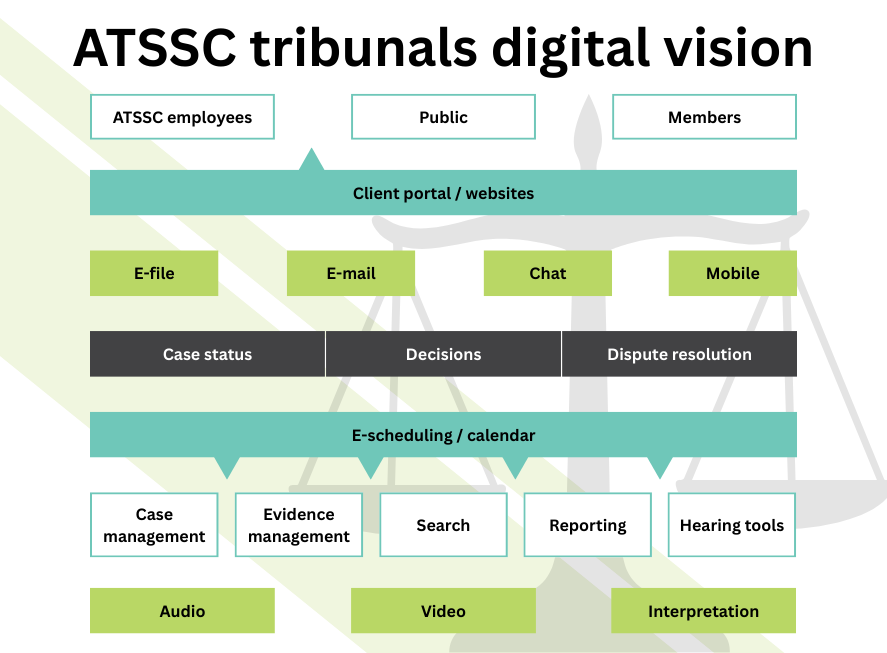
Long description: This diagram explains the ATSSC’s Digital Vision—a strategy for delivering digital services through the integration of enterprise digital systems.
Tribunal members, stakeholders, employees and the public will have access to improved digital services through an integrated enterprise platform.
The platform will let users check case statuses and view decisions by filing documents online, sending emails and using chat tools. They will be able to access services on mobile devices in the future. The ATSSC is also exploring the possibility of allowing users to participate in virtual dispute resolutions through the platform.
The Digital Vision includes a variety of potential options for strengthening internal operations and public facing services. These solutions could support case management, providing and processing evidence, searching for information, creating internal reports and managing the scheduling of hearings. Some of these options will need to be assessed before they are used.
Finally, the Digital Vision will help make hearings more accessible using audiovisual tools and interpretation services.
Canadians expect convenient, trusted and easy-to-use digital government services
The ATSSC’s Digital Vision is our departmental strategy for using innovative tools like AI to:
- create long-term sustainabily
- improve operational efficiency
- facilitate access to justice (A2J)
We’ll continue to find ways of providing more accessible, intuitive and user-friendly digital services as we implement the Digital Vision.
The Digital Vision is aligned with the Government of Canada’s AI Strategy for the Federal Public Service 2025-2027 and the Treasury Board of Canada Secretariat’s (TBS) Policy on Service and Digital. It considers the design principles of GBA+, inclusion and accessibility.
Please see Annex A for more information on the ATSSC’s mandate, and Annex B for more information on how A2J will be enabled and measured for results.
2. ATSSC Digital Strategy 2024-2027
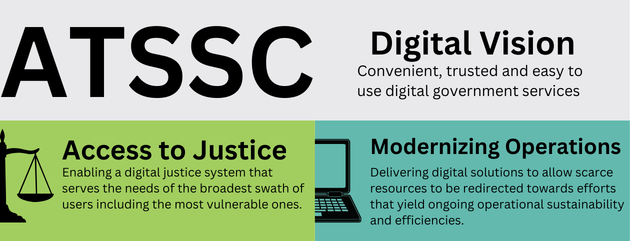
Long description: This diagram explains how the department will use digital solutions and integrated technology to provide convenient, trusted and easy to use digital government services.
The ATSSC will achieve this by helping tribunals improve access to justice by enabling a digital justice system that serves the needs of the broadest swath of users, including the most vulnerable ones; and by modernizing operations by delivering digital solutions to allow scarce resources to be redirected towards efforts that yield ongoing operational sustainability and efficiencies.
The ATSSC’s Digital Strategy 2024-2027 is a roadmap for enhancing digital services. Its goal is to move beyond traditional justice models through the effective, efficient and responsible use of emerging technologies such as AI.
The Digital Strategy and the AI at ATSSC Transformation Strategy work together to show how the ATSSC plans to use AI to make real and measurable improvements to both access to justice and our operational performance.
i. Definition of AI
For purposes of the Digital Strategy, AI includes machine-based systems that use data to figure out how to create outputs that can affect the physical and virtual world. Examples of these outputs include:
- predictions
- content
- recommendations
- decisions
Some AI systems can learn more quickly and act more autonomously than others, once they are put into use. Note: This definition does not include systems that only use software-based solutions without adaptive capabilities after initial training.
For more information, see the What is AI? Can you make a clear distinction between AI and non-AI systems? page on the Organisation for Economic Co-operation and Development website.
ii. The ATSSC as an incubator of AI innovation
The ATSSC will begin its AI journey by focusing on a few targeted pilot projects. We are intentionally starting small so that our department can easily assess risks, see what works, make improvements, build staff knowledge, and increase tribunal and stakeholder confidence.
These early efforts will help shape the foundation of our broader implementation strategies. The ATSSC will be able to rely on this foundation to safely, securely and sustainably grow its AI capabilities while fostering a culture of innovation and continuous learning.
Federal government pilots: The ATSSC is positioning itself as an incubator for AI initiatives within the federal government. This includes our support for the CANChat pilot, a large-scale AI system for use across an entire organization and a key priority of the AI Strategy for the Federal Public Service. Our contributions to this pilot will set an example for the whole government on how AI can be used effectively across departmental operations.
The ATSSC is also ready to pilot other federal AI initiatives to reinforce its leadership in modernizing administrative justice through new technologies.
Academia: The ATSSC is working with institutions like the CyberJustice Laboratory at the University of Montreal to co-develop and test user-focused AI solutions that support the changing needs of the tribunals.
These partnerships show our department’s unique ability to advance digital justice systems while working with academic institutions.
Private sector: The ATSSC is also working with the private sector to support its innovation agenda. For example, we were one of the first federal departments to test AI legal research tools from Thomson Reuters. The ATSSC was also highlighted in the Clerk of the Privy Council’s 31st Annual Report to the Prime Minister on the Public Service of Canada for using AI tools like LogiTerm to quickly translate tribunal decisions in both official languages. These efforts highlight the ATSSC’s proactive approach to AI leadership. We’re committed to strengthening our ability to fulfill our mandate, and the private sector has offered new options. The ATSSC is prepared to experiment with these options, embracing new pathways to success by acting as an early adopter and tester. Our reputation will help shape the federal government’s approach to digital transformation and innovation—and inspire other departments to learn from our approach.
Internal / in-house: The ATSSC is launching its own AI pilots to provide better support to the tribunals and more efficient internal operations. The testing process will build on our ability to use AI responsibly while developing tools that increase productivity, reduce workloads and improve service delivery.
For more details, see the AI at ATSSC priorities section of this document.
3. AI at ATSSC principles
The federal public service AI strategy committed Canada to advancing AI responsibly. The ATSSC will uphold this pledge by following these principles:
- respect tribunal independence by using AI in ways that are consistent with the authority of the tribunals
- promote equitable access to justice by using AI in a responsible and ethical way to reduce barriers for Canadians dealing with legal processes, including historically underserved and marginalized communities
- modernize operations and service delivery by streamlining internal processes, improving case management systems and providing AI tools to tribunal members and ATSSC employees
- advance the ethical and responsible use of AI by following the Government of Canada’s AI direction. This includes the TBS Directive on Automated Decision-Making and relevant AI standards that support transparency, clarity and accountability in digital services
- build digital literacy and competencies within the ATSSC by investing in and using talent, training and partnerships. This will help improve employees’ data and digital literacy as well as their innovation skills, and will ensure the responsible use of AI across the ATSSC
- leverage Government of Canada solutions by using existing Government of Canada digital tools to ensure cost-effective innovation
- protect data by keeping each AI tool separate so that third-party tools trained with ATSSC data will not be able to use the data for other versions of the tool (for example, a generative AI tool trained on 1 tribunal’s records should be kept separate from the tool’s other versions to protect sensitive or confidential information); also, protected documents will not be uploaded to AI systems unless they are secure
- maintain data sovereignty by ensuring tribunal data used on AI tools is stored on ATSSC servers or on cloud servers within Canada
4. AI at ATSSC priorities
The ATSSC will advance the responsible use of AI in fiscal year 2025-2026 by implementing these pilot projects designed to improve the productivity of ATSSC employees:
- AI Translation: The AI Translation pilot focuses on automating the translation of tribunal decisions. AI-assisted translation tools will generate initial translations, which will save a significant amount of time. ATSSC staff will review all AI-generated translations for accuracy and quality.
- AI Editing: The AI Editing pilot will test AI tools that edit and improve draft documents. These tools will check grammar, tone, clarity, plain language and structure.
- AI Legal Research: The ATSSC is working with WestLaw’s legal AI to improve legal research. Automating initial legal research tasks will reduce the time paralegals and legal counsel spend on research, allowing them to focus on higher-value work such as providing legal advice.
- AI Employee Digital Workspace: The ATSSC Digital Workspace will give employees the tools, training (including digital literacy training) and support they need to use emerging technologies confidently and responsibly. The Workspace will allow employees to use Microsoft and other AI tools such as Copilot and Forms to help with tasks like writing emails and preparing reports.
- Other: The ATSSC is open to other opportunities to cost-effectively improve employee productivity or service. These may include tools for interpretation, transcription, analysis, generation of questionnaires and reports and further automation of case management processes. The ATSSC is also open to opportunities to cost-effectively improve the productivity of tribunal members or to improve access to justice for Canadians. Tribunal chairpersons will identify their AI priorities to ATSSC.
The ATSSC will consult individual tribunals prior to launching pilots that affect them.
5. AI at ATSSC leadership
The ATSSC’s Chief Information Officer (CIO) will lead the organization’s work on AI. The CIO will provide strategic digital leadership to ensure AI pilot projects are implemented in a secure, scalable, and sustainable way.
The CIO will work closely with business sponsors to make sure AI tools are technically sound and that the organization is ready to use them. This will allow the ATSSC to adopt and integrate innovative AI solutions that are practical, ethical and impactful.
Each business sponsor will be responsible for managing the operational aspects of their respective AI initiatives. This includes preparing systems and teams through activities such as information clean-up, improving processes, training and change management to integrate AI tools effectively into daily operations.
The CIO will support each business sponsor by offering digital guidance, advice on risk management and information on how to make sure AI solutions align with federal government standards and ATSSC direction.
6. AI at ATSSC governance
The ATSSC will add AI governance to its existing governance structures and consultation bodies. This approach will ensure AI governance aligns with AI principles, and that existing areas of expertise can lead, influence and follow a structured and coordinated framework. This will help the ATSSC adopt AI quickly and responsibly.
Chairperson consultation
The tribunal chairpersons will be consulted for tribunal input and priorities. These consultations will occur through the Chairpersons Council and/or through bilateral discussions between individual chairpersons and ATSSC executives. Executives who provide direct support to tribunals will also arrange for regular updates and ongoing feedback.
ATSSC governance structure
The Senior Management Committee, chaired by the Chief Administrator, will provide strategic direction for the responsible use and adoption of AI. With input from the CIO, the committee will make final decisions and ensure AI is used responsibly and transparently.
The Transformation Sub-Committee will continue to lead AI-related initiatives that support ATSSC functions.
The Employee Digital Workspace Task Force will identify and review AI solutions used across the organization. It will also help develop training programs, policies, and general guidelines, such as on the responsible use of AI tools like Microsoft Copilot. This task force will report to the Transformation Sub-Committee.
7. Digital literacy, talent and training
The Human Resources team will work with the CIO’s Information Services and Solutions Team to help employees improve their digital literacy. These training sessions will give employees the skills they need to use new AI tools and technologies.
Training will be developed in-house and will include resources from the private sector and Government of Canada. Training will be tailored to address the specific needs of ATSSC employees. Tribunals will also be offered training tailored to their unique operational contexts.
Managers will foster a culture of innovation and responsible AI use by promoting AI training and including it in performance agreements (that is, work objectives and learning plans), as applicable.
The CIO will build and maintain an information technology (IT) team of AI experts. This team will support the continued growth of AI across the department. It will receive ongoing training and have access to the tools and information necessary to stay up-to-date with new technologies.
The ATSSC will ensure that user guides are available should the public use any ATSSC AI solutions (for example, chatbots).
8. Next steps
The ATSSC will continue testing AI for staff use to improve ATSSC productivity through pilot projects. We’ll take these exercises as an opportunity to learn what works and to explore other emerging AI opportunities.
The ATSSC will expand its ability to use AI by setting up a new secure, local AI model. This new model will depend on the outcomes of the new Government of Canada-wide AI contract. These outcomes will guide the phased rollout of long-term AI services. This will ensure that deployment is measured, secure and aligned with both organizational needs and federal requirements. This approach will allow the ATSSC to grow its AI use responsibly while getting the most value for internal operations and tribunal services.
ATSSC will also keep itself informed of AI solutions being used by courts and tribunals around the world in case there are solutions that may be of interest to tribunals.
This Strategy is not intended to interfere with the authority of the tribunals to develop and implement their own AI policies, and ATSSC will offer support to tribunals in developing such policies.
Annex A: ATSSC mandate and operating context
Tribunals play an important role in the Canadian justice system by resolving disputes and settling conflicts. The ATSSC is responsible for providing support services and facilities to 12 federal administrative tribunals and the National Joint Council by way of a single, integrated organization. This helps tribunals carry out their responsibilities fairly, efficiently and according to the laws and rules that guide them.
The tribunals have unique mandates, each operating under different legislation, statutes and regulations. They operate independently of each other and maintain specialized expertise in their respective fields.
The ATSSC provides support services to the National Joint Council and the following 12 tribunals:
- Canada Agricultural Review Tribunal
- Canada Industrial Relations Board
- Canadian Cultural Property Export Review Board
- Canadian Human Rights Tribunal
- Canadian International Trade Tribunal
- Competition Tribunal
- Environmental Protection Tribunal of Canada
- Federal Public Sector Labour Relations and Employment Board
- Public Servants Disclosure Protection Tribunal
- Specific Claims Tribunal
- Social Security Tribunal of Canada
- Transportation Appeal Tribunal of Canada
The tribunals have demanding and dynamic workloads. Their legislative and policy mandates are highly sensitive to external demands and changing landscapes. As a result, it is fundamental that the work of the ATSSC have a dual focus. On one hand, the ATSSC must have the ability to adapt to a constantly changing environment with diverse demands. On the other hand, the ATSSC must provide predictable and consistent service, marked by:
- specialized and expert services
- effective and responsive internal services
- efficient and effective use of its resources
The ATSSC provides the specialized services required to support the mandate of each tribunal (Registry Services, Legal Services, and Mandate and Member Services), as well as internal services (for example, human resources, financial services, information management and information technology, accommodations, security).
The ATSSC has approximately 660 employees and a planned departmental annual expenditure of about $100 million. More information can be found on the Administrative Tribunals Support Service of Canada website.
Annex B: Measuring results and providing value to Canadians
The ATSSC will determine how to measure the efficiency of the AI investments mentioned in this document. This will include finding the right tools and methods to assess whether these investments provide value to stakeholders, including the parties who appear before tribunals.
The ATSSC will improve access to justice by helping tribunals choose their own way to measure results against the expectations of stakeholders and users.
Tribunals can use existing best practices, such as the Access to Justice BC’s Access to Justice Measurement Framework to choose the right indicators and methods to suit their needs. There is no one-size-fits-all outcome measurement model, so the tribunals must assess the experiences of their stakeholders and users, as well as the costs associated with the service—all with the goal of improving access to justice.
The ATSSC will measure productivity gains for AI solutions by focusing on how they increase ATSSC efficiency.