Book Review - The Lighthouse of Stalingrad: The Hidden Truth at the Heart of the Greatest Battle of World War II - Iain MacGregor
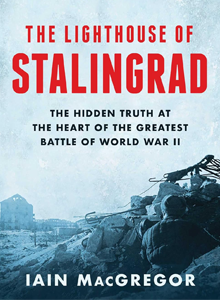
MACGREGOR, IAIN. New York: Scribner, 2022, 355 pages.
ISBN: 978-1982163587
Reviewed by Major Jayson Geroux, CD, guest editor for the CAJ Urban Warfare editions 21.1 and 21.2.
“The accepted story of Pavlov’s House … describes the intense fight for the building: As the weather turned colder, German infantry, often supported by Panzers, assaulted the house daily, sometimes several times, trying to dislodge the stubborn defenders. They would rush the lower windows incessantly and push the barricades aside, only to be met by everything from withering machine gun fire to chunks of hand-thrown masonry, or they were fought off with a sharpened spade. Stukas dive-bombed from above, destroying the facade and killing many of the garrisons. At one point, they called in pinpoint artillery fire from across the Volga to drive off an attack in the nick of time. Pavlov himself is said to have used an antitank rifle and fired upon advancing armour from the rooftop, to which the Panzers could not elevate their gun, and thus he destroyed up to a dozen during the siege. This is all ‘boy’s own adventure’ and is well written … as well … as recounted in testimonies and letters … in the city’s archives. Is it true?”
The 58-day defensive fight for a building that was named after one of its defenders, Sergeant Yakov Fedotovich Pavlov, has become one of the better-known stories from the battle of Stalingrad (23 August 1942–02 February 1943). During and after the Second World War (1939–1945), it developed into an urban legend (pun intended) among military historians in general and in Russian folklore in particular. The defence of “Pavlov’s House” became a David versus Goliath fable—some of it recounted by Iain MacGregor in the above excerpt from The Lighthouse of Stalingrad—in which Pavlov and a small group of Soviet soldiers fought with only small arms, anti-armour weapons and sometimes their bare hands, in a large building that stuck out like a sore thumb into the German lines on the west bank of the Volga River. For almost two months, Pavlov and his soldiers withstood repeated juggernaut attacks from German infantry and tanks. Despite the overwhelming violence, the building and its Soviet defenders held. Pavlov’s house even earned its own codename, “the Lighthouse,” during the battle, because waves and waves of German soldiers crashed against the building but could not break it.
However, as Mr. MacGregor asks at the end of the above quotation from his book, is this story true? That question and the book’s title pique the reader’s curiosity about what the author uncovered in his research when he visited Russia in general and Volgograd (modern-day Stalingrad) in particular in 2020. He was able to visit the archives of the city that hosted the largest battle in modern urban warfare history, and he also gained access to personal and never-before-acquired Russian and German diaries and memoirs of senior officers and soldiers who fought in Stalingrad.
Given the title of the book, I eagerly looked forward to the details. I was anticipating a painstaking investigation that would uncover each of the 58 days in the battle for Pavlov’s House and the ordeal endured by Pavlov, his soldiers and the attacking Germans—but I was initially disappointed. Mr. MacGregor has uncovered some surprising details and dedicates two short chapters (Chapter 12 of 19 and the Epilogue) to what actually occurred in the fight for Pavlov’s House. However, I will not recount those facts here, given that such details would spoil readers’ enjoyment of what, in retrospect, turned out to be a good read. The book covers the entirety of the battle of Stalingrad and the bitter fighting for the city from August 1942 to February 1943. As mentioned above, the author discovered new material from Russian and German senior leaders and soldiers and thus can present their stories, their visceral experiences and their testimonies about the vindictiveness of this urban warfare. These new, raw accounts make up the majority of the book’s pages.
The author devotes the most space to the leaders and subordinates of the opposing units who faced each other within the city’s core during the five-month battle. On the Russian side were Lieutenant-General Vasily Ivanovich Chukov (commanding the 62nd Army), Major-General Alexander Ilyich Rodimtsev (commanding the 13th Guards Rifle Division), Colonel Ivan Pavlovich Elin (commanding the 42nd Guards Rifle Regiment) and the various junior leaders who fought within Pavlov’s House. German leaders whose stories are told are General Friedrich Paulus (commanding the 6th Army), Major-General Alexander von Hartmann (commanding the 71st Infantry Division), Lieutenant-Colonel Friedrich Roske (commanding Infantry Regiment 194) and the junior leaders within Roske’s unit. In telling their stories, the author moves us from August 1942 to February 1943 by essentially focusing on these soldiers and the events they participated in or witnessed within the city, and only occasionally and briefly discussing events that occurred in Stalingrad’s other suburbs or the larger Russian counteroffensive which eventually surrounded and trapped the Germans in the city that winter.
This book is not the last word on the history of the Stalingrad battle, nor does it discuss in meticulous detail the two-month fight for Pavlov’s House. The titanic struggle for the “City of Stalin” is overwhelming in depth and breadth (it is important to remember that this was a fight involving several Army Groups with dozens of divisions made up of hundreds of thousands of soldiers both inside and outside the city, in a battle that lasted several months in a sizeable urban environment), and no one author can encompass in a single project all of the particulars, minutiae and factors that contributed to the history of this enormous fight. I would suggest that it will never be possible to create such a work. Also, the battle for Pavlov’s House was not recorded in great detail, and the urban legend it has become has now obscured some of its truth. However, it is these new accounts of the fighting, largely within but occasionally outside Stalingrad, together with the fresh, important, albeit briefly presented facts that uncover some of the truth about the battle for Pavlov’s House, which make Mr. MacGregor’s book valuable, as it will add to the existing body of literature already produced on this remarkably horrific urban battle.
If this review has sparked your interest in reading The Lighthouse of Stalingrad, you can be confident that after you have done so, you can place it beside classic and well-known works such as Antony Beevor’s Stalingrad – The Fateful Siege: 1942–1943 and William Craig’s Enemy at the Gates: The Battle for Stalingrad, with the comfortable knowledge that the sum of this battle will be made up of many parts.
This article first appeared in the November, 2025 edition of Canadian Army Journal (21-2).