
Canadian Grain Commission’s 2022-2023 Departmental Results Report
International Standard Serial Number: 2560-9955
Canadian Grain Commission
The Honourable Lawrence MacAulay
Privy Councillor, Member of Parliament,
Minister of Agriculture and Agri-Food

From the Minister

The Honourable Lawrence MacAulay,
Privy Councillor, Member of Parliament,
Minister of Agriculture and Agri‑Food
As the Minister of Agriculture and Agri-Food, I am pleased to present the Canadian Grain Commission’s Departmental Results Report for 2022-23. Guided by the Canada Grain Act, the Canadian Grain Commission establishes and maintains science-based standards of quality for grain and regulates grain handling in Canada, to ensure grain is a dependable commodity for domestic and export markets.
Over the past two years, Canadian grain farmers and the grain sector have faced challenges including high input costs, supply chain disruptions, price volatility related to global political instability, and extreme weather. Despite these challenges, long-term stability and growth of the grain sector continues to help drive the Canadian economy and feed the world. Hard work by the women and men who produce grain and better growing conditions in most of Canada’s grain growing regions in 2022 resulted in the third largest national wheat crop on record.
Throughout 2022-23, our government continued to work with the grain sector to position the Canadian Grain Commission as a global leader in grain science. To support this the Canadian Grain Commission developed a Science Strategy, in consultation with stakeholders that establishes a vision for the future of science and research at the Canadian Grain Commission. The strategy ensures that science continues to be the foundation of Canada’s grain quality assurance system and that the Canadian Grain Commission is able to adapt to the changing needs of the Canadian grain sector.
In addition, Canadian Grain Commission research collaboration with plant breeders and agronomists will lead to improved understanding of how climate factors affect the quality and safety of Canadian grain. The strategy positions the Canadian Grain Commission to better support Agriculture and Agri-Food Canada's Strategic Plan for Science in working towards sustainable agriculture, especially in mitigating and adapting to climate change as well as increasing the resiliency of agro-ecosystems.
In 2022-23 our government announced an investment of up to nearly $4.4 million, over two years, to support the sector to grow Canada’s grain exports under the federal AgriMarketing Program. The Canadian Grain Commission continues to collaborate with government partners, academia, and sector stakeholders, to support ongoing marketing access and expand data accessibility through enhanced testing and monitoring capabilities.
To learn more about the work of Canadian Grain Commission, I invite you to read the organization’s Departmental Results Report for 2022 to 2023. I also want to thank all Canadian Grain Commission employees, who continue to go above and beyond to serve Canadians.
From the Chief Commissioner

Doug Chorney
Chief Commissioner
Canadian Grain Commission
As Chief Commissioner, I take great pride in the work done by the Canadian Grain Commission to benefit Canadian grain farmers, the grain sector, and all Canadians.
In 2022-23 the Canadian Grain Commission continued to modernize the organization within existing authorities by pursuing multiple regulatory and operational improvements that stem from Canada Grain Act review submissions.
As part of the Canada Grain Act review consultations, we heard repeatedly the value to producers of binding determination of grade and dockage following disputes with licensees. We also heard the call to update the process. In 2022-23 we amended the grain grade dispute resolution regulations so that grain samples can be sent to the Canadian Grain Commission for a Final Quality Determination for up to seven calendar days after the grain delivery. The amendments also clarify how long samples must be stored and allow more flexibility for producers and elevator operators to reflect and keep pace with the current operational realties of grain handling and delivery in Canada.
We also took action to renew and update grain standards committees based on Canada Grain Act review feedback. As part of this we updated terms of reference of the committees, strengthened membership and increased openness and transparency through improved webpages and communications protocols before and after meetings.
The Canadian Grain Commission also heard consistent support for our role in grain quality and safety research and recognized the need for a science strategy to guide future activity and investment. We sought feedback from stakeholders and released our new Science Strategy in January 2023.
In the 2022-23 fiscal year, the brisk pace of exports returned after the severe drought of 2021 and Canadian Grain Commission staff worked hard to deliver grain inspection and weighing services on a timely basis as well as to conduct research on the new crop. Additionally, the Canadian Grain Commission continued to ensure Canadian producers were protected from non-payment risk through its Safeguards for Grain Farmers Program. I am happy to report that in 2022-23 there were no claim situations.
I am confident that the Canadian Grain Commission will continue to deliver high quality programs and services that benefit the entire grain value chain.
Results at a glance
What funds were used?
- Total actual spending for 2022-23 was $67,044,601
- Spending was funded by annual voted and statutory appropriation of $ 6,912,375 and fees revenue of $47,563,855Footnote 1
Who was involved?
- The Canadian Grain Commission had 473 total actual full-time equivalents for 2022-23.
Key results achieved in 2022-23
The Canadian Grain Commission’s Core Responsibility is to regulate grain handling in Canada and to establish and maintain science-based standards for Canadian grain. The Departmental Results of this Core Responsibility are that domestic and international markets regard Canadian grain as dependable and safe and that farmers are fairly compensated for their grain.
In 2022-23 the Canadian Grain Commission developed its Science Strategy following consultations with stakeholder groups to help identify challenges and emerging trends in the grain sector. The Strategy outlines five key science drivers that will help shape the future of grain science and research at the Canadian Grain Commission as well as the operational pillars required to implement the plan. The key science drivers are global trends and emerging market issues; advances in technology; evolving end-uses; climate change and extreme weather; and food safety and nutrition. To fully implement the Science Strategy, the Canadian Grain Commission continues to develop detailed annual work plans, undertake the necessary steps to deliver on its strategic priorities and program commitments and investments in laboratory infrastructure including the new Laboratory Headquarters project.
The drought conditions across most of the western Canadian grain production area in 2021 resulted in significantly reduced grain volumes at export position in 2022-23. The Canadian Grain Commission inspected lower than expected grain volumes from April 1 to September 30, 2022 as a result of the low inventories coming into 2022. Despite higher yields in 2022, actual grain volumes for official inspection and weighing were 37.98 million metric tonnes (MMT) for fiscal 2022-23, significantly less than the forecast of 48.1 MMT.
The Harvest Sample Program is a major undertaking for the CGC every fall. In 2022-23, excellent quality is seen across all crop kinds, with Canada Western Red Spring crop being second-highest grading on record. The Canadian Grain Commission also continued to deliver on day-today operational activities and made significant progress on the initiatives identified within its key strategic areas of focus for 2022-23:
- Modernize the Canadian Grain Commission’s regulatory framework, programs, and services;
- Position the Canadian Grain Commission as a global leader in grain science;
- Strengthen the Canadian Grain Commission’s stakeholder relationships, with a focus on Canadian grain producers; and
- Establish the Canadian Grain Commission as an employer of choice
In 2022-23, the Canadian Grain Commission continued to enable a flexible and connected work environment to not only meet the GCworkplace design standards but also to support the Treasury Board Secretariat directive to a common hybrid work model for the Federal Public Service.
For more information on the Canadian Grain Commission’s specific initiatives, priorities and results achieved, see the “Results: what we achieved” section of this report.
Results: what we achieved
Core Responsibility
Grain Regulation
Description:
The Canadian Grain Commission regulates grain handling in Canada and establishes and maintains science-based standards for Canadian grain.
Results
The Departmental Results of the Canadian Grain Commission’s Core Responsibility are that domestic and international markets regard Canadian grain as dependable and safe and that farmers are fairly compensated for their grain. The delivery of programs and services is in accordance with the Canada Grain Act, and the Canadian Grain Commission identifies key areas of focus and initiatives to ensure it can continue to deliver upon its mandate and departmental results in the evolving grain sector environment. Key initiatives, activities, and actions the Canadian Grain Commission has taken in 2022-23 to achieve results for each area of focus are as follows:
Modernized the Canadian Grain Commission’s regulatory framework, programs, and services
An efficient, effective, science-based regulatory framework is essential to capitalize on innovation and to meet the evolving needs of the grain sector. In 2022-23, the Canadian Grain Commission advanced work in the following areas:
Modernized the Canadian Grain Commission’s regulatory framework to support an innovative and evolving grain sector. The Canadian Grain Commission continued to provide significant technical and policy support to Agriculture and Agri-Food Canada through evidence-based analysis and advice for a modernized regulatory framework. In response to feedback received as part of Canada Grain Act consultations, the Canadian Grain Commission took action to refresh and renew its standards committees in 2022. This included reviewing and updating procedures related to the Western and Eastern Standards Committees concerning communication protocols, and nomination/appointment procedures.
The Canadian Grain Commission continued to put forward regulatory amendment packages to deliver on established grain grading and producer protection modernization goals as outlined in its Forward Regulatory Plan. In 2022-23, the Canadian Grain Commission initiated three regulatory amendment packages: housekeeping amendments to improve clarity and transparency; eliminating grain delivery declaration requirement for grains not subject to variety registration and for grains for which no merit criteria apply as part of the variety registration process; and modernizing ‘Subject to Inspector’s Grade and Dockage’ provisions. In addition, the Canadian Grain Commission continued advancing work on a comprehensive review of the Canadian Grain Commission’s fees and standards to ensure alignment with costs of service provision.
Continued to develop and deliver a suite of integrated program delivery systems to provide seamless, digital service to Canadian Grain Commission clients. The Canadian Grain Commission continued development of a suite of integrated program delivery systems to provide seamless, digital service to Canadian Grain Commission clients. This included the first release of the MyCGC Portal. MyCGC is a digital service window for the full range of Canadian Grain Commission transactions that will ultimately be the main channel for providing online licensing and certification services. It will also allow for more robust security and reporting functionality. Services released in 2022-23 included integrated access to online statistics applications and a limited user-trial of the full portal functionality. Broad release of the full functionality to all CGC licenses is expected in 2023-24.
The Canadian Grain Commission’s online statistical reporting was updated to meet Government of Canada standards and requirements for user access and security of applications. The Canadian Grain Commission continued implementing its Data Strategy by adopting Microsoft Power-BI for visualizing data (i.e., statistics at a glance). The Data Strategy incorporates action on Open Government directives such as developing a data inventory and assessment of data sensitivities for their security classification. The Canadian Grain Commission created several information dashboards that contribute towards developing a self-service database. In addition, the Canadian Grain Commission continued to create a Digital Operations Roadmap based on its business and cyber security needs and the Government of Canada’s Digital Operations Ambition. Further, the Canadian Grain Commission released an online calculator for test weight/bushel weight conversions, which better equips producers to make business decisions for their farm.
Modernized the grain grading system to strengthen the quality and dependability of Canadian grain. In 2022-23, the Canadian Grain Commission continued to evaluate components of the grain grading system to ensure a strong scientific basis and alignment with the needs of the Canadian grain sector and grain buyers around the world. For example, mildew standards for eastern and western red wheats are being updated after the Canadian Grain Commission conducted extensive research over multiple years, which found that mildew had minimal impact on flour yield and refinement, dough properties, and baking quality.
The Canadian Grain Commission also continued to pursue a sustainable staffing model to ensure accurate and efficient delivery of official inspection and weighing. The model involves ongoing analysis by inspection managers that considers anticipated increases to grain volumes, growing grain shipping capacity, new terminal construction, inspector attrition, and ongoing inspector training and development needs.
Positioned the Canadian Grain Commission as a global leader in grain science
The Canadian Grain Commission is a world class, science-based quality assurance provider. The changing needs of Canada’s grain quality assurance system present new opportunities for the Canadian Grain Commission to position itself as a global leader in grain science. In 2022-23, the Canadian Grain Commission advanced work in the following areas:
Developed the Canadian Grain Commission Science Strategy to provide a vision for the future of grain science and support innovative programs and services. The Canadian Grain Commission concluded consultations on its science and research activities and developed a Science Strategy. Based on consultations with producer and industry organizations, end-users, academia and other provincial and federal government departments, the Science Strategy identifies five drivers that will shape the future of grain science into the next decade: global trends and emerging market issues; advances in technology; evolving end-uses; climate change and extreme weather; and food safety and nutrition. The Strategy also identifies how the organization will support implementation of its goals and outcomes with four operational pillars: excellence in science and innovation; a skilled, adaptable and productive workforce; communication of results; and state-of-the-art infrastructure and technology.
Additionally, the Canadian Grain Commission continued to invest in the Grain Research Laboratory’s infrastructure, technology, and equipment to improve functionality and support grain science. The Canadian Grain Commission continued to engage with Public Services and Procurement Canada to advance the Laboratory Headquarters project to obtain approval for a new building in Winnipeg. This project is driven primarily by the need to relocate the Grain Research Laboratory. A Business Case has been developed by Public Services and Procurement Canada to determine preliminary project costs and schedule based on Canadian Grain Commissions program requirements and market conditions.
The Canadian Grain Commission also continued to work towards the purchase of a Laboratory Information Management System with a Request for Information process to replace current custom databases and manual systems. In addition, the Grain Research Laboratory has expanded its use of innovative technology for DNA-based identification of wheat and barley varieties using the Smart Chip Real Time PCR system. This instrumentation enables high-throughput testing of samples for varietal purity with increased accuracy.
Provided grain quality and safety research and analysis to mitigate market access risks and responded to emerging trade issues. Grain and food safety continue to be concerns in today’s environment as incidents of noncompliance can result in widespread cost ramifications for the entire value-chain. To support continued access to markets around the world, the Canadian Grain Commission conducts monitoring with respect to Maximum Limits for naturally occurring toxins and trace elements, Maximum Residue Limits for pesticides, and the presence of certain genetically modified events. In addition, Canadian Grain Commission scientific and inspection experts routinely provided data or enhanced inspection processes to Agriculture and AgriFood Canada, Global Affairs, the Canadian Food Inspection Agency, and national commodity associations to support Canadian interventions bilaterally or in multilateral market access situations.
Strengthened the Canadian Grain Commission’s stakeholder relationships, with a focus on Canadian grain producers.
For grain producers and sector stakeholders, and ultimately the Canadian economy, to be able to fully benefit from Canadian Grain Commission programs and services, they need to be aware of what is available. To achieve this result, the Canadian Grain Commission worked to deliver on the following strategic area of focus and supporting initiatives:
Enhanced the Canadian Grain Commission’s visibility with grain producers and sector stakeholders to increase awareness of programs and services. The Canadian Grain Commission capitalized on opportunities to reconnect with grain producers and grain industry stakeholders post pandemic, with a full return to in-person tradeshows and sector events. In 2022, in close collaboration with Cereals Canada, the Canadian Grain Commission resumed in-person participation in the New Crop Missions. Canadian Grain Commission leadership and technical experts visited more than a dozen countries across four separate missions, speaking about the excellent quality of the 2022 Prairie harvest, and responding to questions and feedback from international buyers and end-users. The Canadian Grain Commission also participated in in-person and virtual events as well as expanded its virtual presence through increased use of video, interactive tools, and social media. Additionally, the Canadian Grain Commission continued building stronger relationships with stakeholders in eastern Canada to better understand regional perspectives and needs.
Supported grain producers at the point of sale/in-country to ensure they are fairly compensated for their deliveries. In response to the consultation on updating grain grading dispute resolution, the Canadian Grain Commission implemented enhancements to its Final Quality Determination service for grain producers (formerly known as “Subject to Inspector’s Grade and Dockage”). Producers can now ask that a sample of their grain delivery be sent to the Canadian Grain Commission for a Final Quality Determination for up to seven calendar days after the date of their grain delivery. The amendments also clarify how long samples must be stored and allow more flexibility for producers and elevator operators to decide who will store delivery samples and where. In addition, grain producers will not need to be present at the time of delivery to request a Final Quality Determination. Despite limited authority for binding determination of grade and dockage in eastern Canada, the Canadian Grain Commission also worked with stakeholders and provincial authorities to clarify the various regulations and procedures in Ontario, Quebec, and Atlantic jurisdictions. In addition to the focus on binding determination following the launch of an in-country presence strategy in 2022, the Canadian Grain Commission distributed its in-country initiative questionnaire to licensees in spring 2023. Preliminary analysis on the responses generated an increased knowledge of licensees’ quality management systems. Further in-depth analysis will be considered going forward.
Established the Canadian Grain Commission as an employer of choice
Diverse, qualified and motivated staff are integral to the organization successfully fulfilling its mandate now and in the future. In 2022-23, the Canadian Grain Commission continued building barrier-free work environments and investing in fostering a representative and diverse workforce. Through ongoing communication, support and consultation with staff at all levels, the organization has enabled full implementation of the flexible hybrid work model, aligned with the GCWorkplace design standards and requirements set out in the TBS direction on prescribed presence in the workplace. In addition, the Canadian Grain Commission continued to pivot toward activity-based workplaces and state-of-the-art digital tools to promote innovation, productivity, and well-being in the post pandemic environment.
Gender-based analysis plus
Results for the Canadian Grain Commission’s Core Responsibility do not directly contribute to the government-wide priorities of gender quality, diversity, and inclusiveness. However, the Canadian Grain Commission contributes to these priorities by incorporating gender-based analysis plus into its employment equity and diversity goals and framework. The Gender-based analysis plus supplementary information table details these initiatives.
United Nations 2030 Agenda for Sustainable Development and the Sustainable Development Goals
The Canadian Grain Commission became subject to the Federal Sustainable Development Act in December 2020, and adheres to the principles of the Federal Sustainable Development Strategy by complying with the Policy on Green Procurement. In accordance with the new 2022-2026 Federal Sustainable Development Strategy, the Canadian Grain Commission is developing its Departmental Sustainable Development StrategyFootnote 2 which outlines its five-year, forward-looking commitments to respond to: Goal 10: Advance reconciliation with Indigenous peoples and take action on inequality; Goal 12: Reduce waste and transition to zero-emission vehicles; and Goal 13: Take action on climate change and its impacts. Implementation of the Departmental Sustainable Development Strategy will begin in 2023-24.
Innovation
In alignment with the federal government’s evidence-based approach to address problems that traditional approaches have been unable to solve, the Canadian Grain Commission is committed to innovation and experimentation. In 2022-23, the Canadian Grain Commission continued to integrate technical expertise, data analytics, and information to help mitigate market access issues for Canadian grain exports. Demand for government assessment of grain quality and variety traits, and safety issues like chemical residues and toxins continues, often requiring government assurance to gain market access. The Canadian Grain Commission worked closely with stakeholders to address these changing grain sector needs and facilitate continued market access for Canadian exporters.
For example, due to temporary program suspension during COVID-19 pandemic, the Canadian Grain Commission extended collaboration with Pulse Canada for the voluntary testing program that supported small-lot exporters of Canadian pulses in meeting regulatory and contractual requirements until March 31, 2023. Under this program, participants voluntarily submit samples of pulses to the Canadian Grain Commission for analysis. This analysis allows small-lot exporters, on a voluntary basis, to undertake the necessary measures to ensure that all export shipments meet importing country requirements. The program was reviewed annually by the Canadian Grain Commission based on agreed-upon performance indicators and outcomes.
Key risks
Risk management is an essential part of strategic planning and decision making at the Canadian Grain Commission. The organization has established a process to identify, monitor, mitigate and manage corporate level risk.
Specifically, the Canadian Grain Commission has an Integrated Risk Management Working Group that includes representatives from all programs and sections of the organization that systematically identifies, assesses, suggests mitigations, communicates and monitors risk in a way that informs priority setting, optimizes resource allocation and contributes to improved organizational performance. Information and recommendations from this group are shared with Canadian Grain Commission management for review and action as necessary (e.g., implementation of additional mitigation strategies and/or contingency plans).
Results achieved
The following table shows, for grain regulation, the results achieved, the performance indicators, the targets and the target dates for 2022-23, and the actual results for the three most recent fiscal years for which actual results are available.
| Departmental results | Performance indicators | Target | Date to achieve target | 2020-21 Actual results | 2021-22 Actual results | 2022-23 Actual results |
|---|---|---|---|---|---|---|
| Domestic and international markets regard Canadian grain as dependable and safe | Percentage of stakeholders who regard Canadian grain as dependable and safe | TBDFootnote 3 | TBDFootnote 4 | Not availableFootnote 5 | Not availableFootnote 6 | Not availableFootnote 7 |
| Value of Canadian grain exports | $30.6 billionFootnote 8 | April 2025Footnote 9 | $25.3 billionFootnote 10 | $22.3 billionFootnote 11 | 32.6 billionFootnote 12 | |
| Farmers are fairly compensated for their grain | Percentage of sales where farmers are compensated for their grain | 100% | April 2023 | 100% | 100% | 100% |
| Percentage of outstanding liabilities paid to farmers in the event of a default by a Canadian Grain Commission-licensed grain company | 100% | April 2023 | 100%Footnote 13 | 83%Footnote 14 | 100%Footnote 15 |
Financial, human resources and performance information for Canadian Grain Commission’s program inventory is available in GC InfoBase.
Budgetary financial resources (dollars)
The following table shows, for Grain Regulation, budgetary spending for 2022-23, as well as actual spending for that year.
| 2022-23 Main Estimates | 2022-23 Planned Spending | 2022-23 Total Authorities Available for Use | 2022-23 Actual Spending (authorities used) | 2022-23 Difference (Actual spending minus Planned spending) |
|---|---|---|---|---|
| 12,914,594 | 12,914,594 | 13,715,271 | 750,274 | (12,164,320) |
- Planned spending is net of respendable revenues. For planning, revenue forecasts are allocated to both Grain Regulation and Internal Services as required.
The Canadian Grain Commission reports all revenues collected under its Grain Regulation Core Responsibility. These revenues also support the costs of internal services.
Details on the organization’s overall expenditure distribution can be found in the Budgetary Actual Gross Spending Summary (dollars) table.
Financial, human resources and performance information for the Canadian Grain Commission’s Program Inventory is available in GC InfoBase.
Human resources (full-time equivalents)
The following table shows, in full time equivalents, the human resources the department needed to fulfill this core responsibility for 2022-23.
| 2022-23 Planned full-time equivalents | 2022-23 Actual full-time equivalents | 2022-23 Difference (Actual full-time equivalents minus Planned full-time equivalents) |
|---|---|---|
| 333 | 325 | (8) |
Financial, human resources and performance information for the Canadian Grain Commission’s Program Inventory is available in GC InfoBase.
Internal Services
Description
InternaInternal services are the services that are provided within a department so that it can meet its corporate obligations and deliver its programs. There are 10 categories of internal services:
- management and oversight services
- communications services
- legal services
- human resources management services
- financial management services
- information management services
- information technology services
- real property management services
- materiel management services
- acquisition management services
Internal Services support the Canadian Grain Commission’s Core Responsibility by enabling organizational program delivery. One of the organization’s areas of focus in the 2022-23 Strategic Plan was to establish the Canadian Grain Commission as an Employer of Choice, where we have achieved results in the following three areas of focus:
Attraction and retention of talent
The people who work at the Canadian Grain Commission are integral to the organization successfully fulfilling its mandate now and in the future. The Canadian Grain Commission continued to integrate anti-racism, equity and diversity and inclusion principles into its recruitment and promotion practices. As a small department we have integrated government-wide programs and initiatives such as the MOSAIC Leadership Development Program, aiming to develop and equip equity-seeking employees for future EX or EX-equivalent leadership positions. The Canadian Grain Commission also uses Government-wide inventories and tools that are inclusive of persons with disabilities and Indigenous peoples as a recruitment strategy.
The Canadian Grain Commission continues to review and modernize its staffing model to address increasing demands for service, evolving industry practices, and to meet sustainability requirements. We continued to employ various hiring options to find talent across Canada.
In 2022-23, the Canadian Grain Commission identified key and vulnerable positions in Divisions leading to priority succession, knowledge transfer and talent alignment. The Canadian Grain Commission updated its exit survey to better understand why employees leave the organization and to integrate the feedback into its attraction and retention strategies. The Canadian Grain Commission also placed emphasis on employee engagement by way of stakeholder involvement and focus group discussions to shape our future of work. Additionally, employees provided input into the organization’s inaugural Accessibility Plan.
Adaptable and innovative workforce
Key initiatives of this area of focus include implementing hybrid workplace strategies; enhanced and modernized learning and development; and fostering innovation. In 2022-23, the Canadian Grain Commission continued to define its hybrid work environment, following the Treasury Board of Canada Secretariat’s directive to a common hybrid work model for the Federal Public Service. To support the implementation of the hybrid work model, the organization conducted engagement activities such as workplace and technology refresher training sessions, focus groups, and presentations at divisional meetings and manager’s forums to assist employees with the transition to the minimum 40 percent onsite requirement. Telework policies and tools were updated, and formalized agreements were developed.
Diverse, respectful, and healthy workforce
The Canadian Grain Commission is committed in building healthy, safe, respectful and barrier-free work environments in order to foster a representative, diverse and inclusive workforce. The Canadian Grain Commission’s National Employment Equity, Diversity and Inclusion Committee (NEEDIC) leads work on advancing employment equity in our organization, such as promoting awareness through its Diversity and Inclusion Speakers Series and developing the Diversity and Inclusion Calendar. In 2022, the Canadian Grain Commission developed an Accessibility Plan. Moreover, the Canadian Grain Commission is participating in the Indigenous Career Navigator Program—an interdepartmental program initiated following the Clerks Call to Action and in response to the Many Voices, One Mind: A Pathway to Reconciliation Action Plan. The program provides advice and guidance to indigenous employees on their career path.
In response to the Call to Action, during 2022-23 the Canadian Grain Commission developed a common work objective for the 2023-24 fiscal year to foster a culture of accessibility and inclusiveness by undertaking the responsibilities outlined in the Canadian Grain Commission’s Letters on Implementation of the Call to Action on Anti-Racism, Equity and Inclusion and other corporate plans such as the Accessibility Plan.
In accordance with the upcoming amendments to the Public Service Employment Act relating to the evaluation of assessment methods for bias and barriers and associated investigations, the Canadian Grain Commission’s Authority Delegation Instrument has been updated, and tools and training will be provided to managers in fall 2023.
Contracts awarded to Indigenous businesses
The Canadian Grain Commission is a Phase 3 organization and is aiming to achieve the minimum 5 percent target by the end of 2024-25.
In 2022-23, the Canadian Grain Commission developed plans to support the Government of Canada’s commitment and to implement Indigenous Procurement Renewal and the Procurement Strategy for Indigenous Business. Despite the fact that it is not mandatory to comply presently, the Canadian Grain Commission awarded nearly 6 percent of procurement contracts to Indigenous businesses in 2022-2023 and met the minimum 5 percent target. In addition, all staff at Procurement, Contracting and Materiel Management have completed the Indigenous Considerations in Procurement (COR409) course from the Canada School of Public Service. The organization will continue to ensure new members complete upon joining the group.
The Canadian Grain Commission will use a combination of voluntary and conditional set-asides for tender processes where there is a demonstrated capacity. The Canadian Grain Commission will monitor all procurements in order to track and report on any Indigenous business involvement in 2023-24 and beyond.
Budgetary financial resources (dollars)
The following table shows, for internal services, budgetary spending for 2022-23, as well as spending for that year.
| 2022-23 Main Estimates | 2022-23 Planned Spending | 2022-23 Total Authorities Available for Use | 2022-23 Actual Spending (authorities used) | 2022-23 Difference (Actual spending minus Planned spending) |
|---|---|---|---|---|
| 295,356 | 295,356 | 535,356 | 22,337,460 | 22,042,104 |
Note: Planned spending is net of respendable revenues. For planning, revenue forecasts are allocated to both Grain Regulation and Internal Services as required.
The Canadian Grain Commission reports all revenues collected under its Grain Regulation Core Responsibility. However, these revenues also support the costs of internal services.
Details on the organization’s overall expenditure distribution can be found in the Budgetary actual gross spending summary (dollars) table.
Human resources (full-time equivalents)
The following table shows, in full time equivalents, the human resources the department needed to carry out its internal services for 2022-23.
| 2022-23 Planned full-time equivalents | 2022-23 Actual full-time equivalents | 2022-23 Difference (Actual full-time equivalents minus Planned full-time equivalents) |
|---|---|---|
| 149 | 148 | (1) |
Spending and human resources
Spending
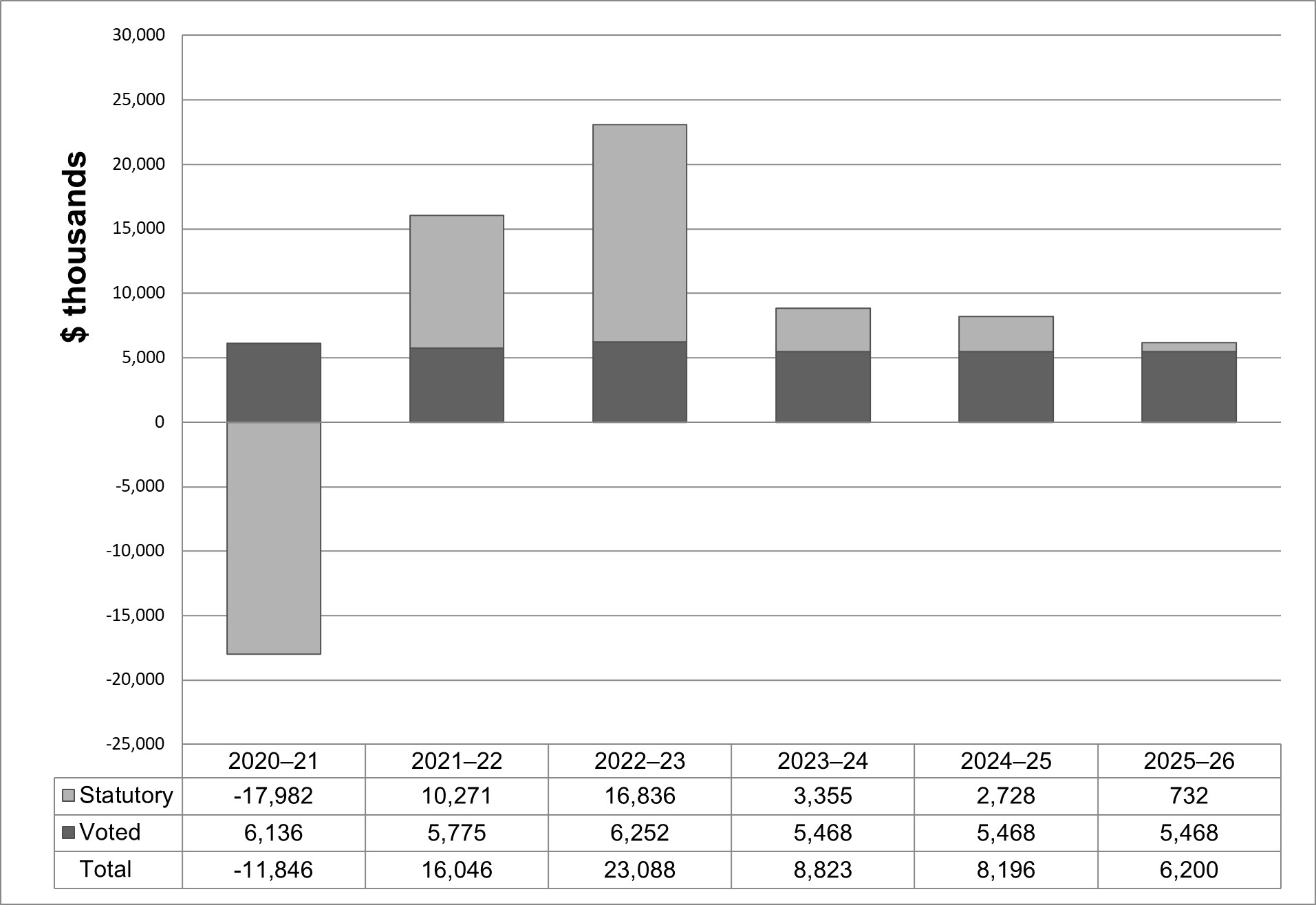
The following graph presents planned (voted and statutory spending) over time.
Spending 2020-21 to 2025-26
-
Spending
Spending 2020-21 to 2025-26 2020-21 2021-22 2022-23 2023-24 2024-25 2025-26 Statutory -17,982 10,271 16,836 3,355 2,728 732 Voted 6,136 5,775 6,252 5,468 5,468 5,468 Total -11,846 16,046 23,088 8,823 8,196 6,200
Note: Statutory amounts are net of respendable revenues and contain employee benefits plan funding.
Budgetary performance summary for core responsibility and internal services (dollars)
The “Budgetary performance summary for core responsibility and internal services” table presents the budgetary financial resources allocated for Canadian Grain Commission’s core responsibility and for internal services.
| Core Responsibility and Internal Services | 2022-23 Main Estimates | 2022-23 Planned Spending | 2023-24 Planned Spending | 2024-25 Planned Spending | 2022-23 Total Authorities Available for Use | 2020-21 Actual Spending (authorities used) | 2021-22 Actual Spending (authorities used) | 2022-23 Actual Spending (authorities used) |
|---|---|---|---|---|---|---|---|---|
| Grain Regulation | 12,914,594 | 12,914,594 | 8,528,087 | 7,901,036 | 13,715,271 | (33,438,499) | (6,136,888) | 750,274 |
| Subtotal | 12,914,594 | 12,914,594 | 8,528,087 | 7,901,036 | 13,715,271 | (33,438,499) | (6,136,888) | 750,274 |
| Internal Services | 295,356 | 295,356 | 295,356 | 295,356 | 535,356 | 21,592,592 | 22,183,002 | 22,337,460 |
| Total | 13,209,950 | 13,209,950 | 8,823,443 | 8,196,392 | 14,250,627 | (11,845,907) | 16,046,114 | 23,087,734 |
Note: Planned spending is net of respendable revenues. For planning, revenue forecasts are allocated to both Grain Regulation and Internal Services as required. The Canadian Grain Commission reports all revenues collected under its Grain Regulation core responsibility; however, these revenues also support the costs of internal services. Details on the overall organization’s expenditure distribution can be found in the 2022-23 Budgetary actual gross spending summary (dollars) table below.
Canadian Grain Commission revenues are dependent on annual grain volumes that can fluctuate considerably from year-to-year and are not fully known prior to the commencement of the fiscal year. This can result in significant variances between projected and actual revenues. The Canadian Grain Commission could accumulate surpluses in years with higher-than-average grain volumes or could be required to draw on its accumulated surplus funds in years with lower-than-average volumes.
From 2013 to 2018, unprecedented increases in Canadian grain production and relatively stable operating costs led to an accumulated revolving fund surplus of approximately $130 million as of March 31, 2018. In response, the Canadian Grain Commission lowered fees in 2018 and announced an Investment Framework to invest the accumulated surplus in programs that would benefit the entire value chain. The Investment Framework retains $40 million of the accumulated surplus for a contingency operating reserve to guard against the possibility of future declines in revenues, while committing $90 million for strategic investments.
When the Investment Framework was announced, the Canadian Grain Commission envisioned rolling out investments over a two-year timeframe. However, this timeline was subsequently delayed as a result of Budget 2019’s announcement of the Canada Grain Act review to ensure alignment between the two processes.
From 2018 to 2021, Canadian grain export volumes continued to grow resulting in further surplus accumulation. In response, the Canadian Grain Commission updated its model for forecasting annual grain volumes and revenue projections. Effective August 1, 2021, the four fees for official inspection and weighing that generated most of the surplus were again reduced by 29 percent and realigned with the adjusted grain volume forecast of 48.1MMT. However, excessively hot and dry growing conditions across most of the western Canadian grain production area in 2021 resulted in significantly decreased yields. This in turn resulted in reduced grain volumes at export position, and accordingly reduced demand for the Canadian Grain Commission inspection, weighing, and certification activity. With reduced revenue, the Canadian Grain Commission utilized its position as a revolving fund to draw down on surplus to cover this revenue shortfall.
Despite the revenue shortfall position, actual spending for 2022-23 remained relatively consistent to spending in 2019 through 2022. Slight increases in expenditures were primarily the result of projects related to the Investment Framework that helped ensure the Canadian Grain Commission continued to deliver on its key areas of focus. As part of the Investment Framework, the Canadian Grain Commission allocated $4 million to fund enhancements to the Harvest Sample Program for five years. Additionally, in 2022-23, the Canadian Grain Commission made modest surplus investments in:
- developing a suite of integrated program delivery systems to provide seamless digital service to Canadian Grain Commission clients;
- renewal of laboratory infrastructure; and
- strategic investments to strengthen research and innovation.
Going forward, the Canadian Grain Commission will consider investment initiatives within the broader context of the Canada Grain Act Review outcomes.
2022-23 Budgetary actual gross spending summary (dollars)
The following table reconciles gross planned spending with net spending for 2022-23.
| Core Responsibility and Internal Services | 2022-23 Actual gross spending | 2022-23 Actual revenues netted against expenditures | 2022-23 Actual net spending (authorities used) |
|---|---|---|---|
| Grain Regulation | 44,685,410 | 43,935,135 | 750,274 |
| Subtotal | 44,685,410 | 43,935,135 | 750,274 |
| Internal Services | 22,359,191 | 21,731 | 22,337,460 |
| Total | 67,044,601 | 43,956,866 | 23,087,734 |
Note: The Canadian Grain Commission does not have any specified purpose accounts to report against. Funding structure is based on budgetary authorities that are comprised of both voted and statutory authorities. The statutory authorities include employee benefit plan authority for appropriation-funded personnel costs and Canadian Grain Commission revolving fund authority, which allows the Canadian Grain Commission to respend fees that it has collected. The organization’s revenue is based on fees for services as per the Service Fees Act.
Human resources
TThe “Human resources summary for core responsibility and internal services” table presents the full-time equivalents (FTEs) allocated to each of Canadian Grain Commission’s core responsibility and to internal services.
| Core Responsibility and Internal Services | 2020-21 Actual full-time equivalents | 2021-22 Actual full-time equivalents | 2022-23 Planned full-time equivalents | 2022-23 Actual full-time equivalents | 2023-24 Planned full-time equivalents | 2024-25 Planned full-time equivalents |
|---|---|---|---|---|---|---|
| Grain Regulation | 306 | 319 | 333 | 325 | 333 | 333 |
| Subtotal | 306 | 319 | 333 | 325 | 333 | 333 |
| Internal Services | 130 | 145 | 149 | 148 | 149 | 149 |
| Total | 436 | 464 | 482 | 473 | 482 | 482 |
Expenditures by vote
For information on the Canadian Grain Commission’s organizational voted and statutory expenditures, consult the Public Accounts of Canada.
Government of Canada spending and activities
Information on the alignment of the Canadian Grain Commission’s spending with the Government of Canada’s spending and activities is available in GC InfoBase.
Financial statements and financial statements highlights
Financial statements
Canadian Grain Commission’s financial statements (unaudited) for the year ended March 31, 2023, are available on the department's website.
Financial statements highlights
| Financial information | 2022-23 Planned results | 2022-23 Actual results | 2021-22 Actual results | Difference (2022-23 Actual results minus 2022-23 Planned results) | Difference (2022-23 Actual results minus 2021-22 Actual results) |
|---|---|---|---|---|---|
| Total expenses | 71,467,315 | 69,818,369 | 66,735,402 | (1,648,946) | 3,082,967 |
| Total revenues | (61,452,447) | (47,563,855) | (45,439,557) | 13,888,592 | (2,124,299) |
| Net cost of operations before government funding and transfers | 10,014,868 | 22,254,514 | 21,295,845 | 12,239,646 | 958,669 |
The 2022-23 planned results information is provided in Canadian Grain Commission’s Future-Oriented Statement of Operations and Notes 2022-23.
2022-23 Actual to 2022-23 Planned
The net cost of operations before government funding and transfers for 2022-23 was a deficit of $22.25 million. This represents an increase of $12.24 million from the 2022-23 planned results of $10.01 million in net cost. This is the result of a decrease to actual revenues earned of $13.89 million compared to 2022-23 planned revenue primarily due to the 2021 drought, which continued to impact grain volumes through the first two quarters of 2022-23. Given this revenue shortfall, the Canadian Grain Commission reviewed spending plans and prioritized key areas of focus to support the grain industry resulting in a decrease of $1.65 million in actual expenses as compared to planned expenses.
2022-23 Actual to 2021-22 Actual
The net cost of operations before government funding and transfers for 2022-23 was a deficit of $22.25 million. This represents an increase of $0.96 million from the 2021-22 actual result of $21.30 million in net cost. This is primarily due to:
- 2022-23 actual expenditures increased by $3.08 million compared to 2021-22 actual expenses. This was primarily due to changes in personnel, transportation and communication, professional services, repairs and maintenance and information.
- 2022-23 actual revenues earned increased by $2.12 million over 2021-22 primarily due to higher grain volumes inspected and weighed as compared to 2021-22.
| Financial Information | 2022-23 | 2021-22 | Difference (2022-23 minus 2021-22) |
|---|---|---|---|
| Total net liabilities | 13,488,160 | 11,308,413 | 2,179,747 |
| Total net financial assets | 7,552,960 | 3,737,956 | 3,815,004 |
| Departmental net debt | 5,935,200 | 7,570,457 | (1,635,257) |
| Total non-financial assets | 11,693,807 | 12,372,880 | (679,073) |
| Departmental net financial position | 5,758,607 | 4,802,423 | 956,184 |
The 2022-23 planned results information is provided in Canadian Grain Commission’s Future-Oriented Statement of Operations and Notes 2022-23.
The Canadian Grain Commission’s net financial position in 2022-23 was $5.76 million, an increase of $0.96 million from the 2021-22 net financial position of $4.80 million. This is a result of:
- Increased total net financial assets of $1.44 million primarily resulting from an increase to accounts receivable due to a 141 percent increase in grain volumes inspected and weighed compared to 2021-22.
- Increased total net liabilities primarily resulting from an increase to retroactive pay payable comprised of an accrual for more expired contracts as compared to 2021-22.
Corporate information
Organizational profile
Appropriate Minister: The Honourable Lawrence MacAulay
Institutional Head: Doug Chorney, Chief Commissioner
Ministerial Portfolio: Agriculture and Agri-Food (AAFC)
Enabling Instrument: Canada Grain Act, R.S.C. 1985, c. G-10
Year of Incorporation / Commencement: 1912
Other: The Canadian Grain Commission’s head office is located in Winnipeg, Manitoba. The Canadian Grain Commission operates two regional offices and eight service centres, and provides service at more than 30 terminal elevators across Canada. A combination of revolving fund (fees) and appropriation sources fund Canadian Grain Commission programs and services. The Canadian Grain Commission plans to recover approximately 90 percent of its costs through fees and approximately 10 percent through appropriation.
Raison d’être, mandate and role: who we are and what we do
“Raison d’être, mandate and role: who we are and what we do” is available on the Canadian Grain Commission’s website.
For more information on the department’s organizational mandate letter commitments, see the Minister’s mandate letter.
Reporting framework
Canadian Grain Commission’s departmental results framework and program inventory of record for 2022-23 are shown below.
| Departmental Results Framework | Core Responsibility: Grain Regulation | Internal Services | |
|---|---|---|---|
| Departmental Result: Domestic and international markets regard Canadian grain as dependable and safe | Indicator: Percentage of stakeholders who regard Canadian grain as dependable and safe | ||
| Indicator: Value of Canadian grain exports | |||
| Departmental Result: Farmers are fairly compensated for their grain | Indicator: Percentage of sales where farmers are compensated for their grain | ||
| Indicator: Percentage of outstanding liabilities paid to farmers in the event of a default by a Canadian Grain Commission licensed grain company | |||
| Program Inventory | Program: Grain Quality | ||
| Program: Grain Research | |||
| Program: Safeguards for Grain Farmers | |||
Supporting information on the program inventory
Financial, human resources and performance information for the Canadian Grain Commission’s Program Inventory is available in GC InfoBase.
Supplementary information tables
The following supplementary information tables are available on Canadian Grain Commission’s website:
- Reporting on Green Procurement
- Gender-based analysis plus
- Response to Parliamentary Committees
Federal tax expenditures
The tax system can be used to achieve public policy objectives through the application of special measures such as low tax rates, exemptions, deductions, deferrals and credits. The Department of Finance Canada publishes cost estimates and projections for these measures each year in the Report on Federal Tax Expenditures. This report also provides detailed background information on tax expenditures, including descriptions, objectives, historical information and references to related federal spending programs as well as evaluations and GBA Plus of tax expenditures.
Organizational contact information
Canadian Grain Commission
600-303 Main Street
Winnipeg, Manitoba R3C 3G8
Telephone: 204-984-0506
TTY: 1-800-853-6705
Facsimile: 204-983-2751
Email: contact@grainscanada.gc.ca
Website: Canadian Grain Commission
Appendix: Definitions
- appropriation
- (crédit): Any authority of Parliament to pay money out of the Consolidated Revenue Fund.
- budgetary expenditures
- (dépenses budgétaires): Operating and capital expenditures; transfer payments to other levels of government, organizations or individuals; and payments to Crown corporations.
- core responsibility
- (responsabilité essentielle): An enduring function or role performed by a department. The intentions of the department with respect to a core responsibility are reflected in one or more related departmental results that the department seeks to contribute to or influence.
- Departmental Plan
- (Plan ministériel): A report on the plans and expected performance of an appropriated department over a 3 year period. Departmental Plans are usually tabled in Parliament each spring.
- departmental priority
- (priorité): A plan or project that a department has chosen to focus and report on during the planning period. Priorities represent the things that are most important or what must be done first to support the achievement of the desired departmental results.
- departmental result
- (résultat ministériel): A consequence or outcome that a department seeks to achieve. A departmental result is often outside departments’ immediate control, but it should be influenced by program-level outcomes.
- departmental result indicator
- (indicateur de résultat ministériel): A quantitative measure of progress on a departmental result.
- departmental results framework
- (cadre ministériel des résultats): A framework that connects the department’s core responsibilities to its departmental results and departmental result indicators.
- Departmental Results Report
- (rapport sur les résultats ministériels): A report on a department’s actual accomplishments against the plans, priorities and expected results set out in the corresponding Departmental Plan.
- experimentation
- (expérimentation): The conducting of activities that seek to first explore, then test and compare the effects and impacts of policies and interventions in order to inform evidence-based decision-making, and improve outcomes for Canadians, by learning what works, for whom and in what circumstances. Experimentation is related to, but distinct from innovation (the trying of new things), because it involves a rigorous comparison of results. For example, using a new website to communicate with Canadians can be an innovation; systematically testing the new website against existing outreach tools or an old website to see which one leads to more engagement, is experimentation.
- full time equivalent
- (équivalent temps plein): A measure of the extent to which an employee represents a full person year charge against a departmental budget. For a particular position, the full time equivalent figure is the ratio of number of hours the person actually works divided by the standard number of hours set out in the person’s collective agreement.
- gender-based analysis plus (GBA+)
- (analyse comparative entre les sexes plus [ACS Plus]): An analytical tool used to support the development of responsive and inclusive policies, programs and other initiatives; and understand how factors such as sex, race, national and ethnic origin, Indigenous origin or identity, age, sexual orientation, socioeconomic conditions, geography, culture and disability, impact experiences and outcomes, and can affect access to and experience of government programs.
- government-wide priorities
- (priorités pangouvernementales): For the purpose of the 2022-23 Departmental Results Report, government-wide priorities are the high-level themes outlining the government’s agenda in the November 23, 2021, Speech from the Throne: building a healthier today and tomorrow; growing a more resilient economy; bolder climate action; fighter harder for safer communities; standing up for diversity and inclusion; moving faster on the path to reconciliation; and fighting for a secure, just and equitable world.
- horizontal initiative
- (initiative horizontale): An initiative where two or more federal organizations are given funding to pursue a shared outcome, often linked to a government priority.
- non-budgetary expenditures
- (dépenses non budgétaires): Net outlays and receipts related to loans, investments and advances, which change the composition of the financial assets of the Government of Canada.
- performance
- (rendement): What an organization did with its resources to achieve its results, how well those results compare to what the organization intended to achieve, and how well lessons learned have been identified.
- performance indicator
- (indicateur de rendement): A qualitative or quantitative means of measuring an output or outcome, with the intention of gauging the performance of an organization, program, policy or initiative respecting expected results.
- performance reporting
- (production de rapports sur le rendement): The process of communicating evidence based performance information. Performance reporting supports decision making, accountability and transparency.
- plan
- (plan): The articulation of strategic choices, which provides information on how an organization intends to achieve its priorities and associated results. Generally, a plan will explain the logic behind the strategies chosen and tend to focus on actions that lead to the expected result.
- planned spending
- (dépenses prévues): For Departmental Plans and Departmental Results Reports, planned spending refers to those amounts presented in Main Estimates.
A department is expected to be aware of the authorities that it has sought and received. The determination of planned spending is a departmental responsibility, and departments must be able to defend the expenditure and accrual numbers presented in their Departmental Plans and Departmental Results Reports. - program
- (programme): Individual or groups of services, activities or combinations thereof that are managed together within the department and focus on a specific set of outputs, outcomes or service levels.
- program inventory
- (répertoire des programmes): Identifies all the department’s programs and describes how resources are organized to contribute to the department’s core responsibilities and results.
- result
- (résultat): A consequence attributed, in part, to an organization, policy, program or initiative. Results are not within the control of a single organization, policy, program or initiative; instead they are within the area of the organization’s influence.
- statutory expenditures
- (dépenses législatives): Expenditures that Parliament has approved through legislation other than appropriation acts. The legislation sets out the purpose of the expenditures and the terms and conditions under which they may be made.
- target
- (cible): A measurable performance or success level that an organization, program or initiative plans to achieve within a specified time period. Targets can be either quantitative or qualitative.
- voted expenditures
- (dépenses votées): Expenditures that Parliament approves annually through an appropriation act. The vote wording becomes the governing conditions under which these expenditures may be made.