
Quality of western Canadian flaxseed 2023
This report presents harvest quality data for western flaxseed grown in 2023. Flaxseed samples were submitted to the Canadian Grain Commission’s Harvest Sample Program by producers and grain companies. Quality data is compiled from the results of analytical tests performed in the Grain Research Laboratory.
ISSN 1700-2087

Summary
The 2023 western Canadian flaxseed samples received by the Harvest Sample Program contained slightly higher oil and protein content and higher iodine values than the 2022 harvest samples.
Tables 1 and 2 contain the 2023 quality data for brown Flaxseed, No. 1 Canada Western harvest samples. Mean oil content was 44.8%, which is similar to the 2022 mean (44.7%) and lower than the 10-year mean (45.6%). Mean protein content was 24.5%, which is similar to the 2022 mean (24.4%) and higher than the 10-year mean (22.9%). Mean iodine value was 189.3 units, which is higher than the 2022 mean (186.8 units) and lower than the 10-year mean (190.6 units). Oil and protein values are reported on a dry matter basis.
| Quality parameter | 2023 | 2022 | 2013 to 2022 mean |
|---|---|---|---|
| Number of samples | 107 | 174 | n/aFootnote 1 |
| Oil contentFootnote 2, % | 44.8 | 44.7 | 45.6 |
| Protein contentFootnote 3, % | 24.5 | 24.4 | 22.9 |
| Free fatty acids, % | 0.3 | 0.3 | 0.2 |
| Iodine value, units in oil | 189.3 | 186.8 | 190.6 |
| Fatty acidFootnote 4, % in oil | 2023 | 2022 | 2013 to 2022 mean |
|---|---|---|---|
| Palmitic acid (C16:0) | 5.0 | 5.2 | 5.1 |
| Stearic acid (C18:0) | 3.4 | 3.6 | 3.5 |
| Oleic acid (C18:1) | 19.2 | 20.0 | 18.6 |
| Linoleic acid (C18:2) | 15.4 | 15.4 | 15.2 |
| Alpha-linolenic acid (C18:3) | 55.8 | 54.6 | 56.6 |

Seeding and growing conditions
Approximately 62% of the flaxseed crop had been seeded by mid-May in Manitoba, below the 5-year average of 81%. Seeding was mostly completed by the second week of June. Variable rainfall throughout the growing season in some areas helped improve yields, but crops struggled in areas with minimal rainfall and high temperatures. Most of the flaxseed crop was harvested by the end of October.
In Saskatchewan, a late snow melt and cool temperatures delayed much of the seeding. Only 38% of the flaxseed crop was seeded by mid-May, below the 5-year average of 53%. Seeding was mostly completed by the first week of June. Rainfall was inconsistent throughout the growing season, which greatly affected yields. Some areas had sufficient precipitation, while crops in other areas experienced heat stress and drought. By mid-October, 92% of the flaxseed crop had been harvested.
Unseasonably warm temperatures in May enhanced seeding progress in Alberta. By mid-May, 55% of the flaxseed crop had been seeded, which was only 3% below the 5-year average. Much needed precipitation in July increased soil moisture, improving yields in most areas. A warm fall allowed harvest to proceed without any delays. Most of the flaxseed crop was harvested by the second week of October.
Sources:
Production and grade distribution
Western Canadian farmers seeded 246,200 hectares (ha) of flaxseed in 2023 (Table 3), which is lower than the area seeded in 2022 (314,400 ha). The yield in 2023 was estimated to be 1,144 kilograms per hectare (kg/ha). Flaxseed production in 2023 was 272,200 metric tonnes (MT), which is a decrease from 2022 (472, 600 MT). Average flaxseed production in Manitoba, Saskatchewan and Alberta was 26,500 MT (41,700 MT in 2022), 223,800 MT (347,700 MT in 2022) and 21,900 MT (83,200 MT in 2022), respectively.
Flaxseed samples were graded by Canadian Grain Commission grain inspectors according to the Official Grain Grading Guide. In 2023, 89% of the submitted flaxseed samples from western Canada were graded No. 1, 2% were graded No. 2 and the remaining 7% were graded No. 3.
The number of harvest samples collected from each province may not represent the actual production or grade distribution. There were, however, a sufficient number of samples to provide good quality information for each province. Samples followed the historical trends in provincial production.
| Location | Seeded area (thousand hectares) | Production (thousand metric tonnes) | Average production (thousand metric tonnes) | ||
|---|---|---|---|---|---|
| 2023 | 2022 | 2023 | 2022 | 2013 to 2022 | |
| Manitoba | 17.4 | 20.7 | 26.5 | 41.7 | 52.1 |
| Saskatchewan | 209.8 | 241.7 | 223.8 | 347.7 | 480.9 |
| Alberta | 19.0 | 52.0 | 21.9 | 83.2 | 74.2 |
| Western Canada | 246.2 | 314.4 | 272.2 | 472.6 | 607.2 |
Table 3 Notes
| |||||
Harvest samples
Flaxseed samples from the Harvest Sample Program were cleaned to remove dockage prior to testing. Individual samples were analyzed for oil content, protein content and iodine values using a Foss NIR Systems 6500 scanning near-infrared spectrometer, calibrated to and verified against the appropriate reference methods. Composite samples were used for more precise and detailed analyses of free fatty acids and fatty acid composition. A brown flaxseed composite and a yellow flaxseed composite were prepared by combining samples graded No. 1 from each province.
The 2023 harvest report includes 107 brown flaxseed samples compared to 174 in 2022. For brown flaxseed graded No. 1, Manitoba contributed 13 samples, Saskatchewan 77 samples and Alberta 17 samples.
In 2023, the Harvest Sample Program received 8 samples of yellow flaxseed. All 8 samples of yellow flaxseed were graded No. 1. In yellow flaxseed, oil and protein content were 45.6% and 25.3%, respectively. The mean free fatty acid content in the 2023 yellow flaxseed composite was 0.23%, while the mean alpha-linolenic acid (C18:3) content and iodine value were 61.1% and 197.8 units, respectively.
Quality data by province
Tables 4 and 5 contain detailed information on the quality of No. 1 brown flaxseed from western Canada in 2023.
Flaxseed is an important source of oil. Alpha-linolenic acid, an omega-3 fatty acid found in flaxseed, can play a role in maintaining good health in humans and animals. It is the main reason for the increased use of whole and ground flaxseed in cereals and baked goods. Flaxseed is also used as a source of oil and protein in animal feed. For example, flaxseed incorporated into chicken feed can result in hens producing eggs that are high in omega-3 fatty acid.
Iodine value is a measure of the overall unsaturation of oil and is calculated from the fatty acid composition. Oils with higher iodine values (with more unsaturation), polymerize more rapidly in the presence of air. In flaxseed, iodine value is directly related to the amount of alpha-linolenic acid present in the oil. Alpha-linolenic acid is one of the most important quality factors for the industrial use of flaxseed oil as it is responsible for most of its drying properties.
| Location | Number of samples | Oil contentFootnote 2, % | Protein contentFootnote 3, % | Iodine value, units | ||||||
|---|---|---|---|---|---|---|---|---|---|---|
| Mean | Min | Max | Mean | Min | Max | Mean | Min | Max | ||
| Western Canada | 107 | 44.8 | 41.5 | 48.1 | 24.5 | 19.9 | 29.3 | 190.9 | 178.7 | 201.4 |
| Manitoba | 13 | 44.6 | 42.1 | 48.1 | 24.3 | 20.2 | 26.5 | 192.4 | 187.4 | 198.6 |
| Saskatchewan | 77 | 44.9 | 41.5 | 47.4 | 24.6 | 20.7 | 29.3 | 188.8 | 178.7 | 201.4 |
| Alberta | 17 | 44.6 | 41.6 | 47.4 | 24.6 | 19.9 | 29.3 | 189.4 | 178.7 | 198.1 |
| Location | Number of samples | Fatty acid compositionFootnote 5, % | Free fatty acid content, % | ||||
|---|---|---|---|---|---|---|---|
| C16:0 | C18:0 | C18:1 | C18:2 | C18:3 | |||
| Western Canada | 107 | 5.0 | 3.4 | 19.2 | 15.4 | 55.8 | 0.3 |
| Manitoba | 13 | 4.8 | 3.1 | 18.8 | 14.0 | 58.0 | 0.8 |
| Saskatchewan | 77 | 5.0 | 3.5 | 19.4 | 15.6 | 55.4 | 0.2 |
| Alberta | 17 | 5.0 | 3.6 | 19.0 | 15.5 | 55.8 | 0.2 |
Oil content
In 2023, the mean oil content of brown flaxseed graded No. 1 was 44.8%, similar to the 2022 mean (44.7%) and lower than the 10-year mean of 45.6% (Figure 2). The mean oil content in samples from Manitoba was 44.6%, similar to Saskatchewan (44.9%) and Alberta (44.6%) (Table 4). The mean oil content for No. 1 brown flaxseed from western Canada ranged from 41.8% to 48.1% (Table 4).
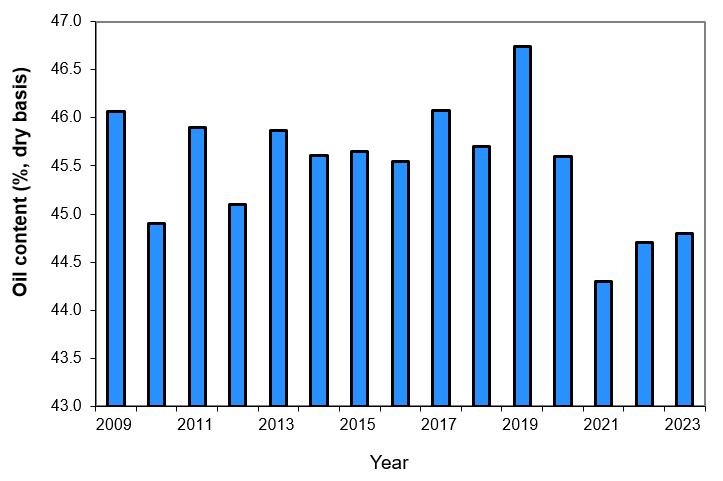
Graph data
| Year | Mean |
|---|---|
| 2009 | 46.1 |
| 2010 | 44.9 |
| 2011 | 45.9 |
| 2012 | 45.1 |
| 2013 | 45.9 |
| 2014 | 45.6 |
| 2015 | 45.7 |
| 2016 | 45.6 |
| 2017 | 46.1 |
| 2018 | 45.7 |
| 2019 | 46.7 |
| 2020 | 45.6 |
| 2021 | 44.3 |
| 2022 | 44.7 |
| 2023 | 44.8 |
| 2013 to 2022 | 45.6% |
Protein content
In 2023, the mean protein content of brown flaxseed graded No. 1 was 24.5%, similar to the 2022 mean (24.4%), and higher than the 10-year mean of 22.9% (Figure 3). The mean protein content in samples from Manitoba was 24.3%, similar to both Saskatchewan (24.6%) and Alberta (24.6%). The mean protein content for No. 1 brown flaxseed from western Canada ranged from 19.9% to 29.3% (Table 4).
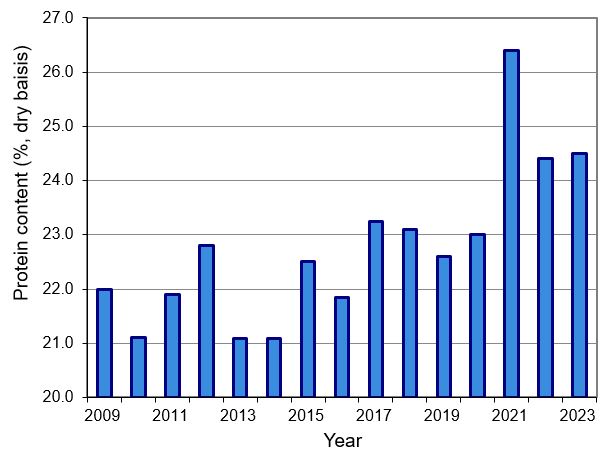
Graph data
| Year | Mean |
|---|---|
| 2009 | 22.0 |
| 2010 | 21.1 |
| 2011 | 21.9 |
| 2012 | 22.8 |
| 2013 | 21.1 |
| 2014 | 21.1 |
| 2015 | 22.5 |
| 2016 | 21.9 |
| 2017 | 23.2 |
| 2018 | 23.1 |
| 2019 | 22.6 |
| 2020 | 23.0 |
| 2021 | 26.4 |
| 2022 | 24.4 |
| 2023 | 24.5 |
| 2013 to 2022 | 23.1 |
Free fatty acid content
In 2023, the mean free fatty acid content in brown flaxseed graded No. 1 was 0.3%. This was similar to the mean in 2022 (0.3%) and the 10-year mean of 0.2% (Figure 4). The mean free fatty acid content in samples from Manitoba was 0.8%, higher than Alberta (0.2%) and Saskatchewan (0.2%) (Table 5).
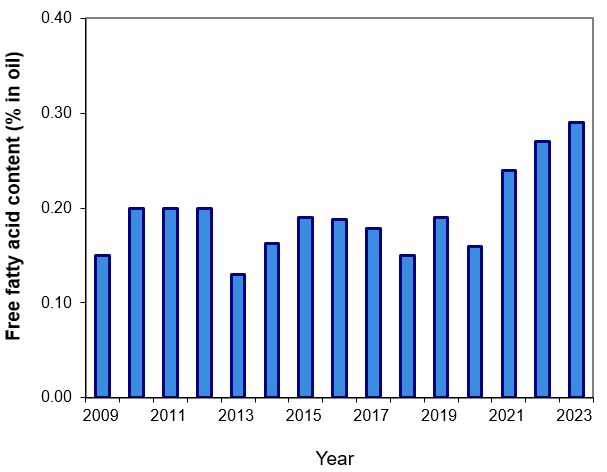
Graph data
| Year | Mean |
|---|---|
| 2009 | 0.15 |
| 2010 | 0.20 |
| 2011 | 0.20 |
| 2012 | 0.20 |
| 2013 | 0.13 |
| 2014 | 0.16 |
| 2015 | 0.19 |
| 2016 | 0.19 |
| 2017 | 0.18 |
| 2018 | 0.15 |
| 2019 | 0.19 |
| 2020 | 0.16 |
| 2021 | 0.24 |
| 2022 | 0.27 |
| 2023 | 0.29 |
| 2013 to 2022 | 0.20 |
Fatty acid composition
In 2023, the mean alpha-linolenic acid (C18:3) content in brown flaxseed graded No. 1 was 55.8%. This was slightly higher than the 2022 mean (54.6 %) but lower than the 10-year mean of 56.8% (Figure 5). The mean alpha-linolenic acid (C18:3) content in samples from Manitoba, Saskatchewan and Alberta was 58.0%, 55.4% and 55.8%, respectively.
In 2023, the mean iodine value for brown flaxseed graded No. 1 was 189.3 units. This was slightly higher than in 2022 (186.8 units) but lower than the 10-year mean (190.6 units) (Figure 6).
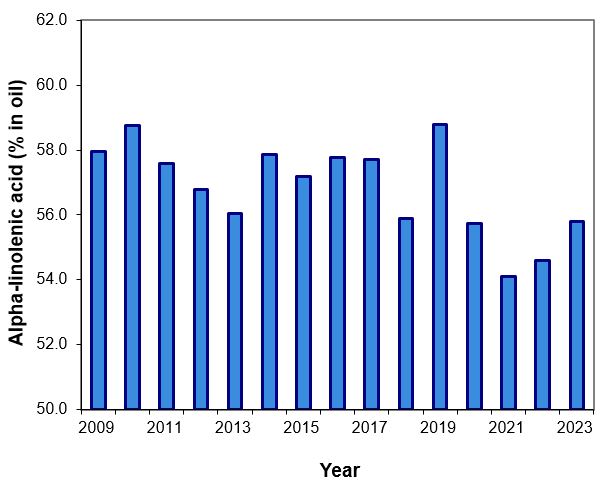
Graph data
| Year | Mean |
|---|---|
| 2009 | 58.0 |
| 2010 | 58.8 |
| 2011 | 57.6 |
| 2012 | 56.8 |
| 2013 | 56.0 |
| 2014 | 57.9 |
| 2015 | 57.2 |
| 2016 | 57.8 |
| 2017 | 57.7 |
| 2018 | 55.9 |
| 2019 | 58.8 |
| 2020 | 55.8 |
| 2021 | 54.1 |
| 2022 | 54.6 |
| 2023 | 55.8 |
| 2013 to 2022 | 56.6 |
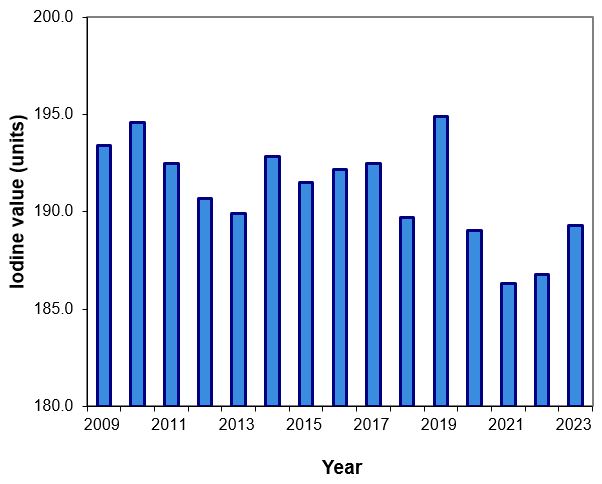
Graph data
| Year | Mean |
|---|---|
| 2009 | 193.4 |
| 2010 | 194.6 |
| 2011 | 192.5 |
| 2012 | 190.7 |
| 2013 | 189.9 |
| 2014 | 192.9 |
| 2015 | 191.5 |
| 2016 | 192.5 |
| 2017 | 192.5 |
| 2018 | 189.7 |
| 2019 | 194.9 |
| 2020 | 189.0 |
| 2021 | 186.3 |
| 2022 | 186.8 |
| 2023 | 189.3 |
| 2013 to 2022 | 190.5 |