
Guidance for Proponents: Developing, Evaluating and Reporting on Follow-up Programs
Our website is undergoing significant changes to provide updated guidance on the Impact Assessment Agency of Canada's practice on the application of the Impact Assessment Act and its regulations. This webpage and its contents may not reflect the Impact Assessment Agency of Canada's current practices. Proponents remain responsible for following applicable legislation and regulations. For more information, please contact guidancefeedback-retroactionorientation@iaac-aeic.gc.ca.
On this page
- List of tables
- List of figures
- Disclaimer
- Purpose
- Context
- Content of a follow-up program
- Evaluating and reporting on follow-up programs
- Conclusion
- Annexes
List of tables
- Table 1: Reporting on the accuracy of predictions
- Table 2: Reporting on the effectiveness of mitigation measures
List of figures
Disclaimer
This guidance document is for informational purposes only. This document is not intended to fetter decision-makers. It is not intended to suggest that the Government of Canada can regulate matters of provincial jurisdiction. It is not a substitute for the Impact Assessment Act (IAA) or its regulations. In the event of an inconsistency between this guidance document and the IAA or its regulations, the IAA and its regulations would prevail.
Proponents should consult the Impact Assessment Agency of Canada’s (IAAC) Practitioner’s Guide to Federal Impact Assessments periodically for updated guidance. If you identify any issues or inconsistencies between this guidance document and other guidance developed by IAAC, please contact postdecision@iaac-aeic.gc.ca.
Purpose
This guidance document aims to provide proponents with guidance on developing, evaluating, and reporting on follow-up programs that are required by conditions of decision statements issued for designated projects under the Impact Assessment Act (IAA). The information contained in this guidance document reflects best practices.
This guidance document helps guide proponents with respect to follow-up requirements, and reporting for follow-up programs. The guidance document aims to reduce the administrative burden on proponents through streamlining and standardizing their reporting for follow-up programs. Finally, the guidance document is meant to help make meaningful follow-up results available to IAAC, which will in turn support more efficient and improved future impact assessments.
To avoid duplication and regulatory burden, IAAC coordinates with other jurisdictions to determine whether the objectives of follow-up programs can be adequately addressed through existing processes or requirements in those jurisdictions. The guidance document clarifies that existing federal or provincial monitoring requirements may be used in determining which issues require monitoring and follow-up. Finally, the guidance document acknowledges that a follow-up program can evolve as new knowledge or best practices emerge during a project’s lifetime, and that monitoring and reporting may cease under various circumstances, such as once predictions have been confirmed or mitigation measures have been proven effective.
Context
A follow-up program is defined in the IAA as a program for verifying the accuracy of the impact assessment of a designated project and determining the effectiveness of any mitigation measures. In this context, a follow-up program is used to answer the following questions:
- Are the predictions made in a project’s impact assessment accurate?
- Are the mitigation measures effective in successfully addressing the predicted effects? If not, how and why are they not effective?
Answers to these questions support adaptive management as it allows ongoing adjustments and improvement to projects’ mitigation measures based on monitoring results before irreversible adverse effects within federal jurisdiction and direct or incidental adverse effects (collectively referred to as adverse federal effects in this guidance document) occur. This is considered a type of adaptive management (“passive adaptive management” or “managing adaptively”). This is distinct from an active adaptive management process that is established in an adaptive management plan considered under the IAA, and which involves learning from outcomes and tiered management thresholds.
Follow-up programs strengthen the Crown’s ability to meet its duty to consult by validating that required mitigation measures for impacts on Indigenous Peoples and their rights remain effective.
They can also help IAAC practitioners, proponents, Indigenous groups and other participants in the impact assessment process to learn from experience with past projects. This can support more robust, efficient and improved impact assessment processes for future projects.
For example, verifying the accuracy of impact assessment predictions can improve the scientific understanding of the accuracy of predictions, allowing future assessments to be streamlined and reducing time and cost. Similarly, evaluating the effectiveness of a project’s mitigation measures can result in project-specific improvements and increase knowledge about applying standard mitigation measures to future projects. Demonstrating that predictions are accurate and mitigation measures work can help build credibility and trust in the impact assessment process. Applying lessons learned from follow-up can help identify lower-risk issues, allowing future impact assessments to focus on key issues.
Under the IAA, an impact assessment must consider a project’s adverse federal effects, technically and economically feasible mitigation measures to eliminate, reduce, control or offset these effects and the elements of the project’s legislatively required follow-up program. During the impact assessment, the proponent identifies valued component(s) that would be included in the follow-up program. This is done by considering the predicted extent to which the project’s likely residual and cumulative adverse federal effects may be significant, the uncertainty associated with these predictions, and whether the effects to be monitored may fall under the jurisdiction of another provincial or federal regulatory authority. The proponent also develops a preliminary design for the follow-up program.
If, at the end of an impact assessment for a project, any adverse federal effects of the project that are likely to be, to some extent, significant are determined to be justified in the public interest by the Minister or the Governor in Council, the Minister issues a decision statement to the proponent. The decision statement includes legally binding conditions in relation to the adverse federal effects of the project, including the requirement for the proponent to implement mitigation measures and a follow-up program. The valued components included in the follow-up program established by the Minister may include those proposed by the proponent and those suggested by other participants in the impact assessment process. Conditions could also be a means by which the Crown accommodates potential impacts on the rights of Indigenous Peoples.
In the Post Decision phase of the impact assessment process, the proponent develops and implements the follow-up program as required by the conditions. This involves considering the views and information of Indigenous groups, relevant authorities, and other interested stakeholders. The proponent also reports annually on the results of the follow-up program.
The proponent’s engagement with Indigenous groups throughout the entire impact assessment process can also guide the design and implementation of the follow-up program. The proponent should collaborate with Indigenous groups to identify ways to appropriately and respectfully include Indigenous Knowledge in the follow-up program. Relevant guidance on Indigenous participation and engagement through the impact assessment process is available on IAAC’s website.
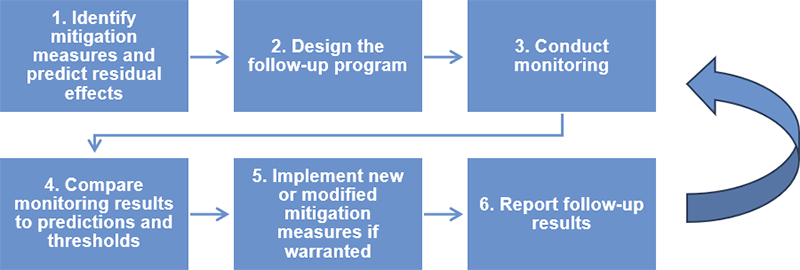
Figure 1 - Text version
Figure 1 is a flowchart showing six steps in a follow-up program with a circular feedback loop. The steps are:
- identify mitigation measures and predict residual effects;
- design the follow-up program;
- conduct monitoring;
- compare results with predictions and thresholds;
- adjust mitigation as needed; and
- report results.
The process is iterative. After reporting, monitoring may continue for multiple reporting periods, repeating steps 3 to 6 as needed.
Figure 1 illustrates the phased implementation of a follow-up program outlined in this guidance document. The identification of mitigation measures and prediction of residual effects (step 1) occur prior to decision-making by the Minister or Governor in Council. The proponent undertakes steps 2 to 6 during the Post Decision phase. The process is iterative. After reporting, monitoring may continue for multiple reporting periods.
Content of a follow-up program
A decision statement generally includes conditions that set out standardized requirements applicable to the follow-up program, on which this guidance document is based. For example, conditions for a specific project may require the follow-up program to include all information relevant to its implementation, including:
- the verifiable impact assessment predictions to be evaluated for accuracy and/or the mitigation measures to be evaluated for effectiveness;
- the technically and economically feasible new or modified mitigation measures that may be implemented if monitoring results indicate that established thresholds have been reached or exceeded;
- a description of how the monitoring associated with the follow-up program will be conducted; and,
- a description of the circumstances under which the follow-up program, including its associated reporting, can end because the accuracy of the impact assessment predictions has been verified and/or the mitigation measures have been determined to be effective.
The following sections and annexes 1 and 2 present information and simplified examples of how a proponent can fulfil these requirements.
Impact assessment predictions
The follow-up program should describe the predictions associated with the residual adverse federal effects that will be evaluated for accuracy. These predictions should be described in a verifiable and measurable manner.
Mitigation measures
The follow-up program should describe the mitigation measures that will be evaluated for effectiveness. The follow-up program should also describe the new or modified technically and economically feasible mitigation measures that may be implemented if monitoring results show that existing mitigation measures are not performing as predicted. This should include a description of how and when new or modified mitigation measures will be implemented.
Given that it may not always be possible to determine in advance which mitigation measures will be suited to respond to an adverse outcome, a range of potential new or modified mitigation measures may be identified, with a description of when each mitigation option would be appropriate.
Thresholds
Thresholds are predefined measurable levels of change that, when reached, can help determine whether new or modified mitigation measures are required to mitigate and manage a project’s adverse federal effects. For example, new or modified mitigation measures may be required if unexpected or greater than predicted adverse federal effects are detected. These thresholds can be quantitative or qualitative.
The proponent’s choice of thresholds can be informed by the results of its engagement with Indigenous groups, relevant authorities and other interested stakeholders. Thresholds may also be derived from existing standards, guidelines, objectives or descriptors, or can be prescribed through conditions of the decision statement or other provincial or federal regulatory permits or authorizations. In addition to prescribed thresholds, the proponent may consider identifying additional thresholds that should not be less stringent than prescribed thresholds. Having multiple thresholds can help address gradual changes and apply a proportional response before prescribed thresholds are exceeded, without important or irreversible effects occurring.
Monitoring activities
Monitoring entails collecting, analyzing, and using information to measure the project’s adverse federal effects, with the goal of verifying the accuracy of the impact assessment predictions and determining the effectiveness of mitigation measures, and whether new or modified mitigation measures are needed. When developing the follow-up program, the proponent should determine the methods, location, frequency, timing, and duration of monitoring activities for the follow-up program. In certain instances, conditions included in the decision statement may prescribe how monitoring must be conducted.
In cases where other jurisdictional requirements may include monitoring activities relevant to a follow-up program, the proponent may rely on those requirements and incorporate them into the follow-up program. For example, provincial water quality monitoring requirements may be used to inform a fish and fish habitat follow-up program.
End points
The follow-up program should describe the circumstances under which its implementation, including reporting, can end, for example because the accuracy of the impact assessment predictions has been verified and/or the mitigation measures have been determined to be effective. Monitoring results should demonstrate consistent prediction accuracy and/or mitigation effectiveness over a period of time before the follow-up program can end. End points may also be prescribed through conditions of the decision statement or other provincial or federal regulatory permits or authorizations.
Evaluating and reporting on follow-up programs
As is usually set out in the conditions, the proponent must report annually on the results of the follow-up program to IAAC until such time that the follow-up program ends. The follow-up program may be updated during its implementation to reflect new information about the project, environmental conditions and other regulatory requirements or improvements in best practices.
If the proponent can justify that information reported to another provincial or federal regulatory authority meets the conditions of the decision statement, the same information can be provided to IAAC.
Verifying the accuracy of predictions
To verify the accuracy of impact assessment predictions, the proponent should assess monitoring results against the relevant predictions to evaluate the extent to which observed residual adverse federal effects are consistent with predicted effects.
When reporting to IAAC on the follow-up program, the proponent should present the predictions and compare them to baseline conditions and to the results of monitoring activities. Statistical and qualitative methods, as well as Indigenous Knowledge can be used to determine the degree of alignment between observed and predicted effects. The proponent should assign a “high”, “moderate”, or “low” accuracy status to predictions and present the rationale used to inform its determination in the report on the follow-up program.
When the accuracy of predictions is determined to be “moderate” or “low”, the proponent should describe and explain any discrepancies between observed and predicted effects. When no conclusions can be made with regards to the accuracy of a prediction, or the proponent is unable to verify the accuracy of a prediction during the reporting period, the proponent should provide a rationale (e.g., the project is not in the appropriate phase to verify the accuracy the prediction).
Determining the effectiveness of mitigation measures
To determine the effectiveness of mitigation measures, the proponent should assess monitoring results against the predictions and the selected thresholds and evaluate the extent to which the thresholds have been reached or exceeded during the reporting period and whether new or modified mitigation measures may be warranted. The accuracy of the predictions may be a relevant factor to consider when determining the effectiveness of mitigation measures. The proponent should also consider whether existing mitigation measures have been implemented properly and/or are functioning as expected.
When reporting to IAAC on the follow-up program, the proponent should present the mitigation measures and associated thresholds, describe the predicted effectiveness of these measures and compare that to the results of monitoring activities. Statistical and qualitative methods can be used to determine the degree of alignment between predicted and actual effectiveness. The proponent should assign a “high”, “moderate”, or “low” effectiveness status to mitigation measures and present the rationale used to inform its determination in the report on the follow-up program.
When the effectiveness of mitigation measures is determined to be “moderate” or “low”, the proponent should describe and explain any discrepancies between predicted and actual effectiveness. When no conclusions can be made with regards to the effectiveness of a mitigation measure, or the proponent is unable to determining the effectiveness a mitigation measure during the reporting period, the proponent should provide a rationale (e.g., the project is not in the appropriate phase to determine the effectiveness of the mitigation measure).
Reporting
When reporting follow-up program results, the proponent should include the analysis undertaken to verify the accuracy of the predictions and determine the effectiveness of the mitigation measures, including:
- the specific predictions and/or mitigation measures associated with the follow-up program;
- a description of the monitoring activities undertaken during the reporting period and the monitoring results (including quantitative data when available) obtained during that period; and,
- the conclusions drawn by the proponent with respect to the accuracy of the predictions and/or the effectiveness of the mitigation measures, including any new or modified mitigation measures implemented or proposed to be implemented by the proponent because of the follow-up program.
The proponent should identify and report on any assumed external or internal factors that may have positively or adversely affected the accuracy of the predictions and/or the effectiveness of the mitigation measures. These factors may include natural stressors, climate change, other physical activities, resource allocation or the robustness and appropriateness of the monitoring methodology for example.
If the proponent is required in the decision statement conditions to implement an adaptive management plan in relation to a follow-up program, specific additional reporting requirements may also apply.
Annexes 1 and 2 are simplified examples of reports. These examples reflect the reporting guidance presented in this document. Individual conditions may require reporting on accuracy, effectiveness, or both for a given valued component.
Conclusion
Follow-up programs verify the accuracy of a project’s impact assessment predictions and determine the effectiveness of mitigation measures identified to address adverse federal effects. In cases where mitigation measures are found to be ineffective, or if effects do not occur as predicted, information gained from follow-up programs can help proponents make ongoing adjustments and improvements to their projects through the implementation of new or modified mitigation measures and prevent adverse federal effects from happening. Streamlined reporting can reduce burden on proponents and will enable IAAC to track, evaluate and report on follow-up results publicly over time, which in turn can speed up approvals and reduce information requests in future impact assessments.
Annexes
Annex 1: Simplified reporting on the accuracy of predictions
This table is a simplified example of a report on the accuracy of the predictions for a hypothetical follow-up program. All values included in the table are fictional and are for demonstration purpose only.
Valued component | Fish and fish habitat |
|---|---|
Impact assessment predictions | Prediction 1: There will be residual adverse federal effects on fish and fish habitat from the project but changes in relative abundance and condition of Key Species A in Lake B are predicted to be within the range of natural variability for the species established during the impact assessment. Prediction 2: There will be residual adverse federal effects on fish and fish habitat from the project but changes in the concentration level of selenium and the quantity of total suspended solids in fish and fish habitat within 20 kilometres downstream of the project site are predicted to be within the range of natural variability established during the impact assessment. |
Monitoring activities | Prediction 1: Monitoring activities include measuring the relative abundance of Key Species A in Lake B in terms of catch per unit effort and the condition of Key Species A in Lake B in terms of length-frequency distribution, as sampled monthly. Prediction 2: Monitoring activities include measuring the concentration level of selenium and the quantity of total suspended solids in fish and fish habitat within 20 kilometres downstream of the project site, as sampled every six months. |
Results | Prediction 1: The range of natural variability established during the impact assessment for Key Species A in Lake B in terms of catch per unit effort was X. The values of catch per unit effort for Key Species A in Lake B measured during the reporting period were between Y and Z. These values are within the range of natural variability established during the impact assessment. The range of natural variability established during the impact assessment for Key Species A in Lake B in terms of length-frequency distribution was X. The values of length-frequency distribution of Key Species A in Lake B measured during the reporting period were between Y and Z. These values are 10 percent greater than the range of natural variability established during the impact assessment. Prediction 2: The ranges of natural variability established during the impact assessment for the concentration level of selenium and the quantity of total suspended solids were X and Y, respectively. The concentration level of selenium and the quantity of total suspended solids in fish and fish habitat within 20 kilometres downstream of the project site during the reporting period for each sampling interval were within their respective range of natural variability established during the impact assessment. |
Accuracy determination and rationale | Prediction 1: Monitoring results are mostly consistent with predictions. Predictions of residual adverse federal effects on fish and fish habitat have been determined to be of moderate accuracy. While relative abundance (expressed in catch per unit effort) of Key Species A remained within the ranges of natural variability, as predicted during the impact assessment, length-frequency distribution of Key Species A was greater (by 10 percent) than predicted for the same reporting period. However, the observed length-frequency distribution was only slightly greater than the established range of natural variability. Moreover, monitoring in previous years, since construction began, always resulted in length-frequency distribution being within the established range of natural variability for each reporting period. As such, observed length-frequency distribution for the current reporting period may be attributed to one-time stressors on Key Species A that are likely outside of the influence of the project. As such, length-frequency distribution of Key Species A observed during the reporting year are not expected to be detrimental to fish and fish habitat over time, unless monitoring results for future reporting years indicate otherwise. Prediction 2: Monitoring results are consistent with predictions. Predictions of residual adverse federal effects on fish and fish habitat have been determined to be of high accuracy because the concentration level of selenium and the quantity of total suspended solids in fish and fish habitat within 20 kilometres downstream of the project site for each sampling interval during the reporting period remained within their respective range of natural variability established during the impact assessment. |
Annex 2: Simplified reporting on the effectiveness of mitigation measures
This table is a simplified example of a report on the effectiveness of mitigation measures for a hypothetical follow-up program. All values included in the table are fictional and are for demonstration purpose only.
Valued component | Fish and fish habitat |
|---|---|
Mitigation measures | The operation of a water treatment plant and the installation of turbidity curtains will mitigate adverse federal effects on fish and fish habitat. |
Monitoring activities | Monitoring activities include measuring the concentration level of Metal A in fish tissue samples collected in Lake B and the quantity of Total Suspended Solids downstream of in-water works. |
Pre-Determined new or modified mitigation measures | A supplementary water treatment module or additional turbidity curtains may be installed if monitoring results show that thresholds are reached or exceeded. |
Thresholds | Threshold 1: If concentration level of Metal A in fish tissue samples collected in Lake B reaches or exceeds Value A, a supplementary water treatment module will be installed. Threshold 2: If Total Suspended Solids downstream of in-water works are reduced by less than 70 percent, additional turbidity curtains will be installed. |
Results | Monitoring showed Metal A levels in fish tissue from Lake B and Total Suspended Solids downstream of in-water works were X and Y, respectively. Threshold 1 was not reached or exceeded but Threshold 2 was not met over a 9-day period, when Total Suspended Solids downstream of in-water works were reduced by only 50 percent during this period. |
Effectiveness determination and rationale | Mitigation measures have been determined to be of high effectiveness, as fish abundance and health were not adversely impacted during the reporting period and the observed short-term increase in quantity of Total Suspended Solids was not detrimental to fish during the reporting period. This is consistent with the predictions. The increase in Total Suspended Solids during the 9-day period can be attributed to a tear in a turbidity curtain, which led to a reduction in Total Suspended Solids of only 50 percent during the time the curtain was faulty. The tear occurred during a heavy rain event. The curtain has since been replaced and will be inspected following future heavy rain events. |