
Canadian Grain Commission’s 2023-24 Departmental results report
Read a summary of the Departmental results report Print this page
Copyright information
2023-24 Departmental Results Report
© His Majesty the King in Right of Canada, represented by the Minister of Agriculture and Agri-Food, 2024
Cat. No.: A91-7E-PDF
ISSN: 2371-6886
This document is available on the Canadian Grain Commission website.
This document is available in alternative formats upon request.
From the Minister

The Honourable Lawrence MacAulay,
Privy Councillor, Member of Parliament,
Minister of Agriculture and Agri‑Food
I am pleased to present the Canadian Grain Commission’s Departmental Results Report for fiscal year 2023-24. Guided by the Canada Grain Act, the Canadian Grain Commission’s mandate is to, in the interests of grain producers, establish and maintain standards of quality for Canadian grain and regulate grain handling in Canada to ensure that Canadian grain remains a reliable commodity here at home and in international markets.
In the face of different challenges, our hardworking producers continue to show their resilience and produce top-quality products for Canadians, and the world. As Canada’s Minister of Agriculture and Agri-Food, I want producers to know that we are here to support them. This includes increasing the interest-free limit under the Advance Payments Program (APP) to $250,000 to help reduce borrowing costs and ease some of the cash flow challenges farmers are experiencing.
The success of Canada's agricultural sector remains a top priority for our Government. With the launch of the five-year Sustainable Canadian Agriculture Partnership last year, we have shown our steadfast commitment to supporting Canada’s agricultural sector through vitally important investments in science, research, and innovation. This includes federal investments of over $66 million in nine grains-related research clusters to drive an innovative, competitive and sustainable grain sector across Canada. This will contribute to a sustainable and profitable future for producers by developing new varieties to improve production efficiency, protein yield and profitability, while working to mitigate climate change. It also builds on the world-class research into grain quality and safety conducted by the Canadian Grain Commission’s Grain Research Laboratory.
The Canadian Grain Commission plays an important role in helping Canadian farmers and businesses secure greater access to international markets. In February, I was pleased to officially open Canada’s first-ever Indo-Pacific Agriculture and Agri-Food Office in Manila, Philippines and begin a new chapter for Canada’s engagement in the region. I am confident this office will be key to building strategic partnerships that will grow our export opportunities and increase the demand for our world-class Canadian products.
I would like to extend my thanks to Canadian Grain Commission employees for their work to support our hardworking producers. I encourage you to read the Canadian Grain Commission’s Departmental Results Report for 2023-2024 and to learn more about their work.
From the Chief Commissioner

David Hunt
Chief Commissioner
Canadian Grain Commission
As the new Chief Commissioner, I am proud to join the Canadian Grain Commission and build on our track record of delivering tangible results for the Canadian grain sector. The 2023-24 Departmental Results Report showcases our significant achievements in advancing the interests of Canada’s grain farmers, the Canadian grain sector and of all Canadians. I am delighted to highlight this work.
The Canadian Grain Commission’s digital transformation continued with the successful deployment of the MyCGC Portal. This digital services hub provides our clients streamlined access to several Canadian Grain Commission services, with further enhancements planned throughout 2024-25. Also, in support of transparency and accessibility, we updated our Open Government Implementation Plan, and refreshed the Canadian Grain Commission website. These efforts ensure that our services are more efficient for stakeholders and provide ready access to information they may need.
The Canadian Grain Commission is committed to ensuring producers are fairly compensated for their deliveries. In response to stakeholder feedback, we have modernized our final quality determination (FQD) process and published a set of standards and guidelines to help industry achieve comparable, consistent results in grain grading at in-country elevators. We also continued to protect Canadian producers from non-payment risk and moved quickly to respond to payment failure situations as they occurred and ensured market access through our grain quality research and testing. In addition, given the importance of providing cost-effective, yet modernized services, the Canadian Grain Commission continued our work on a comprehensive review of our fee framework and service standards.
Over the past year, the Canadian Grain Commission actively engaged in numerous outreach activities to better understand and support grain sector needs, including more in-person engagements with grower groups and expanding our social media presence to reach the broader science community. Our outreach initiatives not only demonstrate a commitment to transparent communication and recognition of diverse perspectives, but to continuously improving our support for the grain sector.
I am confident that our science and evidence-based programs and services, and collaboration with both domestic and international stakeholders, benefited the entire Canadian grain value chain in 2023-24 and will continue to serve us well into the future. I am looking forward to continuing this engagement in my role as Chief Commissioner.
Results – what we achieved
Core responsibilities and internal services
Core responsibility: Grain Regulation
Description
The Canadian Grain Commission regulates grain handling in Canada and establishes and maintains science-based standards of quality for Canadian grain.
Progress on results
This section presents details on how the department performed to achieve results and meet targets for Grain Regulation. Details are presented by departmental result.
Table 1: Targets and results for “Domestic and international markets regard Canadian grain as dependable and safe”
Table 1 provides a summary of the target and actual results for each indicator associated with the results under “Domestic and international markets regard Canadian grain as dependable and safe”.
Departmental Result Indicators | Target | Date to achieve target | Actual results |
|---|---|---|---|
Percentage of stakeholders who regard Canadian grain as dependable and safe | TBDFootnote 1 | TBDFootnote 1 |
|
Value of Canadian grain exports | $30.6 billionFootnote 3 | April 2025Footnote 3 |
|
Table 2: Targets and results for “Farmers are fairly compensated for their grain”
Table 2 provides a summary of the target and actual results for each indicator associated with the results under “Farmers are fairly compensated for their grain”.
Departmental Result Indicators | Target | Date to achieve target | Actual results |
|---|---|---|---|
Percentage of sales where farmers are compensated for their grain | 100% | April 2021 |
|
Percentage of outstanding liabilities paid to farmers in the event of a default by a Canadian Grain Commission-licensed grain company | 100% | April 2021 |
|
Additional information on the detailed results and performance information for the Canadian Grain Commission’s program inventory is available on GC InfoBase.
Details on results
The following section describes the results for Grain Regulation in 2023–24 compared with the planned results set out in the Canadian Grain Commission’s departmental plan for the year.
“Domestic and international markets regard Canadian grain as dependable and safe”
Results achieved:
- Modernized the Canadian Grain Commission’s regulatory framework, programs, and services.
- The Canadian Grain Commission continued to work with portfolio partners to respond to the Canada Grain Act Review outcomes. In addition, targeted opportunities to modernize the Canada Grain Act through the Annual Regulatory Modernization Bill process were explored. The Canadian Grain Commission also continues to prepare regulatory amendment packages to deliver on established grain grading and producer protection modernization goals as outlined in its Forward Regulatory Plan: 2023 to 2025. Regulatory amendments were made effective March 1, 2024 to reflect operational and administrative practices and improve producer protections and to incorporate by reference Chapter 2 of the Canadian Grain Commission Sampling Systems Handbook and Approval Guide on an ambulatory basis.
- The Canadian Grain Commission continues to face challenging financial conditions due to lower-than-expected grain volumes and higher-than-expected cost pressures. In 2023-24 the Canadian Grain Commission conducted a comprehensive review of its fee framework and service standards to ensure alignment with the costs of service provision. The project included a review of the grain volumes forecast, service standards, costing, pricing, and updates to the performance information profiles. The Canadian Grain Commission is planning to communicate the results of this review and next steps in 2024-25.
- The Canadian Grain Commission successfully deployed its MyCGC Portal, a digital service window intended to provide users with access to a range of Canadian Grain Commission transactions in October of 2023. The MyCGC Portal allows for more robust and client-friendly reporting functionality. Work continues to expand and enhance the features of MyCGC with future updates anticipated for 2024-25.
- The Canadian Grain Commission approved an update of its Open Government Implementation Plan in December of 2023. The Canadian Grain Commission published its implementation plan along with a refresh of its website in June of 2024.
- To improve the accessibility of its data releases, the Canadian Grain Commission is now producing its statistical reports in HTML format to allow information to be viewed directly as webpages rather than spreadsheet files. Additionally, the Canadian Grain Commission continues to work on the enhancement and sharing of data visualizations online.
- Positioned the Canadian Grain Commission as a global leader in grain science.
- The Canadian Grain Commission published its Science Strategy in January 2023. The Science Strategy articulates objectives and priorities for science that will help guide long-term decision making and facilitate investments in the organization’s science and research activities. Following its publication, the Canadian Grain Commission has developed an implementation plan to operationalize the Science Strategy.
- To address some of the operational challenges being faced because of the organization’s aging facilities, the Canadian Grain Commission developed options for investments in laboratory infrastructure to ensure organizational capacity to provide innovative and science-based programs and services. A five-year (2021-26) investment plan has been developed for making the required improvements to maintain and improve research capacity so the Grain Research Laboratory functions efficiently. In 2023, the Canadian Grain Commission installed temperature and humidity sensors to provide continuous remote monitoring, trending and alerts for laboratory equipment, as well as airflow monitors on all fume hoods to enhance employee safety. The Canadian Grain Commission also continued to work with Public Services and Procurement Canada to identify a new location for the future that is more suited to the needs of a modern research laboratory.
- The Canadian Grain Commission also finalized a business case and completed a “Request for Information” to procure and implement a Laboratory Information Management System to replace current custom database and manual systems. The intent of this project is to increase efficiency, enhance data quality and improve regulatory compliance reducing risk to the Canadian Grain Commission.
- The Canadian Grain Commission continued its work with government partners and sector stakeholders to provide science-based responses to market access issues supported by robust testing and monitoring to advance the interests of Canadian producers and the entire Canadian grain sector.
- The Canadian Grain Commission, along with our stakeholders, completed the comprehensive review of our Approved Cargo Statement Catalogue and major updates were deployed. Ongoing discussions will be incorporated into annual reviews with clients and stakeholders and are planned to commence in spring 2025.
“Farmers are fairly compensated for their grain”
Results achieved:
- Strengthened relationships with stakeholders and increased awareness of the Canadian Grain Commission mandate, programs, and services among producers and the grain sector.
- In 2023-24, the Canadian Grain Commission dealt with one licensee that was unable to pay farmers for grain deliveries. The Canadian Grain Commission completed the claims process in 2024-25 and issued over $1.2 million in compensation to farmers for unpaid grain deliveries. These farmers received 100% compensation on eligible claims.
- Since November 2023, the Canadian Grain Commission has enhanced its internal process for samples submitted for final quality determination (FQD). We now contact producers to acquire the original quality and grading information provided by the licensed elevator and compare it against our FQD certificate. If discrepancies are detected, the Canadian Grain Commission contacts the elevator to resolve any issues.
- In response to stakeholder feedback on the accuracy of quality assessments at in-country grain elevators received during the Canada Grain Act Review, the Canadian Grain Commission developed and published a set of standardized procedures as guides for industry for testing protein and moisture in grain that yield more consistent, comparable and repeatable results.
- The Canadian Grain Commission sought to support and enhance its understanding of the needs of sector stakeholders by engaging in outreach activities, including attending 13 trade shows across both western and eastern Canada between June 2023 and March 2024. The Canadian Grain Commission used the trade shows as opportunities to increase the visibility and raise awareness of the benefits of the Canadian Grain Commission’s programs and services among producers and the grain sector.
- Canadian Grain Commission personnel travelled overseas and participated on international trade missions in late 2023 and early 2024 to facilitate information exchanges about Canadian grain quality with global markets.
- The Canadian Grain Commission held a combination of in-person and virtual stakeholder meetings in early 2024 to provide an update on its plans and priorities. These engagements were used as an opportunity to seek feedback from grain sector stakeholders on Canadian Grain Commission initiatives.
- The Canadian Grain Commission leveraged its presence on social media (e.g., X and LinkedIn) to reach stakeholders and expand its reach to new audiences such as the broader grain science community. Additionally, the Canadian Grain Commission produced new video content to engage the grain sector including video responses to stakeholder questions.
- To build relationships with groups that represent women, youth, Indigenous Peoples, and Persons with Disabilities, the Canadian Grain Commission established key contacts at multiple levels and will leverage those relationships moving forward while exploring next steps.
Resources required to achieve results
Table 3: Snapshot of resources required for Grain Regulation
Table 3 provides a summary of the planned and actual spending and full-time equivalents (FTEs) required to achieve results.
Resource | Planned | Actual |
|---|---|---|
Spending | 8,528,087 | 451,041 |
Full-time equivalents | 334 | 331 |
Complete financial and human resources information for the Canadian Grain Commission’s program inventory is available on GC InfoBase.
Related government-wide priorities
Gender-based analysis plus
The Canadian Grain Commission has set goals to address areas of underrepresentation in its workforce. Current goals include improving the representation of persons with disability across the organization, improving representation for all employment equity groups in Grain Inspector positions, and strengthening the promotion rates of Indigenous Peoples. Over the last year, progress has been made in many of these areas including closing the employment gap for racialized employees in Grain Inspector positions. Long-term acting appointments for Indigenous employees also exceeded the expected rate. Additionally, there has been progress in many key indicators of positive employment outcomes for persons with disabilities including improved overall workforce representation, better representation in mid-level positions, and an upward trend in senior roles.
The Canadian Grain Commission has a clear strategy to build a diverse workforce including a multi-year Employment Equity, Diversity, and Inclusion Plan. This strategy incorporates the Clerk’s Call to Action, Many Voices One Mind, and the Accessibility Plan as organizational priorities, and has contributed to achieving the Canadian Grain Commission’s goals of improving representation of employment equity group members. More information on these Canadian Grain Commission initiatives can be found in the Supplementary Information Tables for this report.
United Nations 2030 Agenda for Sustainable Development and the Sustainable Development Goals
Information on the Canadian Grain Commission’s contributions to Canada’s Federal Implementation Plan on the 2030 Agenda and the Federal Sustainable Development Strategy can be found in our Departmental Sustainable Development Strategy.
Innovation
The Canadian Grain Commission is committed to adapting to changing technology and industry needs. In October 2023, the Canadian Grain Commission released its MyCGC portal, a client centric portal for online services which supports the Government of Canada’s digital government enterprise approach to migrate applications to Cloud and Enterprise Data Centres. MyCGC improves the Canadian Grain Commission’s online services to clients and has goals of providing a single point of entry when accessing services, increasing internal efficiency and accuracy, and increasing transparency with real-time tracking of service results. For example, clients are now able to submit digital liability reports and supporting information for the Safeguards for Grain Farmers program using the MyCGC portal. MyCGC has been designed and is being implemented using an iterative approach to continuously deliver and improve the product, including client functionality testing and feedback submission.
Program inventory
Grain Regulation is supported by the following programs:
- Grain Quality
- Safeguards for Grain Farmers
- Grain Research
Additional information related to the program inventory for Grain Regulation is available on the Results page on GC InfoBase.
Internal services
Description
Internal services are the services that are provided within a department so that it can meet its corporate obligations and deliver its programs. There are 10 categories of internal services:
- management and oversight services
- communications services
- legal services
- human resources management services
- financial management services
- information management services
- information technology services
- real property management services
- materiel management services
- acquisition management services
Progress on results
This section presents details on how the department performed to achieve results and meet targets for Internal services.
Internal services support the Canadian Grain Commission’s core responsibility by enabling organizational program delivery. Through its 2023-24 strategic planning process, the Canadian Grain Commission confirmed its desire to attract and retain employees in a competitive environment by supporting initiatives to address current and future needs and to sustain a culture of collaborative innovation. The people who work at the Canadian Grain Commission are integral to the organization successfully fulfilling its mandate now and in the future. A key initiative of the Canadian Grain Commission is to promote an inclusive vision for the future of the grain sector that fosters opportunities for women, youth, Indigenous Peoples, and Persons with Disabilities.
In 2023-24, the Canadian Grain Commission implemented corporate and divisional People Plans to: address learning, culture, and succession; evaluate and implement sustainable staffing models to ensure delivery of Canadian Grain Commission core functions; and ensure a workforce in alignment with the Clerk’s Call to Action on Anti-racism, Diversity and Inclusion. Specifically, the Canadian Grain Commission focused on strategic recruitment, developing succession plans for key and vulnerable positions with an emphasis on maximizing internal talent, and employee engagement and morale. By fostering a representative and diverse workforce in barrier-free work environments, the Canadian Grain Commission strives to ensure an inclusive workforce while delivering on its mandate. The Canadian Grain Commission’s Staffing Unit continues to support departmental managers in this effort to improve workplace representation.
The federal public service adopted the common hybrid work model in 2023 requiring employees to work on site a minimum of two days per week. Prior to this 46% of Canadian Grain Commission staff were already working on site five days per week. The Canadian Grain Commission has now adopted the common hybrid work model for the remainder of its staff. The Canadian Grain Commission has provided employees with both the physical space, and secure, state of the art digital tools to support workplace modernization and the Government of Canada’s goals. The Canadian Grain Commission continues to adapt its workplace strategies to ensure the department’s internal operating environment remains grounded in flexibility, trust and service excellence.
Resources required to achieve results
Table 4: Resources required to achieve results for internal services this year
Table 4 provides a summary of the planned and actual spending and full-time equivalents (FTEs) required to achieve results.
Resource | Planned | Actual |
|---|---|---|
Spending | 295,356 | 24,869,016 |
Full-time equivalents | 151 | 144 |
Complete financial and human resources information for the Canadian Grain Commission’s program inventory is available on GC InfoBase.
Contracts awarded to Indigenous businesses
Government of Canada departments are to meet a target of awarding at least 5% of the total value of contracts to Indigenous businesses each year. This commitment is to be fully implemented by the end of 2024–25.
Each year Government of Canada departments are to meet a target of awarding at least 5% of the total value of its contracts to Indigenous businesses. This commitment is to be fully implemented by the end of 2024–25. The Canadian Grain Commission has already met this target in 2023-24 by using a combination of voluntary and conditional set asides for tender processes.
In addition, the Canadian Grain Commission continues to monitor its procurement activities to facilitate tracking and reporting on any Indigenous business involvement.
Spending and human resources
-
In this section
Spending
This section presents an overview of the department's actual and planned expenditures from 2021–22 to 2026–27.
Analysis of actual spending by core responsibility
Refer to the explanatory note under “Graph 1: Approved funding (statutory and voted) over a six-year period” for further details of financial trends.
Budgetary performance summary
Table 5 Actual three-year spending on core responsibilities and internal services (dollars)
Table 5 presents how much money the Canadian Grain Commission spent over the past three years to carry out its core responsibilities and for internal services.
Core responsibilities and internal services | 2023–24 Main Estimates | 2023–24 total authorities available for use | Actual spending over three years (authorities used) |
|---|---|---|---|
Grain Regulation | 8,528,087 | 9,224,149 |
|
Subtotal | 8,528,087 | 9,224,149 | (4,935,573) |
Internal services | 295,356 | 295,356 |
|
Total | 8,823,443 | 9,519,505 | 64,453,905 |
Note: Planned spending is net of respendable revenues. For planning, revenue forecasts are allocated to both Grain Regulation and Internal Services as required.
Analysis of the past three years of spending
Refer to the explanatory note under “Graph 1: Approved funding (statutory and voted) over a six-year period” for further details of financial trends.
More financial information from previous years is available on the Finances section of GC Infobase.
Table 6 Planned three-year spending on core responsibilities and internal services (dollars)
Table 6 presents how much money the Canadian Grain Commission plans to spend over the next three years to carry out its core responsibilities and for internal services.
Core responsibilities and internal services | 2024–25 planned spending | 2025–26 planned spending | 2026–27 planned spending |
|---|---|---|---|
Grain Regulation | 11,874,804 | 6,373,913 | 6,394,989 |
Internal services | 295,356 | 295,356 | 295,356 |
Total | 12,170,160 | 6,669,269 | 6,690,345 |
Note: Planned spending is net of respendable revenues. For planning, revenue forecasts are allocated to both Grain Regulation and Internal Services as required. The Canadian Grain Commission reports all revenues collected under its Grain Regulation core responsibility; however, these revenues also support the costs of internal services. Details on the overall organization’s expenditure distribution can be found in the 2023-24 Budgetary actual gross and net planned spending summary (dollars) table.
Analysis of the next three years of spending
Refer to the explanatory note under “Graph 1: Approved funding (statutory and voted) over a six-year period” for further details of financial trends.
More detailed financial information from previous years is available on the Finances section of GC Infobase.
Table 7: Budgetary actual gross and net planned spending summary (dollars)
Table 7 reconciles gross planned spending with net spending for 2023–24.
Core responsibilities and internal services | 2023–24 actual gross spending | 2023–24 actual revenues netted against expenditures | 2023–24 actual net spending (authorities used) |
|---|---|---|---|
Grain Regulation | 51,421,623 | 50,970,582 | 451,041 |
Internal services | 24,890,877 | 21,861 | 24,869,016 |
Total | 76,312,500 | 50,992,443 | 25,320,057 |
Analysis of budgetary actual gross and net planned spending summary
Gross planned spending includes respendable revenues generated by service fees plus additional spending on the initiatives from the Investment Framework and prior years’ accumulated surplus. Planned revenues netted against spending are based on the fees as set out in Schedule I to the Canada Grain Regulations. This includes annual grain volume projections of 48.10 million metric tonnes.
In accordance with the Service Fees Act, the Canadian Grain Commission adjusts fees annually for inflation each year on April 1 by the percentage change over 12 months in the April All-Items Consumer Index for Canada. Current fee amounts are located on the Canadian Grain Commission’s website.
Planned net spending includes funding anticipated through the Main Estimates for voted appropriations and Canadian Grain Commission accumulated surplus.
Information on the alignment of the Canadian Grain Commission’s spending with Government of Canada’s spending and activities is available on GC InfoBase.
Funding
This section provides an overview of the department's voted and statutory funding for its core responsibilities and for internal services. For further information on funding authorities consult the Government of Canada budgets and expenditures.
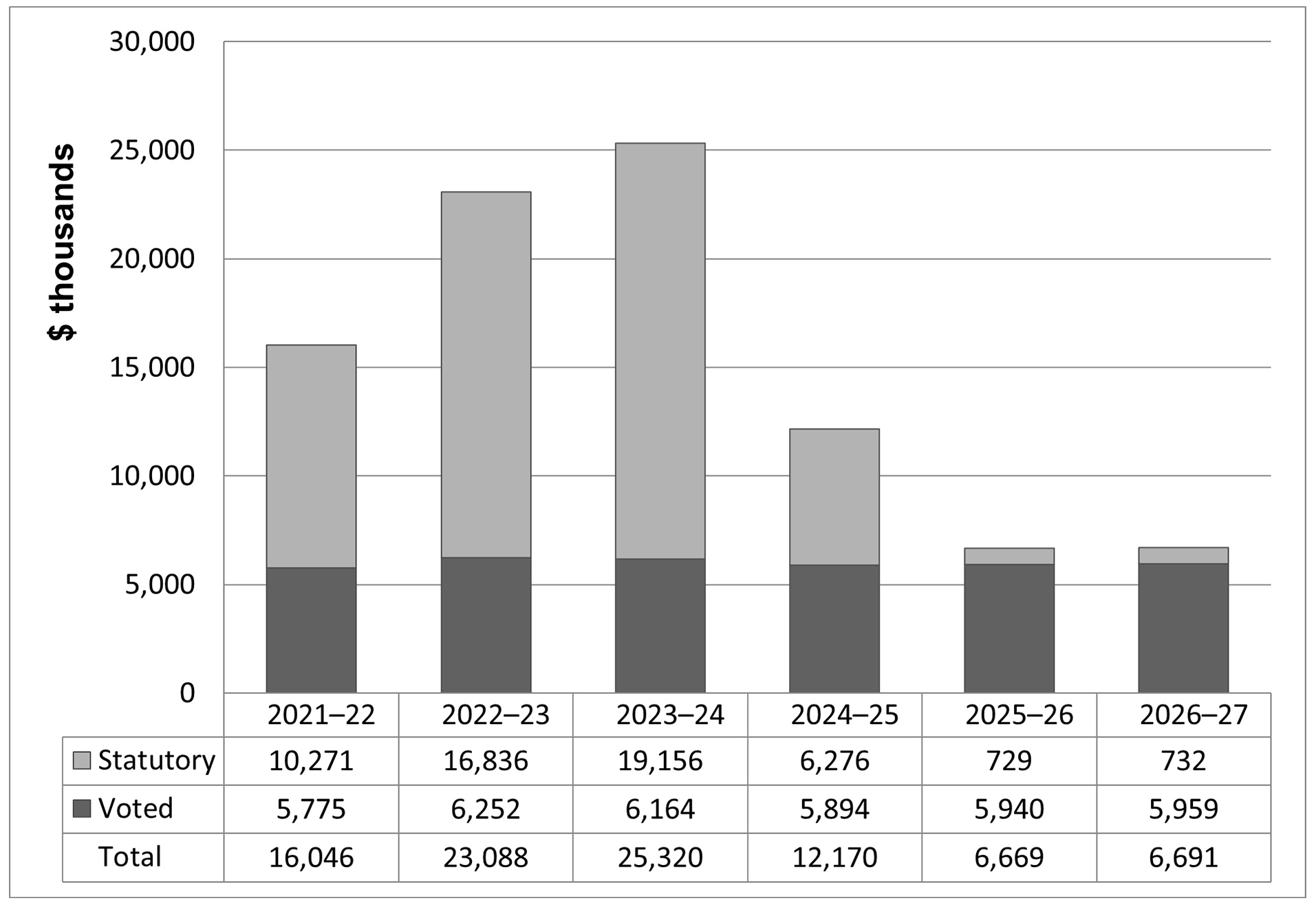
Graph 1 summarizes the department's approved voted and statutory funding from 2021-22 to 2026-27.
-
Text version of graph 1
YearStatutoryVotedTotal2021–22$10,271,000$5,775,000$16,046,0002022–23$16,836,000$6,252,000$23,088,0002023–24$19,156,000$6,164,000$25,320,0002024–25$6,276,000$5,894,000$12,170,0002025–26$729,000$5,940,000$6,669,0002026–27$732,000$5,959,000$6,691,000
Analysis of statutory and voted funding over a six-year period
The Canadian Grain Commission’s revenue is mainly based on grain volumes handled which can fluctuate from year-to-year due to external factors. Significant variances can arise between projected and actual revenues since grain handling volumes are estimated based on historical data while operational costs are relatively fixed. The Canadian Grain Commission accumulates surplus funds (shown as unused authority carried forward in Public Accounts) in years with higher-than-average grain volumes and draws down on accumulated surplus funds in years with lower-than-average grain volumes.
From fiscal year 2013-14 through 2020-21, the Canadian Grain Commission accumulated surpluses due to increases in grain production and exports. The surplus balance as of March 31, 2021, was $155.98 million. The Canadian Grain Commission updated its model for grain volume forecasting, and effective August 1, 2021, official inspection and weighing fees were reduced by 29 percent and realigned with an average grain volume forecast of 48.10 million metric tonnes.
Drought conditions across western Canada grain significantly decreased grain production yields in 2021, affecting grain exports that year and into 2022. As grain volumes continued to be lower-than-forecasted and salary costs increased due to renewed collective agreements through 2023-24, the Canadian Grain Commission used its revolving fund position to draw down on accumulated surplus to cover the revenue shortfalls.
Despite the revenue shortfall position, actual spending for the 2023-24 fiscal year remained relatively consistent to spending in 2021 through 2024. Slight expenditure increases were primarily the result of salary increases from collective agreement bargaining settlements and projects related to the Investment Framework that helped ensure the Canadian Grain Commission continued to deliver on its key areas of focus. As part of its Investment Framework, the Canadian Grain Commission allocated $4 million to fund enhancements to the Harvest Sample Program for five years. Additionally, in 2022-23 and 2023-24, the Canadian Grain Commission made modest surplus investments in the MyCGC portal, renewal of laboratory infrastructure, and other areas to strengthen research and innovation. Going forward, the Canadian Grain Commission will continue to consider investment initiatives within the broader context of the Canada Grain Act Review outcomes.
Fee revenue of approximately $68.52 million and $6.62 million Voted and Statutory appropriations will fund spending in the 2024-25 fiscal year. Planned spending for 2025-26 and forward reflects expected appropriation and fee revenue based on the current fee structure.
Currently, the Canadian Grain Commission is comprehensively reviewing its grain volumes forecast, revenues, and costs to ensure alignment with the costs of service provision. The Canadian Grain Commission is planning to communicate the outcomes of the fees review and next steps in 2024-25. Spending under the Investment Framework for 2025-26 and beyond will be re-visited and continue to consider investment initiatives within the broader context of the Canada Grain Act Review outcomes.
For further information on the Canadian Grain Commission’s departmental voted and statutory expenditures consult the Public Accounts of Canada.
Financial statement highlights
The Canadian Grain Commission’s complete financial statements (unaudited or audited) for the year ended March 31, 2024, are available online.
Table 8 Condensed Statement of Operations (unaudited or audited) for the year ended March 31, 2024 (dollars)
Table 8 summarizes the expenses and revenues for 2023–24 which net to the cost of operations before government funding and transfers.
Financial information | 2023–24 actual results | 2023–24 planned results | Difference (actual results minus planned) |
|---|---|---|---|
Total expenses | 72,925,298 | 73,155,942 | (230,644) |
Total revenues | (49,428,056) | (65,631,213) | 16,203,157 |
Net cost of operations before government funding and transfers | 23,497,242 | 7,524,729 | 15,972,513 |
The 2023–24 planned results information is provided in the Canadian Grain Commission’s Future-Oriented Statement of Operations and Notes 2023–24.
Financial information | 2023–24 actual results | 2022–23 actual results | Difference (2023-24 minus 2022-23) |
|---|---|---|---|
Total expenses | 72,925,298 | 69,818,369 | 3,106,929 |
Total revenues | (49,428,056) | (47,563,855) | (1,864,201) |
Net cost of operations before government funding and transfers | 23,497,242 | 22,254,514 | 1,242,728 |
Table 10 Condensed Statement of Financial Position (unaudited or audited) as of March 31, 2024 (dollars)
Table 10 provides a brief snapshot of the department’s liabilities (what it owes) and assets (what the department owns), which helps to indicate its ability to carry out programs and services.
Financial information | Actual fiscal year (2023–24) | Previous fiscal year (2022–23) | Difference (2023–24 minus 2022–23) |
|---|---|---|---|
Total net liabilities | 11,073,012 | 13,488,160 | (2,415,148) |
Total net financial assets | 5,644,331 | 7,552,960 | (1,908,629) |
Departmental net debt | 5,428,681 | 5,935,200 | (506,519) |
Total non-financial assets | 11,906,590 | 11,693,807 | 212,783 |
Departmental net financial position | 6,477,909 | 5,758,607 | 719,302 |
Human resources
This section presents an overview of the department’s actual and planned human resources from 2021–22 to 2026–27.
Table 11: Actual human resources for core responsibilities and internal services
Table 11 shows a summary of human resources, in full-time equivalents (FTEs), for the Canadian Grain Commission’s core responsibilities and for its internal services for the previous three fiscal years.
Core responsibilities and internal services | 2021–22 actual full-time equivalents | 2022–23 actual full-time equivalents | 2023–24 actual full-time equivalents |
|---|---|---|---|
Grain Regulation | 319 | 325 | 331 |
Internal services | 145 | 148 | 144 |
Total | 464 | 473 | 475 |
Analysis of human resources over the last three years
The increase in full-time equivalents of 464 in 2021-22 to 475 in 2023-24 is due to additional resources required to support strategic initiatives such as digital transformation and strengthening grain inspection capacity.
Table 12: Human resources planning summary for core responsibilities and internal services
Table 12 shows information on human resources, in full-time equivalents (FTEs), for each of the Canadian Grain Commission’s core responsibilities and for its internal services planned for the next three years. Human resources for the current fiscal year are forecasted based on year to date.
Core responsibilities and internal services | 2024–25 planned full-time equivalents | 2025–26 planned full-time equivalents | 2026–27 planned full-time equivalents |
|---|---|---|---|
Grain Regulation | 339 | 339 | 339 |
Internal services | 146 | 146 | 146 |
Total | 485 | 485 | 485 |
Analysis of human resources over the last three years
The planned full-time equivalents in 2024-25 to 2026-27 remains stable at 485 and incorporates a conservative amount for additional resources required to strengthen grain inspection capacity.
Corporate information
Departmental profile
Appropriate minister(s):
The Honourable Lawrence MacAulay
Institutional head:
David Hunt, Chief Commissioner
Ministerial portfolio:
Agriculture and Agri-Food
Enabling instrument(s):
Canada Grain Act
Year of incorporation / commencement:
1912
Other:
The Canadian Grain Commission’s head office is located in Winnipeg, Manitoba. The Canadian Grain Commission operates two regional offices, eight service centres and provides service at more than 30 licensed terminal elevators across Canada. A combination of revolving fund (fees) and appropriation sources fund Canadian Grain Commission programs and services. The Canadian Grain Commission plans to recover approximately 90 percent of its costs through fees and the remaining through appropriation.
Departmental contact information
Mailing address:
Canadian Grain Commission, 303 Main Street, Winnipeg, Manitoba R3C 3G8
Telephone:
204-984-0506
TTY:
1-866-317-4289
Fax:
204-983-2751
Email:
Website(s):
Supplementary information tables
The following supplementary information tables are available on the Canadian Grain Commission’s website:
Federal tax expenditures
The tax system can be used to achieve public policy objectives through the application of special measures such as low tax rates, exemptions, deductions, deferrals and credits. The Department of Finance Canada publishes cost estimates and projections for these measures each year in the Report on Federal Tax Expenditures. This report also provides detailed background information on tax expenditures, including descriptions, objectives, historical information and references to related federal spending programs as well as evaluations and GBA Plus of tax expenditures.
Definitions
List of terms
- appropriation (crédit)
- Any authority of Parliament to pay money out of the Consolidated Revenue Fund.
- budgetary expenditures (dépenses budgétaires)
- Operating and capital expenditures; transfer payments to other levels of government, departments or individuals; and payments to Crown corporations.
- core responsibility (responsabilité essentielle)
- An enduring function or role performed by a department. The intentions of the department with respect to a core responsibility are reflected in one or more related departmental results that the department seeks to contribute to or influence.
- Departmental Plan (plan ministériel)
- A report on the plans and expected performance of an appropriated department over a 3year period. Departmental Plans are usually tabled in Parliament each spring.
- departmental priority (priorité)
- A plan or project that a department has chosen to focus and report on during the planning period. Priorities represent the things that are most important or what must be done first to support the achievement of the desired departmental results.
- departmental result (résultat ministériel)
- A consequence or outcome that a department seeks to achieve. A departmental result is often outside departments’ immediate control, but it should be influenced by program-level outcomes.
- departmental result indicator (indicateur de résultat ministériel)
- A quantitative measure of progress on a departmental result.
- departmental results framework (cadre ministériel des résultats)
- A framework that connects the department’s core responsibilities to its departmental results and departmental result indicators.
- Departmental Results Report (rapport sur les résultats ministériels)
- A report on a department’s actual accomplishments against the plans, priorities and expected results set out in the corresponding Departmental Plan.
- fulltime equivalent (équivalent temps plein)
- A measure of the extent to which an employee represents a full person year charge against a departmental budget. For a particular position, the fulltime equivalent figure is the ratio of number of hours the person actually works divided by the standard number of hours set out in the person’s collective agreement.
- gender-based analysis plus (GBA Plus) (analyse comparative entre les sexes plus [ACS Plus])
- An analytical tool used to support the development of responsive and inclusive policies, programs, and other initiatives. GBA Plus is a process for understanding who is impacted by the issue or opportunity being addressed by the initiative; identifying how the initiative could be tailored to meet diverse needs of the people most impacted; and anticipating and mitigating any barriers to accessing or benefitting from the initiative. GBA Plus is an intersectional analysis that goes beyond biological (sex) and socio-cultural (gender) differences to consider other factors, such as age, disability, education, ethnicity, economic status, geography (including rurality), language, race, religion, and sexual orientation.
- government-wide priorities (priorités pangouvernementales)
- For the purpose of the 2022–23 Departmental Results Report, government-wide priorities are the high-level themes outlining the government’s agenda in the November 23, 2021, Speech from the Throne: building a healthier today and tomorrow; growing a more resilient economy; bolder climate action; fight harder for safer communities; standing up for diversity and inclusion; moving faster on the path to reconciliation; and fighting for a secure, just and equitable world.
- horizontal initiative (initiative horizontale)
- An initiative where two or more federal departments are given funding to pursue a shared outcome, often linked to a government priority.
- non‑budgetary expenditures (dépenses non budgétaires)
- Net outlays and receipts related to loans, investments and advances, which change the composition of the financial assets of the Government of Canada.
- performance (rendement)
- What a department did with its resources to achieve its results, how well those results compare to what the department intended to achieve, and how well lessons learned have been identified.
- performance indicator (indicateur de rendement)
- A qualitative or quantitative means of measuring an output or outcome, with the intention of gauging the performance of an department, program, policy or initiative respecting expected results.
- plan (plan)
- The articulation of strategic choices, which provides information on how a department intends to achieve its priorities and associated results. Generally, a plan will explain the logic behind the strategies chosen and tend to focus on actions that lead to the expected result.
- planned spending (dépenses prévues)
For Departmental Plans and Departmental Results Reports, planned spending refers to those amounts presented in Main Estimates.
A department is expected to be aware of the authorities that it has sought and received. The determination of planned spending is a departmental responsibility, and departments must be able to defend the expenditure and accrual numbers presented in their Departmental Plans and Departmental Results Reports.
- program (programme)
- Individual or groups of services, activities or combinations thereof that are managed together within the department and focus on a specific set of outputs, outcomes or service levels.
- program inventory (répertoire des programmes)
- Identifies all the department’s programs and describes how resources are organized to contribute to the department’s core responsibilities and results.
- result (résultat)
- A consequence attributed, in part, to a department, policy, program or initiative. Results are not within the control of a single department, policy, program or initiative; instead, they are within the area of the department’s influence.
- Indigenous business (enterprise autochtones)
- For the purpose of the Directive on the Management of Procurement Appendix E: Mandatory Procedures for Contracts Awarded to Indigenous Businesses and the Government of Canada’s commitment that a mandatory minimum target of 5% of the total value of contracts is awarded to Indigenous businesses, a department that meets the definition and requirements as defined by the Indigenous Business Directory.
- statutory expenditures (dépenses législatives)
- Expenditures that Parliament has approved through legislation other than appropriation acts. The legislation sets out the purpose of the expenditures and the terms and conditions under which they may be made.
- target (cible)
- A measurable performance or success level that a department, program or initiative plans to achieve within a specified time period. Targets can be either quantitative or qualitative.
- voted expenditures (dépenses votées)
- Expenditures that Parliament approves annually through an appropriation act. The vote wording becomes the governing conditions under which these expenditures may be made.