
Impact Assessment and Permitting Process
This webpage and its contents do not supersede or modify the Impact Assessment Act or its regulations. In the event of an inconsistency between the contents of this webpage and the act and/or the regulations, the act and the regulations prevail. The contents of this webpage are general guidelines only and are subject to change.
On this page
Our role
The Impact Assessment Agency of Canada’s (IAAC) role is to deliver impact assessments for major projects subject to the Impact Assessment Act in a manner that respects the rights of Indigenous Peoples, advances inter-jurisdictional cooperation, and integrates Indigenous Knowledge into the decision-making process. Project reviews consist of an integrated impact assessment process and permitting review.
We serve as the Federal Review Coordinator who works with federal permitting departments to deliver a more efficient and coordinated federal review by ensuring that reviews of permitting applications are integrated and concurrent with any federal impact assessment that applies to a project. We are also responsible for the Crown Consultation Hub to ensure a single, coordinated, Crown consultation process for each project across federal departments and agencies. This coordinated approach supports meaningful consultation and participation by Indigenous Peoples throughout the review process and helps advance efforts seeking free, prior and informed consent through consultation.
We work with and gather information from project proponents, Indigenous Peoples, federal, provincial and other experts, permitting departments, and the public, among others, to help provide a seamless, efficient regulatory process that can be completed in a timely manner.
Our coordination role enables regulatory and permitting decisions on projects to be issued no more than one year from the proponent providing the comprehensive applications and required information and studies.
A cooperative approach
To achieve the goal of "one project, one review," and to reduce duplication between federal and provincial assessment requirements, the Government has co-operation agreements with most provincial governments. We also work with Indigenous Peoples to co-operate during the assessment process in various ways. (Learn more about how we collaborate)
A transparent approach
We post information and documents related to federal impact assessments and required federal permits on the Canadian Impact Assessment Registry (the Registry). Through the Registry, we also engage with and collect comments from Indigenous Peoples and the public.
A coordinated approach
As the Federal Review Coordinator and Crown Consultation Hub, we collaborate with federal departments who issue permits, licenses and authorizations to provide a centralized coordination process for proponents and Indigenous Peoples. For example, we work to ensure that the information required from proponents to meet various laws and regulations is not duplicated, and that all information requests are clear, necessary, and proportionate to the decision being made. We also offer a "one-window" approach to Indigenous consultations. By coordinating a single, integrated process, we streamline funding access, reduce consultation fatigue, and identify and resolve issues early.
A federally focused approach
Federal impact assessment applies only to designated projects that are the most likely to have significant adverse federal effects. Examples of areas of federal jurisdiction are: fish and fish habitat, migratory birds, transboundary water pollution, effects on federal lands, and impacts on Indigenous Peoples.
The approach
The impact assessment and permitting process encourages:
- Iterative discussions and consultations with Indigenous Peoples, relevant authorities and jurisdictions and the public to identify issues and mitigation measures
- Collaboration amongst those involved in a project review to coordinate and review information requirements, including permitting information
- Meaningful consultation and cooperation with Indigenous Peoples throughout the project review process, with the objective of achieving their free, prior and informed consent where decisions may affect their rights and interests
Major Project Review Process
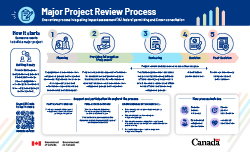
Key Milestones
The impact assessment involves:
The federal government’s work of reviewing the project and releasing a decision would take no more than one year.
Note: This page provides an overview of the process followed by IAAC when conducting an impact assessment for a major project review. Review processes led by other jurisdictions or by review panels are not presented here.
Getting Ready
As proponents are getting ready to enter the major project review process, they should engage us, Indigenous communities, permitting departments and the public as early as possible.
This is a time to design the project and its location in a way that avoids adverse effects and enhances positive effects, identify mitigation measures that could be used to reduce or avoid adverse effects of the project and identify any outstanding key issues, including any raised through early engagement with Indigenous groups, the public and permitting departments. It is also an opportunity to identify additional information or studies that would need to be collected, notably to address key issues, and to gather baseline data needed for the upcoming impact assessment and permitting reviews by using resources like:
Early engagement with Indigenous communities helps identify potential impacts on rights, interests, culture, use of lands and resources, and opportunities for project changes, accommodation measures, and partnership approaches that may address concerns and support consensus-building.
This early preparation enables a more efficient, meaningful and predictable project review. It also allows IAAC to begin consultation with Indigenous groups at the earliest opportunity.
Planning
The impact assessment process officially begins when the proponent provides us an Initial Project Description, and the Planning stage starts when we post the proponent’s Project Description on the Registry and launch a public comment period. We continue consultation with Indigenous groups and collaborate with permitting departments to gather and verify the issues raised when the proponent was getting ready for the assessment by reviewing the comments we receive from this comment period. We then prepare a Summary of Issues and provide it to the proponent who will in turn respond.
Using this information, we, in collaboration with permitting departments, evaluate the potential adverse federal effects of the project. We also consider if there are any other regulatory processes, including those led by the province or Indigenous governing bodies, that may be able to address these effects. With this in mind, we decide whether a federal impact assessment is required.
If it is required, we continue working with the proponent, federal departments and Indigenous communities to establish the requirements and processes for the upcoming impact assessment and major project review. Depending on how the assessment will be carried out, this may include preparing planning documents such as:
- Tailored Information and Studies Guidelines, which may include permitting requirements
- Detailed Permitting Plan
- Indigenous Engagement and Partnership Plan
- Cooperation Plan
These documents are used to guide the impact assessment and permitting review. Planning ends when we announce the start of the assessment and permitting review period.
While IAAC leads most federal impact assessments, other jurisdictions or independent review panels may carry out the assessment. For example, during the Planning stage, provincial and/or Indigenous jurisdictions may request that all or part of the federal assessment be substituted with another assessment process that would address federal requirements. Where substitution is approved, IAAC works with the jurisdiction and federal authorities to ensure federal decision-making requirements can be met.
Summary of key steps
- Project Description is accepted by IAAC
- Comment period on key issues is launched
- IAAC prepares a Summary of Issues
- Proponent responds to Summary of Issues
- IAAC determines if an impact assessment is required
- Process for assessment is established, and may include key planning documents for impact assessment and permitting review issued to the proponent
Providing Information (Proponent)
The proponent collects the required information and studies as laid out by the Tailored Information and Studies Guidelines and the Detailed Permitting Plan developed with permitting departments. This information supports the impact assessment and comprehensive application(s) for permits and associated consultations. IAAC and permitting departments review the information as it is iteratively submitted by the proponent.
As information is submitted by the proponent, IAAC, permitting departments and the proponent conduct on-going consultations and engagement with Indigenous groups and the public to identify and address issues and concerns.
Summary of key steps
- Proponent submits the required information and studies, and any applicable comprehensive application(s)
- IAAC, permitting departments and proponent consult and engage Indigenous groups and the public
Reviewing (Government)
Once we have all the required information and studies from the proponent, a notice of completeness is published. IAAC consults with Indigenous groups and relevant experts, including those across permitting departments, and analyzes the information to determine the likely adverse federal effects of the project and the extent to which they are significant. The Impact Assessment Report sets out the effects that are likely to be caused by the carrying out of the designated project. This can be done jointly with a jurisdiction like a province, to ensure one common report for all decision makers. Notably the Impact Assessment Report:
- considers the information gathered throughout the process, including community and Indigenous Knowledge, as well as comments and input from Indigenous groups, the public, relevant jurisdictions, experts, federal and provincial authorities and stakeholders
- assesses the adverse federal effects of the project and the extent to which they are likely to be significant, including impacts on Indigenous Peoples and their rights
- documents and considers issues raised by Indigenous Peoples, as well as efforts undertaken throughout the process to address concerns and seek agreement
- proposes recommended mitigation measures, including measures to avoid, minimize, restore and offset adverse federal effects and impacts on Indigenous rights
- proposes recommended follow-up program measures to verify the accuracy of the impact assessment and determine the effectiveness of mitigation measures
To prepare the report, we hold a comment period where Indigenous Peoples, the public, federal government experts, and other jurisdictions (e.g., provinces, if the report is not already joint) have an opportunity to review the draft version and provide feedback. We also prepare, notably in consultation with Indigenous Peoples and other government departments, potential legally binding conditions.
Summary of key steps
- Federal permitting departments and IAAC determine they have received any applicable comprehensive application(s) and required information and studies, respectively
- IAAC develops a draft Impact Assessment Report
- Public comment period on draft Impact Assessment Report
- IAAC submits a final Impact Assessment Report and potential legally binding conditions to the Minister of Environment
Decision
The Minister of the Environment, or the Governor in Council (GIC) on the Minister’s referral, determines whether the project is likely to cause significant adverse federal effects and the extent to which those effects are significant, after considering mitigation measures. If adverse federal effects are likely to be significant to some extent, the Minister, or GIC, must also determine whether they are justified in the public interest when considering the benefits the project may provide. In making a decision, the Minister or Governor in Council considers the Impact Assessment Report, including impacts on Indigenous Peoples and their rights, the results of Crown consultation, Indigenous Knowledge provided during the process, and the measures taken to avoid, mitigate or accommodate potential adverse impacts. The proponent receives the Decision Statement which includes legally binding conditions if the Government determines the project is in the public’s interest. This decision is posted to the Registry. As soon as possible after this decision, permitting departments will share their decisions with the proponent.
Post-Decision (On-going)
IAAC along with federal permitting departments monitor project development to ensure the proponent complies with the conditions set in the Decision Statement and all permits.
The Decision Statement is a legally binding document. IAAC tracks and reports on the follow-up activities set out in this document to determine whether:
- the project’s impacts were accurately predicted
- the required conditions and follow-up measures are implemented
- the conditions effectively prevent or reduce adverse federal effects
- the proponent complies with the Impact Assessment Act and regulations
If we find the proponent non-compliant, that is a violation of federal law, and we can take enforcement action.
Any non-compliance with the decision or conditions relating to permits is also a violation of federal law and enforcement action can be taken by the responsible permitting department.
How to participate
Meaningful engagement and consultation with Indigenous Peoples and the public are integral to the impact assessment process. We provide opportunities to submit comments and attend information sessions and hearings. Learn how to participate in assessments.
Did you know? IAAC’s Participant Funding Program provides financial assistance to support assessment and permit-related public engagement and Indigenous consultation. Funding applications are generally open during planning and assessment activities.
Accessing details about assessments
Information and documents related to impact assessments are publicly available through the Canadian Impact Assessment Registry. Subscribe to the Registry’s notification service for up-to-date information and announcements on project assessments.