
Keeping the water flowing during dam reconstruction
The Trent-Severn Waterway National Historic Site is 386 kilometres long and links Lake Ontario with Georgian Bay. Along its length, there are 44 locks and 130 dams for which Parks Canada is responsible. The management of the Waterway includes an intense maintenance, repair and reconstruction program to ensure user safety.
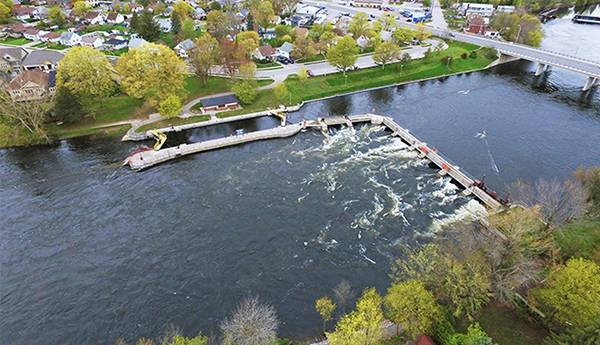
In 2016, engineering inspections found that the Scotts Mills Dam at Lock 19 in Peterborough, built between 1904 and 1906, was nearing the end of its serviceable life. "There were structural concerns about the 119-year-old dam. Engineers noticed cracks and breaks in the concrete, as well as erosion of the river bed below the dam. So it had to be replaced," explains Arun Singh, Senior Project Manager at Public Services and Procurement Canada (PSPC). Singh led a PSPC team that supported Parks Canada with the complex project to build a new dam at this site.
Locks and dams
The Waterway is a constructed system of dams and locks. The dams hold back water between them to maintain water depth for boats to travel between locks. The locks act like stairs that allow boats to move back and forth through the Waterway.
The dam replacement process
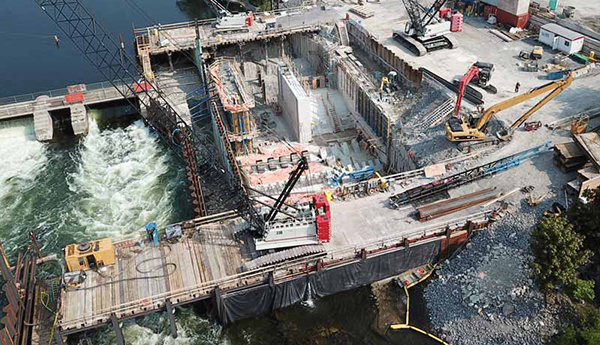
The construction work to replace the dam started in 2019 and it was challenging. First, there was no direct access to the dam from any roadway. As a result, Parks Canada bought 4 houses on the east side of the dam and used the newly purchased area as the main construction access point and to store equipment and supplies. The rebuilding of the dam also had to be completed in 4 phases, "ensuring that water could continue to flow past the dam while the section where the work was being done stayed dry," says Keng Wong, Project Manager at PSPC.
Before and after
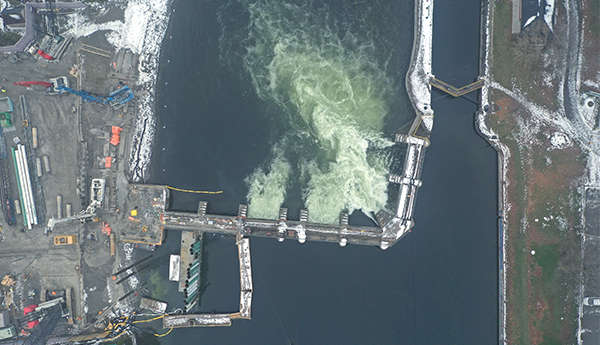
The original dam at Scotts Mills Lockstation had 7 large sluices and 1 small one. The sluices are the openings in the dam for the water to flow through. 2 of the sluices at this site were perpendicular. Patrick Thompson, Project Manager at Parks Canada, explains that this original design was not the best. "Water naturally flows better in the direction of the river. The 2 sluices on an angle don't have very good hydraulics, because the water has to bend around the corner of the dam and therefore loses speed and pressure."
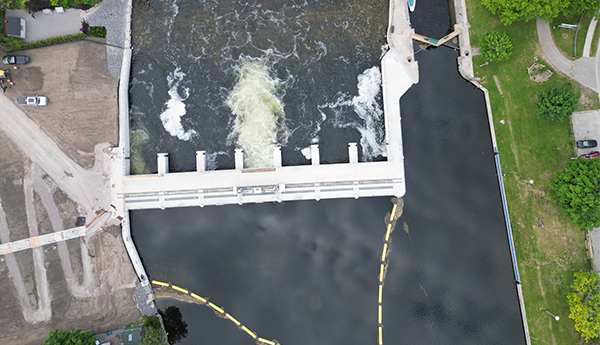
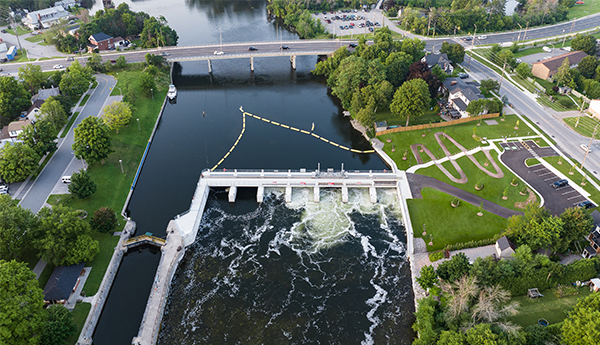
The new dam has the same look and feel as its predecessor, without the bend. The design improves water flow and provides better access for maintenance. It also makes it easier to manage water levels. This is particularly important during the spring thaw and severe rainstorm events that bring higher water volumes into the Waterway. Being able to manage water levels quickly and effectively is key to preventing flooding of nearby properties.
Project completion
The partnership between Parks Canada and PSPC was a success, and the project was completed, with landscaping, in 2023. The new dam will have a life expectancy of more than 80 years.
Thompson explains that the rebuilding of the dam has led to other improvements. "Lock 19 is now a more public-friendly lock site. Visitors' parking on the east side was constructed with electric car charging stations, as part of the Parks Canada greening strategy. Meanwhile, an accessible pathway was added so visitors can view the dam and lock at Scotts Mills, and there is pedestrian access to get onto the dam itself."
Learn more about the Trent-Severn Waterway National Historic Site and Lock 19 - Scotts Mills. For other interesting articles about PSPC people and projects, visit Our stories.