
Statement of Investment Policy for the Government of Canada (August 2026)
1. Purpose of Policy
The Statement of Investment Policy for the Government of Canada (SIP) sets out the policy governing the acquisition, management, and divestiture of assets held in the Exchange Fund Account (EFA). The Minister of Finance (Minister) establishes the SIP under the Currency Act. These policies will be followed to manage the EFA in normal times, while helping to ensure that it is prepared to meet its legislated purposes during a stress period.
2. Purposes of Exchange Fund Account
The EFA is the principal repository of Canada's official international reserves. As stated in the Currency Act, the purposes are
- to aid in the control and protection of the external value of the monetary unit of Canada; and
- to provide a source of liquidity for the Government of Canada.
EFA assets shall be managed to promote orderly conditions for the Canadian dollar in the foreign exchange markets, if required. As they are a key component of the Government of Canada' s (government) prudential liquidity plan (PLP), EFA assets shall be managed to provide liquidity to the government to meet financial requirements when normal access to funding markets may be disrupted.
The EFA also facilitates government transactions with the International Monetary Fund (IMF) under the IMF Articles of Agreement. These transactions include the provision of freely usable currencies to the IMF, through the purchase and sale of special drawing rights, as well as various transactions relating to Canada's reserve position in the IMF (which does not form part of the EFA).
3. Investment Objectives
Consistent with the EFA purposes, the primary objectives for the management of the EFA are to maintain liquidity and preserve capital. The EFA therefore holds assets that can be quickly sold or deployed with minimal market impact and loss of value. It also holds a diversified portfolio of high-credit quality fixed-income assets and follows sound risk management practices (outlined in Section 5) to align with the EFA's purposes and to protect the interests of Canadians. Once the liquidity and capital preservation objectives are met, the EFA is managed to optimize returns.
4. Governance & Investment Process
Part II of the Currency Act governs the management of the EFA and allows the Minister to establish an investment policy for EFA assets. The Minister may delegate the responsibility for the implementation of the approved policy (i.e. this document) to officials of the Department of Finance Canada (Finance Canada). The Bank of Canada Act provides statutory authority for the Bank of Canada (Bank) to act as the government's fiscal agent in the management of the EFA.
The SIP was developed on the basis of principles that a person of ordinary prudence would apply in dealing with the property of others. Delegated officials are expected to implement the SIP on this same basis.
Within the Minister's delegated authorities, the Funds Management Committee (FMC) has policy responsibility for all activities covering the government's financial asset and liability functions, including preparing recommendations for the Minister and overseeing the management of the EFA. The FMC is composed of senior officials from the Department of Finance Canada and the Bank of Canada (together, "EFA officials") and is supported by the Foreign Reserves Committee (FRC) and the Risk Committee (RC) (see Figure 1).
The Ministerial Risk Limits specified under section 6 of this Statement of Investment Policy are inapplicable in circumstances where transactions are conducted to: (i) promote orderly conditions for the Canadian dollar in the foreign exchange markets; (ii) provide liquidity to the government; or (iii) address other similar circumstances.
Committee's accountability and composition specific to the EFA
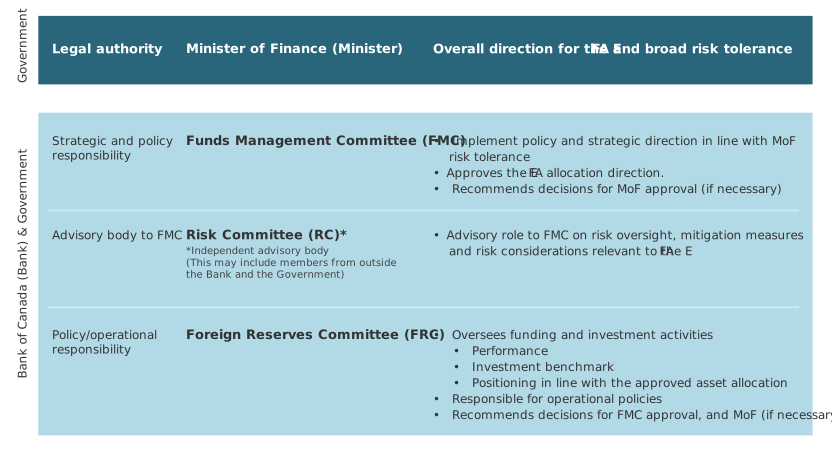
The EFA is governed by a framework that includes a formalized, top-down investment management structure that provides clarity on roles, decision-making authority, and accountability to facilitate the achievement of the EFA's objectives. The Minister establishes specific risk tolerances for the portfolio through approvals of the Ministerial Limits (Section 6). The FMC guides the risk preference and asset allocation within Ministerial limits for the portfolio (sections 5.2.1 and 5.2.2). The FRC establishes a benchmark that details asset allocations to securities deemed eligible for investment.
5. Risk Management
The Minister establishes the broad risk categories for the portfolio to be monitored and managed, which are classified as strategic, financial, and operational.
5.1. Strategic risks
Department of Finance Canada and Bank of Canada officials aim to minimize the following risks in this area.
- Trust and credibility: The risk that internal actions and/or external forces lead to diminished public perception and market confidence in the government and the Bank's ability to manage the EFA in line with its mandate.
- Governance: The risk that inadequate governance frameworks, structures, policies and decision-making mechanisms may not effectively support the EFA's mandate and strategic objectives, and compliance with relevant laws.
- Legislation and government policies : The risk of misalignment between the EFA and the broader goals of the government, its international commitments as well as global regulatory initiatives.
5.2. Financial risks
Financial risks are comprised of liquidity, credit, and market risks.
5.2.1 Liquidity risk
Definition: The risk of insufficient asset and funding liquidity to meet the purposes of the EFA.
- Asset liquidity: Ability to sell assets at fair value within a reasonable time window during stress due to market disruption.
- Funding liquidity: Ability for the EFA to meet financial obligations when these come due, and ability to raise additional funding.
To account for the liquidity objectives, the EFA has a liquidity framework which ensures that the asset allocation reflects each asset's expected liquidity properties under stress scenarios and how this will lead to the EFA meeting its objectives.
5.2.2. Credit risk
Definition: The risk of potential for loss due to the failure of one or more EFA counterparties to meet their financial obligations in accordance with agreed-upon terms.
To account for the capital preservation objective of the EFA, it also categorizes assets based on their credit risk component as:
- Reference issuers and BIS callable deposits: These are sovereign issuers of securities that are deemed by Canada to have reserve currency status and are actively traded, cash, or callable deposits at the Bank for International Settlements (BIS).
- High-credit quality issuers: These issuers are deemed by Canada to be of high credit quality.
- Other issuers: These are other high credit quality sovereigns and other entities that meet Canada's liquidity and capital preservation requirements.
5.2.3 Market risk
Definition: The risk that fluctuations in foreign exchange rates (FX), interest rates (IR), and/or spreads may lead to adverse changes in the market value of assets and/or liabilities.
5.3. Operational risk
Definition: The risk that issues related to technology, process, people, legal, or other operational processes associated with managing the portfolio may result in financial costs and/or operational disruptions, which could affect the EFA's ability to meet its mandate.
6. Ministerial Risk Limits
The SIP outlines specific risk limits set under the Minister's authority, which are consistent with their risk tolerance.
Level of liquid foreign reservesFootnote 1
The total market value of all foreign currency-denominated investments in the EFA must be maintained at or above 3 per cent of Canada's annual nominal gross domestic product.
Eligible assets
Liquid foreign reserves should be readily available to be sold or otherwise deployed with limited price impact to meet the FX and PLP needs.
- Eligible assets include fixed-income securities issued by sovereigns (including central banks and government-related entities), sovereign-supported issuers, sub-sovereign entitiesFootnote 2 , and supranational institutions.
- Eligible assets also include deposits with commercial banks, central banks and the Bank for International Settlements, repurchase agreements, commercial paper and certificates of deposit issued by private sector entities, gold and IMF special drawing rights. Bonds with embedded options, and holdings of securities issued by and deposits with Canadian-domiciled entities (or entities that derive most of their revenues from their Canadian operations), are not permitted.
- All other classes of assets not listed in this appendix are prohibited.
Eligible currencies
There are four eligible currencies for investment, including the US dollar, Euro, British pound and Japanese yen, which contributes to meeting liquidity requirements and helps with currency diversification.
Assets can also be denominated in the International Monetary Fund (IMF) special drawing rights (SDRs).
Liquid asset holding minimums
At least 50 per cent of liquid foreign reserves, measured on a market-value basis, must be denominated in US dollars.
At least 6 per cent of foreign reserves on a market-value basis must comprise US Treasury bills, cash (in all foreign currencies), and callable deposits at the Bank for International Settlement (BIS). The EFA is managed to exceed the 6 per cent minimum, reflecting a bias toward maintaining a stronger liquidity profile in line with its objectives.
Maximum term to maturity
To mitigate duration risk and to preserve the capital value of assets, the maximum term to maturity of individual assets held in the EFA is 10.5 years.
Minimum credit rating for eligible asset issuers and counterparties
The minimum credit ratings are based on external and internal credit rating analysis.
- All eligible issuers must be deemed by Canada to have a credit rating of "A-" or higher.
- If an eligible issuer falls below A-, internal policies are in place to outline the appropriate steps for the held securities.
- However, sovereign securities that are deemed as benchmark status, i.e., primary issuer in their local currency (USD, EUR, GBP or Yen), are exempt from the minimum credit rating requirement.
- Counterparties for deposits, certificates of deposit, commercial paper and repurchase agreements must be deemed by Canada to have a credit rating of "A-" or higher.
- Counterparties for swaps must be deemed by Canada to have a credit rating of "BBB" or higher.
- Counterparties for delivery-versus-payment must be deemed by Canada to have a credit rating of "BBB-" or higher.
- The only allowable unrated investments are the following:
- securities issued by, and deposits with, central banks where the sovereign's credit quality is acceptable; and
- special drawing rights created by the International Monetary Fund.
7. Alignment of EFA Activities with Government of Canda Policy Priorities
The EFA is managed based on the principles of fiscal prudence, financial stability and transparency (see section 9.2), while maintaining a long-term investment horizon.
7.1 Fiscal prudence: Asset-Liability Matching (ALM) framework
The EFA is an account on the government's balance sheet. To recognize the importance of fiscal prudence and the sustainability in public finances, the EFA is managed cost-effectively under an asset-liability matching (ALM) framework. This means matching the market value of assets and liabilities to the extent possible by currency, term and/or duration, to mitigate interest rate and foreign exchange risks, and hence fiscal volatility, on the government's fiscal position. An ALM framework also means that credit risks are not offset and are therefore addressed by other means (section 5.2.2).
7.2 Financial stability
The EFA is an account that supports Canada's preparedness for financial contingencies. To support global and domestic financial stability, Canada will consider international commitments and global regulatory initiatives.
8. Securities Lending and Use of Derivatives
To meet the EFA's objectives, officials may acquire or borrow assets, sell or lend those assets, and undertake related activities (e.g., swaps). Short sales are prohibited.
Derivatives and related activities may be undertaken only in ways that align with the EFA's objectives, as well as with the Minister's and the FMC's respective risk tolerances.
9. Review And Reporting
9.1. SIP review
The SIP shall be reviewed regularly. Any amendments to the SIP require the approval of the Minister.
9.2 Transparency: Public reporting
The Currency Act requires annual reporting to Parliament on the EFA, including on whether the objectives of the EFA have been met. This is accomplished through the annual reporting of the EFA's performance in the Report on the Management of Canada's Official International Reserves. The Minister also provides monthly updates on the level, composition and performance of the EFA, in adherence with the IMF's Special Data Dissemination Standard Plus.
The Financial Administration Act requires annual reporting to Parliament on the funding associated with the investments.
9.3. Performance assessment and risk management reporting
Bank and Finance Canada officials are responsible for measuring and monitoring the performance and risk exposures of the EFA and providing regular reports to senior officials and the Minister.
Performance and risk measures are consistent with leading practices and provide timely and accurate information on the assets' returns, the cost of associated liabilities and the relevant financial risks.
9.3.1. Credit and market risk reporting
Metrics such as Value at Risk, which measure the maximum potential loss the portfolio could suffer over a given period at a given confidence level, shall be monitored by senior officials to ensure the potential negative impacts of credit and market risk are managed within acceptable levels.
9.4. Commercial confidentiality
Notwithstanding the requirement to provide timely and comprehensive information on the EFA to Canadians, the names of individual counterparties or the securities held in the EFA shall not be disclosed for reasons of financial stability and commercial confidentiality.