
Northern Operational Support Hubs enables the projection and sustainment of military forces in the Arctic
December 10, 2025 - Defence Stories
Estimated read time – 2:30
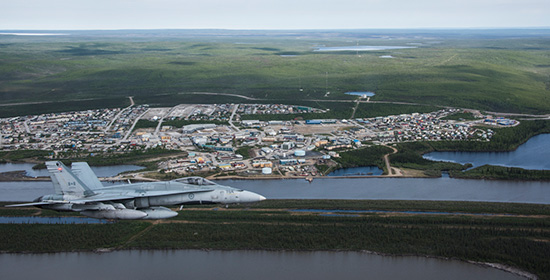
Caption
A CF-188 Hornet fighter jet flies north of Inuvik, Northwest Territories during Exercise AMALGAM DART 15-2 on May 29, 2015.
Photo: Corporal Arthur Ark
The defence of Canada and assertion of sovereignty are high priorities of the Government of Canada, and the Arctic and northern regions are seen as being vital to both. This is why a network of Northern Operational Support Hubs (NOSH) is being established to enable greater CAF presence and responsiveness across northern regions through the provision of infrastructure and logistical support.
The NOSH Program is a major infrastructure enterprise projected to take 10 to 20 years to complete at a cost of $2.67 billion. At full operational capability (FOC) it will form a dispersed network of logistical stations comprised of several principal NOSH sites and secondary Northern Operational Support Nodes (NOSN) connected by one or more transportation spokes.
“These sites will be either purpose-built or may utilize repurposed infrastructure where available.” said Mr. Jean-Marc Doucet, NOSH Program Director. “Where feasible, NOSH sites will also be able to support other federal departments and agencies operating in the region, as well as territorial, provincial, and municipal governments as part of a whole-of-government approach to ensuring a safe, secure, and well-defended Arctic and northern Canada.”
Sites designated as NOSN may be permanent or relocatable. At a minimum, NOSN sites will be capable of acting as a forward operating base (FOB) to a sub-unit-sized Joint Task Force (JTF) or detached element for a minimum of 30 days.
“Categorization of each site as either a NOSH or NOSN will be based upon the inherent operational support capacity, the capabilities and capacity of key enabling civilian infrastructure in proximity to each site, and the potential availability of commercial support and service solutions,” said LCol Rob Thompson, NOSH Sustainment Plans Officer.
The NOSH team is currently focused on engagements with Indigenous partners and northern communities, regional governments, and federal departments and agencies operating in the region to determine where shared aims exist with CAF operational requirements. The siting process is expected to start fall/winter 2025 which will entail site visits, environmental assessments, and regulation review — steps necessary before construction or repurposing of existing infrastructure can commence. Other sites will be identified once all military requirements have been determined.
Supporting CAF operations is the priority of NOSH, but with the aim of providing lasting benefit to the communities in which it maintains a physical presence. Primary benefits realized through NOSH investment in dual-use capabilities will be both operationally essential and offer enduring community utility, such as airports, seaports, medical capacity, and alternative power generation being areas for consideration.
“DND/CAF has a role to play in whole-of-society emergency preparedness while delivering on our core mission to defend Canada, including the Arctic and northern regions in partnership with NORAD, NATO, and other international allies and assisting in the safety of Canadian citizens through the provision of support during domestic disasters or major emergencies, and through the conduct of Search and Rescue (SAR) operations,” said LCol Thompson.
The establishment of NOSH and NOSN sites will, for the first time, provide a purposed matrix of operational support facilities across the Arctic and northern regions of Canada. This foundational backbone of operational support infrastructure will underpin the CAF’s ability to respond to crisis with increased speed and then sustain and support these operations for extended periods.