
Training the next generation of Military Legal Advisors
February 24 2026 - Defence Stories
Estimated read time: 2:01

Caption
Group photo of candidates and course staff who participated in Ex ABLE ADVOCATE 2025. Photo: Kristy Murphy, Photographic Supervisor, Canadian Forces Base Kingston
The Canadian Forces Military Law Centre (CFMLC) continues to shape the next generation of military legal advisors through its Basic Legal Officer Course (BLOC), held annually at Canadian Forces Base Kingston. This intensive program is a cornerstone in the professional development of legal officers within the Canadian Armed Forces (CAF), equipping them with the legal skills and knowledge required to navigate the unique complexities of military law.
BLOC is designed and delivered by CFMLC, and forms part of a broader legal education strategy that includes the Intermediate Law of Armed Conflict (ILOAC) course and the Military Justice at the Unit Level course. Legal officers are trained to provide critical legal advice on military law, including international humanitarian law, military justice, and administrative law, both domestically and abroad.
Lieutenant-Colonel Philippe Doucet, Director of CFMLC, noted, “Our goal is to ensure legal officers are not only technically skilled but also operationally aware. They need to understand deployed environments, experience them, and learn how to provide clear legal advice in different operational contexts where clarity is essential to mission success.”
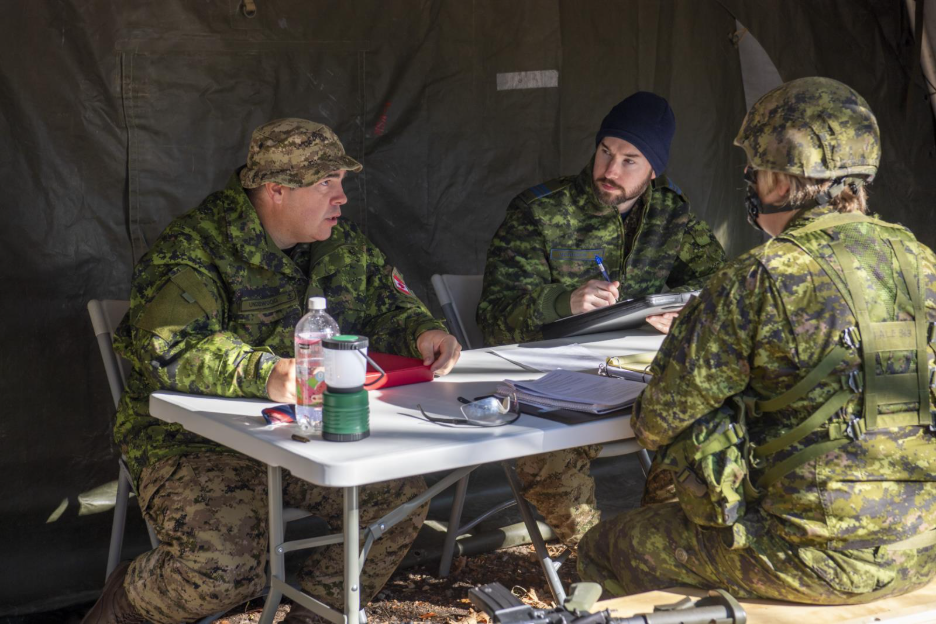
Caption
A legal officer provides legal advice to the fictional multinational task force during one of the legal scenarios during Ex ABLE ADVOCATE 2025. Photo: S1 Elijah Mairs, Imagery Technician, Royal Military College of Canada.
Ex ABLE ADVOCATE: Culminating challenge
The course concluded with Ex ABLE ADVOCATE, a capstone field exercise designed to test participants in a high-pressure operational environment. Legal officers were embedded within a fictional multinational task force deployed overseas and tasked with providing real-time legal advice to commanders and staff.
“Ex ABLE ADVOCATE is one of the ways we test the candidate’s ability to deliver options oriented and operationally driven legal advice regarding the entirety of military law,” said Major Patrick Cashin, Exercise Commander. “It requires our candidates to apply legal principles in a simulated deployed setting, ensuring that they can serve as key advisors to command teams both within Canada and abroad.”
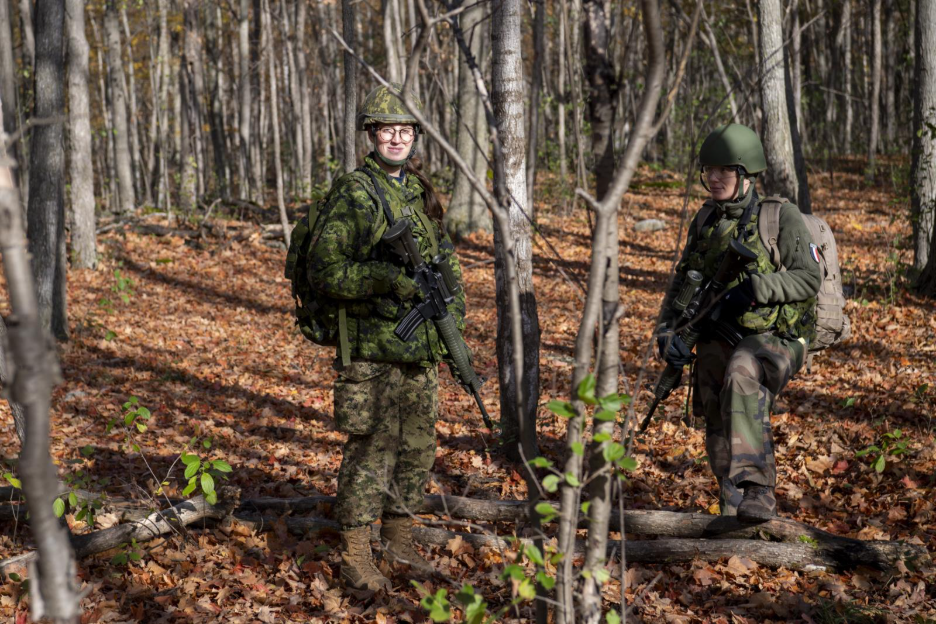
Caption
Two legal officers standing guard during one of the legal scenarios during Ex ABLE ADVOCATE 2025. Photo: S1 Elijah Mairs, Imagery Technician, Royal Military College of Canada.
Strengthening Allied partnerships
A hallmark of this course is its collaborative dimension. This year, like previous years, CFMLC welcomed legal officers from Allied nations, including participants from France, the United Kingdom, New Zealand and Latvia, fostering interoperability and mutual understanding across legal systems. This international engagement was further reinforced through joint training exercises and legal exchanges, highlighting Canada’s commitment to coalition operations and defence diplomacy.
For many international candidates, the experience was not only professionally enriching but strategically vital. The opportunity to train alongside Canadian and Allied legal officers fostered a deeper shared understanding of operational law and enhanced the ability to work effectively in multinational environments. International participants emphasized the importance of this kind of collaboration, noting that shared training experiences build trust and legal interoperability—key ingredients for successful coalition operations. The course provided a platform to explore both commonalities and differences in legal frameworks, preparing legal advisors to navigate the complexities of joint missions with confidence and cohesion.
Looking ahead
As global security challenges evolve, the CFMLC remains at the forefront of military legal education. Through its rigorous training programs and international partnerships, it ensures that CAF legal officers are prepared to uphold the rule of law in every theatre of operation.