
Capt Janes to become first graduate of Critical Care Nursing Officer–Certified Clinical Anesthesia Assistant program
May 14, 2026 – Defence Stories
Estimated read time – 2:12
By: LCdr Shelly Maynard, Senior Practice Leader, Critical Care Nursing Officer-Anesthesia Assistant (CCNO–AA)
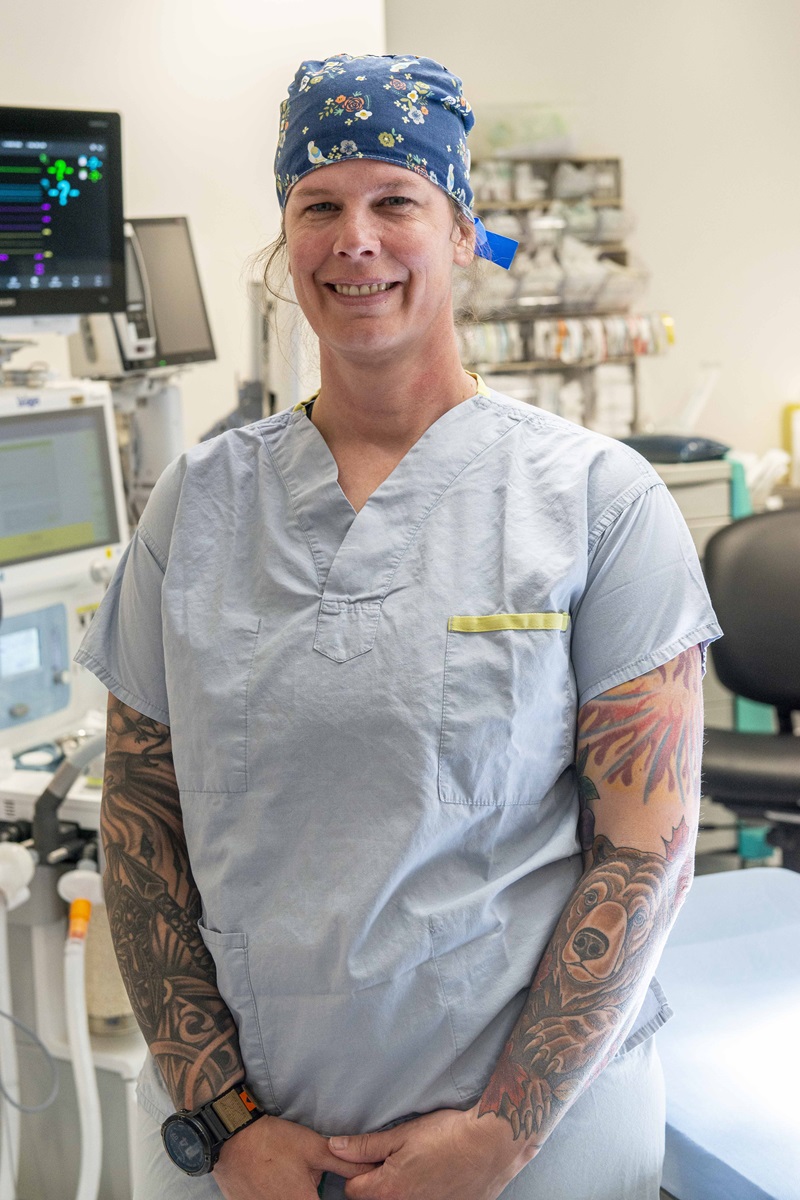
Caption
Captain Stephanie Janes pictured wearing nursing scrubs in an operating room.
Before joining the Canadian Armed Forces (CAF) in 2021, Captain Stephanie Janes spent 15 years building her career as a civilian registered nurse (RN). Capt Janes left the civilian sector during the COVID-19 pandemic in search of broader opportunities and training in addition to bedside nursing. While working in a very busy emergency department during the pandemic, she felt ready for a different challenge, and professional opportunities that are not typically available in the civilian system. Now, as she prepares to become the first graduate of the Canadian Forces Health Services (CFHS) Critical Care Nursing Officer–Certified Clinical Anesthesia Assistant (CCNO–AA) program, Capt Janes’ journey highlights both a major personal milestone and a key advancement in CFHS’s team-based anesthesia capability.
Room for improvement
In 2019, CFHS identified a longstanding gap: the current anesthesia health model lacked a formally recognized anesthesia assistant provider. In Canada and across NATO partners, anesthesia care commonly uses team-based models that include anesthesia assistants or equivalent enhanced-scope roles to increase capacity while optimizing patient care. In 2024, CFHS launched the CCNO-AA program to fill this gap.
CCNO-AA qualification – what does it mean?
The CCNO–AA qualification means critical care nurses have additional anesthesia education and certification as licensed health professionals. Working directly under anesthetist supervision and enabled through medical directives, AAs participate in general, regional, and procedural-sedation anesthesia and across the continuum—from preoperative assessment and preparation, through intraoperative support and physiologic monitoring, to recovery and critical care handover. This capability strengthens the surgical team by improving flexibility, workload sharing, and continuity of care, while helping deliver safer, more efficient care for patients.
Capt Janes’ path to becoming a CCNO-AA
For Capt Janes, becoming a CCNO-AA is a natural step in a career built upon critical care and surgical medicine. Her 15-year career as a civilian RN gave her an extensive range of experience in the operating room, pediatric ICU, post anesthesia care, and emergency care.
After joining the CAF as a Nursing Officer in 2021, Capt Janes was posted to 1 Canadian Field Hospital’s High Readiness Detachment in Edmonton where she completed CCNO specialization. Through ongoing clinical practice and collective training, Capt Janes played a key role in strengthening unit readiness and supporting team excellence. In December 2023, these efforts were formally recognized when Capt Janes received the 1 Canadian Field Hospital Lieutenant Jean Baptiste Arthur Brillant, V.C., M.C. Award for leadership and devotion to duty.
The CCNO–AA program offered Capt Janes an opportunity to formalize and expand her surgical skills while bringing her critical care vigilance into anesthesia support roles where teams are small and timelines are short.
Delivering numerous benefits
For CFHS, the CCNO-AA sub-specialty is a force multiplier. Adding CCNO–AAs creates anesthesia teams that support sustained tempo by enabling safe monitoring, parallel tasking, and continuity of care while strengthening interoperability with allied medical teams and aligning CFHS practice with civilian care models.
Capt Janes’ graduation marks an important milestone for CFHS. As CCNO-AAs are integrated into planning, force generation, and doctrine, CFHS will be better positioned to sustain surgical and resuscitative care on domestic and expeditionary operations.
To learn more about the CCNO-AA sub-specialty, please visit: Critical Care Nursing Officer – Training – Entry plan.