
Flying under pressure: How Canadian Armed Forces pilots stay cool under stress
June 17, 2026 – Defence Stories
Estimated read time – 1:53
Caption
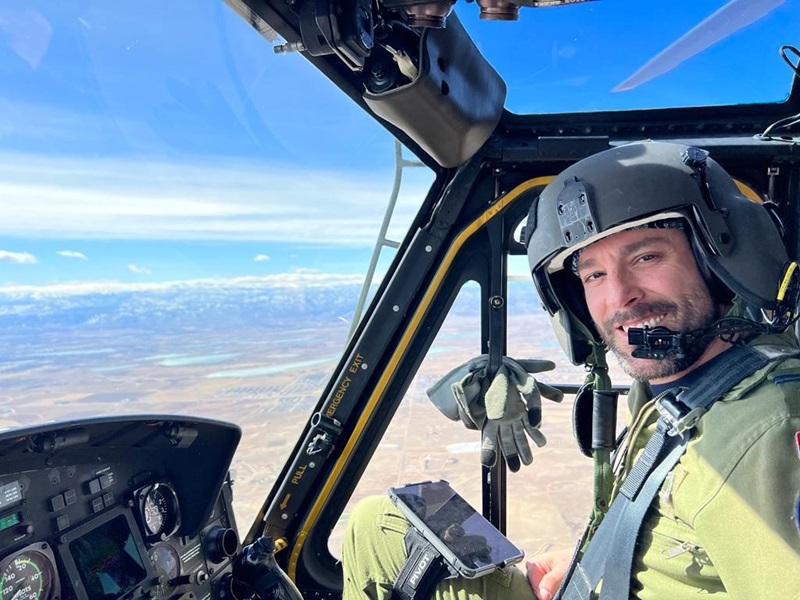
Capt Corey O’Neill flying over South Dakota, United States in 2024. He was on a United States cross country trip with a student.
Photo provided by Capt Corey O’Neill.
Canadian Armed Forces (CAF) pilots train to manoeuvre aircrafts in high-stress situations. A recent example: the Manitoba Wildfires.
In June 2025, three helicopters, six air crew members, and one liaison officer spent four days evacuating civilians in Northern Manitoba. These efforts came after devastating wildfires erupted across the province. Among others, the instructors from 3 Canadian Forces Flying Training School were called to help with evacuations as part of Operation LENTUS.
However, this wasn’t anything new for Captain (Capt) Corey O’Neill.
“We showed up to work like it was any other day. We were asked to pack a bag, go north, and start evacuating people.”
Capt O’Neill is a rotary wing pilot instructor at the training school in Southport, Man. A longtime maritime helicopter pilot, he is used to working in or over the water.
Along with preparation and communication, mental readiness practices allowed him to perform in a high-stress environment. He said it’s important to teach others these practices.
The Road to Mental Readiness (R2MR) program educates CAF members on ways to stay resilient and achieve high performance during their work. Besides implementing these practices in his teaching, Capt O’Neill works as a facilitator for the Performance Readiness Training Program within R2MR’s Occupation Specific Training.
Caption
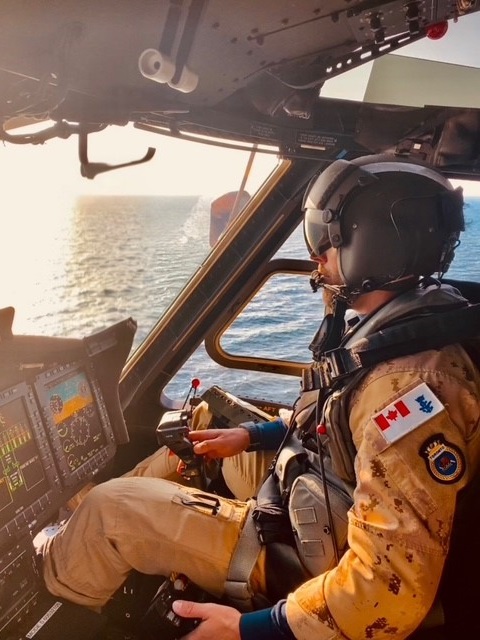
Capt O’Neill flying over the Mediterranean Sea in 2020. He was deployed in the CH-148 Cyclone (maritime helicopter) at the time.
Photo provided by Capt Corey O’Neill.
These courses are co-taught by R2MR clinicians and facilitators like Capt O’Neill. While the clinicians give students tools to deal with stress and failure, his experiences as a pilot make the training relatable by applying them to real-life scenarios.
“People tend to mentally navigate to the worst-case scenario. We give them these tools ahead of time, so that if that happens while they're here, they don't spiral,” he said.
For example, the courses explore different performance and stress management strategies known as the “Big Four +,” originally developed by the Navy SEALS. These include four core skills: self-talk, breathing, visualization, and goal setting, along with additional techniques tailored to the needs of specific audiences. For pilots, this includes advanced attention control, compartmentalization, mindfulness, setback management, and progressive muscle relaxation. Capt O’Neill noted that even a simple action like taking a deep breath can significantly influence a person’s wellbeing.
In addition to being a pilot instructor and an R2MR facilitator, Capt O’Neill is the course director for Helicopter Flight at the Flying Training School. He aims to address a misconception about mental readiness through education: readiness should be treated as maintenance, not as a last-minute triage tool.
“Becoming more knowledgeable in mental health strategies helps you employ these strategies not only when you're in the green zone of the mental health continuum, but in the yellow-gusting-red zone as well.”