
2 Wing key to Exercise MAPLE STRIKE success
August 31 , 2026 – Defence Stories
Estimated read time: 1:45
Caption
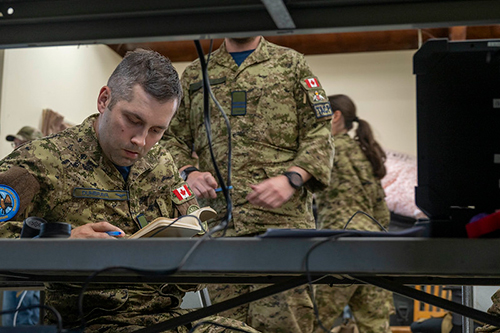
Tactical Air Control Party (TACP) officer coordinates information between the aircraft and Joint Terminal Attack Controller (JTAC) to make a successful air drop, taken on June 23, at Primrose Lake, Alberta.
Photo: Corporal Connie Valin, Canadian Armed Forces
Members of 2 Wing participated in Exercise MAPLE STRIKE 2601 from June 22 to July 3, in Cold Lake, Alberta. The exercise brought together aviators, soldiers, and Allies to strengthen integration between air and land operations in a complex and contested combat environment. Two units, 2nd Air Support Operations Squadron (2 ASOS) and 8th Air Communications and Control Squadron (8 ACCS), were deployed for the exercise and played a pivotal role in its success.
Designed to replicate the realities of modern conflict, Canadian Army Joint Terminal Attack Controllers (JTACs) and Tactical Air Control Parties (TACPs) trained to coordinate air strikes in an environment featuring drones and multi-domain threats. During the exercise, more than 179 aerial sorties were flown over 10 days of operations, representing the highest volume of air activity seen in this training event in nearly a decade.
Caption
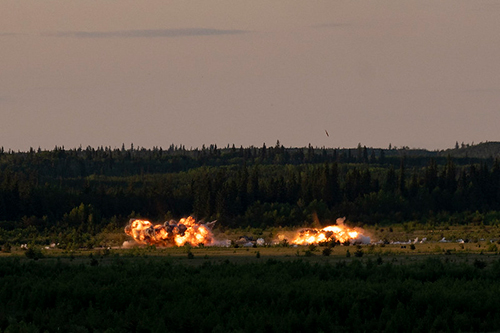
A successful air strike by an American B52 Bomber during EX MAPLE STRIKE at Shaver drop zone located at Jimmy Lake, Alberta.
Photo: Corporal Connie Valin, Canadian Armed Forces
2 ASOS played a key role in this air-ground integration, acting as a link between air and ground forces. Squadron members worked alongside Canadian Army JTACs to plan, coordinate, and execute close air support missions. Their expertise bridged the gap between the needs of ground troops and available air support, including the CF-18 Hornet, the CH-146 Griffon, and the US Air Force B-52H strategic bomber.
“Thanks to this realistic training, our TACPs maintained and honed their qualifications while developing new tactics, techniques, and procedures tailored to the challenges of modern operations,” said Lieutenant Colonel Séguin, Commandant, 2 ASOS.
Caption
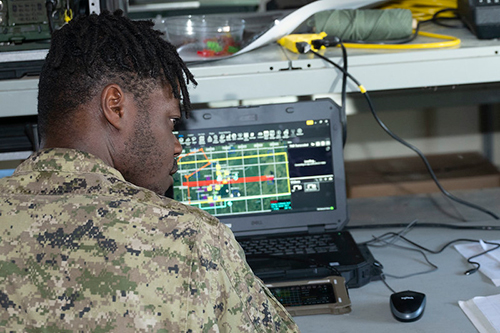
Tactical Air Control Party (TACP) member inserts coordinates for the next air strike taken during EX MAPLE STRIKE on June 25, at Jimmy Lake, Alberta.
Photo: Corporal Connie Valin, Canadian Armed Forces
The success of large exercises depends on far more than the tactical operations visible on the ground. In support of 2 ASOS, 8 ACCS provided the control and communications capabilities needed to support safe and effective operations. Based at 8 Wing Trenton, but also falling under the 2 Wing structure, 8 ACCS is renowned for its ability to rapidly deploy communications and air control systems anywhere in the world.
“Our specialists’ role is to set up computer networks, satellite communications, radio systems, and various secure infrastructures. We enable air operations to continue even in austere or degraded environments,”.
Caption
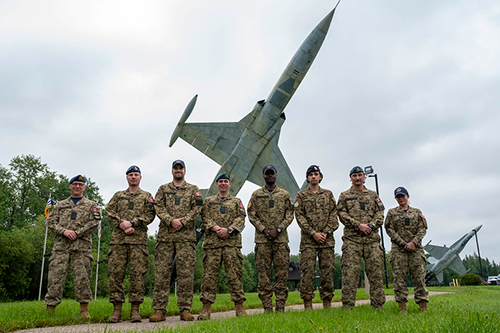
Group photo of 2 Air Support Operation Squadron's Terminal Attack Control Party after EX MAPLE STRIKE taken on July 3, at 4 Wing Cold Lake, Alberta. [Cpl Marc-André Leclerc, Canadian Armed Forces]
The participation of 2 ASOS and 8 ACCS in MAPLE STRIKE 2601 highlights 2 Wing's role in supporting RCAF expeditionary operations. Together, these units provide complementary capabilities that enable the integration of air capabilities into ground operations while ensuring the communications and control necessary for their success.
MAPLE STRIKE provides the Canadian Armed Forces with a great opportunity to demonstrate its effectiveness in integrating land and air forces for future operations, domestic or international.