
Canadian Armed Forces announces new Occupational Health and Public Health occupations
August 17, 2026 – Defence Stories
Estimated read time – 1:51

Caption
WO Girard measures the sound pressure level generated by a pneumatic tool during a tire replacement activity at CFB Valcartier to assess occupational noise exposure and support workplace health protection programs that contribute to CAF personnel readiness.
Preventive Medicine Technicians (PMed Techs) have long played a critical role in protecting the health of Canadian Armed Forces (CAF) personnel. Through public and occupational health programs, they support disease prevention and surveillance, infection prevention and control, and workplace hazard identification and exposure monitoring, across the full spectrum of CAF operations.
A need for change
The PMed Tech occupation recently underwent a comprehensive occupational analysis that identified challenges with its structure, including an exceptionally broad scope of responsibilities spanning two different fields and a need for up-to-date regulatory and professional standards. These challenges made it difficult for members to maintain their full professional scope, reduced job satisfaction, and contributed to personnel turnover, creating staffing pressures and challenges in meeting CAF operational requirements.
A way forward: Introducing two new health protection occupations
As a result, the PMed Tech occupation will be retired and replaced by two new occupations: Occupational Health Technologist (OHT) and Public Health Officer (PHO). Preserving and modernizing PMed Tech expertise, these new occupations will provide distinct specialties in Force Health Protection, enabling more focused training, greater depth of expertise, and enhanced operational effectiveness.
The OHT occupation will focus on managing occupational health hazards in Defence Team workplaces through prevention and surveillance. This includes identifying, inspecting, and responding to occupational exposures and environmental conditions that may pose health risks, such as mould, lighting, thermal stress, vibration, radiation, laser exposure, noise, indoor air, and ventilation issues. OHTs will also support occupational health programs and workplace health protection initiatives, contributing to CAF personnel readiness.
The PHO occupation will focus on managing communicable diseases and public health hazards across the Department of National Defence. This includes identifying, inspecting, and responding to public health risks related to food, water, waste, insects or other pests that can spread disease, and infectious disease threats. PHOs will also support commanders in identifying and reducing health threats to personnel at home and abroad.
Benefits and next steps
These new occupations will reflect similar professions in the civilian workforce, improving alignment with recognized professional standards and practices. This is expected to increase attraction and retention of CAF personnel by offering clear career pathways and increased professional recognition both within and outside the military.
To begin this transition, current PMed Techs will undergo a Compulsory Occupational Transfer into either OHT or PHO based on personal preferences, qualifications, and service requirements. Career management support and training pathways have been developed to ensure continuity in the delivery of force health protection services, minimize disruptions to operational capabilities, and to support members’ continued service within the CAF.
For more information on these occupation changes, please contact the implementation team at OHTPHOimpl-ImplTHTOSP@forces.gc.ca.

Caption
WO Morin-Quinn monitors environmental heat stress using a QuestTemp 34 Area Heat Stress Monitor during Operation IMPACT at Ali Al Salem Air Base, supporting the identification and management of occupational health hazards in deployed operations.
Caption
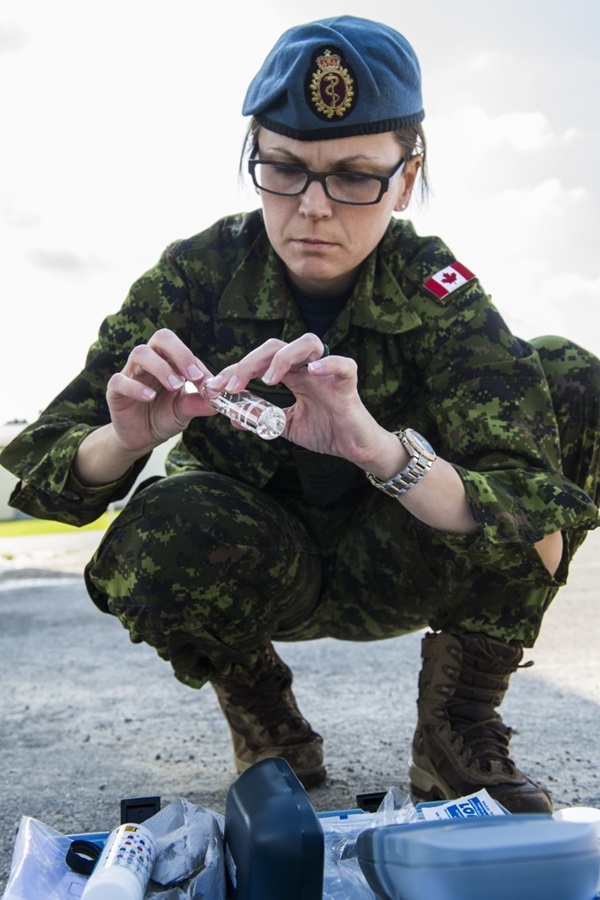
Sgt O'Connell conducts bacteriological and chemical water analysis during Operation REASSURANCE to identify and mitigate water-borne health hazards affecting deployed personnel.

Caption
WO Morin-Quinn measures the temperature of a hot holding unit at a food facility in CFB Valcartier to verify compliance with food safety standards and support the prevention of food-borne illness among CAF personnel through routine public health inspections.