
Canadian Cyclists receive 18 First World War battle honours
September 28, 2026 – Defence Stories
Estimated read time: 1:55
By Lieutenant-Colonel Casey Anderson, Canadian Intelligence Corps
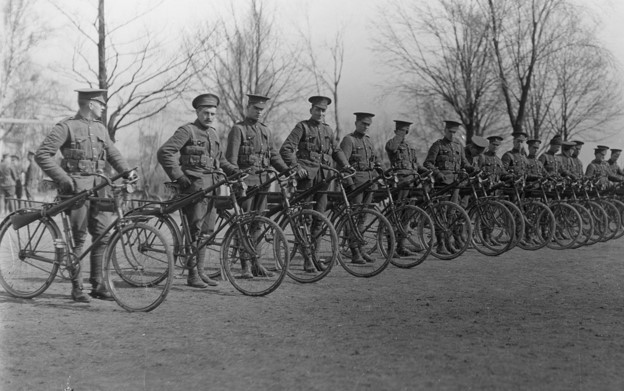
Caption
Canadian Cyclists stand with their bicycles in Toronto, circa 1915.
Photo Credit: City of Toronto Archives, Fonds 1244, Item 793.
More than a century after their service on the battlefields of the First World War, five Cyclist units of the Canadian Expeditionary Force have been awarded 18 battle honours, announced by the Chief of the Defence Staff in CANFORGEN 103/26 on August 20.
The Canadian Corps Cyclist Battalion received 11 honours: Vimy, 1917; Arras, 1917; Amiens; Scarpe, 1918; Drocourt Quéant; Canal du Nord; Cambrai, 1918; Arras, 1918; Hindenburg Line; Pursuit to Mons; and France and Flanders, 1916 to 1918.
The 1st Canadian Division Cyclist Company received Gravenstafel, St. Julien, Ypres, 1915, and France and Flanders, 1915 to 1916. The 2nd and 3rd Canadian Division Cyclist Companies each received France and Flanders, 1915 to 1916. The 4th Canadian Division Cyclist Company received The Great War, 1916.
The honours close a long-standing gap in Canadian military history. The Cyclists were mounted troops trained for reconnaissance and other light cavalry tasks, while also carrying messages and performing other lines-of-communications duties.
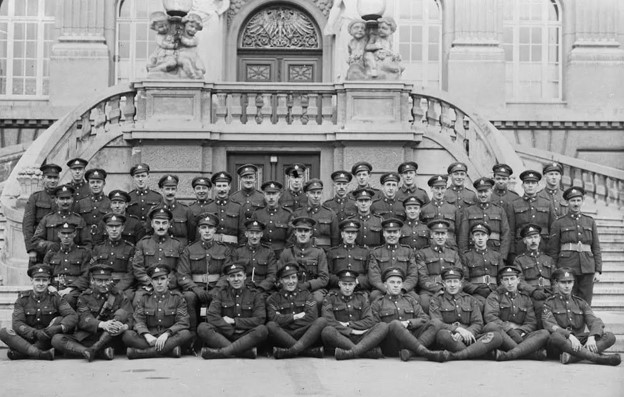
Caption
Non-Commissioned Officers of the Canadian Corps Cyclist Battalion, Bonn, January 1919.
Photo Credit: Library and Archives Canada.
Many of the Cyclists transferred from the Corps of Guides, Canada’s pre-war military intelligence organization, creating a direct personnel and functional link between the two. Post-war, the Guides’ 12 mounted detachments were re-roled as cyclist companies, solidifying the connection.
In May 1916, the 1st, 2nd, and 3rd Divisional Cyclist Companies combined to form the Canadian Corps Cyclist Battalion. The battalion was part of the Canadian Corps at Vimy Ridge. During the Hundred Days campaign in 1918, it served with Brigadier-General Raymond Brutinel’s Canadian Independent Force and often operated at the vanguard of the advance.
Their service came at a cost. The Cyclists suffered 261 casualties from a wartime strength of 1,138. The Canadian Corps Cyclist Battalion’s final wartime casualty was Lance Corporal Delbert Bean, MM, who died on November 9, two days before the 1918 Armistice, and is buried at Cuesmes Communal Cemetery in Mons, Belgium.
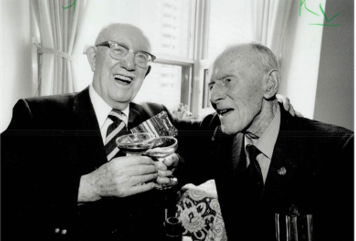
Caption
Wilfred “Dick” Ellis and Billy Richardson, the last known surviving First World War Cyclist veterans, raise champagne glasses together in Toronto in 1992.
Photo Credit: Toronto Public Library Digital Archive, Object Number: TSPA_0028491F.
Disbanded in 1920, the battalion had no serving perpetuating unit or veterans’ association when Canada allocated most First World War battle honours in the late 1920s and early 1930s. Captain Wilfred “Dick” Ellis, the final known surviving member of the battalion, died in 1996 without ever seeing his battalion receive its honours.
The recognition carries a living responsibility. Lieutenant-General Michael Wright, Commander Canadian Army, has designated the Canadian Intelligence Corps as the historical successor to the Cyclists under Canadian Army Order 11-27, the Canadian Army’s new preservation of heritage policy. The designation builds on years of commemoration of the Cyclists by the Canadian Intelligence Corps. Going forward, the Corps will formally preserve the Cyclists’ customs, heritage, traditions, and memory.
More than a century after they served, the Cyclists have their honours. Their legacy now passes to a Corps whose members serve the same fundamental purpose: find information, understand its meaning, and enable action.