
2Lt Alan McLeod: Canada's youngest aviator to receive VC in First World War
News Article / April 26, 2013
Throughout the First World War, except for the short-lived Canadian Aviation Corps and the Royal Canadian Naval Air Service, Canada did not field an air force.
Instead, Canadians who wished to fly flocked to join either the Royal Flying Corps (RFC) or the Royal Naval Air Service (RNAS). Thousands served and it is estimated that more than 5,000 were killed.
During the war, three Canadians were awarded the Victoria Cross (VC), the British Empire’s highest award for gallantry in the face of the enemy. Of the three, the best known are Captain (Acting Major) William Barker and Captain William Avery “Billy” Bishop, both fighter pilots. Often overlooked however, is 18-year-old Second Lieutenant Alan Arnett McLeod, the youngest of the VC recipients.
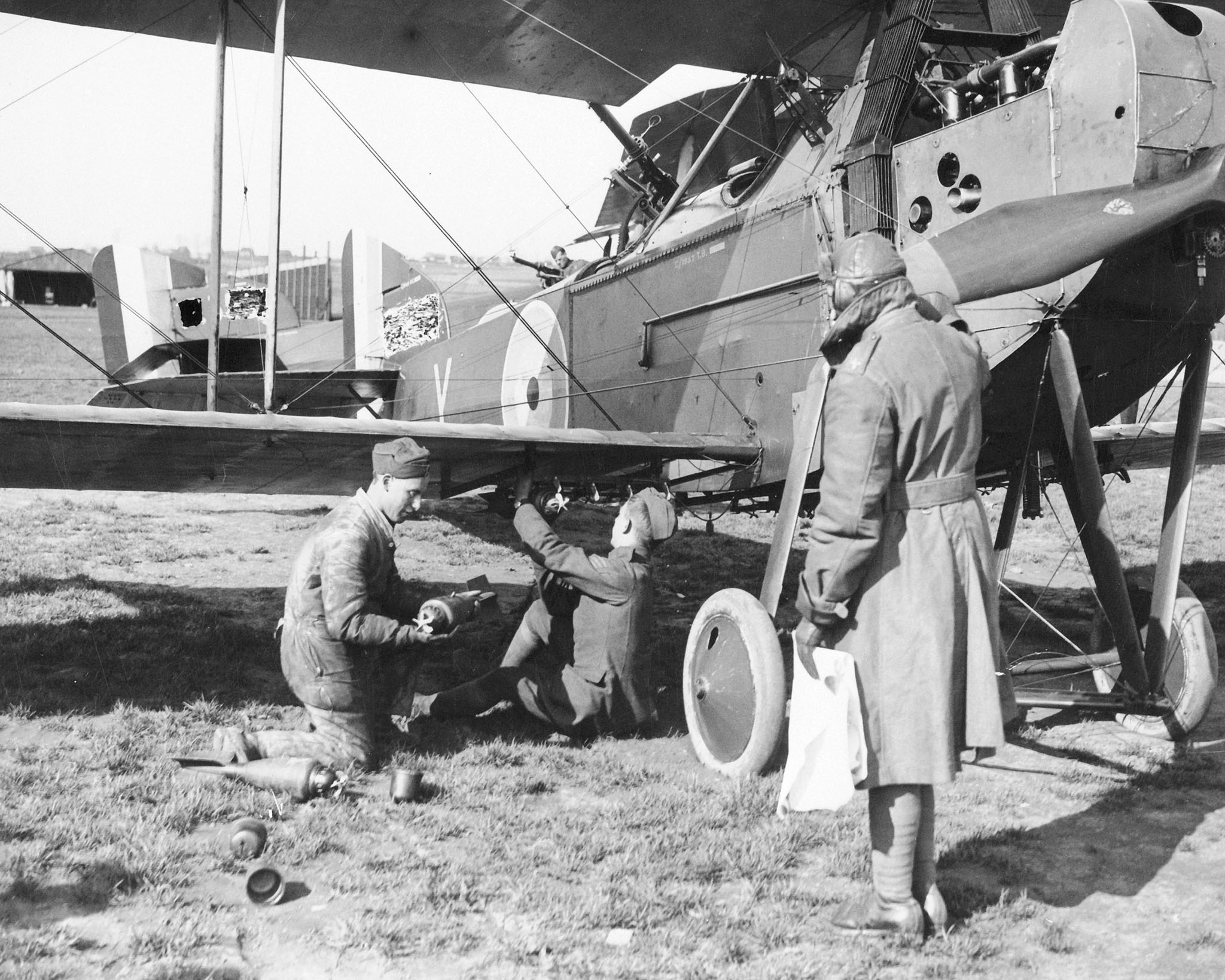
In 1918, 2Lt McLeod served as a pilot in No. 2 Squadron, flying the two-seat, general-purpose Armstrong Whitworth FK 8 aircraft, which was used for reconnaissance, artillery spotting, ground attack, contact patrols (that is, locating armies on the ground) and bombing.
Also known as the “Big Ack,” the FK 8 was effective and dependable. It could carry up to 118 kilograms of bombs and was equipped with one forward-firing Vickers machine gun, with a Lewis machine gun mounted in the rear observer’s position.
On March 21, 1918, the German army launched its last great offensive of the war and British and French forces fell back in disarray. It was a desperate time and anything the RFC had that could fly was called upon to try to stem the German advance. 2Lt McLeod and his observer, Lieutenant Arthur William Hammond (who had already been awarded a Military Cross [MC] for bravery), went aloft on March 27 as part of what we would today call a “strike package” to attack advancing German infantry.
The story of 2Lt McLeod’s VC makes for remarkable reading. However, less than a week later, he wrote home to his family and described what transpired that day.
The letter shows a badly injured young man trying his best to assuage any worry his family might have and gives us some insight into the personality of this self-effacing young Canadian. So in his own words, here is what transpired the day that “Babe” McLeod won the VC. (Editor’s note: Due to length, this is only a short excerpt.)
Prince of Wales Hospital
Marylebone Road,
London, W.W. 1.
April 2nd, 1918
My Dear Old Dad and Mom,
When we got to the lines we were the only one of our machines around, and there were lots of Boches [Germans]. We went quite a piece over the lines and were just going to drop our bombs on a Hun battery that was in action, when suddenly a bunch of Boches came out of the clouds on us. There must have been eight of them. I foolishly stayed to scrap with them. We jumped up to about five or six thousand feet and fought for a while and got three of them down in flames. Then they got us. By this time I had a few bullets in me and they were beginning to hurt, when our machine burst into flames. As soon as I saw this I put the machine into a dive to try to get to the ground. We stood out on the side of the machine as soon as we got near enough and jumped for the ground. Our flying suits were burned off us and our clothes partly burned, but we were hardly burned ourselves. My observer, Hammond, was certainly a hero. When we were coming down in flames — it looked like certain death — and he was badly wounded, he still fired at the Huns and brought one down too. That takes some nerve, believe me.
Heaps of love and kisses to the girls and yourselves.
Ever your own dear son,
Alan
P.S. Please don't worry. It would just be like you both, and I'm as fit as a fiddle. I believe our escape was one of the most remarkable I ever heard of. Here I am six days after, feeling like a prize fighter, and have just shown one of the fellows in this room that I am one.
Lt Hammond became an “ace” with the aircraft claimed that day, giving him a total of five enemy aircraft shot down. He was presented with a “bar” to his MC denoted a second award for gallantry. Unfortunately, he lost a leg as a result of his wounds, left the RFC and immigrated to Canada. He served with the Royal Canadian Air Force during the Second World War and passed away in Victoria, British Columbia, on December 22, 1959.
Wounded six times in this action, 2Lt McLeod’s condition was far worse than he had let on in his letter, and his life hung in the balance for several weeks. His father, a doctor, left Winnipeg to help look after his son.
On September 4, walking on crutches, 2Lt McLeod was awarded the VC at Buckingham Palace by King George V. He returned home soon after to Stonewall, Manitoba.
Weakened from his wounds, 2Lt McLeod died on November 6, 1918, during the Spanish Flu epidemic — five days before the end of the war.
Major March is a historian with Air Force History and Heritage.