
PO1 Evans: Finding purpose beneath the surface
March 2, 2026 - Royal Canadian Navy
Caption
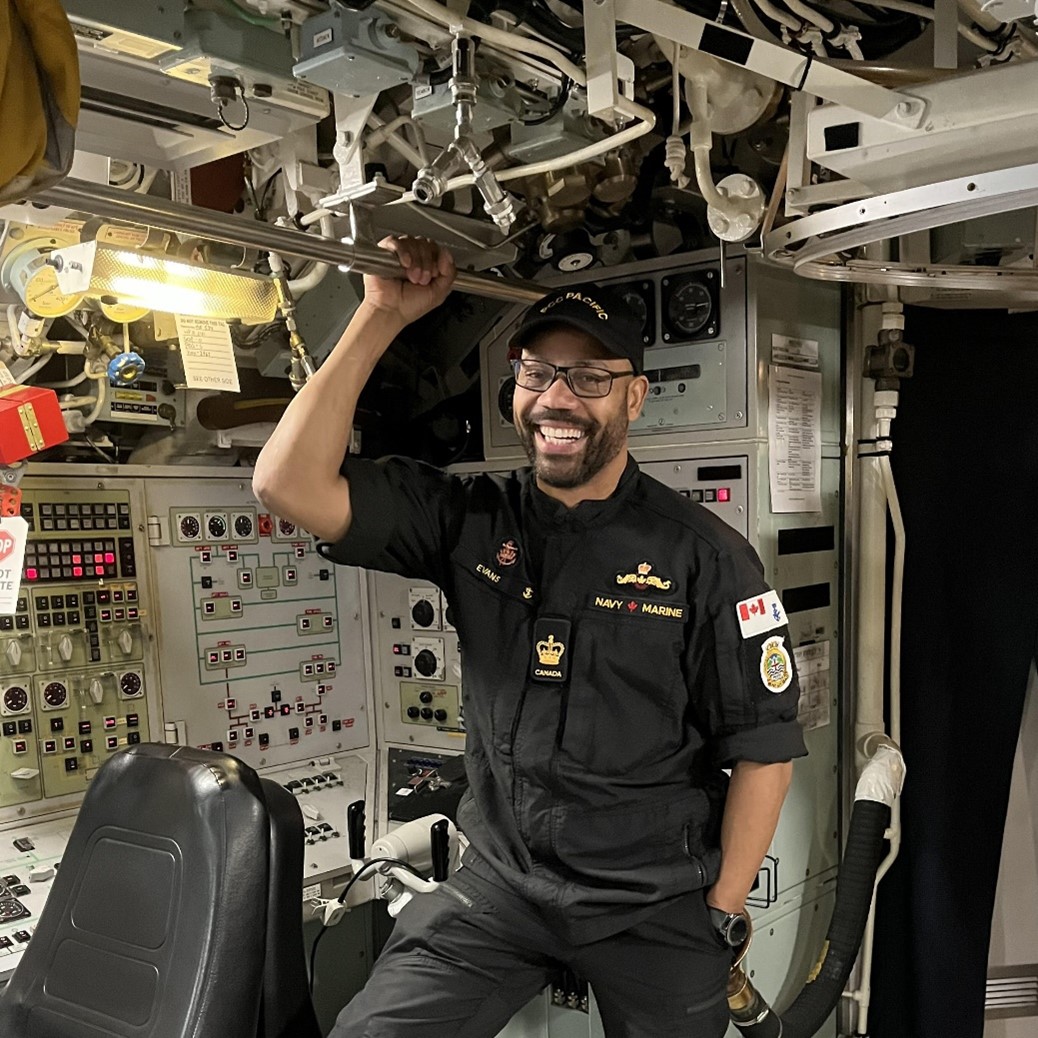
PO1 Evans reminisces on the Corner Brook in the control room.
Caption
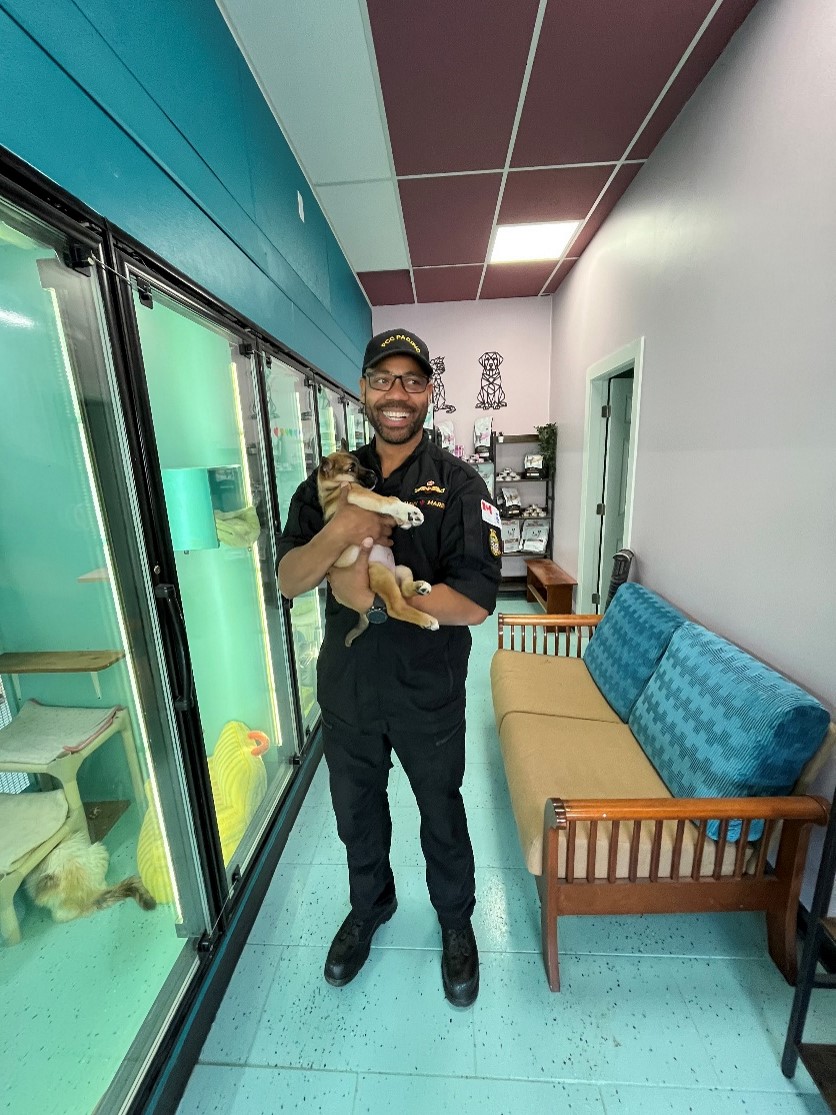
Petty Officer 1st Class (PO1) Yevrag Evans holds a puppy while volunteering at a local animal rescue shelter in his community.
When Petty Officer First Class (PO1) Yevrag Evans joined the Canadian Armed Forces (CAF) in 2005, he was continuing a proud family legacy of military service.
“My grandfather served in the military during the Second World War, and my uncle was also part of the Jamaican Defence Force prior to him joining the Canadian Armed Forces,” said PO1 Evans.
Despite those ties, and his experience in the Cadet movement and the Reserve Force, he knew little about the Royal Canadian Navy (RCN) or the trades available to him at the time. Willing to take a leap of faith, he selected naval combat information operator.
“I threw a dart at a dartboard, and naval combat information operator landed,” he said.
Early in his career, PO1 Evans was posted from ship to ship in the surface fleet. The experience strengthened his technical skills and adaptability, but frequent transitions meant repeatedly integrating into new teams.
“You work your way into the team on a ship. You can be proficient at your job. Then you jump to another ship, new team, you start all over again,” said PO1 Evans.
During his first sail, while standing the middle watch in the operations room, he began reflecting on whether he had made the right choice.
“When I got posted to my first ship, on the mids watch during my first sail I started questioning my life choices.”
Over time, he realized he was looking for a stronger sense of permanence and shared responsibility. That search led him to the submarine service.
“The fear of the unknown,” he said. “Am I good enough, will I be able to cut it, do I have what it takes. Will I pass my board or will I fail and return to the surface fleet.”
Submarine qualification demands a deep understanding of interconnected systems and trust within a small crew. On September 21, 2009, PO1 Evans earned his dolphins and became a qualified submariner. It marked a defining moment in his career.
“I earned my dolphins, but I didn’t do it alone,” he said. He credits the submarine community for supporting him through the process. “With the help, guidance, and mentorship from the submarine community I was able to do it.”
“Now it was my turn to help the next prospective submariner earn their dolphins,” said Evans.
That experience continues to shape how he approaches leadership and mentorship.
“I’m more patient than I used to be,” he said. “Taking ownership and accepting the consequences of my mistakes, being available to those that require assistance... I can’t solve everyone’s problems but together we can find possible solutions.”
Over more than 21 years of service, PO1 Evans has taken on a broad range of responsibilities, from anti-submarine plotting and electronic warfare to submarine fire control and intelligence gathering. He has progressed toward advanced roles such as Operations Room Supervisor and Chief of Operations.
The sense of community he found in the submarine service also extends into his life at home. After returning from sea one day, he was greeted by an unexpected sight.
“I walked into a house with 20 cats,” PO1 Evans said, laughing.
His wife operates a cat and dog rescue. When ashore, PO1 Evans lends a hand wherever needed.
“It’s a small community on submarines; everyone helps each other,” he said. “I wanted to take that sense of community into the larger world and help by fostering cats and dogs.”
For PO1 Evans, the submarine community provided what he had been searching for early in his career: stability, shared responsibility and a lasting sense of belonging.
Whether mentoring the next prospective submariner or supporting his family’s rescue efforts, service remains rooted in teamwork and care for others.
Beneath the surface, trust is essential. Above it, those same values continue to guide how he lives and leads.