
Impact Assessment Agency of Canada
Quarterly Financial Report
For the quarter ended December 31, 2025
Statement outlining results, risks, and significant changes in operations, personnel, and program
Introduction
This quarterly report has been prepared by management as required by section 65.1 of the Financial Administration Act and in the form and manner prescribed by the Treasury Board. It should be read in conjunction with the Main Estimates, Supplementary Estimates, and the previous Quarterly Financial Report for the current year.
This quarterly report has not been subject to an external audit or review.
Mandate and program activities
The Impact Assessment Agency of Canada (IAAC) delivers high-quality environmental and impact assessments under the Impact Assessment Act (IAA). Through open and efficient assessments, IAAC facilitates the development of designated projects. These assessments identify ways to ensure the environment and Indigenous rights are protected as projects get built. To support needed investment in designated projects, IAAC works closely with other jurisdictions to achieve the goal of "one project, one review."
Additional information about IAAC’s mandate can be found on its website and additional financial information may be found in IAAC’s 2025-26 Departmental plan and in the 2025-26 Main Estimates.
Under its two programs, IAAC delivers the Impact Assessment Grants and Contributions Program (Funding Programs), which includes:
- Participant Funding Program;
- Indigenous Capacity Support Program;
- Policy Dialogue Program; and
- Research Program.
Basis of presentation
This quarterly report has been prepared by management using the expenditure basis of accounting. The accompanying Statement of Authorities includes IAAC’s spending authorities granted by Parliament, and those used by IAAC consistent with the Main Estimates and Supplementary Estimates for the 2025-2026 fiscal year. This quarterly report has been prepared using a special purpose financial reporting framework designed to meet financial information needs with respect to the use of spending authorities.
The authority of Parliament is required before funds can be spent by the Government. Approvals are given in the form of annually approved limits through appropriation acts, or through legislation in the form of statutory spending authority for specific purposes.
When Parliament is dissolved for the purposes of a general election, section 30 of the Financial Administration Act authorizes, under certain conditions, the preparation of special warrants to be signed by the Governor General authorizing payments to be made out of the Consolidated Revenue Fund. Special warrants are deemed to be an appropriation for the fiscal year in which they are issued.
Special warrants issued during the first quarter 2025-2026 were included in the total appropriations in Main Estimates 2025-2026.
IAAC uses the full accrual method of accounting to prepare and present its annual financial statements that are part of the departmental results reporting process. However, the spending authorities voted by Parliament remain on an expenditure basis.
Highlights of fiscal quarter and the fiscal year-to-date (YTD) results
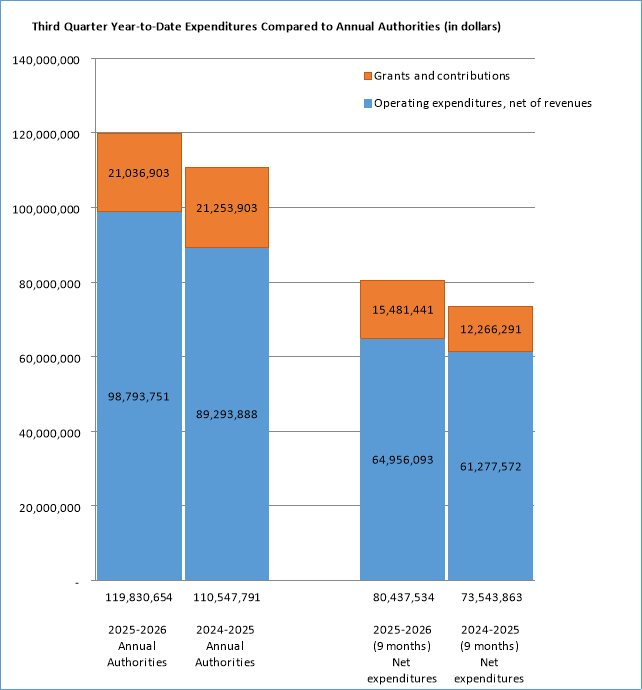
The annual authorities available for use ($119.83M in 2025–2026 and $110.55M in 2024–2025), which represents the budgetary expenditures granted by Parliament at quarter-end less the vote-netted revenue IAAC has authority to collect, increased by $9.28M (8.40%) due to new funding announced in the Fall Economic Statement 2022 (FES 2022) for IAAC to continue to implement the IAA and complete assessments started under the Canadian Environmental Assessment Act, 2012 (CEAA 2012).
The third quarter year-to-date budgetary expenditures, net of revenues, increased by $6.89M (9.37%) from the previous year ($80.43M in 2025–2026 and $73.54M in 2024–2025). This increase is explained by the following:
- Transfer payments (grants and contributions) increased by $3.21M ($15.48M in 2025–2026 and $12.27M in 2024–2025). The variance reflects the timing of multi-year project phases, obligations maturing and reporting cycles, while the full-year forecast of transfer payments remains consistent with planned levels.
- Personnel expenditures increased by $5.54M ($56.17M in 2025–2026 and $50.63M in 2024–2025) due to a variance in workforce composition, the increase in wages, and the increase in employee benefit costs.
- Other budgetary expenditures decreased by $1.38M ($9.26M in 2025–2026 and $10.64M in 2024–2025) due to expenditures being limited to routine and legally required items at the start of the fiscal year during the caretaker convention, and IAAC’s immediate alignment with the spending restraint measures under the Comprehensive Expenditure Review announced in Budget 2025.
- Revenues were higher than the prior year ($0.48M in 2025–2026 compared to $2,669 in 2024–2025), reflecting ongoing impact assessments and related cost-recovery activity.
Risks and uncertainties
Legal challenges
IAAC is subject to litigation, the extent and costs of which are uncertain. If applicable, these costs are normally covered by IAAC’s annual appropriations. IAAC mitigates these risks through proactive legal oversight, close monitoring of ongoing cases, and the implementation of sound risk management and governance practices.
Digital modernization
IAAC’s limited digitization poses a strategic risk to operational efficiency and service delivery, as reliance on manual processes reduces agility, increases the potential for errors, and constrains our ability to leverage data for timely, evidence-based decision-making. To address these risks, IAAC is strengthening its planning and investment approach for digital initiatives and continues to explore opportunities for collaboration and shared solutions across government.
Financial sustainability
IAAC operates in an environment of growing operational pressures and ongoing government-wide efforts to identify cost efficiencies. While prudent financial management and careful expenditure planning have supported stability, these factors also reduce financial flexibility and can make it more difficult to respond quickly to emerging priorities or unexpected demands. To strengthen long-term financial sustainability, IAAC is modernizing its integrated business planning processes to better align resources with strategic priorities and a more focused mandate. IAAC has begun rethinking how it is structured to operate more efficiently and is taking proactive steps to ensure it can continue delivering effectively under reduced funding levels. These measures will enhance adaptability while ensuring that cost management measures do not compromise program outcomes or service delivery.
Approval by Senior Officials
Approved by:
___________________________________
Terence Hubbard
President
Ottawa, Canada
February 20, 2026
___________________________________
Ian Ketcheson
Vice-President, Indigenous Relations and Corporate Services and Chief Financial Officer
Ottawa, Canada
February 17, 2026
Statement of Authorities (unaudited)
Total available for use for the year ending March 31, 2026 1 | Used during the quarter ended December 31, 2025 | Year-to-date used at quarter ended December 31, 2025 | |
|---|---|---|---|
VOTE 1 - Net operating expenditures | 88,607,010 | 20,296,166 | 57,316,037 |
VOTE 5 - Grants and contributions | 21,036,903 | 5,224,171 | 15,481,441 |
Statutory Authorities - Employee benefits | 10,186,741 | 2,546,685 | 7,640,056 |
Total Authorities | 119,830,654 | 28,067,022 | 80,437,534 |
1 Includes authorities available for use and granted by Parliament at quarter-end. | |||
Total available for use for the year ending March 31, 2025 1 | Used during the quarter ended December 31, 2024 | Year-to-date used at quarter ended December 31, 2024 | |
|---|---|---|---|
VOTE 1 - Net operating expenditures | 81,262,031 | 19,804,314 | 55,253,679 |
VOTE 5 - Grants and contributions | 21,253,903 | 6,061,816 | 12,266,291 |
Statutory Authorities - Employee benefits | 8,031,857 | 2,007,964 | 6,023,893 |
Total Authorities | 110,547,791 | 27,874,094 | 73,543,863 |
1 Includes authorities available for use and granted by Parliament at quarter-end. | |||
Budgetary Expenditures by Standard Object (unaudited)
Planned expenditures for the year ending March 31, 2026 | Expended during the quarter ended December 31, 2025 | Year-to-date used at quarter ended December 31, 2025 | |
|---|---|---|---|
Expenditures | |||
Personnel | 76,893,629 | 19,343,809 | 56,175,538 |
Transportation and telecommunications | 3,134,755 | 335,877 | 702,496 |
Information | 807,909 | 66,486 | 191,223 |
Professional services | 15,255,460 | 2,866,920 | 7,639,096 |
Rentals | 139,684 | 25,664 | 50,878 |
Purchased repair and maintenance | 141,810 | 128 | 27,856 |
Utilities, materials and supplies | 269,918 | 15,686 | 32,705 |
Acquisition of machinery and equipment | 3,131,792 | 433,041 | 573,818 |
Transfer payments | 21,036,903 | 5,224,171 | 15,481,441 |
Other expenses | 31,406 | (585) | 38,250 |
Total gross budgetary expenditures | 120,843,266 | 28,311,197 | 80,913,301 |
Less revenues netted against expenditures | |||
Panel reviews | 1,012,612 | 244,175 | 475,767 |
Total net budgetary expenditures | 119,830,654 | 28,067,022 | $80,437,534 |
Note 1: IAAC has authority to collect up to $8,001,000 in vote-netted revenue. | |||
Planned expenditures for the year ending March 31, 2025 | Expended during the quarter ended December 31, 2024 | Year-to-date used at quarter ended December 31, 2024 | |
|---|---|---|---|
Expenditures | |||
Personnel | 66,233,721 | 17,671,522 | 50,634,938 |
Transportation and telecommunications | 3,052,432 | 487,937 | 1,042,130 |
Information | 1,399,498 | 78,663 | 254,335 |
Professional services | 13,976,110 | 3,372,963 | 8,251,617 |
Rentals | 131,547 | 40,913 | 76,985 |
Purchased repair and maintenance | 722,289 | 10,957 | 54,511 |
Utilities, materials and supplies | 664,572 | 37,300 | 82,050 |
Acquisition of machinery and equipment | 3,250,550 | 81,230 | 842,275 |
Transfer payments | 21,253,903 | 6,061,816 | 12,266,291 |
Other expenses | 17,507 | 32,829 | 41,400 |
Total gross budgetary expenditures | 110,702,129 | 27,876,130 | 73,546,532 |
| Less revenues netted against expenditures | |||
Panel reviews | 154,338 | 2,036 | 2,669 |
Total net budgetary expenditures | 110,547,791 | 27,874,094 | 73,543,863 |
Note 1: IAAC has authority to collect up to $8,001,000 in vote-netted revenue. | |||