
How archives are organized
Archives are not organized by topic. Instead, they are grouped by the person or organization that created or collected them during their activities. These groups are called fonds or collections. Within these groups, records are arranged in a hierarchy.
On this page
Government versus private
Government records come directly from government departments, whereas private records come from people or organizations such as artists, politicians, businesses or non-profits.
Hierarchy
Archival record hierarchy is the structured arrangement of records in archives, organized from general to specific. This hierarchy ensures that records are preserved in their original context and are easily accessible. The main levels in this hierarchy include:
- Fonds or collection: A group of documents that share the same source.
- Sous-fonds: Some collections have 'sous-fonds,' if the collection is large enough. The sous-fonds generally contains all the records related to a particular activity or function.
- Series: Groups of similar records arranged together, often by function or subject.
- Sub-series: A subdivision of a series, used to further organize records based on specific criteria.
- File: A folder or group of related documents within a series or sub-series.
- Item: An individual document or record within a file unit.
This hierarchical structure helps maintain the provenance and original order of records, which is crucial for understanding their context and significance. For information on how this hierarchy is used in Collection search, see the Using Collection search page for search tips.
Visual example of how archival records are organized in a hierarchy
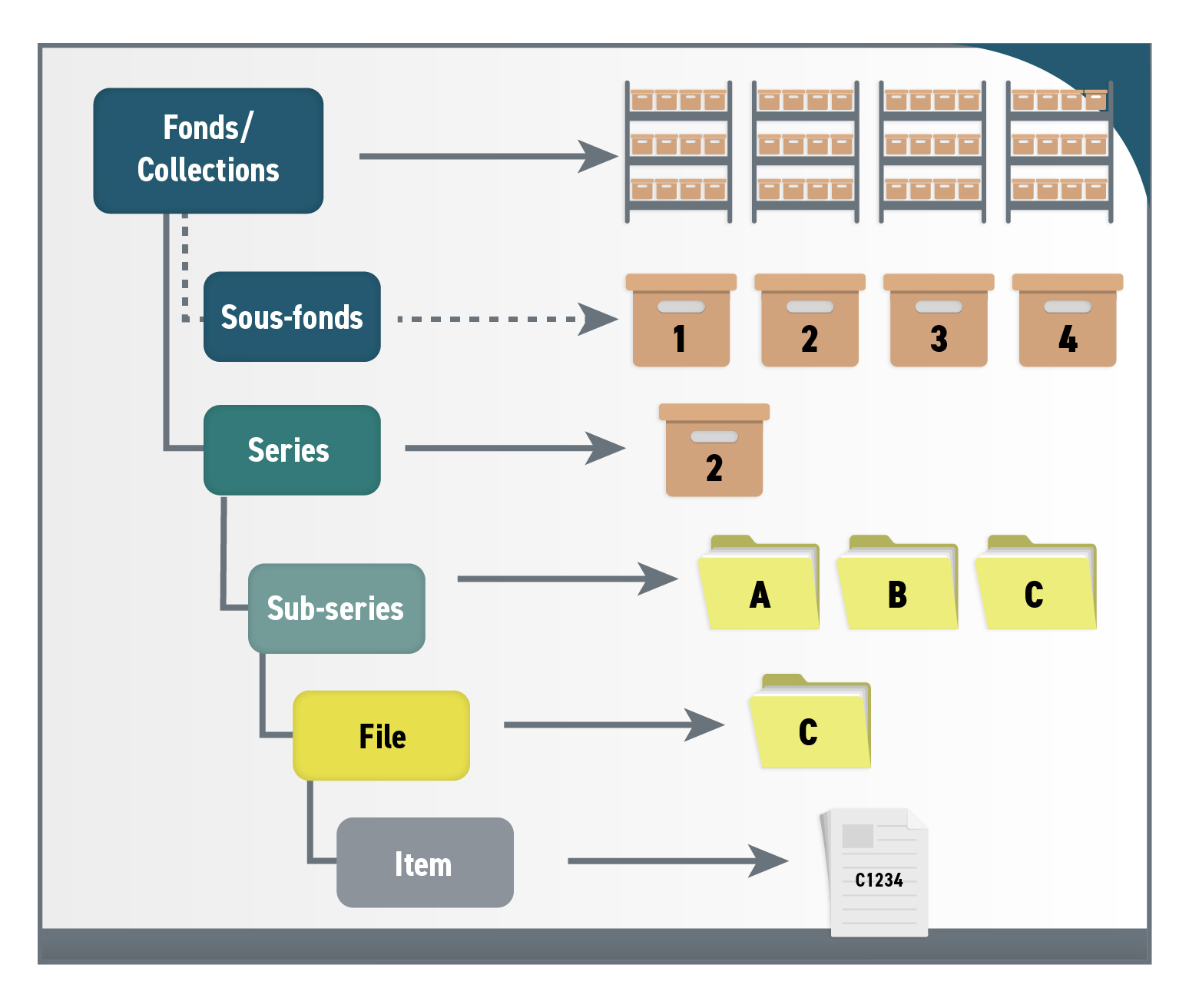
Visual example of how archival records are organized in a hierarchy - Text version
The main levels in this hierarchy include:
- Fonds or collection: A group of documents that share the same source.
- Sous-fonds: Some collections have 'sous-fonds,' if the collection is large enough. The sous-fonds generally contains all the records related to a particular activity or function.
- Series: Groups of similar records arranged together, often by function or subject.
- Sub-series: A subdivision of a series, used to further organize records based on specific criteria.
- File: A folder or group of related documents within a series or sub-series.
- Item: An individual document or record within a file unit.
Finding aids
Finding aids are research tools that can help you identify and locate archival records. They can be found in the Finding aid section of archival descriptions (the catalogue entries in our database).
Finding aids come in a variety of formats and list the specific files and items that the archival descriptions cover more generally. They often include details like the location and creation date of each file or item.
The most common formats are listed below.
Linked archival descriptions
Higher levels of description (such as series) and accessions may have a finding aid that is a linked list of lower-level descriptions (such as files) in Collection search. You can consult this type of finding aid by clicking on “View lower level description(s)” in the Hierarchy section.
The results will open in a new tab and provide a list of files or items. To see other records related to a specific finding aid, click on the Finding aid number in the Finding aid section of a file-level or item-level record.
You can then search within these records to find the most relevant files or items for your research. Click on “Modify Search,” then refine your search in one or more of the following ways:
- Enter your keyword(s) in the top two “All of these words” fields
- Add a date
- Add specific terms, such as title or name
- Choose type of material, hierarchical level, or available online
Linked documents
Some collections link to documents like PDFs or digitized microfilms. Click on the link to open the document, then browse the file to note any titles that interest you. You can use CTRL-F to search most documents for specific words or phrases. To order the material, find the corresponding volume or box number as well as the file number, if present.
Paper
If there is a finding aid number in the description but no way to access it, you may need to consult it on site. If a trip to Ottawa isn’t possible, please Ask us a reference question and include the finding aid number in your question. We can provide advice on how to best access a copy.
No finding aid
If there's no finding aid section, or no tools listed in it, you may need to look through the material yourself by requesting it and consulting it in Ottawa. You can also Ask us a reference question to find out more about these records.