
File history cards, 1872 to 1984
Table of contents
- About the file history cards
- How the cards are arranged
- Examples of file history cards
- List of content of volumes
- Volume 10885
- Bands — Alphabetical
- Bands — Alphabetical — Old Number
- Economic, Industrial and Business Development — Alphabetical
- Economic, Industrial and Business Development — Numerical
- First Series
- 0/ — Headquarters
- Joint Schools — Alphabetical
- Joint Schools — Numerical
- Oil and Gas — Alphabetical
- Oil and Gas — Numerical
- Old Schools — Alphabetical
- Old Schools — Numerical
- Reserves — Alphabetical
- Reserves — Alphabetical — Old Number
- Schools — Alphabetical
- Volume 10886
- Volume 10887
- Other resources
About the file history cards
The file history cards were created by the former Department of Indian Affairs and Northern Development (now Aboriginal Affairs and Northern Development Canada) and its predecessors between 1872 and 1984. They were produced to keep track of file numbers and to monitor those files that were later moved, transferred to Library and Archives Canada (LAC) or destroyed.
Most of the cards are typewritten, and many have handwritten notes and other annotations indicating which files were destroyed or moved to another file number. For this reason, the cards are helpful for tracking a particular file number, or confirming what files the Department created, or did not create.
If you wish to cite the file history cards, include the following reference information:
Title: Indexes to Headquarters records [textual record (microform)] [ca. 1872–1950].
Reference: RG10-B-3-f (R216-254-9-E), Volumes 10884 to 10887
Digital versions of the cards are available in PDF format throughout this page.
How the cards are arranged
The cards are part of the Indian and Inuit Affairs Program sous-fonds, Headquarters Central Registry, Index History Cards in RG10-B-3-e (R216-254-9-E) and are organized into four volumes:
- 10884
- 10885
- 10886
- 10887
Within each volume, the cards are grouped by subject. Library and Archives Canada holds only a microfiche version of these cards. Some documents contain personal information, for example, Volume 10884, and portions of Volumes 10885 and 10886 (these are part of the Modified Duplex Numeric System). These cards are not included in the first release of this research tool.
The microfiches have been digitized and the images appear in the same order as in the volumes. You can browse through the images as you would through the original volume. You can move through the images one by one, or skip ahead by entering a new page (image) number in the page navigation box. The records are not searchable by name.
Examples of file history cards
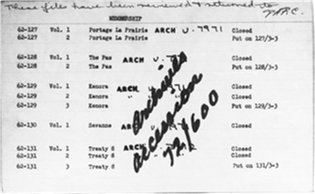
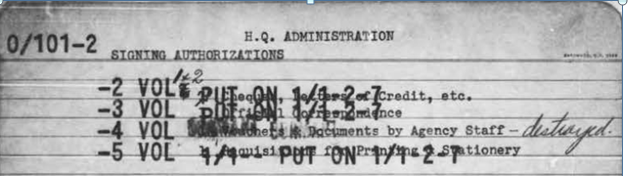

List of content of volumes
- To facilitate your search, limit yourself to one type of cards.
- This list describes the contents of each volume of file cards, and will help you determine which set of cards you should access for the information you need. You can search by keywords, for example, a band or place name, by pressing 'Control,' then 'F' on your keyboard (Ctrl + F), then entering the search term(s) in the new pop-up window. Consult the list below by clicking on the relevant series name.
Volume 10885
Bands — Alphabetical (RG 10, Volume 10885)
Cards are arranged alphabetically by band name.
These cards provide the name, the more recent band number, and the agency or district responsibility code (e.g., District 191) assigned to the agency or district responsible for each band.
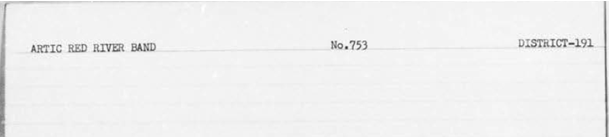
Example of card from Bands — Alphabetical, Abegweit to Garden River, e010780793-001
List of PDFs
- Abegweit to Garden River [PDF 2.96 MB]
- Gaspé to Necoslie [PDF 2.88 MB]
- Nekaneet to Takla Lake [PDF 2.97 MB]
- Tanakteuk to York Factory [PDF 1.06 MB]
Bands — Alphabetical — Old Number (RG 10, Volume 10885)
Cards are arranged alphabetically by band name.
The cards indicate the band name and number, the superseding band number handwritten on the card, and the agency or district responsibility code (e.g., 507).

Example of card from Bands — Alphabetical — Old Number, Gibson to Nemaska, e010780794-002
List of PDFs
- Abegweit to Gaspé [PDF 4.94 MB]
- Gibson to Nemaska [PDF 4.72 MB]
- Neskainlith to The Pas [PDF 4.66 MB]
- Thessalon to Yale [PDF 1.87 MB]
Economic, Industrial and Business Development — Alphabetical (RG 10, Volume 10885)
Cards are arranged in the alphabetical index by name of corporate body, and in the numerical index by the tertiary file number assigned to a given project.
These cards list headquarters files generated under the modified duplex 19-10 (Industrial and Business) file primary. For example, 401/19-10-43 Economic, Industrial and Business Development—Manitoulin Island Cedar Oil Plant.
In the alphabetical index, this file appears under Manitoulin Island Cedar Oil Plant.

Example of card from Economic, Industrial and Business — Alphabetical, Abamoweg Woodworkers Coop Ltd. to Zekelman Mobile Homes Project, e010780852-001
List of PDFs
Economic, Industrial and Business Development — Numerical (RG 10, Volume 10885)
Cards are organized by the tertiary file number assigned to a given project.
For example, File No. 401/19-10-43 is listed between No. /19-10-42 and No. /19-10-44.

Example of card from Economic, Industrial and Business Development — Numerical, 0 to 591, e010780853-001
The tertiary number may not be unique to one project until the number 72 is reached in the sequence. Until that point, tertiary numbers were used by more than one agency or district.
For example, both 191/19-10-22 and 201/19-10-22 exist. The first file is a file on Hay River Business Development in Mackenzie District (District Code 191); the second is a file on a Heritage Center in the Maritimes (District Code 201)

Example of card from Economic, Industrial and Business Development — Numerical, 0 to 591, e010780853-00
List of PDFs
- 1/19-10-0 to E-4574-591 [PDF 1.70 MB]
First Series (RG 10, Volume 10885)
The First Series is a sub-series consisting of headquarters central registry files classified according to the duplex numeric filing system.
Cards are arranged numerically by subject block number.
The first card contains an index to the subject block numbers used in the First Series.
The remainder of the cards contain a list of headquarters files created under the First Series subject-based numerical file system. Under this system, file numbers were comprised of two elements:
- a subject block (e.g., 62 = Membership)
- and an agency code (e.g., 131 = Lesser Slave Lake).
This file would appear as 62-131.
The cards are also helpful in indicating if files were destroyed or migrated to other files.
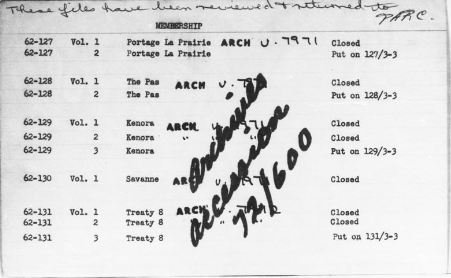
Example of card from First Series Block Index, Block Nos. 59 to 68, e010780856-0071
List of PDFs
- File Block Index [PDF 350.39 KB]
- 1 à 12 [PDF 4.61 MB]
- 13 à 24 [PDF 3.70 MB]
- 25 à 37 [PDF 3.70 MB]
- 38 à 47 [PDF 3.53 MB]
- 48 à 58 [PDF 4.14 MB]
- 59 à 68 [PDF 4.10 MB]
- 59 à 68 [PDF 3.88 MB]
- 68 à 80 [PDF 4.01 MB]
- 81 à 96 [PDF 3.67 MB]
- 97 à 111 [PDF 3.68 MB]
- 112 à 134 [PDF 2.67 MB]
- 134 à 420 [PDF 3.08 MB]
- 420 à 482 [PDF 4.95 MB]
- 485 à 565 [PDF 3.04 MB]
0/ — Headquarters (RG 10, Volume 10885)
Cards are arranged numerically by file number.
Classified according to the modified duplex numerical system, these cards contain a list of headquarters central registry files that employed 0/ as the responsibility code for headquarters.
This system was used only for a short time and most files created with this responsibility code were migrated forward into other district responsibility codes. The cards are especially helpful in tracing a specific modified duplex numerical file number with the responsibility code 0/.
Files that were destroyed are also indicated.
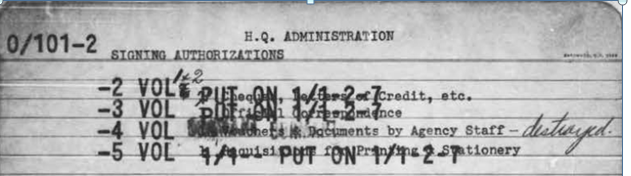
Example of card from 0/ — Headquarters, 0/100-1 to 0/113-4, e010780857-001
List of PDFs
- O/100-1 to O/113-4 [PDF 4.60 MB]
- O/114-1 to O/130-10 [PDF 2.72 MB]
Joint Schools — Alphabetical (RG 10, Volume 10885)
In 1945, the federal government introduced integrated joint schools, which allowed for education off reserves at provincially administered schools. The federal government bought seats in non-Aboriginal provincial schools. Many children attended federal day schools on reserves until about grade six, and were then transferred to one of the integrated joint schools.
Cards in this series are arranged alphabetically by name of joint school.
These cards can be used to identify the name or number of a joint school.
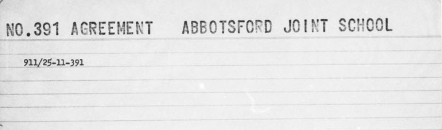
For example, File No. 911/25-11-391 breaks down as follows:
| 911/ | = | Agency No. |
| 25-11 | = | Joint Schools |
| -391 | = | Joint School Agreement No. |

Example of card from Joint Schools — Alphabetical, Abbotsford Joint School to Keremeos Elementary Joint School, e010780858-001
List of PDFs
- Abbotsford Joint School to Keremeos Elementary Joint School [PDF 4.33 MB]
- Keremeos Elementary Joint School to Sir Alexander Mackenzie (Hogensborg) Joint School [PDF 4.24 MB]
- Sir Alexander Mackenzie Secondary School to Yukon (Pelly and Ross River) Joint School [PDF 2.24 MB]
Joint Schools — Numerical (RG 10, Volume 10885)
Cards are arranged numerically by school number.
These cards contain the same information as the Joint Schools — Alphabetical cards.
Example of card from Joint Schools — Numerical, 181 to 400, e010780860-002
List of PDFs
- No. 1 to No. 180 [PDF 4.10 MB]
- No. 181 to No. 400 [PDF 4.05 MB]
- No. 401 to No. 704 [PDF 3.36 MB]
Oil and Gas — Alphabetical (RG 10, Volume 10885)
Cards are arranged alphabetically by name of company.
These cards were generated to locate files pertaining to oil and gas companies that were involved with the Department of Indian Affairs. They refer to modified duplex numerical files, and in a few instances the E Series of the Department’s current central registry system. They provide a way to locate files by company, as well as to identify the company number.
Here is an example of one of these cards:
| Canadian Delhy Oil Co. | No. 4 |
| Blood Reserve No. 148 | 773/20-6-435-148-4 |
This file number breaks down as follows:
| 773 | = | Agency |
| /20-6 | = | Oil and Gas |
| -435 | = | Account No. |
| -148 | = | Reserve No. |
| -4 | = | Oil and Gas Company No. |
These files are also listed on the District or Agency Index cards.

Example of card from Oil and Gas — Alphabetical, Aberdeen Minerals Ltd. to Seaton Jordan, e010780861-001
List of PDFs
- Aberdeen Minerals Ltd to Seaton, Jordan [PDF 3.81 MB]
- Sharples Oils (Canada) Ltd to Zipperstein, J. [PDF 1.18 MB]
Oil and Gas — Numerical (RG 10, Volume 10885)
Cards are arranged numerically by company number.
These cards contain the same information as the Oil and Gas — Alphabetical cards.
These files are also listed on the District or Agency Index cards.

Example of card from Oil and Gas — Numerical, 0 to 168, e010780862-001
List of PDFs
- No. 0 to No. 168 [PDF 3.83 MB]
- No. 169 to No. 266 [PDF 554.54 KB]
Old Schools — Alphabetical (RG 10, Volume 10885)
Cards are arranged alphabetically by school name.
These cards can be used to identify the agency name, the school responsibility code, and the files created and classified under the School Files classification system in use until about 1953.
The files of the School Files Series transferred to Library and Archives Canada are in RG 10, Volumes 6001–6491.
The Old School File “subject primaries” are as follows:
- General
- Returns
- Salaries
- Supplies
- Buildings, Accounts, etc.
- Inspectors’ Reports
- Agents’ Reports
- Teachers’ Residence
- School Land
- Admissions and Discharges—Pupils
- Manual Training
- Supervising Principal
- Medical
- Live Stock
- Music Teachers—Appointment
- Music Teachers—Expenses
- Cadet Corps and Bands
- Not assigned
- Not assigned
- Physical Instructor
- Not used on the card
- High School Pupils
- Deaths—Pupils at Residential Schools
- Audit
- Preventorium
- Not assigned
- Not assigned
- Not assigned
- Not assigned
Departmental headquarters did not necessarily create records in all “subject primaries” for each school.For the most part, these cards have been replaced by the electronic finding aid 10-17 that allows you to search by keyword or file number.
These cards can be used to determine the agency responsibility codes and names for the agency or district responsible for the school.
Cards for Day Schools are marked with a D and those for Residential Schools are marked with an R. This information is located in the card headings between the name of the school and the province.

Example of card from Old Schools — Alphabetical, Abitibi to Fountain, e010780863-001
List of PDFs
- Abitibi to Fountain [PDF 8.32 MB]
- Fraser Lake-Lejac to Moose Fort-Bishop Borden [PDF 8.10 MB]
- Moosehide to Sechelt [PDF 8.31 MB]
- Seine River to Youville [PDF 5.80 MB]
Old Schools — Numerical (RG 10, Volume 10885)
Cards are arranged numerically by school number.
The completeness of the cards is uncertain. For the most part, these cards have been replaced by the electronic finding aid 10-17 that allows you to search by keyword or file number.

Example of card from Old Schools — Numerical, 1 to 125, 0101780864-001
List of PDFs
- No. 1 to No. 125 [PDF 5.39 MB]
- No. 125 to No. 169 [PDF 4.24 MB]
Reserves — Alphabetical (RG 10, Volume 10885)
Cards are arranged alphabetically by reserve name.
These cards can provide the name, the more recent reserve number, and the agency or district responsibility code assigned to the agency or district responsible for each reserve.

Example of card from Reserves — Alphabetical, Ta-a-ack to Utza (Nahounli Creek), e010780865-012
List of PDFs
- Aass to Beaver Creek [PDF 2.83 MB]
- Beaver Island to Chemahawin Res. 32B [PDF 2.83 MB]
- Chemahawin Res.32C to Duck Lake [PDF 2.74 MB]
- Dufferin to Gros Cap [PDF 2.67MB]
- Hesquis to Kaykaip [PDF 2.70 MB]
- Keecha to Lake of the Woods Res. 31G [PDF 3.07 MB]
- Lake of the Woods Res. 31H to Montana [PDF 2.86 MB]
- Montreal Lake to Old Country Meadow [PDF 2.79 MB]
- Old Crow to Quisitis [PDF 2.78 MB]
- Quortsowe to Shumal Creek [PDF 2.80 MB]
- Shumarl to Sydney [PDF 2.98 MB]
- Ta-a-ack to Utza (Nahounli Creek) [PDF 2.88 MB]
- Valley River to Zoht [PDF 2.23 MB]
Reserves — Alphabetical — Old Number (RG 10, Volume 10885)
Cards are arranged alphabetically by reserve name.
These cards can provide the name, the old reserve number, and the agency or district responsibility code of the agency or district responsible for each reserve.
These cards should be used as a reference tool to determine the responsibility code of the agency or district under whose administration the reserve fell. Once determined, the Agency or District Index Cards can be used to identify the numbers of headquarters files created about a particular reserve.

Example of card from Reserves — Alphabetical — Old Number, Slosh Res. 1A to The Dalles Res. 38C, e010780866-012
List of PDFs
- Aass to Bearskin Lake [PDF 4.51 MB]
- Beaton River to CHemahawin Res. 32B [PDF 4.50 MB]
- Chemahawin Res. 32C to Drift Pile River [PDF 4.41 MB]
- Driftwood River (Kastberg Creek) to Grass Point [PDF 4.37 MB]
- Grassy Island to Kakweken [PDF 4.28 MB]
- Kallieseks (Bear River) to Kul [PDF 4.74 MB]
- Kuldekduma to Maklaksadagmaks Res. 41 [PDF 4.59 MB]
- Maklaksadagmaks Res. 42 to Nequatque Res. 1 [PDF 4.92 MB]
- Nequatque Res. 2 to Peigan [PDF 4.49 MB]
- Peigan Timber Limit to Sahhaltkum [PDF 4.40 MB]
- Sakimay to Slosh Res. 1 [PDF 4.60 MB]
- Slosh Res. 1A to The Dalles Res. 38C [PDF 4.56 MB]
- The Dalles Res. 38C to Waswanapi Set. O [PDF 4.32 MB]
- Waterhen to Zoht [PDF 2.97 MB]
Schools — Alphabetical (RG 10, Volume 10885)
Cards are arranged alphabetically by name of school.
These cards provide the agency or district responsibility code and the school number.
For example, the card for Adams Lake, B.C. 976/003 breaks down as follows:
| 976/ | = | District Responsibility Code for Kamloops |
| 003 | = | School No. for Adams Lake School |
These cards are tools to identify which Districts or Agencies Index cards have lists of the folders for a specific school. These sheets can confirm the existence of files on a specific school in the records of the Department of Indian Affairs.

Example of card from Schools — Alphabetical, Adams Lake to Espanola, e010780868-001
List of PDFs
- Adams Lake to Espanola [PDF 3.60 MB]
- Fairford to Lejac Student Residence [PDF 3.39 MB]
- Lennox Island to Pic [PDF 3.51 MB]
- Pickle Lake to St. Mary's Student Residence (Blood) [PDF 3.56 MB]
- St. Paul to Yukon [PDF 2.39 MB]
Volume 10886
Alphabetical Reserve List (RG 10, Volume 10886)
Cards are arranged alphabetically by reserve.
These cards are helpful if you are starting out only with a reserve name; they indicate the reserve number, band name(s), as well as the agency name and responsibility centre code. From this tool, you can then search under the appropriate Agency Index cards for files about the reserve in question.
These cards are useful only for files created before 1966. In 1966, agency codes were converted to district codes as part of a general reorganization of the Department of Indian Affairs and Northern Development.

Example of card from Alphabetical Reserve List, Lennox Island to Morley (Stoney), e010780894-007
List of PDFs
- Abitibi to Boston Bar [PDF 3.64 MB]
- Botsford to Cohoe [PDF 3.74 MB]
- Cokqueneets to Fond du Lac [PDF 3.72 MB]
- Fontas to Hay Ranch [PDF 3.87 MB]
- Hazelton to Kildala [PDF 3.72 MB]
- Kildala Arm (Mud Bay) to Leech Lake (Little Bone) [PDF 3.61 MB]
- Lennox Island to Morley (Stony) [PDF 3.58 MB]
- Morrel to Opatseeash [PDF 3.63 MB]
- Open Bay to Red Earth [PDF 3.67 MB]
- Red Pheasant to Sickameen and Chemainus Band [PDF 3.89 MB]
- Silicon to Tanoo [PDF 3.86 MB]
- Tappen Siding (North Bay) to Wannumin [PDF 3.68 MB]
- Wapachawinak to Zoht [PDF 3.52 MB]
Volume 10887
Thousand Series (RG 10, Volume 10887)
The Thousand Series is a sub-series of central registry files introduced at departmental headquarters in 1923.
In this system, file numbers are comprised of two elements:
- a subject block number in the thousands (e.g., 29000 = Surrenders),
- and an agency code (e.g., 32 = Six Nations).
Hence, in this example, File No. 29032 documents surrenders of Six Nations lands.
The Thousand Series contains files relating to the general administration of Indian Affairs throughout Canada. Cards are arranged according to the subject blocks employed in the Thousand Series classification system.
The title of each set of cards provides the subject number, subject title, the range of file numbers contained on each card, and the number of cards per subject; for example, 1000—Fairs—1001-1168—1 of 1.
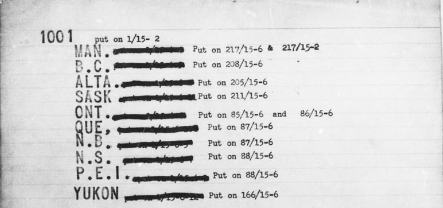
Example of card from Thousand Series, File Block Number 1000, Fairs, e010780985-001
The Thousand Series used a filing system in which the file number consisted of a subject number and the Department of Indian Affairs old agency responsibility codes.
For example:
- If you are searching for records related to leases concerning the Carleton Agency (107), you would search under the 13000—Leases cards.
- But, you would need to know the particular agency responsibility code to find the proper record. In this case, it is File No. 13107: (13000 series number) and the responsibility code for Carleton Agency (107).
The agency responsibility codes are listed as part of finding aid 10-96.
Note: The physical file for Block Number 28000 on Survey Accounts is empty.

Example of card from Thousand Series, File Block Number 13000, Leases, e010780997-002
List of PDFs
- 1000 (Fairs) 1001 to 1168 [PDF 1.17 MB]
- 2000 (Bridges) 2001 to 2169 [PDF 2.41 MB]
- 3000 (Cemeteries) 3001 to 3169 [PDF 1.88 MB]
- 4000 (Churches) 4001 to 4169 [PDF 3.11 MB]
- 5000 (Council Halls) 5002 to 5171 [PDF 1.73 MB]
- 6000 (Dams and Flooding) 6001 to 6169 [PDF 1.41 MB]
- 7000 (Drains and Ditches) 7002 to 7169 [PDF 1.48 MB]
- 8000 (Enfranchisement) 8001 to 8032-255 [PDF 3.70 MB]
- 8000 (Enfranchisement) 8032-256 to 8125-163 [PDF 3.84 MB]
- 8000 (Enfranchisement) 8126 to 8211 [PDF 3.22 MB]
- 9000 (Estate) 9001 to 9014-45 [PDF 7.31 MB]
- 9000 (Estate) 9014-46 to 9032-320 [PDF 7.12 MB]
- 9000 (Estate) 9032-321 to 9040-91 [PDF 7.86MB]
- 9000 (Estate) 9040-92 to 9103-143 [PDF 5.42 MB]
- 9000 (Estate) 9104 to 9132 [PDF 6.80 MB]
- 9000 (Estate) 9133 to 9157 [PDF 6.98 MB]
- 9000 (Estate) 9158 to 9217 [PDF 6.79 MB]
- 10000 (Farming) 10000 to 10310 [PDF 2.06 MB]
- 11000 (Gravel and Sand) 11001 to 11169 [PDF 1.66 MB]
- 12000 (Irrigation) 12001 to 12211 [PDF 688.10 KB]
- 13000 (Leases) 13001 to 13032-46 [PDF 5.01 MB]
- 13000 (Leases) 13032-47 to 13107-8 [PDF 4.32 MB]
- 13000 (Leases) 13107-10 to 13136-6 [PDF 3.64 MB]
- 13000 (Leases) 13136-7 to 13153-33 [PDF 4.05 MB]
- 13000 (Leases) 13154 to 13165-2-3 [PDF 4.17 MB]
- 13000 (Leases) 13165-2-5C to 13211 [PDF 2.76 MB]
- 14000 (Lighthouses) 14003 to 14168
- 15000 (Location Tickets) 15001 to 15027 [PDF 4.63 MB]
- 15000 (Location Tickets) 15029 to 15112-7-14 [PDF 4.67 MB]
- 15000 (Location Tickets) 15112-7-15 to 15168-122 [PDF 3.50 MB]
- 15000 (Location Tickets) 15168-123 to 15211 [PDF 321.26 KB]
- 16000 (Loans) 16001 to 16027 [PDF 3.48 MB]
- 16000 (Loans) 16029 to 16061 [PDF 3.40 MB]
- 16000 (Loans) 16063 to 16151 [PDF 3.19 MB]
- 16000 (Loans) 16152 to 16211 [PDF 1.22 MB]
- 17000 (Mills) 17001 to 17169 [PDF 1.15 MB]
- 18000 (Mining) 18001 to 18169 [PDF 1.65 MB]
- 19000 (Murder) 19001 to 19026 [PDF 1.50 MB]
- 20000 (Oil and Gas) 20001 to 20217 [PDF 1.30 MB]
- 21000 (Right of Way other than Railway) 21001 to 21171 [PDF 2.16 MB]
- 22000 (Railways) 22001 to 22169 [PDF 2.21 MB]
- 23000 (Roads) 23001 to 23211 [PDF 2.98 MB]
- 24000 (Rules and Regulations) 24001 to 24168 [PDF 1.15 MB]
- 25000 (Soldier Settlement Indians) 25000 to 25165 [PDF 1.77 MB]
- 26000 (Soldier Settlement Whites) 26001 to 26165 [PDF 864.66 KB]
- 27000 (Surveys and Reserves) 27001 to 27171 [PDF 3.61 MB]
- 28000 (Survey Accounts) Not applicable
- 29000 (Surrenders) 29001 to 29171 [PDF 1.02 MB]
- 30000 (Timber) 30001 to 30169 [PDF 3.77 MB]
- 31000 (Waterworks and Wells) 31001 to 31169 [PDF 2.08 MB]
- 32000 (Wharves) 32001 to 32168 [PDF 1.11 MB]
- 33000 (Land Applications) 33009 to 33167 [PDF 334.32 KB]
- 34000 (Water Licences) 34001 to 34169 [PDF 745.90 KB]
- 35000 (Debts) 35001 to 35168 [PDF 2.36 MB]
- 36000 (Dyking) 36004 to 36169 [PDF 585.88 KB]
- 37000 (Light, Power Plants)37001 to 36168 [PDF 947.62 KB]
- 38000 (Claims, Disputes) 38001 to 38168 [PDF 160.29 KB]
- 39000 (Adoption) 39000 to 39167 [PDF 1.41 MB]
- 40000 (Accounting) 40001 to 40300A [PDF 2.13 MB]
- 41000 (Handicrafts) 41000 to 41212 [PDF 1.81 MB]
- 42000 (School Matters) 42000 to 42211 [PDF 2.80 MB]
- 43000 (Timber on Reserves) 43025 to 43168 [PDF 238.68 KB]
- 45000 (Veterans’ Land Act) 45001 to 45171 [PDF 4.05 MB]
- 46000 (Amalgamation of Bands) 46000 to 46167 [PDF 364.89 KB]
Black Series (RG 10, Volume 10887)
The Black Series — named after the colour of the leather letter books used by the records office — is a sub-series of central registry files dealing with almost all aspects of the departmental administration of Indian Affairs in Western Canada, 1872–1959. The bulk of the records concern the period 1872–1923.
These cards, arranged numerically from 1 to 600552, document all Black Series files in existence at the time the card system was created. The cards list no file titles. They contain information about the migration of Black Series files into later central registry filing systems adopted by the Department of Indian Affairs or within the Black Series itself.
Note: The physical folder containing files 4 to 93257 is empty.

Example of card from Black Series, 317001 to 404349, e010781030-005
List of PDFs
- 4 to 93257 [PDF 5.27 MB]
- 93258 to 133646 [PDF 4.57 MB]
- 133656 to 233590 [PDF 4.52 MB]
- 233920 to 316950 [PDF 4.69 MB]
- 317001 to 404349 [PDF 4.56 MB]
- 404519 to 488039 [PDF 4.80 MB]
- 488190 to 600552 [PDF 3.65 MB]
Black Series — P.A.C. Accession (Public Archives of Canada) (RG 10, Volume 10887)
Cards are arranged numerically by file numbers and contain a handwritten list of the Black Series records transferred to Library and Archives Canada (formerly the National Archives of Canada). This index groups the file numbers by the RG 10 volume numbers assigned to them by the National Archives of Canada.
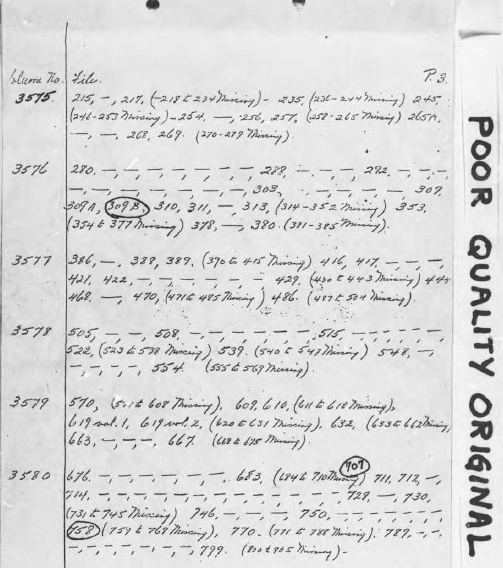
Example of card from Black Series — P.A.C. Accession, Vols. 4083 to 4095, e010781031-001
List of PDFs
- Vol. 3555 to Vol. 4082 [PDF 6.00 MB]
- Vol. 4083 to Vol. 4095 [PDF 1.00 MB]
Black Series — Destroyed Files (RG 10, Volume 10887)
Cards are arranged in numerical file order, and document which Black Series files were destroyed by the Department of Indian Affairs.

Example of card from Black Series — Destroyed Files, 61939 to 583000, e010781034-002
List of PDFs
- 61939 to 583000 [PDF 1.47 MB]
Red Series (RG 10, Volume 10887)
The Red Series — named after the colour of the leather letter books used by the records office — is a sub-series of central registry files dealing with almost all aspects of the departmental administration of Indian Affairs in Eastern Canada from 1872–1964. The majority of the records concern the period 1872–1923.
Cards are arranged in numerical order, from numbers 1 to 600592, and document all Red Series files in existence at the time the card system was created. The cards do not list file titles. They contain information about the migration of Red Series files within the Red Series, as well as into later central registry filing systems adopted by the Department of Indian Affairs.
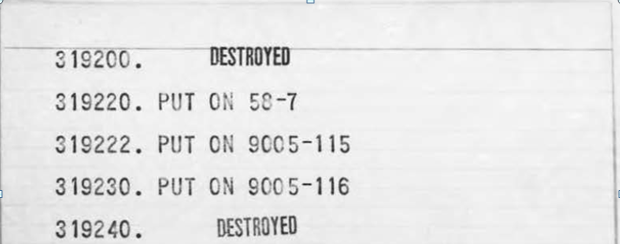
Example of card from Red Series, 313335 to 341460, e010781037-010
List of PDFs
- 1 to 5342 [PDF 3.99 MB]
- 5343 to 43168 [PDF 5.49 MB]
- 43168 to 106136 [PDF 5.74 MB]
- 106148 to 156924 [PDF 5.47 MB]
- 156926 to 193572 [PDF 4.54 MB]
- 193618 to 231270 [PDF 4.44 MB]
- 231272 to 256830 [PDF 4.50 MB]
- 256850 to 283780 [PDF 4.28 MB]
- 283781 to 313333 [PDF 4.53 MB]
- 313335 to 341460 [PDF 4.39 MB]
- 341470 to 375290 [PDF 4.48 MB]
- 375407 to 421339 [PDF 4.52 MB]
- 421584 to 466237 [PDF 4.70 MB]
- 466238 to 512938 [PDF 4.42 MB]
- 513202 to 588021 [PDF 4.09 MB]
- 590000 to 600592 [PDF 2.26 MB]
Red Series — P.A.C. Accession (Public Archives of Canada) (RG 10, Volume 10887)
Cards are arranged numerically by file numbers and contain a handwritten list of the Red Series records transferred to Library and Archives Canada (formerly the National Archives of Canada). This index groups the file numbers by the RG 10 volume numbers assigned to them by the National Archives of Canada.
This list is also contained in electronic Finding Aid 10-10. Red Series files comprise mainly records from Eastern Canada. For additional information, consult Finding Aid 10-376.
This list is also contained in electronic Finding Aid 10-13. Black Series files comprise mainly records from Western Canada. For additional information, consult Finding Aid 10-376.
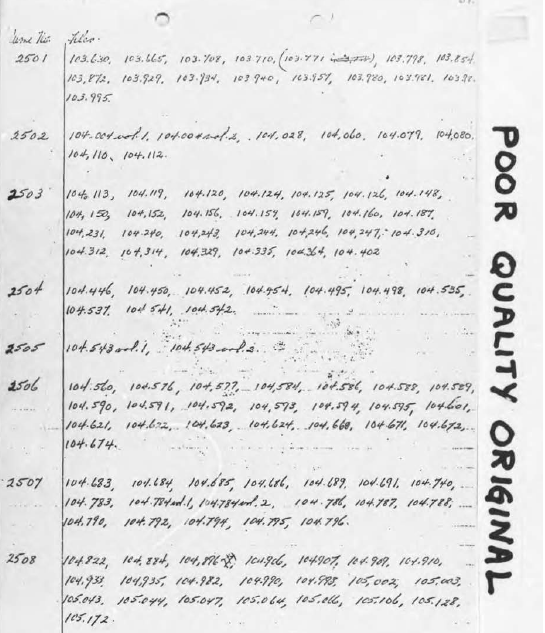
Example of card from Red Series — P.A.C. Accession, 2408 to 3038, e010781038-002
List of PDFs
- 1855 to 2407 [PDF 6.80 MB]
- 2408 to 3038 [PDF 6.91 MB]
- 3091 to 3251 [PDF 2.36 MB]
Red Series — Destroyed Files (RG 10, Volume 10887)
Cards are arranged in numerical order and document which Red Series files were destroyed by the Department of Indian Affairs.

Example of card from Red Series — Destroyed Files, 9 to 52117, e010781039-001
List of PDFs
- 9 to 52117 [PDF 3.77 MB]
- 52120 to 111714 [PDF 3.95 MB]
- 111765 to 600580 [PDF 3.13 MB]
Island Index Cards (RG 10, Volume 10887)
The Island Index Cards provide references to a wide range of files concerning any aspect of the administration of island reserve lands. Some reserves are islands (e.g., Parry Island, Walpole Island, Seabird Island), while others include islands within their boundaries (e.g., Akwesasne).
Cards are arranged alphabetically according to the geographic location. They contain the following information: island name; file title; and file number.
Example:
| French River | ||
| Island in North Shore of Lake Huron | ||
| Island in Dry Pine Bay - French River | ||
| 404812.................506-24-1 | ||
| ............................1/35-24-1 | ||
This index pertains to files created in the Red and Black, First, Thousand, and Modified Duplex Numerical Series.
The index indicates what files were merged into successive central registry filing systems. These cards are helpful if you are searching for records about a particular island. Use the index cards for the Red and Black, First, Thousand, and Modified Duplex Numerical Series if you do not have a particular island in mind.

Example of card from Island Index Cards, A–Z and Numerical, e010781034-001

Example of card from Island Index Cards, A–Z and Numerical, e010781034-001
List of PDFs
- A-Z to #506 [PDF 4.40 MB]
Other resources
There are many resources that can assist in using the file history cards.
Further information about the headquarters central registry systems can be found in the following resources:
- Finding aid 10-376 explains the different filing systems used by the headquarters of the Department of Indian Affairs. It also gives agency and district responsibility codes and subject codes for each of the headquarters filing systems. This finding aid is not available online yet and you should contact Reference Services for assistance.
- Finding aid 10-160 (hard copy only, not yet digitized) indicates the volume within RG 10 where a particular file number can be found. If it is on microfilm, it also gives this number. Note: Finding aid 10-160 only lists permanent volumes in RG 10 up to Volume 13099.
- Finding aid 10-160 (hard copy only, not yet digitized) indicates the volume within RG 10 where a particular file number can be found. If it is on microfilm, it also gives this number. Note: Finding aid 10-160 only lists permanent volumes in RG 10 up to Volume 13099.
- The Aboriginal Documentary Heritage virtual exhibition (archived) contains an essay by Sean Darcy entitled The Evolution of the Department of Indian Affairs' Central Registry Record-keeping Systems: 1872–1984, which gives more detail about each filing system and how it was used at the Department.