
Report on cases of misconduct and wrongdoing at Library and Archives Canada
On this page
- Message from the Librarian and Archivist of Canada
- Introduction
- Definition of misconduct and wrongdoing
- Overview of cases of misconduct and wrongdoing, 2024–2025
- Cases by category of misconduct, 2024–2025
- Investigation results, 2024–2025
- Conclusion
Message from the Librarian and Archivist of Canada
We present to you the first annual report on the handling of cases of misconduct and wrongdoing at Library and Archives Canada (LAC), as part of our ongoing commitment to providing a healthy, safe, and inclusive workplace.
At LAC, we strive to uphold high standards of ethics and professional conduct so staff can operate in a respectful environment that embodies the values and expected behaviours set out in the Values and Ethics Code for the Public Sector, as well as in the organization’s Code of Conduct.
Supporting the priorities of the Clerk of the Privy Council with respect to values and ethics, this first annual report from LAC on cases of misconduct and wrongdoing is part of a commitment to transparency and accountability. It provides a summary of the cases reported during the 2024–2025 fiscal year and the measures implemented to address them. It also serves as a tool to support the prevention of misconduct, the continuous improvement of our workplace, and the ethical culture of the organization.
Every staff member at LAC plays an important role in supporting and strengthening our ethical culture, whether by leading by example, respecting our shared values or reporting inappropriate actions and behaviours. Reports of misconduct and wrongdoing are handled with thoroughness, fairness, diligence, and confidentiality, and we strive to ensure that all staff feel comfortable reporting them without fear of reprisal.
We thank you for your ongoing efforts to promote a respectful work environment, where integrity and accountability are at the heart of our actions and decisions.
Leslie Weir
(she/her)
Librarian and Archivist of Canada
Introduction
This annual report presents a summary of the cases of misconduct and wrongdoing handled at LAC during the 2024–2025 fiscal year. It provides data on the number of reports received, investigations conducted, and founded cases that resulted in disciplinary or administrative measures.
The data on substantiated cases are presented based on six categories of misconduct and wrongdoing:
- financial mismanagement
- harassment and violence (notice of occurrence received)
- breach of the LAC Code of Conduct
- administrative misconduct
- breach of the Policy on Service and Digital
- security breach
To collect the data presented in this report, LAC conducted consultations with internal partners holding information on cases of misconduct and wrongdoing. These partners are listed in the following table, by category of misconduct.
| Category of misconduct | Partners consulted |
|---|---|
| Financial mismanagement |
|
|
Harassment and violence |
|
| Breach of the LAC Code of Conduct |
|
| Administrative misconduct |
|
| Breach of the Policy on Service and Digital |
|
| Security breach |
|
It should be noted that no disclosures of wrongdoing were submitted in 2024–2025. The data contained in this report pertain only to cases of misconduct.
Definition of misconduct and wrongdoing
In this report, misconduct is defined as a deliberate act or omission by a staff member that violates one of their obligations as a public servant. It may be a violation of:
- a law
- a regulation
- a policy
- the Values and Ethics Code for the Public Sector
- the LAC Code of Conduct
- an organizational policy instrument
Contravening any of these obligations may result in disciplinary or administrative measures.
A wrongdoing refers to any incident handled under the Public Servants Disclosure Protection Act (the Act). The Act defines wrongdoing as follows:
- a contravention of any act of Parliament or of the legislature of a province or of any regulations made under any such act, other than a contravention of section 19 of this Act
- a misuse of public funds or a public asset
- a gross mismanagement in the public sector
- an act or omission that creates a substantial and specific danger to the life, health or safety of persons or to the environment, other than a danger that is inherent in the performance of the duties or functions of a public servant
- a serious breach of a code of conduct established under section 5 or 6
- knowingly directing or counselling a person to commit a wrongdoing set out in any of paragraphs (a) to (e)
(Source: Office of the Public Sector Integrity Commissioner of Canada)
Under paragraph 11(1)(c) of the Public Servants Disclosure Protection Act, LAC is required to make public information regarding substantiated cases of wrongdoing.
Overview of cases of misconduct and wrongdoing, 2024–2025
The following graph shows the total number of cases of misconduct and wrongdoing at LAC for the 2024–2025 fiscal year.
Cases of misconduct and wrongdoing at LAC for 2024–2025

Cases of misconduct and wrongdoing at LAC for 2024–2025 - Text version
| Complaints and allegations | Investigations launched | Founded cases | |
|---|---|---|---|
| Cases of misconduct | 24 | 23 | 23 |
| Wrongdoings | 0 | 0 | 0 |
In 2024–2025
- LAC received 24 complaints and allegations of misconduct.
- There were no disclosures of wrongdoing under the Public Servants Disclosure Protection Act.
- LAC launched 23 investigations into the allegations and complaints of misconduct received.
- All cases that were investigated were deemed to be founded and resulted in administrative and/or disciplinary measures.
It is important to clarify that complaints and allegations do not always lead to an official investigation. For instance, an informal resolution process may sometimes be more appropriate to address a situation. Furthermore, an allegation may prove to be unfounded following an investigation.
Cases by category of misconduct, 2024–2025
The following table presents the number of complaints and allegations received, the number of investigations initiated, and the number of cases deemed founded that led to disciplinary and/or administrative measures for the 2024–2025 fiscal year, by category of misconduct.
Cases by category of misconduct, 2024–2025

Cases by category of misconduct, 2024–2025 - Text version
| Complaints and allegations | Investigations launched | Founded cases | |
|---|---|---|---|
| Financial mismanagement | 0 | 0 | 0 |
| Harassment and violence (notice of occurrence) | 1 | 0 | 0 |
| Breach of the LAC Code of Conduct | 10 | 10 | 10 |
| Administrative misconduct | 12 | 12 | 12 |
| Breach of the Policy on Service and Digital | 0 | 0 | 0 |
| Security breach | 1 | 1 | 1 |
| Categories of misconduct | Examples of misconduct (this list is not exhaustive) |
|---|---|
|
Financial mismanagement Cases of financial mismanagement result in the loss of public funds or government property. |
|
|
Harassment and violence Harassment and violence in the workplace include any act, behaviour or statement, particularly of a sexual nature, that could reasonably be expected to offend, humiliate or cause any other injury or illness, physical or psychological, to a staff member. |
Examples of harassing behaviour:
Examples of violent behaviour:
|
|
Breach of the LAC Code of Conduct A breach occurs when a staff member contravenes the expected values and ethics outlined in the LAC Code of Conduct. |
|
|
Administrative misconduct Cases of administrative misconduct cover a range of inappropriate workplace behaviours. |
|
|
Breach of the Policy on Service and Digital Violations include the misuse of the organization’s computer networks and related devices to engage in criminal or disruptive activities or to handle sensitive data on non-accredited systems. |
|
|
Security breach Personnel security investigations deal with information security, national security, misconduct, insider threats, and reliability-status reviews. |
|
In 2024–2025
- The majority of complaints and allegations received were related to cases of administrative misconduct (12) and breaches of the LAC Code of Conduct (10).
- There was one (1) complaint or allegation of a security breach, and one (1) notice of an incident of harassment and violence.
- No complaints or allegations were received concerning financial mismanagement or IT security.
- All of the cases that were investigated were deemed to be founded.
Investigation results, 2024–2025
When complaints or allegations are determined to be founded following an investigation, administrative and/or disciplinary measures are taken to correct a behaviour or adjust a situation.
A disciplinary measure is an action taken by the employer in response to misconduct. It serves to deter personnel from committing acts of misconduct, to correct the behaviour of offenders, and to motivate personnel to adhere to the expected behaviours outlined in the Values and Ethics Code for the Public Sector and in the LAC Code of Conduct.
Disciplinary measures can take various forms, depending on the severity of the misconduct. They are generally progressive and include, in increasing order of severity: oral reprimands, written reprimands, suspensions, financial penalties, demotions and, in the most serious cases, termination. Disciplinary measures can be the subject of a grievance. (Source: Guidelines for Discipline)
An administrative measure can be taken to make the necessary adjustments to a situation. This may take the form of letters of expectations, training, coaching, recovery of funds, revocation of reliability status or security clearance, return to the home department, etc.
In some cases, a situation may require both disciplinary and administrative measures.
The following chart provides a summary of the disciplinary and administrative measures taken in response to misconduct cases deemed to be founded in 2024–2025.
Actions taken to respond to founded cases of misconduct, 2024–2025
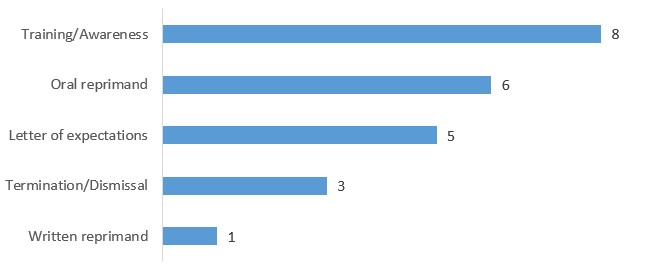
Actions taken to respond to founded cases of misconduct, 2024–2025 - Text version
| Action | Number of cases |
|---|---|
| Written reprimand | 1 |
| Termination/Dismissal | 3 |
| Letter of expectations | 5 |
| Oral reprimand | 6 |
| Training/Awareness | 8 |
In 2024–2025
- The 23 cases of misconduct deemed to be founded resulted in the implementation of 23 administrative and/or disciplinary measures.
- The most commonly applied measures during the fiscal year were training/awareness (8), verbal reprimands (6), and letters of expectations (5).
- Following the investigations, three (3) cases of misconduct led to terminations, and one (1) case resulted in a written reprimand.
It should be noted that the total number of administrative and disciplinary measures does not always correspond to the total number of founded cases. In some instances, a situation may require several administrative and/or disciplinary measures. For example, it is common for training to be recommended in addition to another measure.
Conclusion
This first annual report provides an analysis of the handling of misconduct and wrongdoing cases at LAC. It reports on the efforts made in 2024–2025 to respond diligently to all reports received.
This report serves primarily to enhance transparency and accountability regarding the management of complaints and allegations received during the 2024–2025 fiscal year. Among other things, it demonstrates that all complaints and allegations deemed founded led to administrative and/or disciplinary measures.
The data contained in this report will serve as a reference point for future annual reports and will allow for comparative analyses across fiscal years.
Furthermore, this report helps raise awareness among all personnel about the importance of reporting cases of misconduct and wrongdoing, and the role each person plays in maintaining a healthy, safe, inclusive, and respectful work environment at LAC.
We invite you to share your ideas and feedback on this report with LAC’s Values and Ethics team at: valeursetethique-valuesandethic@bac-lac.gc.ca.