
What we Heard: Proposals for Getting Major Projects Built in Canada
Alternate format:

Proposals for Getting Major Projects Built in Canada [PDF - 1.1 MB]
Disclaimer
This report summarizes perspectives shared during engagement activities on proposed legislative, regulatory, and policy changes related to regulatory efficiency for federal reviews and decision-making on major projects. It is not intended to represent consensus, nor does it attribute views to any individual participant, community, organization, or government.
The information in this report has been organized thematically based on the proposals outlined in the Getting Major Projects Built in Canada discussion paper. The ideas and views compiled in this report do not necessarily represent the views of the Government of Canada, except where otherwise indicated. Views are summarized collectively to protect confidentiality and to identify recurring themes; it should not be read as implying uniform views among First Nations, Inuit, and Métis governments, communities, or organizations, as well as stakeholders from Industry, Environmental Non-Governmental Organizations (ENGOs) and investment boards, or the general public.
Artificial intelligence (AI) tools [Cohere and Copilot], were used to supplement government officials’ analysis and to summarize responses to this engagement process, excluding responses from Indigenous groups that were analyzed and summarized by government officials only. All content has been reviewed and validated by Government of Canada employees. For more information on how we use AI, please see our AI Strategy for the Federal Public Service 2025-2027: Overview.
Acknowledgements
The Government of Canada thanks all participants for sharing their time, expertise, priorities, and concerns. The perspectives shared throughout this engagement are essential to balance consideration of economic, environmental, Indigenous, and broader public interest benefits of major projects.
Executive summary
The Government of Canada is advancing proposed reforms intended to strengthen Canada’s regulatory efficiency, support timely decision-making, improve investment certainty, and diversify trade.
The engagement process started on May 8, 2026, with the publication of the discussion paper entitled Getting Major Projects Built in Canada on the One Canadian Economy website. Letters were then sent to Indigenous Peoples and provinces and territories, inviting them to provide written feedback on the proposals. Engagement lasted for 75 days and concluded on July 22, 2026.
This report summarizes what the Government of Canada heard throughout this period. In the end, feedback was received from provinces and territories, Indigenous Peoples, industry stakeholders, environmental non-government organizations (ENGOs), academia, think tanks, and the general public.
On May 8, 2026, the Government of Canada also started a separate engagement process on Strengthening One Canadian Economy through Trade and Transportation. Engagement with Indigenous Peoples on proposals to strengthen regulatory and supply chain efficiency was closely coordinated. Transport Canada is preparing a similar report to this one on what the Government heard from its engagement on supply chain efficiency.
During the engagement period, on the Getting Major Projects Built in Canada discussion paper, the Government of Canada received 403 written submissions from stakeholders and Indigenous Peoples, and over 26,000 emails from the general public (including letter writing campaigns). Government officials also attended 30 meetings with Indigenous groups (including three virtual engagement sessions) and 30 stakeholder meetings.
Views about federal regulatory processes from stakeholders and Indigenous Peoples ranged from support to opposition. Provinces and Territories welcomed the proposals to streamline federal decision-making and demonstrated broad consensus on the need for faster, more predictable federal decision-making process for major projects. Provinces and Territories are supportive of the proposals and are set to continue collaboration and coordination for effective implementation and regulatory alignment. Stakeholders broadly support faster, more coordinated federal reviews to strengthen Canada's competitiveness and attract investment.
Stakeholders and Indigenous Peoples who expressed opposition were not broadly opposed to major project development itself, but rather to specific mechanisms that they believe could compromise environmental safeguards, Indigenous rights, and regulatory integrity. What emerged were clear perspectives for effective assessment processes: one that prioritizes consultation with Indigenous Peoples, maintains thorough environmental evaluation, preserves species at risk protections, and ensures transparent decision-making. Participants also broadly supported developing a strong Canadian economy, reducing process overlaps and duplications, and improving efficiency overall.
Emails received from citizens were mostly from advocacy campaigns distributed through civic engagement platforms and petitions. These campaigns consistently emphasized concern relating to the following three proposals: the creation of Economic Zones, changes to the Species at Risk Act, and designating the Canada Energy Regulator as sole assessor for pipeline projects. At the same time, diverse stakeholders expressed support for economic zones and the Canada Energy Regulator being responsible for assessing pipeline projects. They identified these as proposals that will contribute to supporting and diversifying Canada's economy.
The strong interest and participation in this engagement process underscored the importance of these issues to Canadians. This includes a desire to improve Canadian competitiveness and efficiency in regulation, to preserve environmental protections, and to uphold Indigenous rights. Feedback summarized in this report will inform federal analysis of the proposed reforms.
1. Background
1.1 Purpose of this What We Heard report
This What We Heard Report summarizes input received throughout the engagement on proposed legislative, regulatory, and policy changes related to regulatory efficiency for federal reviews and decision-making on major projects (see Annex A for the Proposed Major Project Review Process), with the goal of getting major projects approved within one year. It is intended to reflect the diversity of views shared during engagement, identify common and distinct themes, and support transparency about how feedback may inform federal decision-making and implementation.
1.2 Background
Since last year, the Government of Canada has been working to advance major projects efficiently and responsibly to help connect the economy, diversify industries and trade, and create high-paying careers for Canadian workers. In the face of global economic shifts, Canada will require strengthened regulatory efficiency to get major projects built faster and make Canada an attractive place for investment.
Major projects in Canada can sometimes face a complicated and time-consuming federal decision process. There are issues like duplication, poor coordination between government departments, and consultation processes that can be difficult to navigate. In the past, it has often taken more than five years for a project to receive the federal decisions necessary to begin construction. As a result, investment in machinery, innovation and technology, and major projects has stifled. Inefficient project approval regimes for trade-enabling infrastructure also mean that Canada’s export capacity is being pushed to the limit.
Canada is competing with other countries, such as the United Kingdom, Australia, and the United States, to attract investments in large-scale projects. These countries are already working on ways to speed up their decision processes by simplifying steps, reducing repetitive consultations, combining decision-making authorities, and allowing quicker decision-making. Without comparable improvements, Canada risks losing investment and the economic opportunities associated with major infrastructure, energy, critical minerals, and other nation-building projects.
Progress has been made with the Building Canada Act, accelerating impact assessment and permitting coordination processes, and the signing of federal-provincial co-operation agreements. However, more needs to be done to ensure that federal reviews and decision-making timelines take no longer than one year, once all information from the project proponent has been received. Legislative and regulatory changes are needed to provide a durable, predictable framework for federal decision-making. The proposals in the Getting Major Projects Built in Canada discussion paper will support the government in meeting its objective of achieving federal reviews and decisions within 1 year, and providing certainty and timeliness for project proponents and investors, while maintaining environmental protection and upholding the rights of Indigenous Peoples. Given current economic and geopolitical risks, investments in major projects are necessary for Canada to respond more quickly to emerging opportunities, to diversify international markets, and to strengthen long-term competitiveness. Proposed reforms will benefit all Canadians through better jobs, higher incomes and greater economic stability.
Recent polls suggest that Canadians widely support objectives to strengthen certainty, energy security, and efforts to build projects more efficiently1 (project approvals, timelines, and economic priorities). A Montreal Economic Institute-Ipsos poll (Dec 2025) found that 71% of Canadians think federal approval processes for major projects are too slow and need reform, while only 3% disagree.
1.3 Commitment to Indigenous rights, reconciliation and United Nations Declaration on the Rights of Indigenous Peoples Act (UN Declaration Act)
The Government of Canada reaffirms its commitment to achieve mutually beneficial outcomes through partnership and collaboration, and work to advance reconciliation with First Nations, Inuit, and Métis Peoples.
Engagement on these proposals was intended to provide opportunities for Indigenous Peoples to share feedback on the proposed changes, identify potential impacts, and inform policy design processes, decision-making and implementation in a manner consistent with the UN Declaration Act. It was also intended to seek the perspectives of Indigenous Peoples on how these proposals align with the articles of the UN Declaration.
Canada is committed to respecting the rights and obligations contained in modern treaty and self-government agreements. The discussion paper Getting Major Projects Built in Canada reiterated this commitment to upholding modern treaty rights and obligations and to not alter treaty-based environmental approval processes. Indigenous groups with modern treaties have highlighted that their agreements can provide certainty and shared economic prosperity for all Canadians.
1.4 Scope and limitations of the report
This report summarizes what was heard through engagement activities and written submissions. It does not assess the validity of individual perspectives, determine legal obligations, or replace Indigenous consultation required to fulfill the Duty to Consult. It also does not determine whether proposed reforms are consistent with the UN Declaration; rather, it documents feedback relevant to that analysis.
2. About this engagement
2.1 General
The Government of Canada engaged with key stakeholders and Indigenous Peoples on proposals related to regulatory efficiency for federal reviews and decision-making on major projects. To support engagement, a discussion paper entitled Getting Major Projects Built in Canada was posted on the One Canadian Economy website. Engagement started on May 8, 2026, and lasted until July 22, 2026, for a total duration of 75 days.
Throughout the engagement period, the Government of Canada received 403 written submissions from Indigenous groups (135), industry (103), ENGOs (112), think tanks (14), academia (21), and provinces, territories and municipalities (18). In addition, more than 26,000 emails were received from the general public (including letter writing campaigns, which accounted for the vast majority of emails). The Government of Canada also held 60 virtual and in person engagement sessions and bilateral meetings with Indigenous Peoples, industry and ENGOs.
2.2 Engagement with provinces and territories
The Minister for One Canadian Economy sent letters to provincial and territorial Premiers, seeking feedback on the discussion paper and offering to meet with federal officials to discuss the proposals in more detail. Meetings were held with interested jurisdictions.
2.3 Engagement with Indigenous Peoples
Indigenous Peoples were invited to participate in engagement on these proposed reforms. Engagement with Indigenous peoples was conducted in four ways: 1) sending letters to 781 Indigenous groups2 with an invitation to provide written feedback; 2) hosting virtual engagement sessions; 3) meetings with National Indigenous Organizations (NIOs); 4) multilateral and bilateral meetings with Indigenous groups, including modern treaty and self-governing groups. The government offered $15,000 in capacity funding to eligible Indigenous groups to support their participation in engagement on the Getting Major Projects Built in Canada and the One Canadian Economy through Trade and Transportation proposals. In total, $1 million was provided to 71 recipients. This funding supported reviewing the proposals as outlined in the discussion paper, attending engagement sessions and/or meetings, and providing written feedback.
Engagement sessions were designed to support a distinctions-based approach. This means recognizing First Nations, Inuit, and Métis as distinct Peoples with unique rights, histories, cultures, governance structures, legal orders, priorities, and circumstances. It also means recognizing the roles and rights of modern treaty and self-governing Indigenous governments and avoiding approaches that collapse distinct perspectives into a single pan-Indigenous voice.
2.4 Engagement with the public and stakeholders
In addition to posting information online, the Government proactively sent the discussion paper to 92 stakeholders from industry and ENGOs, and offered to meet with a number of key stakeholders to discuss the proposal in more detail. The Government of Canada was also responsive to requests for in person or virtual meetings.
3. What We Heard
The Government of Canada heard feedback on each of the six themes identified in the discussion paper, as well as other key themes detailed below.
3.1 Federal review and decision-making in no more than one year
Provinces, territories and municipal governments
There is broad support from other jurisdictions for improving the efficiency, predictability, and timeliness of federal reviews for major projects. Municipal governments stress that local governments should play a meaningful role in project planning and decision-making, given their responsibilities for supporting project implementation, managing local impacts, and ensuring community readiness. Provincial governments support stronger alignment between assessment and permitting processes, clearer institutional roles and accountability and approaches that reduce overlap. Some call for further reforms to limit federal involvement to matters of federal jurisdiction, reduce ministerial discretion in approvals, and strengthen legislative or administrative certainty. Other provincial and territorial governments emphasize that implementation should be tailored to regional circumstances and existing governance frameworks, particularly in northern and remote jurisdictions where regulatory systems, logistical challenges, and Indigenous governance structures require flexible, region-specific approaches.
Indigenous participants
Indigenous participants stated that legislative timelines should include consideration for if or when Indigenous groups require more time. Some respondents felt strongly that proposals to “fast-track” projects are inconsistent with the UN Declaration and the duty to consult or fail to represent participants’ previous submissions.
The importance of pre-application engagement and funding was emphasized as the pre-application engagement is essential for conducting baseline studies, seek direction from rights holders and leadership, obtain expert advice, understand the potential impacts on Indigenous rights, and make informed decisions on consent, prior to the start of the one-year federal assessment and decision-making timeline begins. They identified issues that could hamper an expedited one-year assessment and permitting timeline. This includes such items as applicants submitting incomplete materials; travel or technology constraints that make it difficult to schedule community meetings or hearings in remote communities; and capacity constraints due to financial, human, or environmental limitations, like harvesters being unavailable during critical harvesting periods, or land-based technical research that is seasonal. While acknowledging the Government of Canada’s commitment to continue to respect Indigenous rights and fulfill the Duty to Consult, some Indigenous groups wanted to know more about how Canada would achieve that within the specified timelines.
There are concerns that concurrent permitting reviews could create multiple federal contacts, fragment Indigenous consultations and engagement, and blur lines of accountability across government departments. Participants also emphasized that pressure on Indigenous groups to respond would increase, which could further strain existing capacity constraints. Investments in Indigenous capacity and access to clear up-front regulatory information would be required to advance projects within shorter timelines. Additionally, they questioned how industry can meet requirements within one year, given that fulfilling project requirements is often a multi-year process. Some felt that environmental assessments should inform and precede permitting.
Stakeholders
There is considerable common ground that regulatory systems should be more coordinated, transparent, and predictable. There is also widespread agreement that reform should not come at the expense of environmental protection or Indigenous rights.
Supporters generally view shorter timelines, concurrent impact assessment and permitting, and stronger coordination among federal departments as important tools for improving investment certainty, competitiveness, and project delivery. To further strengthen the proposal, supporters advocated for clear and objective application completeness criteria, disciplined and relevant information requirements, limits on timeline pauses and extensions, and greater accountability through enforceable service standards and oversight mechanisms, such as a federal review coordinator. Many also supported risk-based reviews that are proportionate and focused on material impacts, and that reduce duplication, align with provincial processes, and avoid simply shifting regulatory burdens to earlier (application) or later (conditions) stages of the approval process.
However, some stakeholders also noted that a fixed one-year timeline may be insufficient for complex projects. They emphasized that accelerated review timelines should be supported by clear readiness criteria and adequate capacity for proponents, governments, and Indigenous communities before assessments begin. Some stakeholders argued that major projects often require multi-season environmental studies, cumulative-effects analysis, extensive public participation, and meaningful Indigenous consultation. In their view, compressed timelines and concurrent review processes should continue to provide opportunities to identify and address risks and ensure that impacts on the environment are fully understood before decisions are made.
Many of these submissions cite other sources of project delays, including economic factors such as market uncertainty and unviability, proponent driven time extensions, and design and construction challenges. Some stakeholders argued that delays could be shortened by surfacing environmental risks early in the review process of proposed projects.
3.2 One Crown consultation process
Provinces, territories and municipal governments
There is broad support for improving the coordination and efficiency of Indigenous consultation, including through mechanisms such as a centralized Crown Consultation Hub. Common priorities include reducing duplication and consultation fatigue, improving alignment between federal and provincial/territorial consultation processes, providing clear guidance on consultation requirements, and establishing a single coordinated consultation process for each project and affected community where appropriate. Many stress the importance of early, ongoing engagement among Indigenous groups, governments, regulators, municipalities, and project proponents to build stronger relationships, improve project planning, and provide greater certainty.
Indigenous participants
Indigenous participants emphasized that, consistent with section 35 of the Constitution Act, 1982, the Crown has constitutional and fiduciary obligations to uphold and protect Indigenous rights and interests. The concept of one Crown consultation process was welcomed by some participants who noted the proposed Crown Consultation Hub at the Impact Assessment Agency of Canada (IAAC) could reduce consultation fatigue and administrative burden. However, they emphasized that the process must truly function as a single window that advances meaningful consultations by coordinating consultation processes for impacted Indigenous groups; distinguishing rights-holders from representative organizations; respecting community timelines and Nation-specific laws, governance processes and consultation protocols; remaining relationship-based; and flowing project-specific capacity funding before a project begins. Importantly, there must be clarity about standards for early notice and the protection of Indigenous knowledge, as well as which federal entity would be responsible for accommodation measures. As processes are streamlined and expedited, supporting corresponding capacity will be important to ensure that Indigenous groups potentially impacted by these changes are ready to meet these timelines.
Some Indigenous participants noted that one Crown consultation process could prioritize investor and proponent interests, noting that regulatory reform must be rights-based and recognize the distinct rights, governance structures, and legal relationships of First Nations, Inuit, and Métis Peoples. Participants emphasized that federal consultation processes should not create or elevate competing rights claims in areas of overlapping interests, including in unceded territories. Some questioned how the coordination of consultation with provincial and territorial regulators would work. Others said that the consultation hub does not respond to Indigenous calls for shared decision-making.
Stakeholders
There is broad support for a more coordinated approach to Indigenous consultation through a “one Crown” or single-window consultation model. Stakeholders underscored the need for predictable timelines, practical coordination, and solution-oriented engagement. Supporters generally endorsed a centralized Crown Consultation Hub as key to reducing duplication, improving consistency across federal departments, providing clearer points of contact for Indigenous groups and project proponents, reducing consultation fatigue, and better aligning consultation activities with regulatory and permitting processes. Submissions stressed the importance of early, continuous, and relationship-based engagement, aligned with a broader shift toward partnership with Indigenous Nations.
Stakeholders expressed support for maintaining meaningful, rights-based consultation. They consistently emphasized that consultation must remain grounded in the Crown’s constitutional obligations and the principles of the UN Declaration, including free, prior, and informed consent where applicable. Many argued that consultation should remain a Crown responsibility, even where project proponents contribute technical information and maintain direct relationships with Indigenous groups. There is also widespread recognition that successful consultation requires adequate capacity funding, sufficient government resources, transparent processes, and mechanisms for issue resolution and escalation.
Some stakeholders sought clarification on how federal and provincial consultation processes would be coordinated under the proposed Crown Consultation Hub and how eventual differences between federal and provincial Crown positions would be resolved.
Overall, there is substantial consensus that coordinated consultation can improve efficiency and reduce duplication, but only if it strengthens, rather than diminishes, Indigenous rights, meaningful participation, Indigenous knowledge, and Nation-to-Nation relationships. Stakeholders broadly agreed that durable project approvals depend on consultation processes that are adequately resourced, legally defensible, respectful of Indigenous governance systems, and capable of supporting reconciliation while maintaining public confidence in project decision-making.
3.3 One project decision
Provinces, territories and municipal governments
Overall, comments supported more coordinated and predictable review systems but emphasized that efficiency should not come at the expense of independent assessment of what is in the public interest, modern treaty-based assessments, provincial, territorial and municipal input, or comprehensive consideration of environmental and socio-economic impacts. Other jurisdictions expressed a desire for narrowing federal involvement in projects with significant adverse effects within federal jurisdiction, increasing reliance on provincial processes through equivalency and/or substitution mechanisms, refining project triggers through amendments to the Physical Activities Regulations, and focusing federal public-interest decisions more closely on matters of federal authority.
Indigenous participants
Indigenous participants raised concerns regarding the one project, one decision proposal, stating that transparency and regulator independence could be eroded and accountability for project conditions, including environmental and cumulative effects assessments, could be obscured. Many participants were concerned that consultation requirements under a single project decision could less adequately reflect the impacts on different dimensions of Indigenous rights that would be required under separate decisions. Others identified that there may be a risk that decisions would be finalized without Indigenous input, resulting in mechanisms that would be difficult to reverse if problems surfaced during implementation.
Stakeholders
Many stakeholders support a “one project, one decision” model that would consolidate federal reviews, permits, approvals, and conditions into a single decision framework. Several submissions stressed that successful major project development requires clear roles, practical integration across agencies, and durable, transparent decisions. Supporters view this approach as key to improving overall system efficiency, predictability, and competitiveness. The proposal can simplify decision-making, improve coordination, provide greater certainty for proponents, enhance investor confidence, and accelerate project delivery. Supporters see an opportunity to harmonize environmental compensation, offsetting, and mitigation requirements across multiple federal statutes within a consolidated framework, while maintaining rigorous environmental oversight. Many emphasize that the model will achieve these benefits if it captures all relevant federal permits and decision points, aligns assessment and permitting processes, and integrates effectively with provincial regulatory systems. Many argued that federal reviews should focus on core areas of federal jurisdiction and avoid duplicating provincial assessments where equivalent processes already exist.
A recurring concern is the potential concentration of decision-making authority in a single minister or a small group of decision-makers, as well as the inability to appeal a decision. Many cautioned that increased ministerial or Cabinet discretion could weaken accountability, increase politicization, reduce predictability, and diminish the role of independent scientific, technical, environmental, and Indigenous expertise. Several submissions noted that expert departments and regulators should remain central participants in assessments and decision-making, particularly on issues related to environmental protection, public health, climate resilience, species conservation, water resources, and natural hazards.
3.4 Single project authority
Provinces, territories and municipal governments
Some provinces and municipalities supported a regulator-led model, arguing that specialized regulators possess the technical expertise and established oversight framework, including for environmental assessments, operational experience, public hearing processes and relationships needed to lead efficient reviews. They contended that such an approach could reduce duplication, improve coordination, strengthen regulatory certainty, maintain rigorous safety oversight, and provide more predictable approval pathways.
Others, however, argued that impact assessment and regulatory oversight serve distinct functions and efforts should be made to maintain their integrity in any reforms. Across submissions, there is general support for greater alignment between lifecycle regulators, assessment processes, and permitting decisions, provided that reforms preserve rigorous review standards, transparent decision-making, public confidence, meaningful consideration of non-technical impacts, and clear delineation of institutional responsibilities. Some comments emphasized that improvements in efficiency could be supported through enhanced coordination between assessment and regulatory processes, alongside clear institutional roles and responsibilities.
Indigenous participants
Indigenous participants noted that consolidating federal decision-making under a single project authority could reduce Cabinet oversight in the decision-making process, and result in expedited approvals without environmental assessments and Indigenous participation. There were also concerns that oversight on major projects would be significantly reduced. While recognizing that they have technical expertise, some participants questioned whether the Canada Energy Regulator (CER) or Canadian Nuclear Safety Commission (CNSC) would be able to address a full rights-based impact assessment, or if it would have the expertise to assess social, sustainability or environmental considerations. Some felt strongly that nuclear projects must remain with IAAC.
Other participants requested more clarity about how impact assessment would be fulfilled by CER and CNSC. It was emphasized that CER and CNSC should be held to the same standard as IAAC with regards to Indigenous Peoples, and that Indigenous Peoples should be engaged in reviewing and updating the mandates and legislation governing the CER and CNSC to be consistent with the UN Declaration. There was a particular focus on better understanding how assessments of nuclear projects that are already underway but still in the planning phase would be transitioned. The need for free, prior, and informed consent related to nuclear and pipeline development was raised. Additionally, northern Indigenous participants emphasized the importance of the existing co-management processes continuing to operate as set out in modern treaty-based legislation. Finally, it was recommended that the Indigenous Loan Guarantee Program be “scaled up” to reflect the size and complexity of some projects, particularly transmission lines and pipelines.
Stakeholders
Supporters of this proposal expressed strong support for assigning project authority to sector-specific lifecycle regulators that are best positioned to lead reviews and coordinate permitting based on their technical expertise and ongoing regulatory responsibilities, while assessing environmental impacts and upholding Indigenous rights. Advocates argued this approach would create a true one-window system, reduce duplication, provide greater certainty, eliminate process handoffs, improve accountability, and accelerate decisions, while maintaining rigorous environmental protection and Indigenous consultation obligations. Supporters also favour stronger alignment between federal and provincial processes, greater reliance on technical expertise, expanded regulator authority, and fewer layers of political decision-making to achieve more efficient and predictable outcomes. Some stakeholders recommended better aligning regulatory requirements with actual project risk, for greater efficiency in decision-making for low impact pipelines.
In contrast, many stakeholders oppose transferring primary assessment responsibilities from broader federal assessment bodies to sector regulators alone. They argue that lifecycle regulators have historically been focused on licensing, safety, compliance, engineering, and project operations and do not replace the multidisciplinary public-interest analysis provided through independent impact assessments. They noted that removing separate impact assessment requirements for energy, pipeline, transmission, offshore renewable energy, nuclear, or uranium projects could weaken scrutiny of cumulative effects, species at risk, climate impacts, and Indigenous rights. Some also warned that combining regulatory and assessment functions within a single institution could reduce public confidence and diminish opportunities for meaningful public and Indigenous participation.
While some supported moving public-interest determinations earlier in the process and reducing multiple layers of approvals, others argued that this approach risks prejudging outcomes and undermining evidence-based decision-making.
Overall, the debate centered less on the goal of improving efficiency and more on ensuring that greater reliance on lifecycle regulators is achieved in a careful and deliberate way that doesn’t compromise public trust, independent oversight, environmental protection, Indigenous rights, and the quality of project assessments.
3.5 Enable economic zones through regional assessments
Provinces, territories and municipal governments
Some jurisdictions expressed strong support for economic zones and viewed them as a promising policy tool. They noted their experience with regional assessment processes as a strong model for implementing coordinated, regionally informed approaches to understanding cumulative effects within a region. Submissions highlighted the need for collaborative federal–provincial approaches, respect for constitutional divisions of authority, and clear links to matters within federal jurisdiction.
Municipal governments stressed that regional planning and assessment should involve multiple jurisdictions and levels of government, with municipalities recognized as important partners because of their knowledge of local infrastructure, emergency management, community readiness, and implementation challenges.
Overall, comments identified potential value in regional planning and economic zones if they supported better coordination, informed decision-making, and reduced project-level duplication, while preserving environmental safeguards, meaningful local input, and respect for provincial and municipal roles.
Indigenous participants
Indigenous participants cautioned that economic zones could enable unilateral Crown actions without adequate safeguards or consent mechanisms. They noted that any “pre-approval” of projects would undermine efforts to advance reconciliation and would likely lead to litigation. Indigenous Peoples also highlighted the absence of clear provisions for post-development mitigation and environmental clean-up. More broadly, economic zones were viewed as potentially limiting the ability of rights-holders to assert their rights within their territories. It was argued that all projects should be subject to consistent environmental review and Indigenous consultation requirements, regardless of location. Some participants referenced their opposition to the Special Economic Zones introduced by Ontario’s Bill 5 as a parallel concern and emphasized the need for the federal government to demonstrate how its proposals ensure Indigenous rights, interests, and governance are meaningfully incorporated. Lastly, Indigenous participants noted the lack of detail in the proposals, making it difficult to fully assess implications.
Stakeholders
There was significant interest in using regional assessments and economic zones to improve predictability and regulatory efficiency, reduce duplicative project-by-project reviews, strengthen regional and infrastructure planning, and accelerate project development by establishing baseline conditions and addressing cumulative effects upfront. Many stakeholders viewed this approach as particularly valuable in established industrial regions, trade corridors, transportation hubs, resource development areas, and locations with existing environmental data, where pre-approved frameworks could reduce regulatory burden and investment risk while balancing important environmental and socio-economic considerations. Supporters argued that economic zones could streamline approvals by reducing repetitive reviews in areas where environmental conditions are already well understood and where governments have identified development priorities. Some stakeholders saw economic zones as opportunities to proactively establish compensation regimes for these regions, including offsets, habitat banking and in-lieu fees. But substantial clarification is still needed regarding governance, legal authorities, implementation, jurisdictional clarity, and how such zones would interact with existing environmental assessment and permitting regimes.
Some stakeholders raised concerns about whether these zones could proceed without a full understanding of environmental consequences, potentially resulting in irreversible impacts on ecosystems, communities, and species at risk.
Opponents expressed concerns that proposed economic zones could potentially bypass or weaken project-specific environmental assessment and consultation processes. Some stakeholders stressed that regional assessments and economic zones should support project-specific reviews. A common view was that regional assessments can provide valuable information on cumulative effects, environmental conditions, development constraints, and suitable locations for future projects, but cannot fully account for the site-specific impacts of individual projects.
Despite these differences, there was considerable common ground. Most stakeholders supported regional planning, cumulative-effects assessment, and strategic assessment as valuable tools for informing development decisions. Many emphasized that successful implementation would require strong federal-provincial coordination and meaningful involvement of Indigenous groups and municipalities.
3.6 Streamlined and efficient regulatory environment
Provinces, territories and municipal governments
There was broad support for improving regulatory efficiency, reducing duplication, and increasing coordination across federal, provincial, territorial and municipal approval processes, while upholding environmental protection, public confidence and Indigenous rights. Other jurisdictions also referenced the distinctive nature of northern projects, where seasonality, distance and limited modal options can constrain efficiency, and may require tailored approaches to ensure national policies deliver meaningful benefits in the North.
Submissions stressed that faster approvals will only succeed if accompanied by greater alignment between federal and provincial regulatory systems, including emissions reporting, permitting, and environmental oversight.
Indigenous participants
Indigenous participants noted that a streamlined regulatory environment could misalign with or omit opportunities for Indigenous groups to co-develop and participate in governance related to the implementation of these processes. We also heard that Modern Treaty Partners must play a meaningful role in the development of streamlined processes. Several participants also called for clear explanations on proposed processes, and how the legislative reforms would interact with the Building Canada Act. There were also new suggestions for expediting processes, such as expanding paperless filing requirements.
Other participants cautioned that streamlining should not impact environmental protection and oversight of activities that directly affect Indigenous rights and interests. Some felt the proposals did not sufficiently address how cumulative impacts or impacts on community safety would be considered. There was concern around the proposal to allow early, temporary, and minor construction work to proceed before the assessment and decision-making process is complete, in part because it could allow projects to gain momentum as consultations are ongoing. There were also concerns about the proposal to allow impact assessment conditions to be adjusted by a minister in exceptional circumstances.
Several Indigenous participants shared concerns about the Species at Risk Act proposal and Fisheries Act proposal. Specifically, they were concerned that allowing the GIC to approve certain activities in exceptional circumstances deemed to be in the public interest, even with high thresholds and strict conditions, could raise questions of potential precedents for legislative overrides of rights-based and environmental protections and infringe on Indigenous rights. There are also concerns that fee-in-lieu of offsetting could adversely impact harvesting rights and the integrity of waterways, as well as diminish in-territory protection of habitat used by harvesters. As a result, populations of fish and waterborne species could be diminished, resulting in adverse impacts on food security for Indigenous groups. It was suggested that environmental offsetting should be Indigenous-led and preserve opportunities for the continued exercise of rights. Lastly, there are concerns around the decline of wildlife populations, biodiversity and culturally important species, including moose and caribou.
Stakeholders
Many stakeholders supported a more streamlined, risk-based, and proportionate regulatory system that is better aligned between federal and provincial processes and makes greater use of equivalency and substitution arrangements. Common recommendations included tailoring requirements proportionally to project risk and complexity and creating more efficient pathways for lower-risk projects such as brownfield expansions, existing facilities, and projects with well-understood environmental effects. There was strong support for modernizing permitting systems; for coordinating reviews across statutes governing fisheries, species at risk and navigable waters, including more flexible offsetting mechanisms; and for improving predictability through clearer requirements and better intergovernmental coordination. Several submissions favoured allowing certain low risk early work, phased permitting, conditional approvals, and greater reliance on existing provincial oversight. Regulatory requirements should be technically and economically feasible, focused on material risks and outcomes rather than prescriptive processes, and supported by clear guidance, predictable conditions, and limits on duplicative information requests.
However, there was a consistent view that streamlining must not become deregulation. While many stakeholders supported improvements to efficiency, there was opposition to measures that could weaken core environmental safeguards. Of concern were the proposals on the Species at Risk Act, or those that would potentially reduce environmental review requirements, or increase ministerial and cabinet discretion over environmental conditions. Similarly, some stakeholders noted that allowing early work before environmental assessments are complete could create irreversible impacts, predetermine approval outcomes, and undermine the purpose of assessment processes.
A recurring theme was the importance of maintaining the mitigation hierarchy, with avoidance and minimization prioritized before restoration or offsetting. Some stakeholders noted that the economic cost of habitat and species recovery is more significant than the cost of protection. (For more on mitigation, see section “Integrating the Mitigation Hierarchy in Federal Decision-Making for Major Projects”, below.)
Overall, stakeholders generally supported comprehensive regulatory modernization that improves coordination, competitiveness, and predictability, but they emphasized that efficiency gains must be achieved without compromising environmental accountability, scientific integrity, Indigenous rights, public confidence, or the long-term protection and recovery of species and ecosystems.
3.7 Participation from the general public
Over 26,000 submissions in the form of emails from citizens were received throughout the engagement period, mostly from advocacy campaigns distributed by ENGOs through civic engagement platforms and petitions. While some feedback supported increased efficiency and sought faster approval of energy projects like pipelines, respondents consistently emphasized concern relating to the following three proposals: the creation of economic zones, changes to the Species at Risk Act, and designating the Canada Energy Regulator as sole assessor for pipeline projects.
3.8 Other themes
Indigenous participants
Section 5, UN Declaration Act
Indigenous participants raised concerns about whether the engagement process would fully meet the Government of Canada’s obligations under Section 5 of the UN Declaration Act to consult and co-operate in taking all measures necessary to ensure the consistency of the proposed regulatory efficiency initiatives with the UN Declaration. As such, some Indigenous groups sought in-person meetings to discuss the proposals and called on the Government to extend the engagement period to ensure a meaningful opportunity to respond to detailed legislative, regulatory and policy measures before they are finalized.
Accountability to missing and murdered Indigenous women and girls, and 2SLGBTQQIA+ Indigenous People
Some Indigenous leaders emphasized that major project legislation and regulatory reform must meaningfully address the safety and well-being of Indigenous women, girls, Two-Spirit, and gender-diverse people. They expressed concern that accelerated major project development and associated transient workforce environments can heighten risks of violence and vulnerability, as documented in the National Inquiry into Missing and Murdered Indigenous Women and Girls. They stressed that efforts to expedite project approvals must be matched with strong protections, accountability mechanisms, and Indigenous-led safety frameworks into project planning, assessment, and decision-making processes prior to approvals being issued.
They also emphasized the importance of ensuring that Indigenous women’s voices and leadership are meaningfully included in governance, oversight, and decision-making structures related to major projects. Overall, there was a clear view on the need for safety-related conditions and protections for Indigenous women, girls, and 2SLGBTQQIA+ people, and that the drive to accelerate project timelines must not increase risks to already vulnerable populations.
Stakeholders
Integrating the mitigation hierarchy in federal decision-making for major projects
In order to advance both economic development and the protection of nature, some stakeholders advocated for the modernization of the federal compensation framework and its integration in decision making for major projects. Compensation frameworks include elements such as offsetting, habitat banking, and in-lieu fees to compensate for the loss of ecosystems and biodiversity. They maintained that a modernized compensation framework could help accelerate project approvals while improving the scale and quality of nature-positive outcomes.
To achieve these goals and support more efficient, more consistent and more defensible project decisions, these stakeholders recommended implementing a number of measures:
- establishing a whole-of-government federal mitigation hierarchy policy;
- embedding ecological risk assessment and mitigation hierarchy requirements in federal decision instruments and major projects governance processes;
- expanding federal leadership on cumulative effects through regional and strategic assessments; and
- building the ecological mapping and environmental data infrastructure.
Expanding the scope of reforms beyond major projects
Many stakeholders emphasized that regulatory reform should be applied across the entire infrastructure and project development system—not just to a limited set of major projects, which would create a two-tiered system. They called for broad, predictable, and efficient approval processes for projects of all sizes, including supporting and enabling infrastructure. They argued that system-wide modernization is needed to reduce delays, improve investment certainty, enhance competitiveness, support rural and Indigenous economic opportunities, and ensure that interconnected projects and value chains can be developed efficiently.
Advancing Canada’s position as a global energy leader
The submissions often stressed that strengthening Canada’s global competitiveness requires a more predictable, efficient, and coordinated regulatory environment that attracts investment, reduces project risk and duplication, and enables timely development of major resource and energy infrastructure. They emphasized that regulatory reform is essential to supporting economic growth, job creation, energy security, and Canada’s ambition to be a leading global energy producer. At the same time, some stakeholders noted the importance of balancing economic pressure with preventing greater future environmental, financial, and social costs and that the full costs and range of alternatives should be explored.
Workforce considerations
Some submissions noted that labour supply is a critical determinant of project success and should be considered within the regulatory approval framework. Because of workforce shortages, aging demographics, and training needs, project approvals should include credible labour plans, apprenticeship commitments, and engagement with unions. Regulatory reforms are an opportunity to align project approvals with workforce development, economic growth, and long-term capacity building for Canadian workers.
Canada’s national and international commitments
Some stakeholders argued that the proposed reforms should be designed in a manner that is not at odds with Canada’s international commitments regarding the environment, climate, biodiversity, and reconciliation. They raised concerns that reduced environmental oversight could hinder progress toward domestic and international obligations related to biodiversity conservation, emissions reduction, species protection, and sustainable development, while increasing the risk of long-term environmental harm and potential trade-related consequences.
Economic value of ecosystem services
Some submission highlighted how ecosystems provide significant economic and intrinsic value through services such as clean water, carbon storage, flood mitigation, air quality, tourism, fisheries, employment, and other benefits that support long-term prosperity. Some stakeholders cautioned that if policies are designed in a manner that weakens safeguards, they could create longer-term economic and environmental costs by reducing ecosystem resilience, biodiversity, climate benefits, and public trust.
Major projects as supporting the transition to a sustainable economy
Some submission noted that regulatory reform should accelerate Canada's transition to a low-carbon and environmentally sustainable economy without weakening environmental safeguards. Some stakeholders also indicated the importance of intergenerational equity as a lens through which decisions are made – ensuring that choices on major projects contribute to long-term stewardship of resources.
Modernization of Canada’s assessment infrastructure
Some submissions emphasized that achieving faster and more effective project approvals require strengthening the underlying systems that support decision-making and implementation. Key themes raised include modernizing assessment processes through better use of data, evidence, technology, and accountability measures; improving coordination across governments and stakeholders; ensuring transparency and legal defensibility; and building institutional capacity to support timely decisions while maintaining environmental protections and Indigenous rights.
4. Next steps
4.1 How feedback may inform decision-making
Feedback summarized in this report will inform federal analysis of the proposed reforms, including policy design, legislative and regulatory drafting, implementation planning, consultation processes, capacity supports, guidance materials, interdepartmental coordination, and future engagement. The Government of Canada will continue to assess how the proposals can be implemented while upholding Indigenous and treaty rights, including modern treaty and self-government rights and obligations, UN Declaration Act commitments, and environmental protections. The Government of Canada is committed to upholding its obligations under the UN Declaration Act, the duty to consult, and Modern Treaties and Self-Government Agreements.
4.2 Next steps
Parliamentary process
Following the conclusion of the public engagement period and analyzing the information received, the Government of Canada intends to introduce legislation in the following sitting of Parliament. For more information on the parliamentary process, please visit the Parliament of Canada’s webpage How a Bill Becomes a Law.
Regulatory process
Where implementation of the proposed measures requires amendments to federal regulations, proposals will proceed through the Government of Canada's established federal regulatory development and approval process, including publication in the Canada Gazette and opportunities for public comment, as appropriate, before regulations are finalized and brought into force.
Policy work, evolution, refinement over time
The Government acknowledges that regulatory modernization is an iterative process. Feedback received through this engagement will inform the ongoing refinement of policy and regulatory proposals, implementation approaches, and operational guidance. As proposals evolve, the Government will continue to consider how measures can strengthen regulatory efficiency while maintaining robust environmental protections, respecting Indigenous and treaty rights, including modern treaty and self-government rights and obligations, and supporting investment certainty and public confidence.
This includes refining legislative and policy language, strengthening implementation approaches, clarifying roles and responsibilities, identifying barriers and opportunities, and ensuring that proposed authorities and policy options better reflect the perspectives, priorities and considerations identified by First Nations, Inuit, and Métis participants through the engagement process.
Ongoing engagement
The Government remains committed to implementing proposed measures in a transparent and collaborative manner. Ongoing engagement will help identify implementation challenges, improve guidance and operational practices, and support continuous improvement of Canada's impact assessment and regulatory systems. Future engagement activities and public reporting may be undertaken, as appropriate, to communicate progress and summarize feedback received during implementation.
As regulatory measures are developed and implemented, the Government will continue to work with Indigenous Peoples, provinces and territories, industry, environmental organizations, and other interested parties to support effective implementation, monitor outcomes, and identify opportunities for continuous improvement.
This engagement process does not replace or limit project-specific consultation. Where the Duty to Consult is engaged, the Government of Canada will continue to fulfill its constitutional obligations through meaningful consultation and, where required, accommodation processes.
Annex A
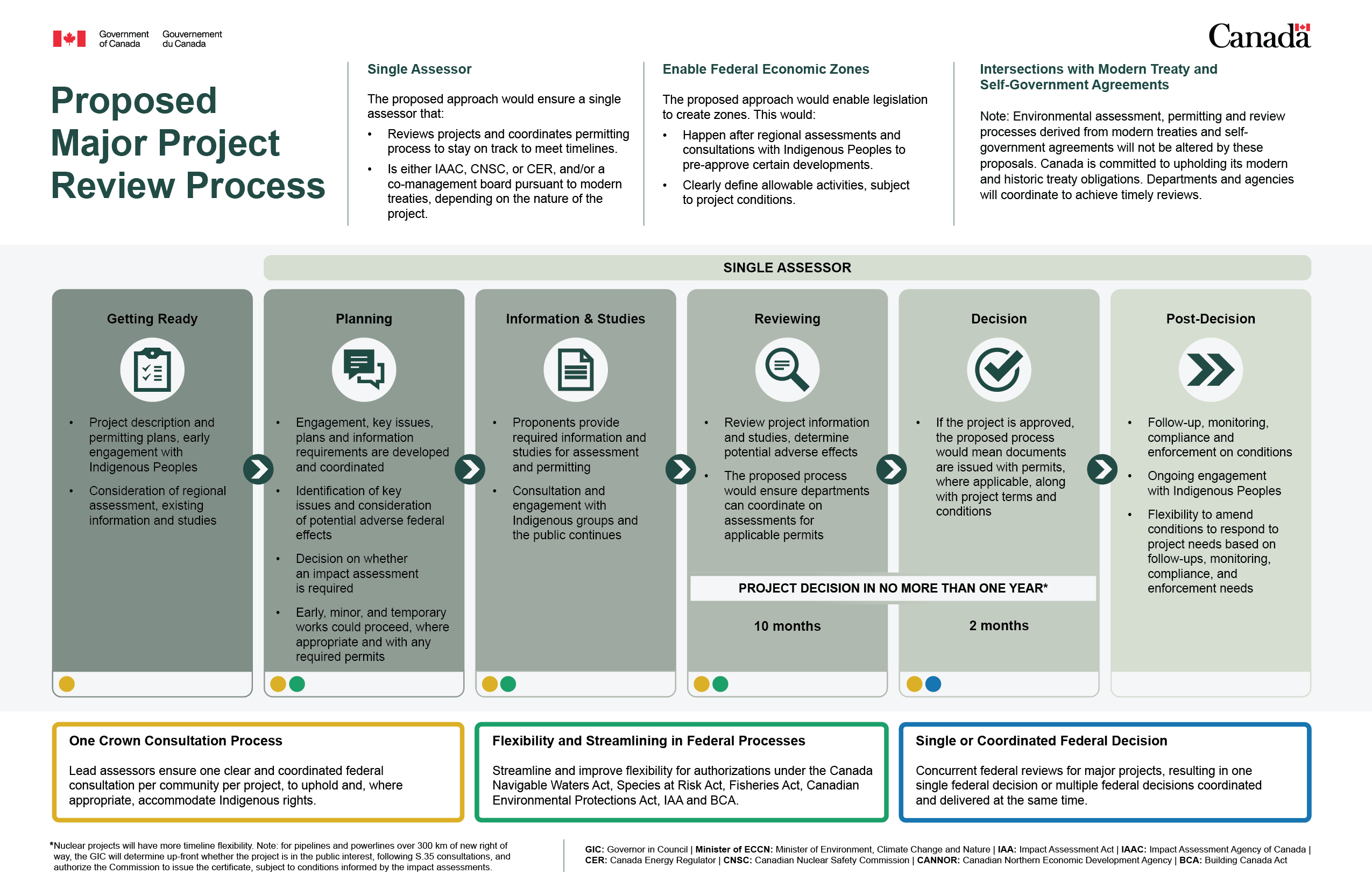
Text version
Proposed Major Project Review Process
Single Assessor
The proposed approach would ensure a single assessor that:
- Reviews projects and coordinates permitting process to stay on track to meet timelines.
- Is either IAAC, CNSC, or CER, and/or a co-management board pursuant to modern treaties, depending on the nature of the project.
Enable Federal Economic Zones
The proposed approach would enable legislation to create zones. This would:
- Happen after regional assessments and consultations with Indigenous Peoples to pre-approve certain developments.
- Clearly define allowable activities, subject to project conditions.
Intersections with Modern Treaty and Self-Government Agreements
Note: Environmental assessment, permitting and review processes derived from modern treaties and self-government agreements will not be altered by these proposals. Canada is committed to upholding its modern and historic treaty obligations. Departments and agencies will coordinate to achieve timely reviews.
Single Assessor
Getting Ready
- Project description and permitting plans, early engagement with Indigenous Peoples
- Consideration of regional assessment, existing information and studies
Planning
- Engagement, key issues, plans and information requirements are developed and coordinated
- Identification of key issues and consideration of potential adverse federal effects
- Decision on whether an impact assessment is required
- Early, minor, and temporary works could proceed, where appropriate and with any required permits
Information and Studies
- Proponents provide required information and studies for assessment and permitting
- Consultation and engagement with Indigenous groups and the public continues
Project Decision in No More Than One Year*:
Reviewing (10 months)
- Review project information and sturdies, determine potential adverse effects
- The proposed process would ensure departments can coordinate on assessments for applicable permits
Decision (2 months)
- If the project is approved, the proposed process would mean documents are issued with permits, where applicable, along with project terms and conditions
Post-decision
- Follow-up, monitoring, compliance and enforcement on conditions
- Ongoing engagement with Indigenous Peoples
- Flexibility to amend conditions to respond to project needs based on follow-ups, monitoring, compliance, and enforcement needs
One Crown Consultation Process
Lead assessors ensure one clear and coordinated federal consultation per community per project, to uphold and, where appropriate, accommodate Indigenous rights.
Flexibility and Streamlining in Federal Processes
Streamline and improve flexibility for authorizations under the Canada Navigable Waters Act, Species at Risk Act, Fisheries Act, Canadian Environmental Protections Act, IAA and BCA.
Single or Coordinated Federal Decision
Concurrent federal reviews for major projects, resulting in one single federal decision or multiple federal decisions coordinated and delivered at the same time.